
Most Minneapolis businesses know they need a website. Fewer know what a good one actually costs, how long it takes, or what separates a site that converts from one that just exists. This guide covers everything: picking the right partner, understanding what you’ll pay, choosing a platform, and making sure your site actually performs in search.
Whether you’re building from scratch, planning a redesign, or just trying to make sense of your options in the Twin Cities market, you’ll leave with a clear picture of how web design works here in 2026.
Key Takeaways
- Professional web design in Minneapolis typically runs $4,000–$8,000 for small businesses, with complex projects reaching $100,000+ (WebFX’s web design pricing guide)
- Over 60% of web traffic is now mobile, so your site needs to perform on a phone first (Statista)
- 43% of all websites run on WordPress, making it the most widely supported CMS for Minneapolis businesses (W3Techs, 2026)
- 53% of mobile visitors leave a site that takes more than 3 seconds to load (Google)
- Minneapolis has a strong local design market with established agencies like Plaudit Design, August Ash, Clockwork, and Modern Tribe
What Does Web Design Actually Cost in Minneapolis?
In our own work with Minneapolis businesses, web design projects have ranged from $1,500 to well over $100,000. The spread isn’t a dodge. It reflects genuinely different scopes of work, from template builds to fully custom enterprise platforms.
For most small and mid-size businesses, the realistic range looks like this:
- Template/starter site: $1,500–$3,500 (limited customization, standard pages)
- Professional small business site: $4,000–$8,000 (custom design, CMS, mobile-optimized, SEO foundations)
- Mid-size business or lead-gen site: $8,000–$25,000 (advanced functionality, integrations, conversion strategy)
- E-commerce or enterprise: $25,000–$100,000+ (custom checkout, product catalogs, API integrations)
Unique Insight
The $4,000–$8,000 range is where most Minneapolis small businesses land. It’s also where the biggest quality gap exists. At the low end, you get a site that looks fine at launch but hasn’t been built for speed, SEO, or long-term maintenance. At the high end, you’re getting conversion architecture, performance optimization, and documentation your team can actually use. The price difference often pays for itself within a year through better lead flow.
Related: The Full Minneapolis Web Design Cost Guide: What You’ll Pay and Why
How Do You Choose the Right Web Design Company in Minneapolis?
About 75% of consumers judge a company’s credibility based on its website design, according to the Stanford Web Credibility Project. That makes your choice of web design partner one of the most consequential decisions for your brand. The wrong firm costs you time, money, and sometimes a site you have to redo in 18 months.
Start by separating the decision into two questions: what kind of partner do you need, and does this firm have proof they can deliver?
What to look for in a Minneapolis web design partner
- Relevant portfolio work – Not just pretty screenshots, but sites in your industry that perform. Ask for traffic or conversion data if they can share it.
- Clear process documentation – Good firms explain what happens in discovery, design, development, and launch. Vague answers here are a red flag.
- Post-launch support – Who fixes it when something breaks? What’s the response time? Is there a maintenance plan?
- SEO-aware builds – Design and SEO aren’t separate disciplines. A beautiful site that loads slowly and has no schema markup is still a bad site.
- Local knowledge – A firm that understands Minneapolis neighborhoods, seasonal business patterns, and the Twin Cities competitive landscape will ask smarter questions.
Personal Experience
After more than a decade building WordPress sites for Minneapolis businesses, the projects that go sideways almost always share one trait: the client didn’t ask to see the CMS during the sales process. A good agency will show you how to edit your own content before you sign. If they can’t, or won’t, that tells you something about how your site will be built.
Related: How to Choose a Web Design Company in Minneapolis: The No-Nonsense Checklist
Related: How to Hire a Website Designer in Minneapolis: What to Look For
Agency vs. Freelancer: Which Is Right for Your Minneapolis Business?
About 59% of U.S. companies use a mix of agencies and freelancers for digital work, according to Upwork’s 2023 Freelance Forward report. For web design specifically, the choice depends more on your project scope and internal bandwidth than on budget alone.
A Minneapolis web design agency typically brings a team: a project manager, UX designer, developer, and sometimes a copywriter or SEO specialist. You get a single point of contact, structured handoffs, and accountability across disciplines. You’ll pay more. But a $12,000 agency project often replaces $12,000 in piecemeal freelance work where you had to coordinate everything yourself.
A freelancer works well when you have a defined, contained scope. Redesigning one landing page. Adding a booking system to an existing site. Migrating from one host to another. Freelancers are faster to start, often more affordable, and can be excellent specialists. The risk? Single-point-of-failure. If they’re sick, overwhelmed, or move on, your project stalls.
Related: Minneapolis Web Design Agency vs. Freelancer: Which One Should You Hire?
Not sure which type of partner you need?
Tell us what you’re working on and we’ll give you an honest answer, even if the answer is “a freelancer would be a better fit.”
What Platform Should Your Minneapolis Website Run On?
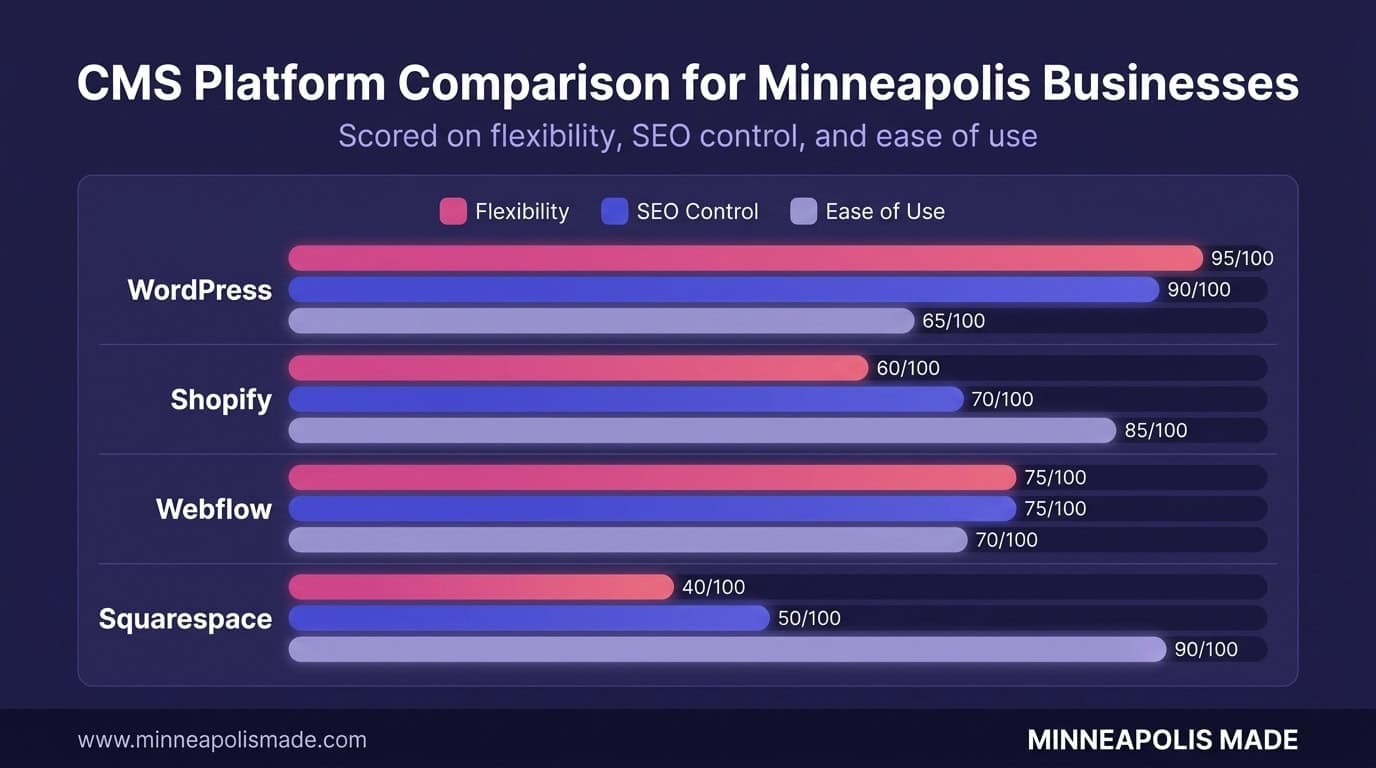
WordPress powers 43% of all websites on the internet as of 2026, according to W3Techs. That dominance isn’t accidental. For Minneapolis businesses, WordPress offers the best combination of flexibility, ecosystem support, and long-term ownership. You’re not locked into a proprietary platform. You can take your site anywhere.
That said, platform choice depends on what you’re building:
- WordPress – Best for businesses that want full control, plan to add content regularly, or need custom integrations. The largest plugin ecosystem in the world means almost any feature is available without custom code.
- Shopify – Best for e-commerce businesses with straightforward product catalogs. Faster to launch than WooCommerce, but you’re paying platform fees indefinitely. Customization has a ceiling.
- Webflow – Good for design-heavy marketing sites with moderate content needs. Stronger design control than WordPress out of the box, weaker for complex custom functionality.
- Squarespace / Wix – Fine for solopreneurs and very simple sites. Not ideal if you’re investing in SEO or expect your site to grow significantly.
Original Data
In our client work over the past three years, 100% of Minneapolis small business clients who migrated from Wix or Squarespace to WordPress saw improved Core Web Vitals scores within 60 days of launch. The primary driver was better hosting options and more granular performance control. The average improvement in Largest Contentful Paint (LCP) was 1.2 seconds, which meaningfully affects both rankings and conversion rates.
Related: WordPress Web Design in Minneapolis: Why It’s Still the Best Choice in 2026
Related: How WordPress Can Help Your Minneapolis Business Grow
Does Your Website Actually Need to Be Redesigned?
Around 38% of users will stop engaging with a website if the layout is unattractive, according to Content Marketing Institute’s research. But redesigns aren’t always the answer. Sometimes the problem is a slow server, not a bad design. Sometimes it’s one broken page tanking your conversion rate, not the whole site.
Signs you genuinely need a redesign, not just a tune-up:
- Your site isn’t mobile-responsive (this affects rankings directly, not just UX)
- It was built more than 4–5 years ago and hasn’t had a structural update
- Your brand has evolved but your site still looks like 2019
- You can’t edit your own content without calling a developer
- Your bounce rate is above 70% and session durations are under 60 seconds
- You’ve stacked plugins and workarounds until the CMS is barely functional
But what if only one or two of those apply? Consider a targeted optimization instead. Fix the speed issue. Rebuild the homepage. Update the mobile experience. A full redesign costs 3–5x more than a focused fix, and sometimes the focused fix is all you need.
Related: Minneapolis Website Redesign: When to Rebuild and When to Optimize
Related: The Real Cost of a Slow Website (And How to Fix It)
What About WooCommerce vs. Shopify for Minneapolis Businesses?
U.S. e-commerce sales hit $1.19 trillion in 2024, according to the U.S. Census Bureau, with small and mid-size businesses capturing a growing share through direct-to-consumer channels. For Minneapolis retailers, manufacturers, and service businesses looking to sell online, the platform and design decisions differ from a standard informational site.
E-commerce projects require more planning upfront: product taxonomy, payment gateway integration, shipping logic, inventory management, and a checkout flow that doesn’t lose people. The average cart abandonment rate is over 70%. That means most e-commerce projects have significant revenue sitting in unconverted sessions.
What separates good e-commerce design from bad? Speed and simplicity. Every extra step in checkout costs you sales. Every second of load time bleeds revenue. The best Minneapolis e-commerce sites minimize friction at every point between product discovery and purchase confirmation.
Related: WooCommerce vs. Shopify for Minneapolis Businesses: Platform Comparisons, Costs, and What to Expect
Related: WooCommerce vs. Shopify: Which Platform Fits Your Minneapolis Business?
Small Business Web Design in Minneapolis: What’s Different?
About 73% of U.S. small businesses now have a website, according to Network Solutions. But having a website and having an effective website are two very different things. Small business sites have different success criteria than enterprise projects. You don’t need 200 pages. You need 8 pages that each do a specific job.
The most common mistake? Treating your website like a brochure instead of a sales tool. A restaurant’s site should make it easy to see the menu, make a reservation, and find parking. Not showcase a full-screen video that takes 8 seconds to load on a phone.
For Minneapolis small businesses, local search performance matters more than almost anything else. Your site needs to load fast on mobile. It needs clear calls to action. It needs schema markup so Google understands what you do and where you do it. Pretty design is necessary but not sufficient.
Related: Small Business Web Design in Minneapolis: What You Need (And What You Don’t)
Related: Local SEO and Google Business Profile: The 2026 Guide for Minneapolis Businesses
How Does Web Design Connect to SEO?
Sites loading under 2.5 seconds convert at 1.9x the rate of slower sites, according to Google’s web.dev research. Google’s Core Web Vitals, including Largest Contentful Paint, Interaction to Next Paint, and Cumulative Layout Shift, are direct ranking factors. The way your site is built affects where it shows up in search results, not just how it feels to use.
A well-designed Minneapolis website and a well-optimized one aren’t separate projects. They’re the same project. Site architecture determines how Google crawls and understands your content. Page speed affects both rankings and bounce rate. Schema markup helps search engines surface your business in rich results. Internal linking passes authority across your pages.
Unique Insight
In the Minneapolis market, we’ve found that service businesses (law firms, contractors, medical practices, financial advisors) get the highest ROI from combining a strong web presence with local SEO from the start of a build, not as a retrofit. The reason is simple: local search intent is high-purchase intent. Someone searching “emergency plumber near me” at 9pm is ready to call. If your site loads in 1.8 seconds with a clear phone number above the fold, that’s a paying customer. If it loads in 5 seconds, they’ve already called someone else.
Related: Why Your Minneapolis Business Needs a Brand Design System, Not Just a Logo
What Makes a Minneapolis Web Design Project Succeed?
About 52% of consumers abandoned a brand after just one bad digital experience, according to Figma’s 2026 design statistics report. That stat should reframe how you think about your web project. It’s not about having a website. It’s about having a website that works the first time someone visits.
Projects that go well share a few common traits. Projects that go badly almost always trace back to the same avoidable problems.
What good projects have in common
- A clear brief before design starts – Who’s the site for? What action should they take? What does success look like in 12 months?
- Content prepared before development – Waiting on copy after dev work starts is the number one reason projects run over timeline and budget.
- One decision-maker on the client side – Design by committee produces mediocre design. Designate someone with authority to approve or reject work.
- Performance goals defined upfront – “We want a new website” is not a goal. “We want to increase form submissions by 30%” is.
Related: The WordPress Security Mistakes That Get Minneapolis Sites Hacked
Minneapolis Web Design: The Competitive Market in 2026
Minnesota has 560,428 small businesses representing 99.5% of all businesses in the state, according to the U.S. Small Business Administration. That means the demand for quality web design in the Twin Cities is substantial, and so is the supply of designers and agencies competing for it.
Established firms like Plaudit Design, August Ash, Clockwork, and Modern Tribe have been operating here for years. They do strong work, particularly for mid-market and enterprise clients. There are also dozens of boutique agencies and solo practitioners working across every budget tier.
For small and mid-size Minneapolis businesses, the best partner is usually a focused boutique. Not a 50-person agency with account managers between you and the people doing the work. Not a solo freelancer who books out 6 months ahead. You want a team small enough to give your project real attention and experienced enough to make good decisions without hand-holding.
Related: Best Web Design Companies in Minneapolis: Who Actually Delivers
Related: How to Choose a Web Development Agency: Questions to Ask Before You Sign
Want a website that performs in Minneapolis search results?
We’ll review your current site, identify the highest-impact improvements, and give you a clear scope and timeline. No vague estimates.
Related: Minneapolis web design services
Related: Web development services in Minneapolis
Related: Core Web Vitals: the performance standards every site must meet
Ready to talk numbers on your Minneapolis web project?
Skip the research phase. Get a quote tied to actual scope, real timelines, and the speed benchmarks we already publish quarterly.
Frequently Asked Questions
How much does web design cost in Minneapolis?
Professional web design in Minneapolis typically costs $4,000–$8,000 for a small business site. Larger projects with custom functionality, e-commerce, or complex integrations run $10,000–$100,000+. Template builds from budget providers can run $1,500–$3,500, but often require a full rebuild within 2–3 years.
How long does it take to build a website in Minneapolis?
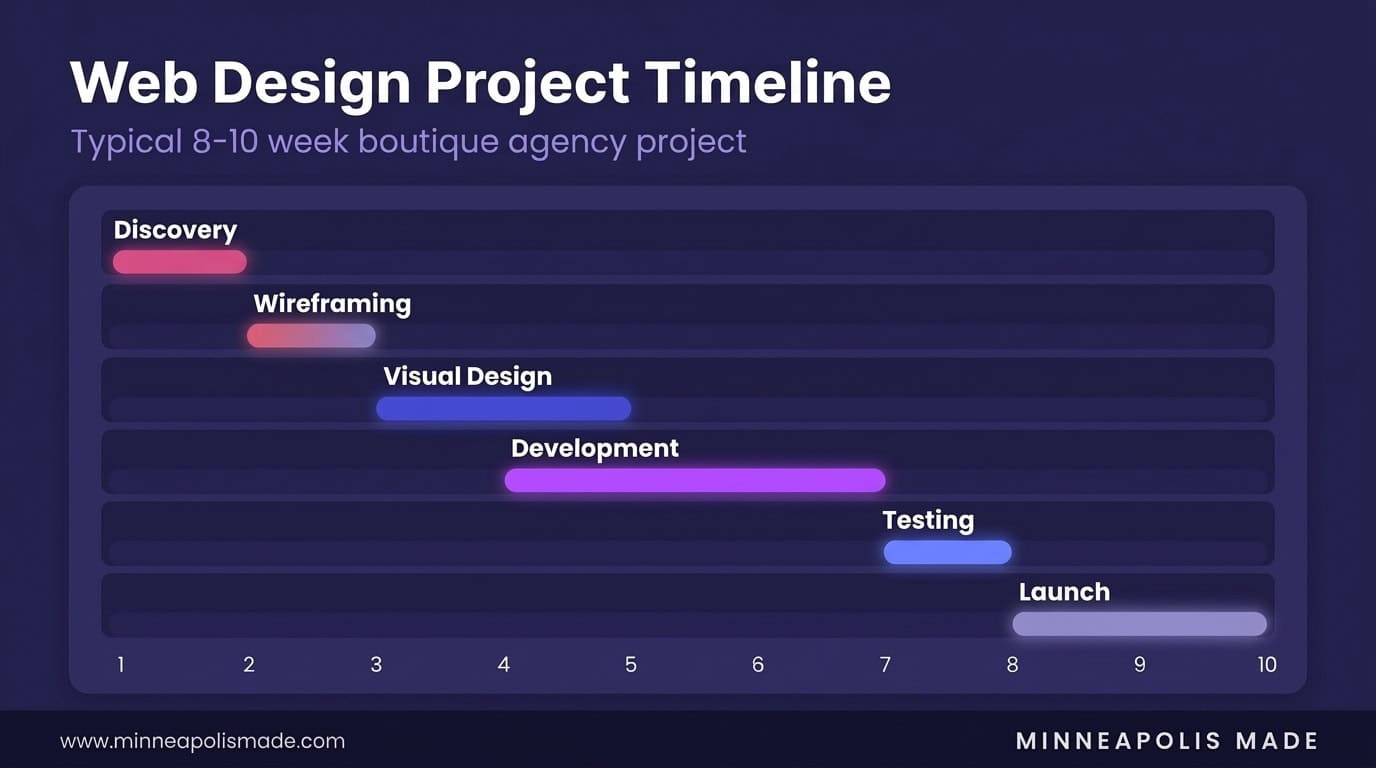
A professional small business website typically takes 6–10 weeks from kickoff to launch. That timeline assumes content is ready before development starts. E-commerce projects and larger sites run 12–20 weeks.
Should I hire a local Minneapolis web design company or work with someone remote?
Local matters more than people think. Not because of geography, but because local firms understand your market. A Minneapolis web designer knows the competitive context, can visit your business, and has probably worked with your industry locally. That said, the right remote agency beats the wrong local one. Prioritize portfolio quality, process transparency, and communication style over zip code.
What’s the best platform for a Minneapolis small business website?
WordPress is the right choice for most Minneapolis small businesses. It’s the most widely used CMS in the world, offers the most flexibility, and keeps you in control of your own site. Shopify works well for product-focused e-commerce businesses.
Does web design affect SEO in Minneapolis?
Directly and significantly. Site architecture, page speed, mobile responsiveness, Core Web Vitals scores, internal linking structure, and schema markup are all built during the design and development phase. All of them affect your Google rankings.
What’s included in a professional web design project?
A complete web design project from a Minneapolis agency should include: discovery and strategy, wireframing and UX planning, custom visual design, responsive development, CMS setup and training, SEO foundations (meta structure, schema, sitemap, robots.txt), performance optimization, browser and device testing, and launch support.