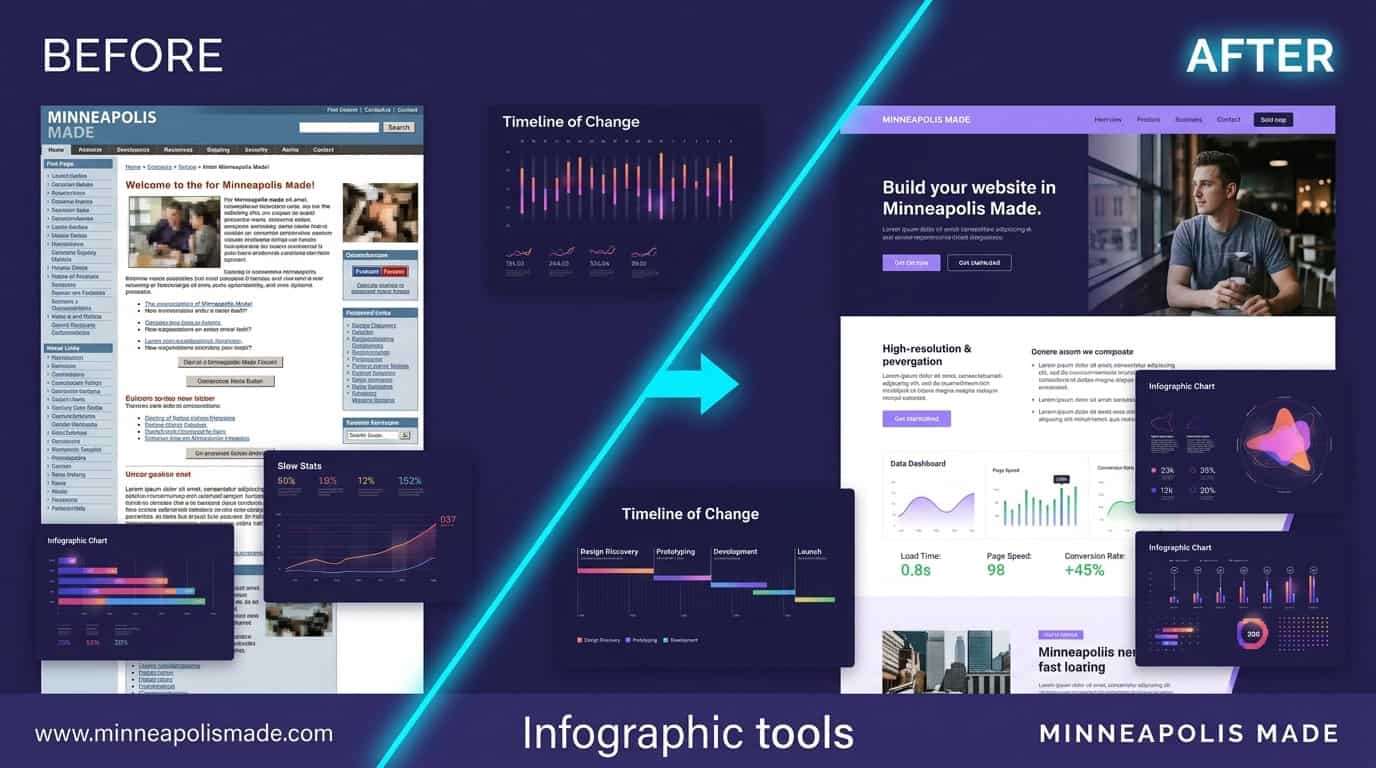
Most business owners don’t plan a website redesign. They wake up one day and realize their site looks like it was built during a different era of the internet. Meanwhile, a competitor down the street just launched something that makes their old site feel embarrassing to share. If that sounds familiar, you’re not alone, and you’re probably overdue.
A website isn’t a one-time asset. It’s a living piece of your sales team. And in Minneapolis’s competitive market, where every neighborhood has its own mix of scrappy independents and established players, a stale site costs you real money every month it stays up.
Key Takeaways
- 75% of consumers judge a company’s credibility based on website design (Kinesis Inc. via Sweor)
- The average website lifespan before a major refresh is just 2-3 years (HubSpot)
- 88% of users won’t return after a bad web experience (Sweor)
- Sites meeting all three Core Web Vitals see 24% fewer abandonments (Google Chrome UX Report)
- A mid-size Minneapolis redesign typically runs $8,000 to $20,000 depending on scope
Related: How much does web design cost in Minneapolis?
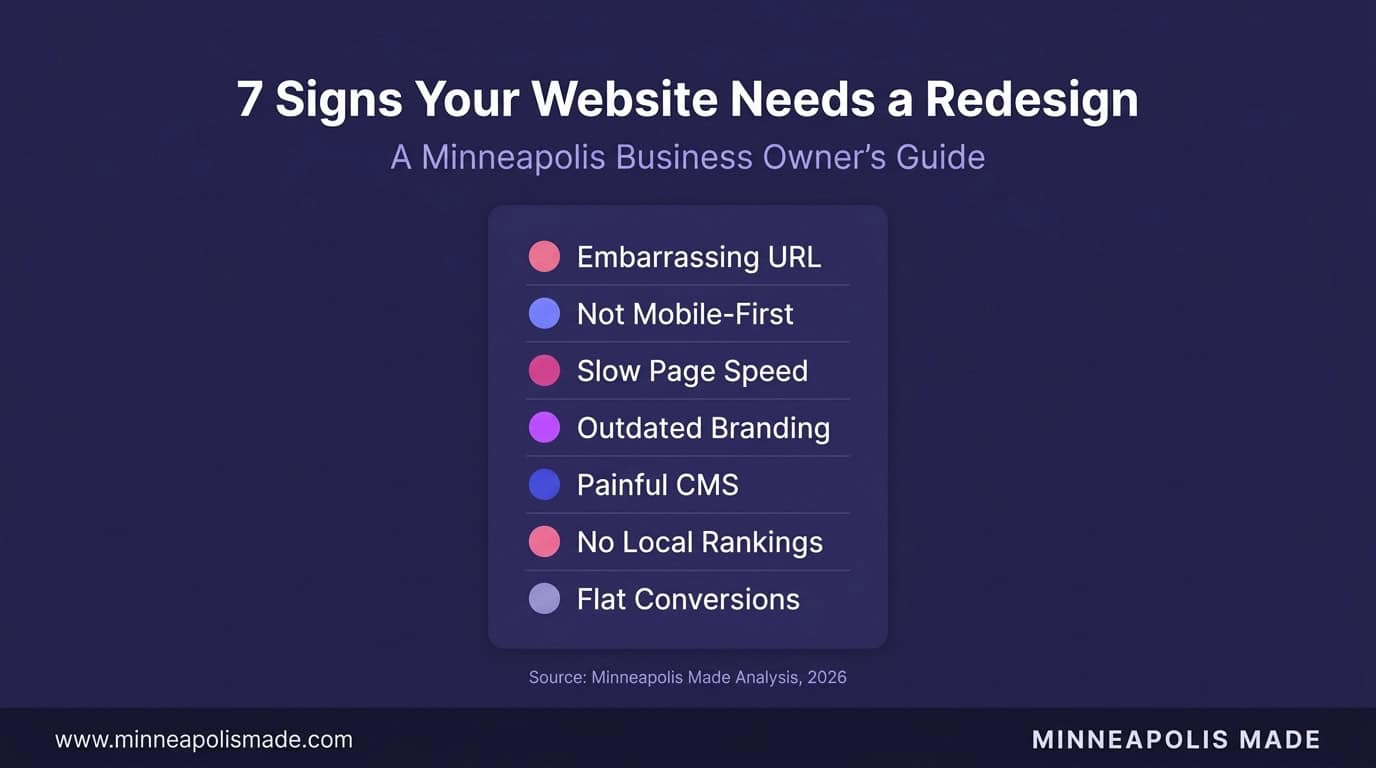
Are You Embarrassed to Share Your Website URL?
According to research compiled by Sweor, 75% of consumers judge a company’s credibility based on its website design alone. Users form that opinion in roughly 0.05 seconds. If you hesitate before giving someone your web address, or add a disclaimer like “it’s a little outdated” before they click, that hesitation is a warning sign you shouldn’t ignore.
Do you find yourself steering prospects to your Instagram instead of your homepage? That’s a red flag. Your website should be the strongest link in your sales process, not the weakest.
Personal Experience
We’ve audited dozens of Minneapolis business sites over the years. The ones that generate the most redesign inquiries share a common pattern: the owner knows the site is weak but keeps pushing the project back. By the time they finally rebuild, they’re usually looking at 18+ months of lost conversions they can never recover.
Is Your Site Still Designed for Desktop First?
Mobile devices now account for 62-64% of all web traffic globally (Statcounter, 2025). If your site was built before 2020 and hasn’t been significantly updated, there’s a good chance it was designed for desktop and “adapted” for phones. That’s not the same thing as mobile-first.
What does a mobile-first gap look like? Tap targets too small to hit with a thumb. Text that requires pinch-to-zoom. Navigation menus that collapse into something unusable. Forms with tiny input fields. These aren’t cosmetic issues. They’re conversion killers.
Related: What a slow website is actually costing your business
Is Your Page Speed Costing You Conversions?
According to Google’s own research, 53% of mobile users abandon a page that takes more than 3 seconds to load. And a Deloitte and Google study found that a 0.1-second improvement in mobile load time increases retail conversions by 8.4%. Speed isn’t a nice-to-have. It’s money.
Original Data
In our site audits of Minneapolis small business websites, the most common Core Web Vitals failures are Largest Contentful Paint (LCP) caused by unoptimized hero images, and Cumulative Layout Shift (CLS) from missing image dimensions on mobile. These are fixable in a rebuild but not with a patch on an outdated theme.
Related: Core Web Vitals explained for Minneapolis business owners
Has Your Brand Outgrown Your Website?
According to Lucidpress research cited by Sweor, consistent brand presentation across all platforms increases revenue by up to 23%. Brands evolve. You’ve refined your messaging, updated your logo, maybe repositioned from “affordable” to “premium.” But if your website still reflects who you were three years ago, it’s creating a gap between how you present yourself in person and what prospects see online first.
That gap erodes trust. When your business cards, social media, and pitch deck feel polished but your website looks like it belongs to a different company, prospects notice. They may not say anything, but they’ll feel it.
Related: Why your brand needs a design system, not just a logo
Your site should sell as hard as your best salesperson
We audit Minneapolis sites for speed, conversion gaps, and mobile performance, then rebuild them to close the gap. No bloated proposals, just a clear scope.
Is Your CMS Making Updates Harder Than They Should Be?
A BrightLocal survey found that 96% of consumers read online reviews before visiting a local business. That means your content needs to stay current. If updating a page takes 45 minutes, requires a developer, or breaks formatting every other time, your CMS is a liability, not a tool.
Modern platforms like WordPress with a proper block editor setup should let you edit content in minutes. If you’re avoiding updates because the process is painful, your website is falling further behind every week. Content freshness matters for both users and search engines.
Related: WordPress web design in Minneapolis
Why Aren’t You Ranking for Local Searches?
According to Google’s research published on Think with Google, 46% of all searches have local intent. A website redesign isn’t just cosmetic. It’s a technical SEO reset. Old sites often carry years of accumulated problems: duplicate meta tags, missing structured data, slow load times, and URL structures that made sense in 2015 but confuse Google today.
Here’s the thing most business owners miss: Google can’t rank what it can’t understand. If your site lacks LocalBusiness schema, has inconsistent NAP data, or hasn’t been submitted to Search Console in years, a redesign is your chance to fix all of it at once.
Related: Minneapolis SEO services
Why Is Your Conversion Rate Flat Despite Good Traffic?
The average website conversion rate across industries is 2.35%, but the top 25% of sites convert at 5.31% or higher (WordStream). If your analytics show consistent visitors but flat leads, the issue isn’t awareness. It’s your site’s ability to convert. Traffic without conversions is the most expensive problem in digital marketing.
Unique Insight
The conversion failures we see most often on outdated Minneapolis sites aren’t about missing CTAs. They’re about trust signals. Outdated testimonials, no case studies, stock photos that look nothing like the actual team, and contact forms that don’t confirm submission. Visitors who can’t verify credibility don’t convert. We’ve seen redesigns double conversion rates simply by adding real team photos and recent project examples.
Related: Minneapolis web design services
What Does a Website Redesign Actually Cost in Minneapolis?
According to Clutch’s 2026 pricing data, the average web design project costs $38,105 across all sizes, but most small business projects come in well under $20,000. Here’s a quick breakdown for Minneapolis:
| Project Type | Scope | Budget Range |
|---|---|---|
| Refresh | Design update, same CMS | $3,000-$8,000 |
| Mid-size rebuild | 5-20 pages, custom design | $8,000-$20,000 |
| Complex site | E-commerce, integrations | $20,000-$50,000+ |
For a detailed breakdown of what drives these costs, see our complete Minneapolis web design pricing guide.
Related: Agency vs. freelancer for your Minneapolis web project
What Should You Expect During a Minneapolis Website Redesign?
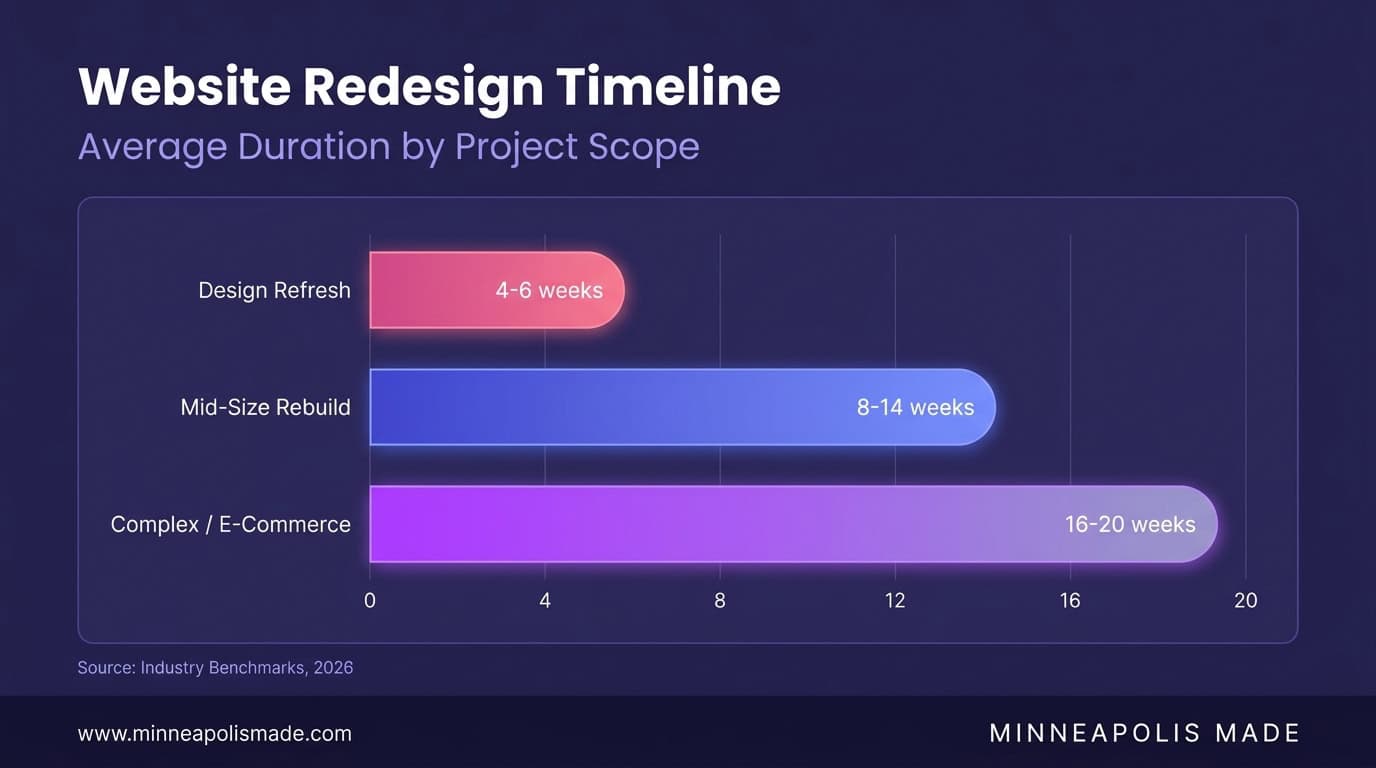
According to Clutch survey data, mid-size web projects typically take 8 to 14 weeks from signed contract to launch. A well-run redesign follows a predictable sequence, and knowing what to expect keeps both sides aligned.
- Weeks 1-2: Discovery. Goals, audiences, competitor benchmarks, content audit. This is where the strategy gets set.
- Weeks 2-3: Strategy and sitemap. Information architecture, wireframes, copy direction. Design comes after alignment on strategy, not before.
- Weeks 3-6: Design and development. Visual design, coding, content integration, mobile optimization, speed tuning.
- Weeks 6-10: Review, revisions, and QA. Client feedback rounds, cross-browser testing, mobile testing, content polishing.
- Weeks 10-12: Launch and monitoring. DNS migration, SSL setup, 301 redirects, analytics verification, 30-day monitoring window.
Related: The complete Minneapolis web design guide
Website Redesign Checklist: What to Include in Your Scope
A HubSpot study found that the average website needs a major refresh every 2-3 years, yet most businesses skip the planning phase entirely. Whether you’re working with an agency or managing internally, your redesign scope should cover these essentials:
- Goals audit: Define what “success” looks like before anyone opens a design tool. Leads? Sales? Phone calls? Be specific.
- Content inventory: Map every page on your current site. Decide what stays, what gets rewritten, and what gets cut. Most sites have 30-40% dead weight.
- SEO redirect plan: Every old URL needs a 301 redirect to its new equivalent. Skip this and you’ll lose whatever organic rankings you’ve built.
- Mobile-first wireframes: Design for phones first, then scale up. Not the other way around.
- Speed budget: Set a target for Largest Contentful Paint under 2.5 seconds. Make it a contractual requirement.
- Analytics setup: GA4, Search Console, conversion tracking, and call tracking should all be configured before launch, not after.
- Post-launch monitoring: Plan for a 30-day window where the team monitors for broken links, ranking shifts, and conversion changes.
Related: Small business web design packages in Minneapolis
Related: E-commerce web design in Minneapolis
Ready to rebuild something worth sending to clients?
We scope Minneapolis redesign projects in a single call. You’ll walk away with a clear sense of timeline, cost, and what’s holding your current site back.
Related: How to choose the right web design company for your redesign
Time for a redesign? We audit before we redesign.
Most “redesigns” rebuild the same broken structure with new colors. We audit conversion, speed, and content gaps first, so the new site solves the right problem.
Frequently Asked Questions
How long does a website redesign take in Minneapolis?
Most mid-size redesigns run 8 to 14 weeks from signed contract to launch. Complex projects with e-commerce or custom integrations can run 16 to 20 weeks. The biggest timeline variable is content readiness on the client side.
How much does a website redesign cost in Minneapolis?
A design refresh on an existing CMS typically costs $3,000 to $8,000. A mid-size custom rebuild runs $8,000 to $20,000. Complex sites with e-commerce or API integrations start at $20,000 and can exceed $50,000. See our full pricing guide for detailed breakdowns.
Should I refresh my existing site or rebuild from scratch?
If your current site is less than 3 years old with a modern CMS and solid architecture, a refresh can work. If it’s older or carries significant technical debt, a clean rebuild is usually more cost-effective long-term than patching problems one at a time.
Will a redesign hurt my SEO rankings?
A poorly handled redesign can cause temporary drops. A well-managed rebuild with proper 301 redirects, URL mapping, and SEO planning typically holds or improves rankings within 60 to 90 days. The key is planning redirects before launch, not after.
What’s the difference between a website redesign and a website refresh?
A refresh updates the visual design without rebuilding the underlying structure. A redesign rebuilds from the ground up: new architecture, new CMS, new page structure. Refreshes are faster and cheaper but don’t fix accumulated technical debt.
How do I choose a web design agency in Minneapolis for a redesign?
Look for a team that asks about your business goals before talking about design. Request case studies with measurable outcomes, not just screenshots. Verify they include post-launch support and SEO redirect planning in the contract.
What should be included in a website redesign checklist?
At minimum: goals audit, content inventory, SEO redirect plan, mobile-first wireframes, speed budget (LCP under 2.5s), analytics setup, and a 30-day post-launch monitoring window. Missing any of these leads to preventable problems.