![How to Choose a Web Design Company in Minneapolis [2026 Checklist]](https://www.minneapolismade.com/wp-content/uploads/2026/04/hero-choose-web-design-mpls.jpg)
Three out of four consumers judge a company’s credibility based on its website design alone, according to the Stanford Web Credibility Project. That’s not a soft preference. It’s a snap judgment that determines whether someone stays or bounces.
Minneapolis has over 200 web design companies listed on Clutch and Google Maps. Some are full-service agencies with decades of experience. Others are freelancers working from a coffee shop on Lyndale. The gap in quality is enormous, and choosing wrong doesn’t just waste your budget. It costs you months of lost leads and credibility you can’t easily rebuild.
This guide breaks down exactly what to look for, what to ask, and what to avoid when hiring a web design company in Minneapolis.
Related: The Complete Minneapolis Web Design Guide
Key Takeaways
- 75% of consumers judge credibility by website design (Stanford Web Credibility Project)
- Always request live URLs, not just mockups, when reviewing portfolios
- Ask about post-launch support and site ownership before signing anything
- Minnesota has 560,428 small businesses (SBA, 2025), so local market knowledge matters
- Average custom web design costs $5,000–$50,000+ depending on scope (WebFX’s web design pricing guide)
Why Does Your Choice of Web Design Company Matter So Much?
A bad website isn’t just ugly. According to Figma’s 2026 web design statistics report, 52% of consumers stopped using a brand entirely after a single poor web experience. That means your choice of design partner directly affects whether customers stay or leave.
The real cost isn’t the project fee. It’s the revenue you lose while running a site that underperforms. Slow load times, confusing navigation, and broken mobile layouts push visitors to competitors. And in a market like Minneapolis, where buyers research locally before committing, first impressions carry outsized weight.
Google’s own research backs this up. Sites that meet Core Web Vitals thresholds see measurably better engagement and conversion rates, according to web.dev case studies. Your web design company needs to understand performance, not just aesthetics.
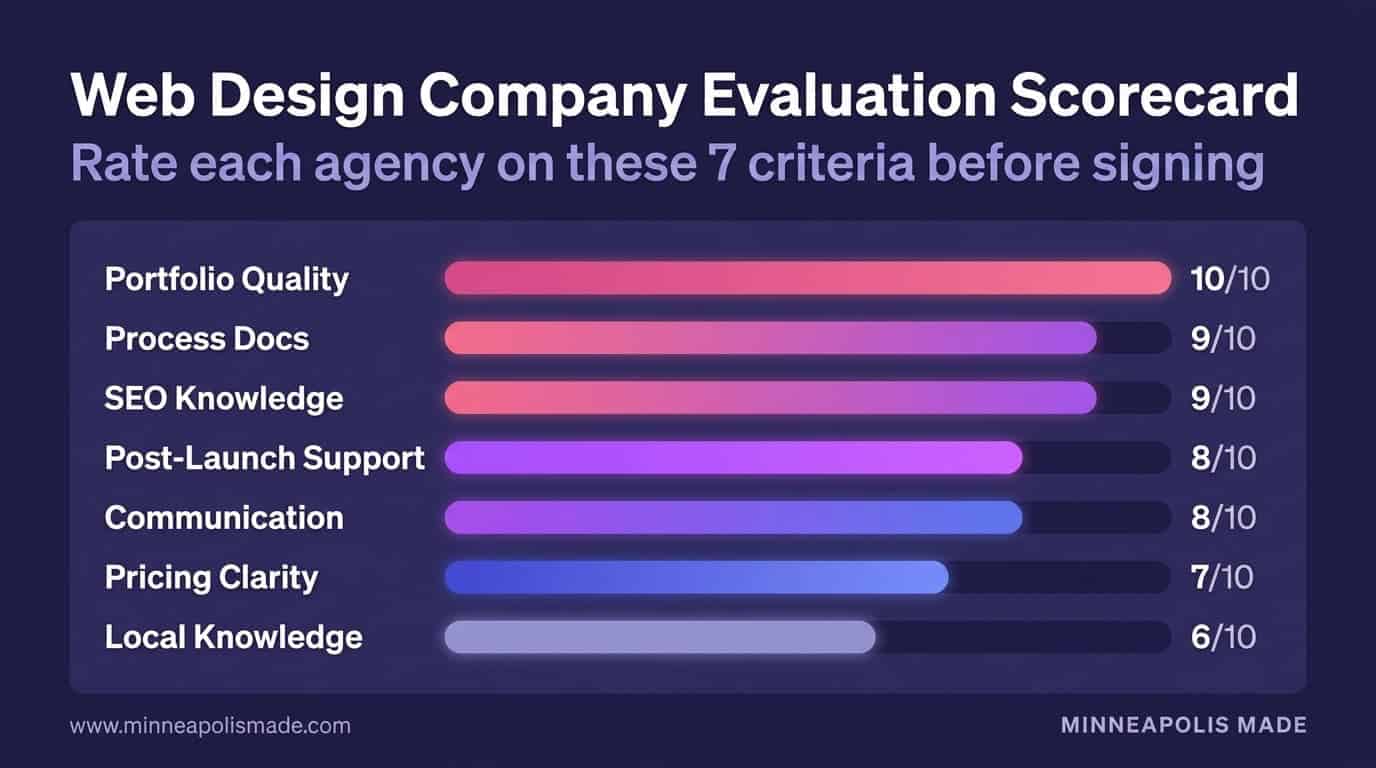
The scorecard above shows how we’d weight the criteria that actually predict project success. Portfolio quality and process documentation matter more than price. If a company can’t explain how they work, that’s a signal.
Related: When to Redesign Your Minneapolis Website
What Should You Look for in a Minneapolis Web Design Portfolio?
A portfolio tells you more than any sales pitch. Portfolio quality is consistently cited as the single most important factor when evaluating a web design partner, per WebFX’s partner-selection guide. But most people review portfolios wrong.
Don’t just look at screenshots. Ask for live URLs. Open each site on your phone. Check if pages load in under three seconds. Test the navigation. Screenshots can hide slow performance, broken responsive layouts, and placeholder content that never got replaced.
What separates a strong portfolio from a weak one?
Strong portfolios show range and results. Look for sites in industries similar to yours, but also check for variety. A company that only builds one type of site may struggle when your project has unique requirements.
Pay attention to the details. Are contact forms functional? Do images have alt text? Is the content well-written or clearly Lorem Ipsum? These small things reveal how thorough a team really is.
Personal Experience
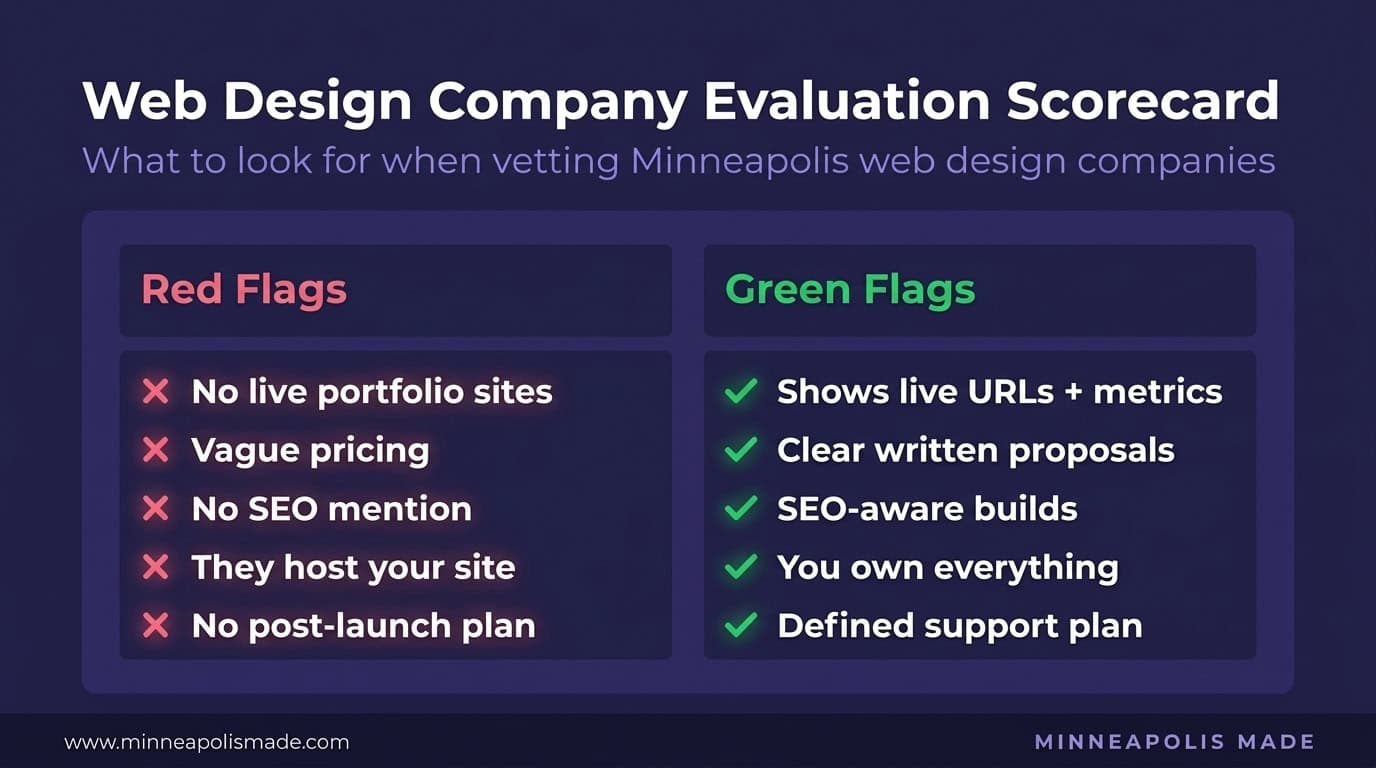
We’ve found that asking a company to walk you through a live CMS demo during the sales process reveals more than any portfolio page. You’ll quickly see whether the backend is organized, whether content editing is intuitive, and whether the agency builds sites that clients can actually maintain. If they hesitate to show you the admin panel, that’s a red flag worth noting.
Related: Small Business Web Design in Minneapolis
Should You Choose a Local Minneapolis Agency or a National One?
Minnesota has 560,428 small businesses according to the SBA’s 2025 state profile. That density creates a competitive local market where understanding Minneapolis-specific buyer behavior gives agencies a real edge over national firms.
Local agencies know the neighborhoods. They understand that a North Loop restaurant targets a different audience than a Bloomington dental practice. They’ve seen what works on Google Maps for Twin Cities searches. National agencies optimize for templates and scalability, not local nuance.
When does a national agency make more sense?
If you’re an enterprise company with offices in multiple states, a national firm’s infrastructure might serve you better. They’ll have larger teams, more specialized roles, and established processes for complex builds. But for most Minneapolis small businesses, local knowledge and accessibility outweigh scale.
In-person meetings still matter. Being able to sit across the table from your designer, review prototypes on a shared screen, and hash out feedback in real time speeds up projects and reduces miscommunication. That’s harder to replicate over Zoom with a team three time zones away.
Related: Agency vs. Freelancer: Which Is Right for You?
What Questions Should You Ask During the Sales Process?
According to the Better Business Bureau, web design is consistently among the top categories for service-related complaints. Asking the right questions upfront prevents most of those problems. Here are the questions that matter most.
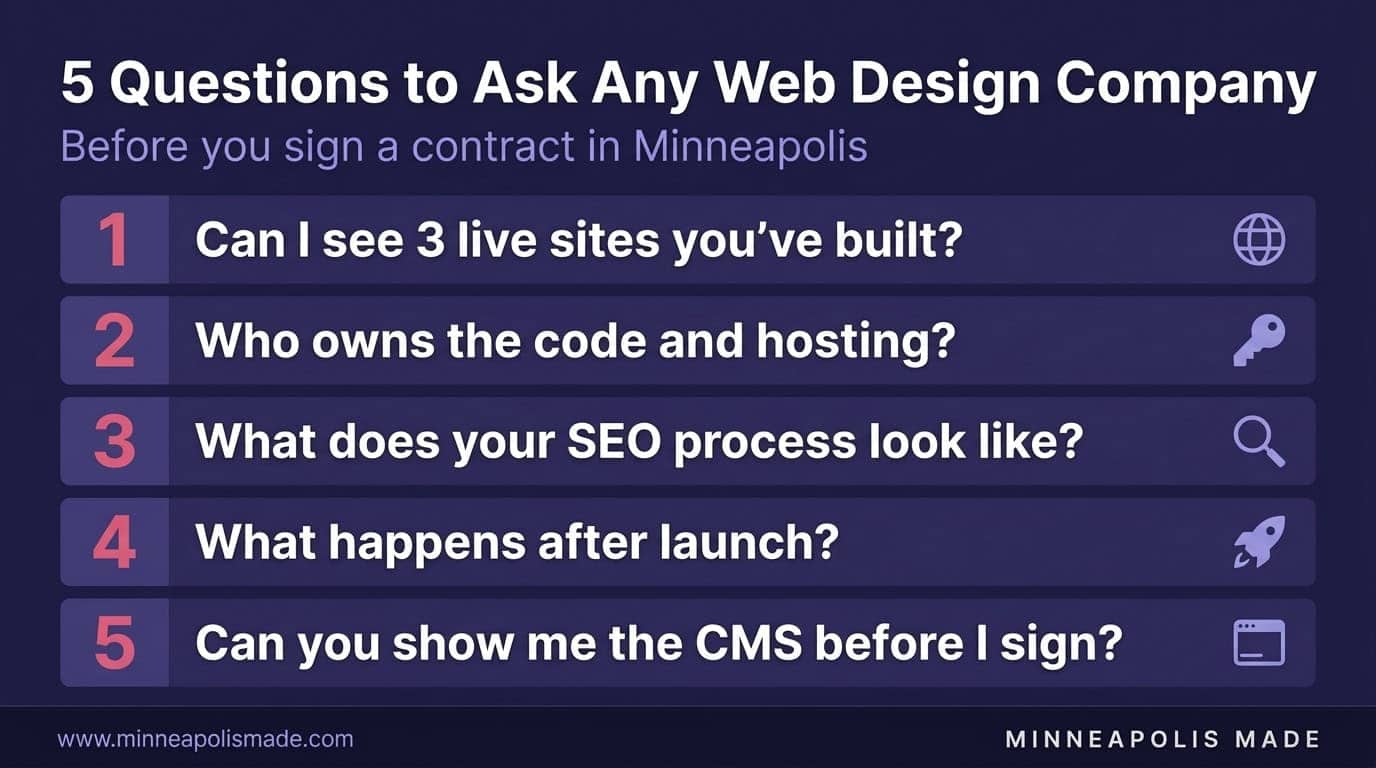
- Can you share 3–5 live URLs from recent projects? Not mockups, not PDFs. Live, clickable websites you can test yourself.
- What does your process look like from kickoff to launch? A documented process with clear milestones signals professionalism.
- Who owns the site after launch? You should own your domain, your hosting account, and your code. Full stop.
- How do you handle SEO during the build? If they say “we add SEO later,” walk away. SEO needs to be baked into the site architecture from day one.
- What does post-launch support look like? Get specifics: response times, monthly retainer costs, what’s included and what’s billed hourly.
- Can you provide references from clients in my industry? Industry-specific experience reduces the learning curve and the risk of misaligned expectations.
- What CMS will you build on, and why? The answer should reference your team’s technical skill level, your content update frequency, and your growth plans.
Not sure what to ask in your next agency meeting?
We’ll review your shortlist and tell you exactly what to look for based on your project scope, budget, and goals.
How Do You Evaluate Pricing Without Getting Burned?
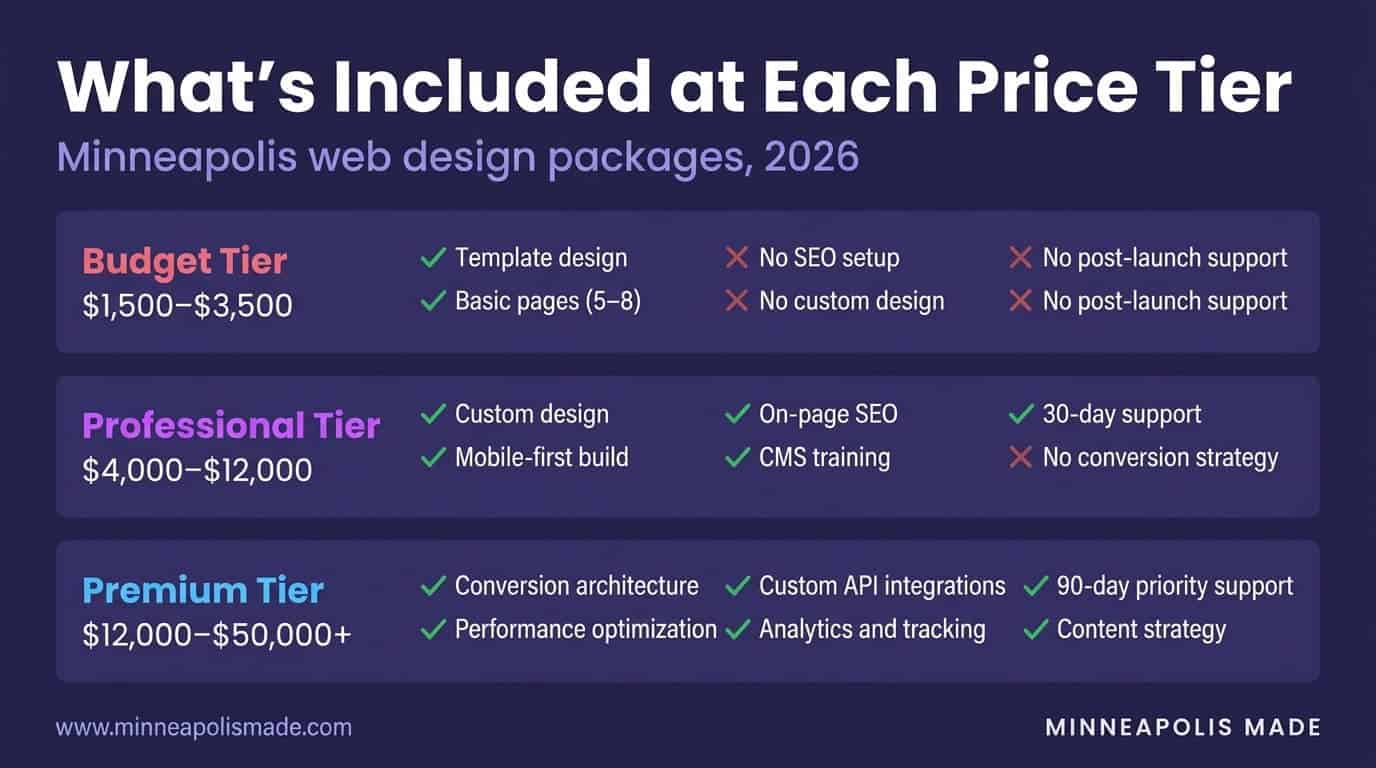
Custom web design typically costs between $5,000 and $50,000+, according to WebFX’s 2026 web design pricing guide. That’s a massive range. Understanding what drives the price helps you spot both lowball bids and inflated quotes.
A $2,000 website and a $25,000 website aren’t the same product. The cheaper option usually means a template with minimal customization, limited revisions, and no SEO work. The more expensive build includes custom design, responsive development, content strategy, on-page SEO, accessibility compliance, and testing across devices.
What should a good proposal include?
Expect a detailed scope of work, a timeline with milestones, a payment schedule tied to deliverables, and a clear statement of what’s not included. Vague proposals that quote a flat fee without explaining the breakdown are a warning sign.
Watch for hidden costs. Hosting fees, plugin licenses, stock photography, content migration, and post-launch edits can all add up. Ask explicitly: “What will I need to pay for beyond this proposal?” A trustworthy company won’t dodge that question.
Original Data
From our intake data over the past two years, roughly 30% of new client inquiries involve remediating a site built by another agency. The average remediation project costs 40–60% of what the original build cost, essentially paying twice for the same website. Choosing a cheaper option upfront often becomes the most expensive decision a business makes.
Related: What Does Web Design Cost in Minneapolis?
What Platform Should Your Web Design Company Use?
WordPress powers 43.5% of all websites on the internet, according to W3Techs (2026). It’s the default recommendation for most small to mid-size businesses, and for good reason. But it’s not the only option worth considering.
Shopify dominates ecommerce. Webflow appeals to design-focused teams that want visual editing without plugin dependencies. Headless CMS setups work well for companies with developer resources and complex content needs. The right answer depends on your team, your budget, and how often you’ll update content.
Red flags around platform choice
Be cautious if an agency only builds on one platform and can’t explain why. A Wix-only shop might lack the technical depth for a complex project. Conversely, a company pushing a headless architecture for a five-page brochure site is overengineering the solution.
Ask who manages hosting, updates, and security patches after launch. Some agencies bundle these into a monthly retainer. Others hand you the keys and walk away. Know which model you’re signing up for before the contract is finalized.
Related: WordPress Web Design for Minneapolis Businesses
Common Mistakes Minneapolis Businesses Make When Hiring
Roughly two-thirds of small businesses spend under $10,000 on their website, per SiteBuilderReport’s small-business website statistics. Many of those businesses end up spending again within 18 months because of avoidable mistakes during the hiring process.
1. Hiring on price alone
The cheapest bid almost never delivers the best value. Low-cost providers cut corners on mobile optimization, page speed, accessibility, and SEO. You’ll pay for those shortcuts later in lost traffic and expensive fixes.
2. Not checking references
A beautiful portfolio doesn’t tell you how the company communicates, handles revisions, or responds to problems. Call two or three references. Ask specifically about timelines, responsiveness, and whether the final product matched what was promised.
3. Skipping the SEO conversation
A site that looks great but doesn’t rank is a brochure nobody sees. Your web design company should discuss keyword strategy, site architecture, page speed, and schema markup during the planning phase. If SEO is an afterthought, keep looking.
4. No ownership clause in the contract
Some agencies retain ownership of your domain, your code, or your design files. If the relationship sours, you’re stuck. Insist on full ownership of all deliverables in writing.
5. No post-launch plan
A website isn’t a one-time project. It needs security updates, content refreshes, performance monitoring, and ongoing SEO work. Ask what happens after launch day before you sign the contract.
Unique Insight
Here’s what most “how to hire a web designer” guides won’t tell you: the most expensive web design mistake isn’t overpaying for the build. It’s the opportunity cost of running a site that doesn’t convert for 12–18 months while you figure out something’s wrong. By the time most businesses realize their site underperforms, they’ve lost far more in missed leads than the original project cost.
Related: Understanding the True Cost of Web Design
Already comparing Minneapolis web design companies?
Send us your top 2–3 proposals. We’ll give you an honest breakdown of what’s strong, what’s missing, and where to negotiate.
Related: See how Minneapolis Made approaches web design
Related: Best web design companies in Minneapolis ranked
Related: How to hire a website designer in Minneapolis
Done with the checklist? Let us run through it together.
We will walk you through every item on this list, on a 30-min call. No pitch, just a vetting conversation so you can decide whether to shortlist us.
Frequently Asked Questions
How much does web design cost in Minneapolis?
Custom web design in Minneapolis typically ranges from $5,000 to $50,000+, according to WebFX’s 2026 pricing guide. Template-based sites start lower, around $2,000–$5,000. The final price depends on page count, custom functionality, ecommerce needs, and content creation requirements.
Should I hire a freelancer or an agency for web design?
Freelancers work well for smaller projects with clear scope. Agencies offer broader skill sets, backup resources, and structured project management. For sites requiring SEO, custom development, and ongoing support, an agency typically provides more accountability. Read our agency vs. freelancer comparison for a detailed breakdown.
How long does it take to build a website?
Most custom business websites take 8–16 weeks from kickoff to launch. Simple brochure sites can launch in 4–6 weeks. Complex ecommerce or membership sites may take 4–6 months. Timeline depends on revision rounds, content readiness, and third-party integrations.
What CMS should my web design company use?
WordPress is the default recommendation for most businesses, powering 43.5% of all sites globally (W3Techs, 2026). Shopify is ideal for ecommerce. Webflow suits design-heavy sites with minimal backend complexity. The right choice depends on your team’s technical comfort and how often you’ll update content.
How do I know if a web design company is legitimate?
Check for live portfolio URLs you can test yourself, BBB accreditation, and Google reviews with specific project details. Ask for references and call them. A legitimate company will have a documented process, transparent pricing, and a clear contract that grants you full ownership of your website.
What’s the most important thing to look for in a web design company?
Portfolio quality and process documentation. A company that can show you live, high-performing websites and clearly explain how they work from kickoff through launch is far more likely to deliver a successful project than one that relies on flashy sales pitches alone.