Choosing a web development agency is one of the most consequential decisions a business owner makes. According to Clutch's 2025 Small Business Website Survey, 45% of small businesses outsource web development to agencies or freelancers. That's a lot of trust placed in outside partners for an investment that shapes how customers perceive your brand. After 25 years building websites in Minneapolis, we've watched companies thrive with the right partner and hemorrhage cash with the wrong one. This guide shares what we've learned, so you can skip the expensive lessons.
What Are the Red Flags When Hiring a Web Development Agency?
A GoodFirms survey (2021) found that 73.1% of web designers cited non-responsive design as a top reason visitors leave websites. If the agency pitching you has an outdated site themselves, that tells you everything. We've consulted with dozens of Twin Cities businesses recovering from bad agency experiences, and the warning signs are almost always the same.
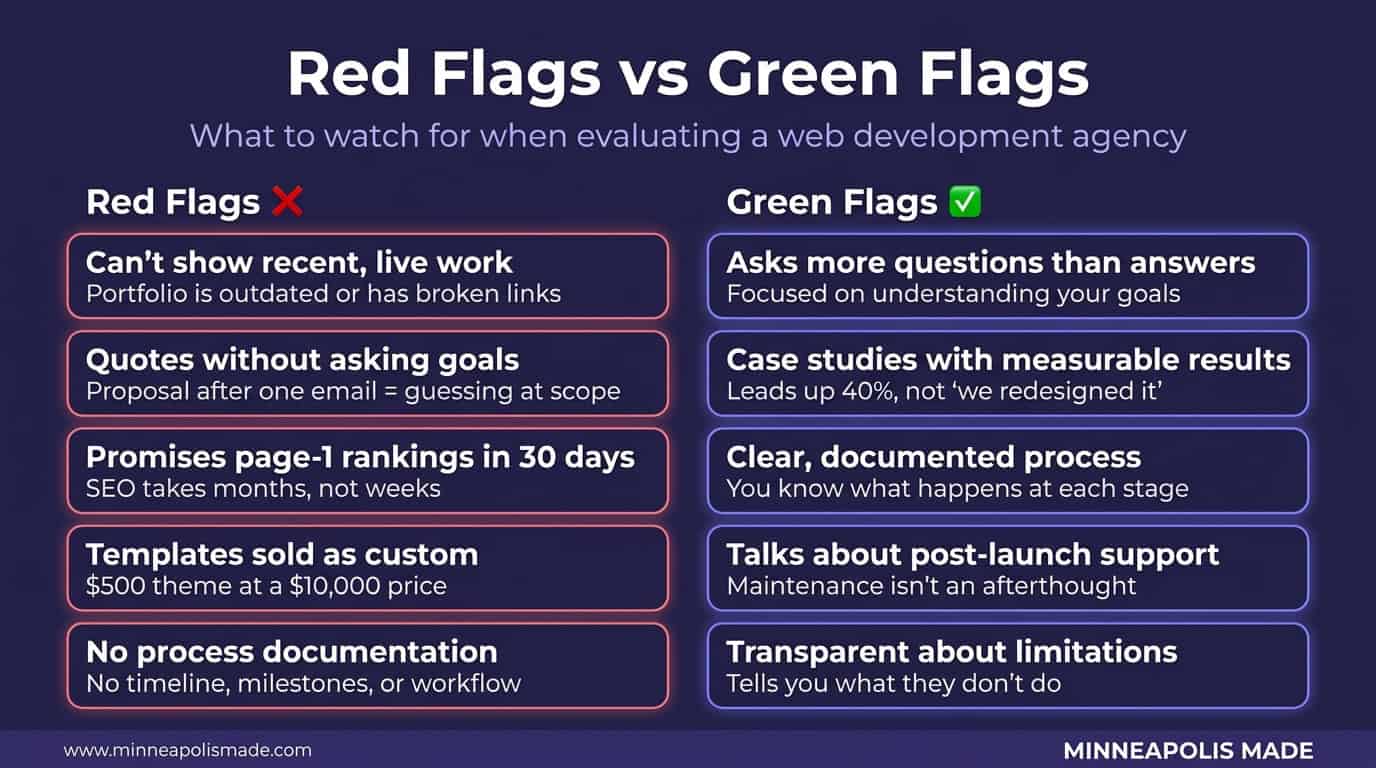
They can't show you recent work. Not work from three years ago, not a Dribbble page with mockups that never launched. Recent, live websites you can click through and test on your phone. If their portfolio page has five items and two are broken links, walk away.
They quote a price before asking a single question about your goals. A real discovery process matters. Any agency that sends a proposal after one email exchange is guessing at scope, and you'll pay for that guesswork in change orders later.
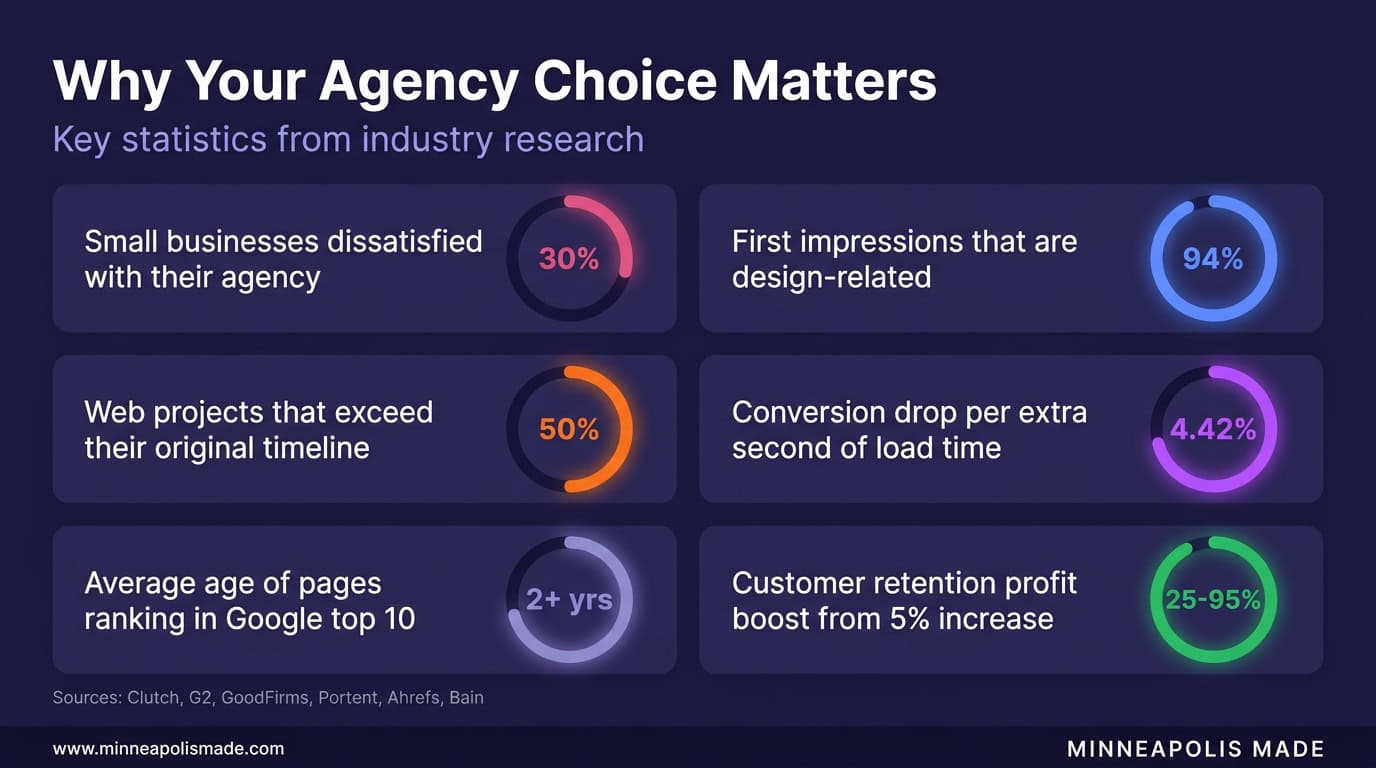
They promise first-page Google rankings in 30 days. Ahrefs research (2023) shows the average page ranking in the top 10 is over two years old. SEO takes time. Anyone guaranteeing instant results is either lying or planning to use tactics that get your site penalized.
They use generic page builder templates and call it custom development. There's nothing wrong with WordPress themes or Elementor for certain projects. But if you're paying custom development prices, you should get custom code. Ask to see the source. If every site in their portfolio looks like it came from the same ThemeForest template, you're buying a $500 product at a $10,000 price.
They have no process documentation. No timeline. No defined milestones. No content collection system. We've found that agencies without a documented workflow tend to wing it, and their clients feel the chaos at every stage.

What Are the Green Flags That Signal a Great Agency?
The best agencies ask more questions than they answer during the first conversation. Research from Bain & Company shows that increasing customer retention by just 5% boosts profits 25% to 95%. Good agencies understand this, so they focus on long-term client success rather than closing a quick sale.
They show case studies with measurable results. Not "we redesigned their site" but "we redesigned their site and their lead form submissions increased 40% in six months." Numbers matter. Vague success stories are just marketing copy.
They explain their process clearly, from kickoff to launch and beyond. You should know exactly what happens at each stage, who's responsible, and what you need to provide. Here in Minneapolis and St. Paul, we've seen agencies range from solo freelancers to 50-person shops. Size doesn't determine quality, but process discipline does.
In our experience, the agencies that talk about ongoing support during the sales process are the ones that actually deliver it. If post-launch maintenance is an afterthought in the pitch, it'll be an afterthought in practice. Your website isn't a one-time project. It's a living system that needs updates, security patches, and content refreshes.
They're transparent about what they don't do. A good Minneapolis web agency will tell you upfront if they don't handle copywriting, photography, or paid advertising. That honesty saves everyone time and prevents scope confusion three months into the project.

What Questions Should You Ask a Web Development Agency?
A G2 Research report notes that 94% of first impressions relate to a site's design and usability. With stakes that high, your vetting process needs to be thorough. Here are the questions we recommend, and honestly, the questions we respect most when prospective clients ask us.
Who will actually do the work? Some agencies sell with a senior team and then hand your project to junior developers or offshore contractors. There's nothing inherently wrong with distributed teams, but you deserve to know who's writing the code and designing the layouts. Ask to meet them.
What does your development process look like? Look for defined phases: discovery, wireframing, design, development, testing, launch. If they can't describe their process in plain language, they probably don't have one.
How do you handle scope changes? Scope creep kills projects. Every agency handles it differently. Some use change order forms. Some bill hourly overages. Some build buffer into the original estimate. None of these approaches is wrong, but you need to understand which one you're agreeing to before you sign.
What happens after launch? This question separates partners from vendors. A vendor delivers files and disappears. A partner has a maintenance plan, monitors uptime, handles hosting questions, and is available when something breaks on a Saturday morning. We've seen too many Twin Cities businesses left stranded after launch day with no support plan in place.
Can I talk to three recent clients? Not testimonials on their website. Actual phone numbers or email addresses for people who've worked with them in the last 12 months. Any agency confident in their work will hand these over without hesitation.
What is your approach to SEO during the build? SEO shouldn't be an add-on bolted onto a finished site. Technical SEO, site speed, URL structure, heading hierarchy, schema markup: these decisions happen during development, not after. If an agency treats SEO as a separate line item disconnected from the build, they're setting you up for a costly retrofit.
What Does Web Development Actually Cost?
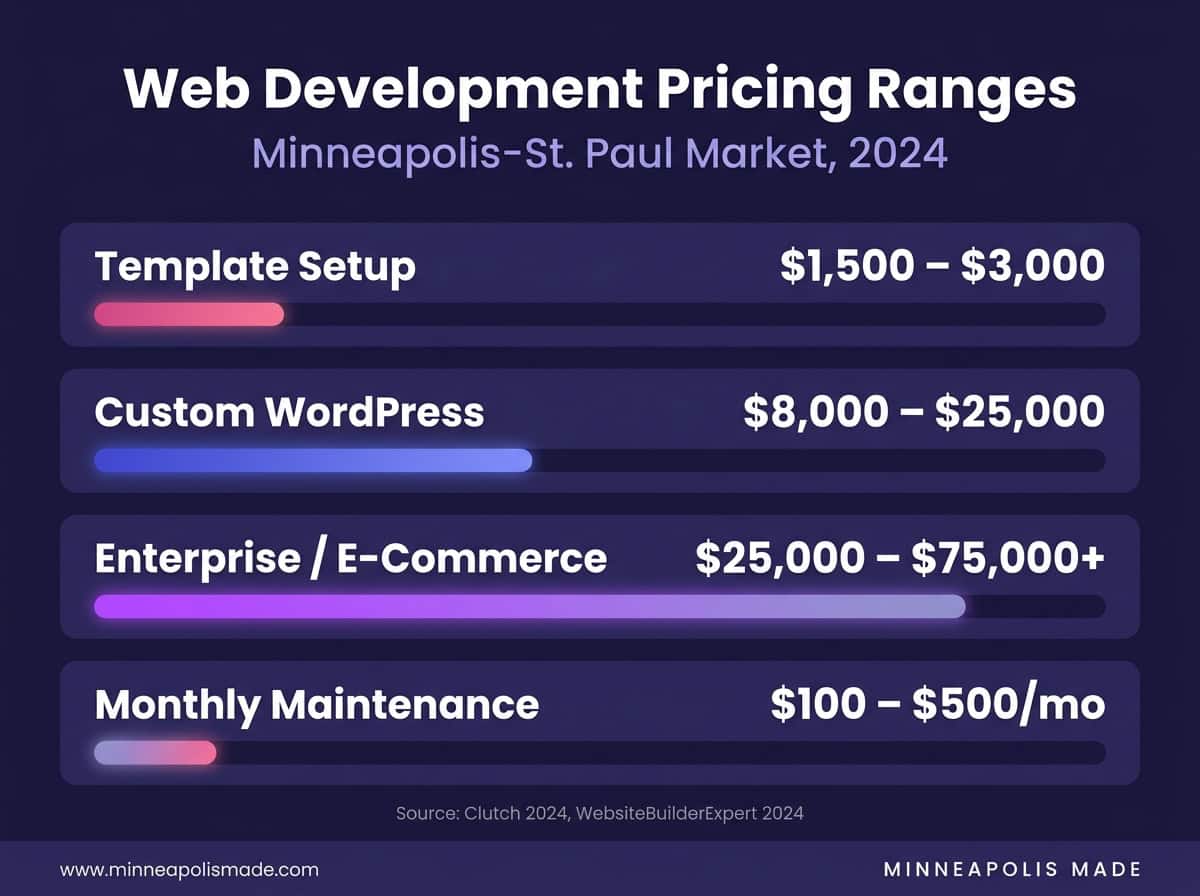
In the Minneapolis-St. Paul market, a custom WordPress website from a reputable agency costs between $8,000 and $25,000 for most small businesses, according to Clutch's web development pricing data. That range covers discovery, custom design, development, content migration, basic SEO setup, and launch support. Understanding this baseline helps you spot both lowball traps and inflated quotes.
If someone quotes $2,000 for a "custom" site, they're installing a pre-built theme, swapping in your logo, and calling it done. That's not custom development. For some businesses, a well-configured theme is perfectly adequate, but you should know what you're buying and pay accordingly. A theme setup should cost $1,500 to $3,000, not be disguised as bespoke work.
On the other end, if a quote exceeds $50,000, make sure the scope justifies it. E-commerce with custom integrations, membership portals, API connections to your CRM, multilingual support: these features legitimately drive costs up. But a brochure site for a Minneapolis law firm or restaurant doesn't need a six-figure budget. We've reviewed proposals from other agencies where businesses were quoted $40,000 for what amounted to a 10-page WordPress site with a contact form.
We regularly review proposals for Twin Cities businesses considering a new website. Ask for a line-item breakdown. Design, development, content, project management, hosting, and post-launch support should each have their own number. If the proposal is one lump sum with no detail, you have no way to evaluate whether the price is fair.
For Minneapolis businesses, also consider ongoing costs. Hosting, SSL certificates, plugin updates, security monitoring, and content updates add $100 to $500 per month depending on complexity. WebsiteBuilderExpert (2024) estimates average annual maintenance costs at $400 to $60,000, with most small business sites falling in the $400 to $1,200 range. Budget for this from the start.
Why Should You Trust Your Gut When Choosing an Agency?
A Harvard Business Review study (2022) on service provider selection found that buyers who prioritized communication quality over portfolio prestige reported higher satisfaction rates. Data matters, but so does the human element. The best agency relationships we've built over 25 years in Minneapolis started with a genuine connection in the first conversation.
If the chemistry isn't there during the sales process, it won't improve after you sign the contract. The sales phase is when an agency is most attentive, most responsive, most eager to impress. If emails take a week to get answered now, imagine what happens three months into a six-month project.
Pay attention to how they handle disagreement. Do they explain their reasoning, or do they get defensive? A good agency pushes back when you're making a decision that hurts your project. A bad one says yes to everything, delivers exactly what you asked for, and lets you discover the problems on your own.
Does their team seem genuinely interested in your business? Or are they just nodding through your explanation so they can get to the proposal? We've found, both as an agency and as clients ourselves, that curiosity is the single best predictor of a successful engagement. When someone cares enough to ask "why" three times, they'll build something that actually works.
Finally, check their local reputation. In a market like Minneapolis-St. Paul, word travels. Ask around at local business groups, check Google reviews, look at their presence in the Twin Cities tech community. An agency that's been here for years and maintains strong relationships has earned that trust through consistent delivery.
Frequently Asked Questions
How long does it take to build a custom website?
Most custom WordPress sites take 8 to 16 weeks from kickoff to launch. Complex projects with e-commerce, integrations, or large content libraries can extend to 6 months. According to GoodFirms (2021), 50% of web projects exceed their original timeline, so build buffer into your expectations and ask how the agency manages delays.
Should I choose a local agency or a remote one?
Both can work well. Local agencies offer easier in-person collaboration and often understand your regional market better. For Minneapolis businesses, a local partner knows the competitive landscape and can reference what works in the Twin Cities. Remote agencies may offer cost savings. The deciding factor should be communication quality, not geography.
What's the difference between custom development and template-based design?
Custom development means your site is built from scratch with unique code tailored to your needs. Template-based design starts with a pre-built theme and customizes it. Templates work fine for straightforward sites. Custom builds make sense when you need unique functionality, specific performance targets, or a design that can't be achieved within theme constraints.
How do I know if my current website needs a full rebuild or just updates?
If your site loads in under 3 seconds, works well on mobile, generates leads consistently, and runs on supported software, updates may be enough. Portent (2022) found that conversion rates drop by an average of 4.42% with each additional second of load time. If your site fails on speed, mobile experience, or conversions, a rebuild is likely the better investment.
What should a web development contract include?
A solid contract covers project scope, timeline with milestones, payment schedule, revision limits, intellectual property ownership, hosting details, post-launch support terms, and a termination clause. If any of these are missing, ask why. Never start a project on a handshake, regardless of how trustworthy the agency seems.
Choosing a web development agency doesn't have to feel like a gamble. Do your homework: check portfolios, ask hard questions, compare line-item pricing, and talk to real clients. The right agency will welcome your scrutiny because they know their work holds up. Whether you're a startup in North Loop or an established business in Edina, the principles are the same. Find a partner who listens, delivers, and sticks around after launch day.
Related: Minneapolis web development services
Related: Web design services from Minneapolis Made
Related: Agency vs freelancer: which is right for your project?
Related: How to choose a web design company in Minneapolis
Related: How much does web development cost in Minneapolis?
Related: Why development quality directly impacts your bottom line