Minneapolis
Headless CMS Developer.
Decoupled architecture for Twin Cities teams who want WordPress-quality editing with sub-second load times. We build on WordPress headless, Sanity, Contentful, and the right framework for your stack.
Want a traditional build instead? See Minneapolis WordPress development for our monolithic WP work, or custom web development for from-scratch builds.






Verified Proof
We tested 21 Minneapolis web design agencies. We ranked #1.
Our site scored 98 on Lighthouse mobile with a 2.2-second LCP, the fastest in the Minneapolis market. See every agency's actual Lighthouse score, including the 16 that failed Core Web Vitals.
See the 2026 Speed Report →What is a headless CMS, exactly?
A traditional CMS like WordPress does two jobs in one box: it stores your content and it renders the HTML pages your visitors see. A headless CMS only does the first job. The HTML rendering is delegated to a separate front-end app — usually Next.js, Astro, or Nuxt — that pulls content from the CMS through an API.
That split unlocks things a monolith can't do: sub-second page loads, the same content reused across web, app, and email, and the freedom to use any modern framework without forcing it through PHP. Your editors keep their familiar admin; your visitors get a site that loads before they finish blinking.
Monolithic CMS
One server renders everything. Slow under load.
Headless / Decoupled
Pre-rendered HTML on a CDN. Always fast.
Three things headless does
that monoliths can't.
Sub-second load times
Static HTML pre-rendered at build time and served from a global CDN. No PHP execution, no database queries, no plugin slowdowns between visitor and page.
One CMS, every channel
Edit content once. Push it to your website, mobile app, email templates, voice assistant, and digital signage. The CMS becomes a single source of truth instead of one of many.
Framework freedom
Build the front end in Next.js, Astro, Nuxt, or whatever your team knows. The CMS doesn't care, and you're not stuck with whatever theme language the platform shipped in 2003.
Headless CMS options
we ship with.
Ten headless CMSs we've evaluated, scoped, or shipped. Linked CMSs have a deep-dive section below; the rest link to the vendor.
| CMS | Stack | Hosting | Edit UX | Pricing | Best For |
|---|---|---|---|---|---|
| WordPress (headless) ↗ | PHP / GraphQL | WP Engine, Kinsta, self-host | Block editor (familiar) | $ | Marketing teams who already know WP |
| Sanity ↗ | Node / GROQ + GraphQL | SaaS (Sanity-hosted) | Sanity Studio (custom) | $$ | Structured content, real-time preview |
| Contentful ↗ | Node / REST + GraphQL | SaaS (Contentful-hosted) | Web app, multi-language | $$$ | Enterprise workflows, localization |
| Storyblok ↗ | Node / REST + GraphQL | SaaS | Visual editor (live preview) | $$ | Marketing teams who want WYSIWYG |
| Payload ↗ | Node / REST + GraphQL | Self-host (Node + DB) | Admin UI (developer-tuned) | Free / $ | Developer-led teams, full control |
| Strapi ↗ | Node / REST + GraphQL | Self-host or Strapi Cloud | Admin panel | Free / $$ | Teams that need data ownership |
| Ghost ↗ | Node / Content API | Ghost(Pro) or self-host | Editor + Membership tools | $ | Publishers, paid newsletters |
| Hygraph ↗ | GraphQL-first | SaaS | Web app, schema-driven | $$ | GraphQL-native projects |
| Prismic ↗ | Node / REST + GraphQL | SaaS | Slice Machine + page builder | $ | Component-driven marketing sites |
| Directus ↗ | Node + SQL | Self-host or Directus Cloud | Admin app over SQL | Free / $$ | Existing SQL databases |
- Stack
- PHP / GraphQL
- Hosting
- WP Engine, Kinsta, self-host
- Edit UX
- Block editor (familiar)
- Best for
- Marketing teams who already know WP
- Stack
- Node / GROQ + GraphQL
- Hosting
- SaaS (Sanity-hosted)
- Edit UX
- Sanity Studio (custom)
- Best for
- Structured content, real-time preview
- Stack
- Node / REST + GraphQL
- Hosting
- SaaS (Contentful-hosted)
- Edit UX
- Web app, multi-language
- Best for
- Enterprise workflows, localization
- Stack
- Node / REST + GraphQL
- Hosting
- SaaS
- Edit UX
- Visual editor (live preview)
- Best for
- Marketing teams who want WYSIWYG
- Stack
- Node / REST + GraphQL
- Hosting
- Self-host (Node + DB)
- Edit UX
- Admin UI (developer-tuned)
- Best for
- Developer-led teams, full control
- Stack
- Node / REST + GraphQL
- Hosting
- Self-host or Strapi Cloud
- Edit UX
- Admin panel
- Best for
- Teams that need data ownership
- Stack
- Node / Content API
- Hosting
- Ghost(Pro) or self-host
- Edit UX
- Editor + Membership tools
- Best for
- Publishers, paid newsletters
- Stack
- GraphQL-first
- Hosting
- SaaS
- Edit UX
- Web app, schema-driven
- Best for
- GraphQL-native projects
- Stack
- Node / REST + GraphQL
- Hosting
- SaaS
- Edit UX
- Slice Machine + page builder
- Best for
- Component-driven marketing sites
- Stack
- Node + SQL
- Hosting
- Self-host or Directus Cloud
- Edit UX
- Admin app over SQL
- Best for
- Existing SQL databases
WordPress headless — when you keep the editor and gain the speed.
WordPress is still the right answer for most marketing teams. The block editor is familiar, the plugin ecosystem is unmatched, and content authors already know it. The problem is that shared and budget-managed WordPress hosting often starts to show strain past ~50k monthly page views without aggressive caching. Caching plugins help, but they don't fix the fundamental architecture.
Headless WordPress keeps the editor your team uses and replaces the front end with Next.js or Astro. The page is built once at deploy time and served from a CDN, so visitors hit a static file instead of triggering a database query. Sub-second loads, perfect Core Web Vitals scores, and zero architectural changes for your editors.
For sites that need the WordPress preview workflow intact we use the WP Engine Headless WordPress Toolkit (the multi-framework successor to Faust.js) with WPGraphQL. For simpler builds we pair WPGraphQL directly with Apollo Client or urql against vanilla Next.js. ISR (incremental static regeneration) means new posts go live in seconds, not on the next deploy. We've shipped this stack on WP Engine, Vercel, and self-hosted Node, so the architecture is what matters, not the host.
The migration is straightforward: existing posts, pages, media, and URLs all stay where they are. Your editors don't change a thing. The only thing that changes is the speed.
Sanity — structured content, customized to your team.
Sanity is the headless CMS we reach for when content needs to be modeled deeply — products with twenty attributes, articles with author bios and citations, landing pages built from a fixed library of components. WordPress's flexibility comes from plugins; Sanity's comes from a typed schema you define yourself.
The Studio is the differentiator. It's a React app that ships with the platform, and it's fully customizable. We've built Studios that match a client's brand, that add custom previews for marketing teams, and that lock down fields by editor role. Your editors don't see a generic "Sanity admin" — they see a tool tuned to their workflow.
We pair Sanity with Next.js by default. The combination handles structured content, image transformations, and live preview without any extra tooling. For documentation-heavy sites, we sometimes pair with Astro instead for an even smaller JavaScript footprint.
When to pick Sanity over WordPress headless: editors are comfortable with structured fields, content needs to be reused in multiple places (web + app + email), or the content model is genuinely complex (think e-commerce, real-estate listings, multi-author publications).
Contentful — enterprise content workflows, ready out of the box.
Contentful is what happens when a headless CMS is designed for the constraints of large organizations — multi-language, role-based publishing, content scheduling, audit trails, and SOC 2 compliance. It's not the cheapest option, and that's the point. The pricing aligns with the kind of company that needs marketing, legal, and product teams collaborating on the same content without stepping on each other.
Where Sanity gives you a customizable Studio, Contentful gives you a polished web app that works the same for every customer. That consistency is a feature for enterprise teams — onboarding is fast, training is documented, and switching agencies doesn't mean retraining everyone. The trade-off is less flexibility in the editor itself.
Localization is where Contentful pulls clearly ahead. Field-level translations, locale fallbacks, and content variant workflows are built in. If you publish in three or more languages, Contentful saves weeks of custom plumbing on every other platform.
We pair Contentful with Next.js for marketing sites and with Nuxt for teams already invested in Vue. The Contentful GraphQL API is mature and well-documented, so integration is fast. Where we spend time is on the content model — getting it right up front pays back ten times during build and ongoing editorial work.
Frameworks We Pair
How we ship
a headless build.
Discovery
We map your content model, your team's editing habits, and the channels content needs to flow to.
Architecture
CMS choice, framework choice, hosting choice. We document the why so future you (or another team) can pick up where we left off.
Build
Schema, components, integrations. Speed-optimized from the first commit. Staging environment for you to break things safely.
Migrate
Existing content moves over. Redirects mapped 1:1. Schema and metadata preserved so SEO holds the line.
Launch & train
DNS, SSL, analytics, search console. Plus a recorded training session so your editors know the new tools.
Architecture call
Not sure which CMS fits your stack?
45 minutes on a call, no pitch deck. We'll look at your content, your team, and your goals — and recommend the headless setup that actually fits.
Book a Headless Architecture CallWhy a Minneapolis team for headless?
Headless projects live and die on the content model. The model is decided in workshops, not Slack threads — and workshops work better in a room than over a video call. We're 15 minutes from downtown Minneapolis and an hour from St. Paul, and we'll show up in person for kickoff and the first content-modeling session whenever it's useful.
Twin Cities verticals also matter. We've built for clients in financial services, healthcare, manufacturing, and retail — the four industries that anchor the local economy. That means we know the compliance posture your legal team is going to ask about, the localization needs of a brand selling in three states, and the editorial rhythms of a marketing team that runs lean.
Same time zone, no jet-lagged stand-ups, no contractor in a country eight hours off the schedule. When something breaks at 4pm Central, we're the ones picking up the phone.
Frequently Asked Questions
About Headless CMS Development
A headless CMS separates the place where you edit content (the back end) from the place where readers see it (the front end). Instead of WordPress rendering your pages, the CMS hands content to a fast JavaScript framework like Next.js or Astro through an API. You get the editing experience your team already knows and the page-load speed Google rewards.
Traditional WordPress is the right choice when your team needs the lowest cost, the largest plugin ecosystem, and a single hosting setup. Headless makes sense when speed and editorial flexibility matter more than plugin compatibility — typically content-heavy marketing sites, multi-channel publishing, or teams that want to use modern frameworks without giving up the WordPress editor. We build both and recommend the fit honestly after a discovery call.
Yes — and we do this regularly. The migration plan includes preserving every URL through redirect mapping, keeping schema and metadata intact, exporting content via the WordPress REST or GraphQL API, and testing with staging before any DNS swap. Done right, organic rankings hold or improve because the new site loads faster.
A headless CMS developer architects the content model in the chosen CMS, builds the front-end application in a framework like Next.js or Astro, and wires the two together through APIs, webhooks, and incremental builds. They also handle hosting, preview environments, image optimization, and editorial training so your team can publish without technical help.
A typical headless build runs 6 to 12 weeks. Discovery and content modeling take 1 to 2 weeks. Design and component build is 3 to 6 weeks. Migration, integration testing, and launch are another 2 to 4 weeks. Tighter timelines are possible with a smaller scope; longer ones happen when the content model is unusually deep or the integrations are complex.
Minneapolis Made bills hourly at $85/hour and most headless projects land between $15,000 and $45,000 depending on scope. The CMS itself adds a software cost: WordPress is free to license, Sanity and Storyblok start free and scale to a few hundred dollars a month, Contentful enterprise plans run higher. We give a fixed estimate after a discovery call so you know the ceiling before signing.
Related Reading
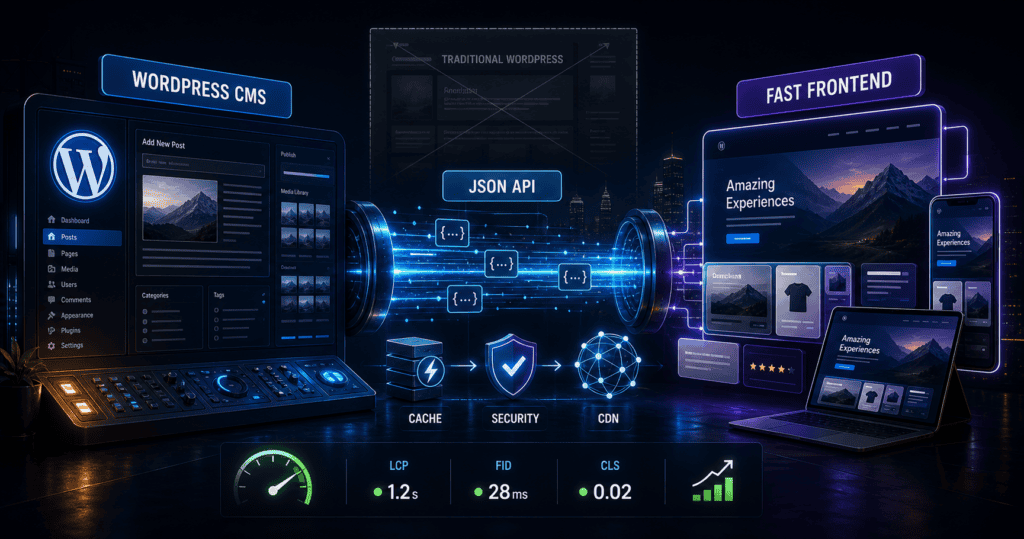
Why Headless WordPress Is the New Industry Standard
WordPress powers 42.2% of the web but was built for blogs. Why headless WordPress is the new standard for blazing fast pages and custom UX.
How WordPress Can Help Your Business
WordPress is a great tool to use that can be your 24/7 salesman or automate lead generation and help your business.

WordPress Security: 5 Mistakes That Leave Your Site Wide Open
97% of WordPress vulnerabilities come from plugins and themes (Wordfence, 2022). Here are the 5 security mistakes Minneapolis businesses...
Free 30-min audit
Ready to ship faster sites
without giving up your CMS?
Send us your current site and the goals you're trying to hit. We'll come back with a written take on whether headless is worth it for your stack — and if it isn't, we'll say so.
See if Headless Fits Your StackMinneapolis Made
Minneapolis, MN 55402
Service Area
Headless CMS development for businesses across the entire 7-county Twin Cities metro area: Hennepin, Ramsey, Dakota, Anoka, Washington, Scott, and Carver counties.
Where we work in the Twin Cities
Headquartered in downtown Minneapolis. Dedicated landing pages for the suburbs we work in most often.
Plus Wayzata, Saint Louis Park, Richfield, Hopkins, and the broader 7-county Twin Cities metro on a project basis.