WordPress powers 42.5% of all websites on the internet and holds 59.8% of the entire CMS market as of 2026. No other platform comes close. For businesses in Minneapolis and the Twin Cities, that dominance translates into a practical advantage: the largest ecosystem of developers, plugins, themes, and support resources available anywhere. After 25 years building WordPress sites for local businesses, we've watched this platform evolve from a simple blogging tool into the foundation that runs Microsoft, Disney, Bloomberg, Salesforce, and Mercedes-Benz. Here's why WordPress remains the best choice for businesses of every size.
Key Takeaways
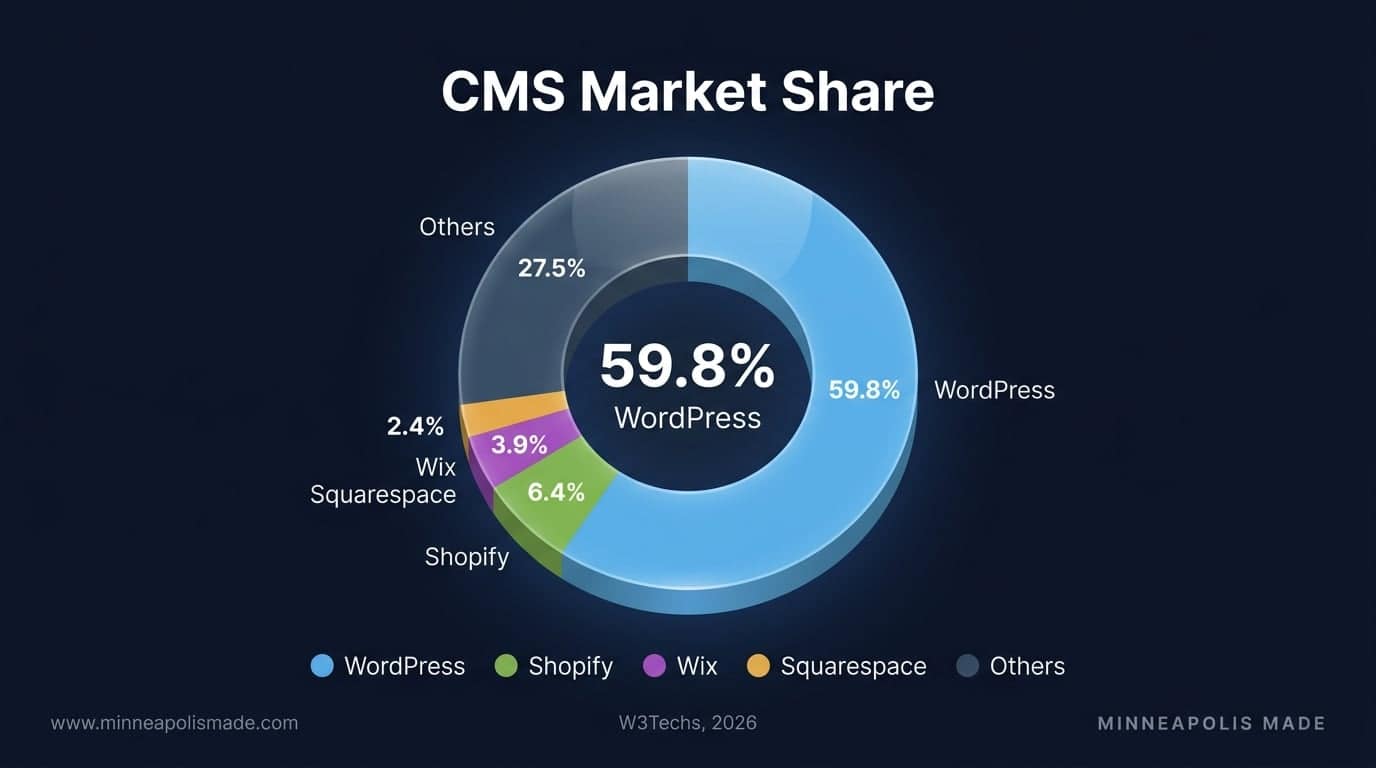
- WordPress holds 59.8% of the CMS market, more than Shopify (6.4%), Wix (3.9%), and Squarespace (2.4%) combined (W3Techs, 2026)
- 60,000+ free plugins with submissions doubling in 2025, giving businesses tools for virtually any functionality
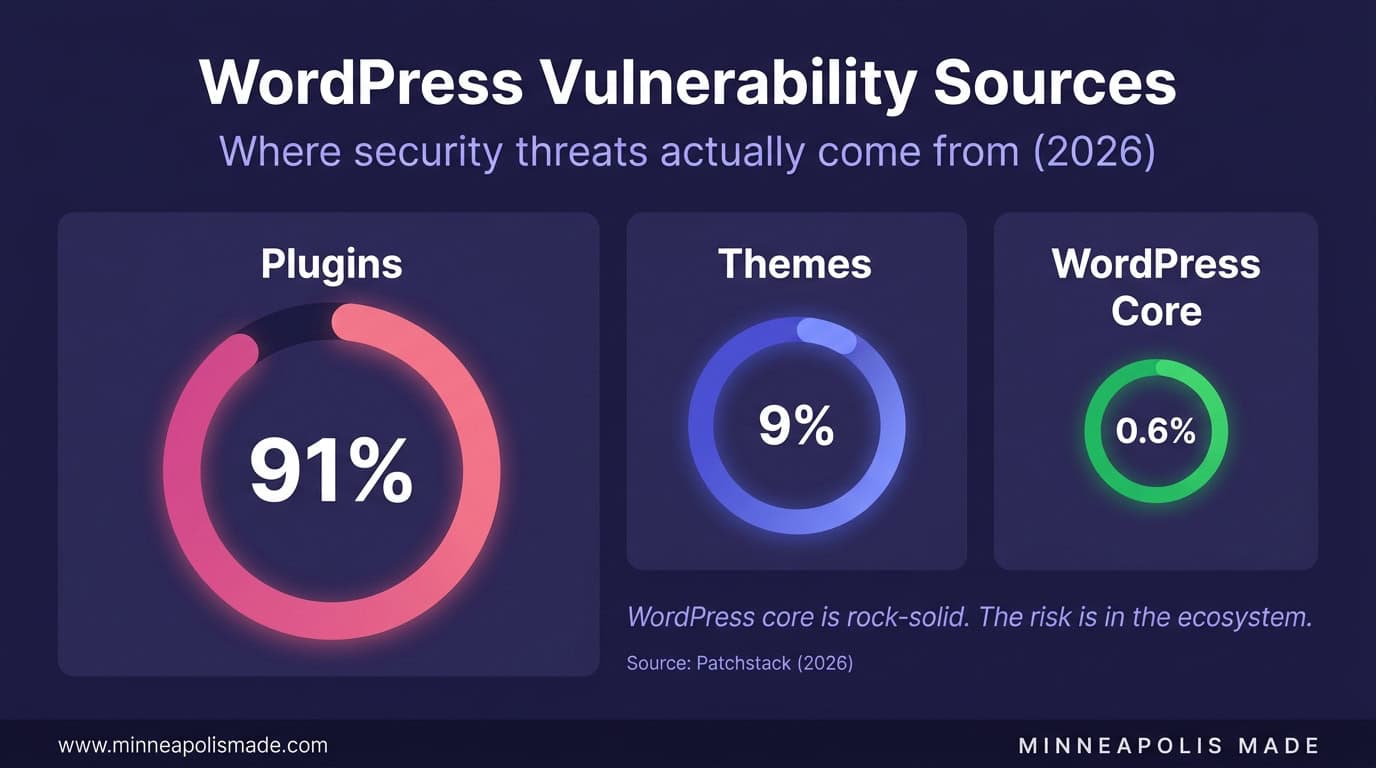
- WordPress core had only 6 security vulnerabilities in 2025, all low priority. 91% of issues came from third-party plugins (Patchstack, 2026)
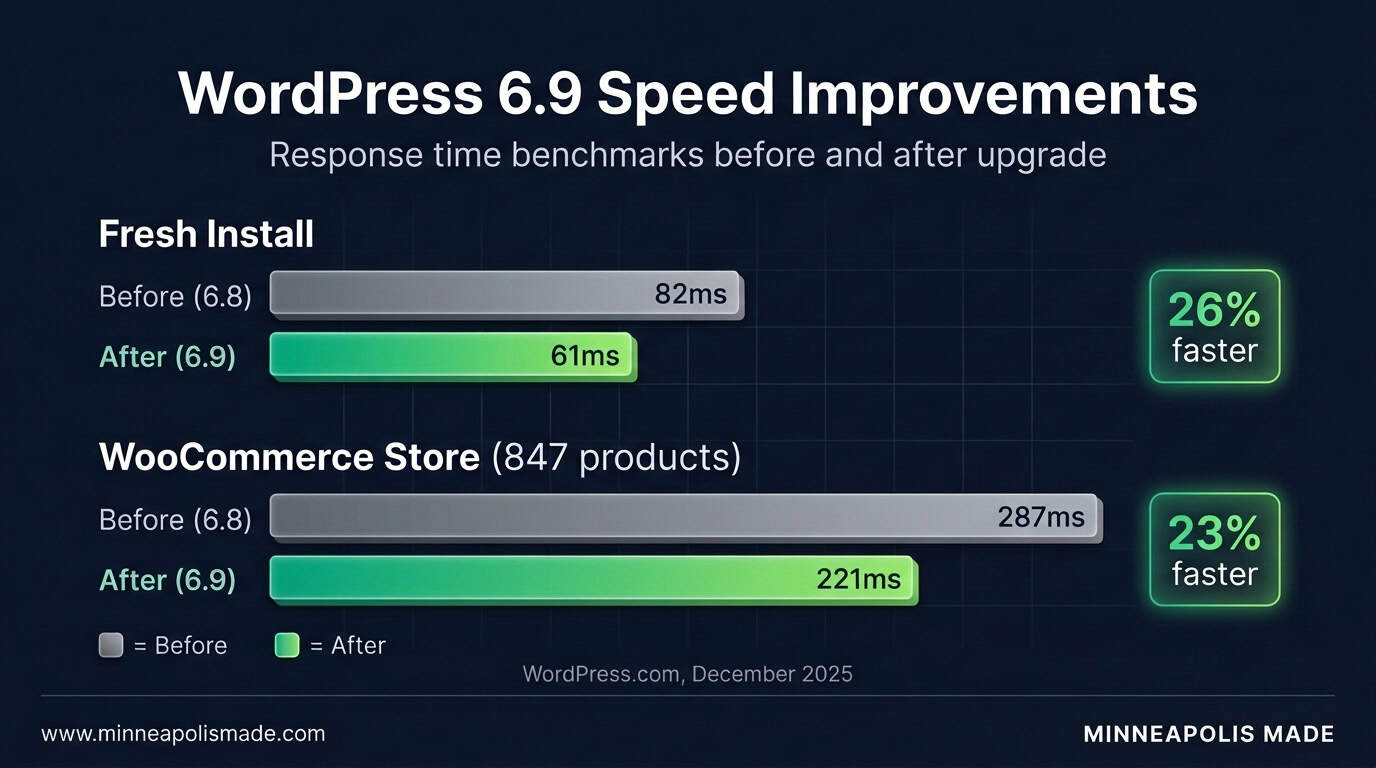
- WordPress 6.9 delivered a 26% speed improvement out of the box, with WooCommerce stores seeing 23% faster response times
- WooCommerce powers 4.53 million stores with 33.4% global e-commerce market share
Why Does WordPress Dominate the CMS Market?
The numbers aren't even close. W3Techs reports that WordPress powers 42.5% of all websites globally, holding 59.8% of the CMS market. The next closest competitor, Shopify, sits at just 6.4%. Wix follows at 3.9%, and Squarespace trails at 2.4%. Together, WordPress, Shopify, and Wix control 73% of the CMS market, but WordPress alone holds more than the rest combined.
For businesses, this matters because market share equals ecosystem strength. When you build on WordPress, you're choosing the platform with the most developers who know it, the most themes designed for it, the most plugins extending it, and the most hosting providers optimized for it. Finding a WordPress developer in Minneapolis is straightforward. Finding a Drupal specialist? Significantly harder and more expensive.
That dominance has held steady for over a decade, and while Shopify has grown aggressively (929% since 2015, per Search Engine Journal), WordPress's absolute numbers remain unmatched. It's not a legacy platform coasting on momentum. It's an actively evolving ecosystem that enterprise companies continue choosing over proprietary alternatives.
How Does the Plugin Ecosystem Help Businesses?
WordPress.org hosts over 60,000 free plugins, and the ecosystem is accelerating, not slowing down. In 2025, the WordPress Plugin Team reviewed 12,713 plugins, up 40.6% year over year. Weekly submissions doubled from roughly 150 to over 330 per week during 2025.
What does that mean for your business? Whatever functionality you need, there's likely a mature, well-tested plugin for it. Payment processing, appointment booking, CRM integration, email marketing, inventory management, multilingual support, accessibility compliance, all available without writing custom code. This is the difference between a $2,000 integration and a $50-per-year plugin license.
For the Twin Cities businesses we work with, plugins solve specific problems. A restaurant in Northeast Minneapolis needs online ordering? WooCommerce plus a delivery plugin. A law firm in downtown St. Paul needs client intake forms with conditional logic? Gravity Forms or WPForms. A non-profit in Uptown needs event registration with payment? The Events Calendar. The plugin ecosystem means you're buying proven solutions, not funding custom development from scratch.
Related: Minneapolis Made WordPress development services
Is WordPress Secure Enough for Business?
This is the most misunderstood aspect of WordPress. Yes, Patchstack's 2026 State of WordPress Security report found 11,334 new vulnerabilities in the WordPress ecosystem in 2025, up 42% year over year. That headline sounds alarming until you look at where those vulnerabilities actually come from.
91% come from third-party plugins. 9% from themes. WordPress core itself had exactly 6 vulnerabilities in all of 2025, and every single one was classified as low priority. Only 36% of discovered vulnerabilities (4,124 out of 11,334) represented actual threats requiring action.
The security story isn't "WordPress is insecure." It's "businesses that maintain their plugins stay secure." That's a maintenance discipline issue, not a platform problem. And it's exactly why having a managed WordPress hosting provider or a maintenance partner matters. We update plugins weekly for every client site we manage in the Twin Cities, which is why none of them have been compromised.
How Does WordPress Performance Compare in 2026?
WordPress has historically been criticized for speed, but the platform has made massive strides. WordPress 6.9, released in December 2025, delivered a 20-25% speed improvement across the board. Fresh installations went from 82ms to 61ms response time, a 26% improvement. WooCommerce stores with 847 products saw response times drop from 287ms to 221ms, 23% faster.
Real-world performance data from DebugHawk's Q4 2025 performance report, analyzing 5.7 million pageviews, shows that properly configured WordPress sites pass Core Web Vitals at high rates: 86.2% pass LCP, 90.6% pass INP, and 93.5% pass CLS. The median LCP was 1,124ms and median TTFB was 587ms.
The aggregate CrUX data shows WordPress at a 43.44% mobile CWV pass rate compared to Shopify's 75.22%, but that number is misleading. It includes millions of poorly hosted WordPress sites on cheap shared hosting with unoptimized themes. Well-configured WordPress sites with proper hosting and caching consistently outperform the aggregate. Page caching alone delivers 7x faster TTFB, and persistent object caching cuts PHP execution time by 67%.
Can WordPress Handle E-Commerce?
WooCommerce, the WordPress e-commerce plugin, powers 4.53 million active stores globally with 33.4% e-commerce market share. That's more stores than Shopify's 2.66 million, though Shopify processes higher total transaction volume due to its concentration in larger merchants.
For most Twin Cities small and mid-size businesses, WooCommerce offers a critical advantage over Shopify: you own your store completely. No monthly platform fees beyond hosting. No transaction fees on top of your payment processor's rates. Full access to your customer data without platform lock-in. And because WooCommerce is WordPress, your store lives alongside your content, your blog, your landing pages, all managed from a single dashboard.
Among the top 1 million e-commerce sites, WooCommerce holds 18.2% market share (BuiltWith data), proving it scales beyond small shops. When a Minneapolis retailer outgrows their Etsy or Square Online storefront, WooCommerce is where they move, and they never have to migrate again because the platform grows with them.
Related: Minneapolis Made e-commerce development
Why Is WordPress So Strong for SEO?
WordPress wasn't just built to publish content. It was built in a way that search engines understand naturally. Clean permalink structures, semantic heading hierarchy, XML sitemaps, and proper HTML markup come standard. Add a plugin like Yoast SEO, which accounts for nearly 70% of all detected SEO tool usage on the web, and you have enterprise-level SEO capabilities at a fraction of the cost.
The results speak for themselves. A Rankability study analyzing 59,000 top-ranking domains found that WordPress accounts for 49% of CMS-using sites in top positions. That's disproportionate to its 42.5% overall market share, suggesting WordPress provides a genuine SEO advantage when properly optimized.
For our Minneapolis clients, SEO is often the primary reason they choose WordPress over Wix or Squarespace. Those platforms handle basics well, but WordPress gives you full control over technical SEO: schema markup, canonical URLs, robots directives, XML sitemap configuration, server-side rendering, and crawl budget management. That granular control is the difference between ranking and not ranking in competitive local searches like "family law attorney Minneapolis" or "best restaurant Northeast Minneapolis."
Related: Minneapolis Made SEO services
Is WordPress Still Easy to Use?
WordPress has evolved significantly since its blogging roots. Full Site Editing, now production-ready in WordPress 6.8+, lets business owners customize headers, footers, templates, and page layouts directly in the browser without touching code. Pattern-based page building has become the new standard, making it possible to assemble professional-looking pages from pre-designed blocks.
WordPress 6.9 also introduced on-demand block CSS loading, which only loads styles for the blocks actually used on each page. This is a developer-facing feature, but the result is faster page loads for visitors, with performance improvements that happen automatically without any action from the site owner.
For the businesses we work with in Minneapolis and St. Paul, this means handing over a site that clients can genuinely manage themselves. Adding blog posts, updating service pages, swapping photos, changing hours, all doable without calling a developer. When they need structural changes, custom functionality, or design updates, that's when they call us. WordPress makes the everyday work accessible and keeps the complex work possible.
What About the WordPress Community in Minneapolis?
WordPress isn't just software. It's a global community with 469,951 members across 687 meetup groups worldwide. Locally, the Minneapolis-St. Paul WordPress User Group has 1,797 members and has been active since 2012, maintaining a 4.6 out of 5 rating from 387 reviews.
That local community matters for business owners. It means local expertise, local networking, and local support beyond what any agency provides. WordCamp Minneapolis has historically drawn hundreds of attendees, connecting developers, designers, content creators, and business owners who all build on the same platform. When you choose WordPress, you're joining a community, not just licensing software.
Related: Managed WordPress services to keep your site running
Related: WordPress web design in Minneapolis
Related: WordPress security mistakes that put your business at risk
Related: WooCommerce vs Shopify: which e-commerce platform fits your business?
Frequently Asked Questions
How much does a WordPress website cost for a small business?
In the Minneapolis-St. Paul market, a custom WordPress site typically costs $8,000 to $25,000 from a reputable agency. This covers discovery, custom design, development, content migration, basic SEO, and launch support. Template-based setups run $1,500 to $3,000. Monthly hosting and maintenance adds $100 to $500 depending on complexity.
Is WordPress better than Shopify for e-commerce?
It depends on your needs. WordPress with WooCommerce gives you full ownership, no platform fees, and unlimited customization. Shopify offers a simpler setup with built-in payment processing. For businesses that need content marketing alongside their store (a blog, landing pages, resource libraries), WordPress is the stronger choice because everything lives in one system.
How often should a WordPress site be updated?
WordPress core, themes, and plugins should be updated at minimum weekly. Patchstack's 2026 data shows 91% of WordPress vulnerabilities come from plugins, so keeping them current is the single most important security measure. We recommend managed maintenance for business-critical sites.
Can WordPress handle high traffic?
Absolutely. WordPress powers sites for Microsoft, Disney, Bloomberg, and Salesforce. With proper hosting (managed WordPress hosting like WP Engine, Kinsta, or Cloudways), caching, and a CDN, WordPress handles millions of monthly visitors. The platform itself is not the bottleneck. Hosting infrastructure and optimization are.
Do I need a developer to maintain a WordPress site?
For day-to-day content updates, no. WordPress's admin interface lets business owners add posts, edit pages, upload media, and manage basic settings without technical knowledge. For plugin updates, security monitoring, performance optimization, and structural changes, working with a developer or maintenance service is recommended.
Making WordPress Work for Your Business
WordPress isn't perfect. Its aggregate Core Web Vitals scores lag behind closed platforms. Its plugin ecosystem creates security responsibility. Its flexibility means you need someone who knows what they're doing to set it up properly. But no other platform gives businesses the combination of ownership, flexibility, SEO capability, e-commerce readiness, and ecosystem depth that WordPress provides.
The businesses that succeed with WordPress, the ones we've built and maintained across Minneapolis, St. Paul, and the greater Twin Cities for over two decades, treat it as a business tool, not a set-it-and-forget-it project. They invest in proper hosting. They keep plugins updated. They publish content consistently. And they work with developers who understand both the platform and their business goals.
If you're evaluating CMS platforms for a new site or considering a migration from Wix, Squarespace, or an aging custom build, WordPress deserves serious consideration. The numbers say it's the market leader. Our experience says it's the right choice for most businesses.
Related: Talk to Minneapolis Made about your WordPress project