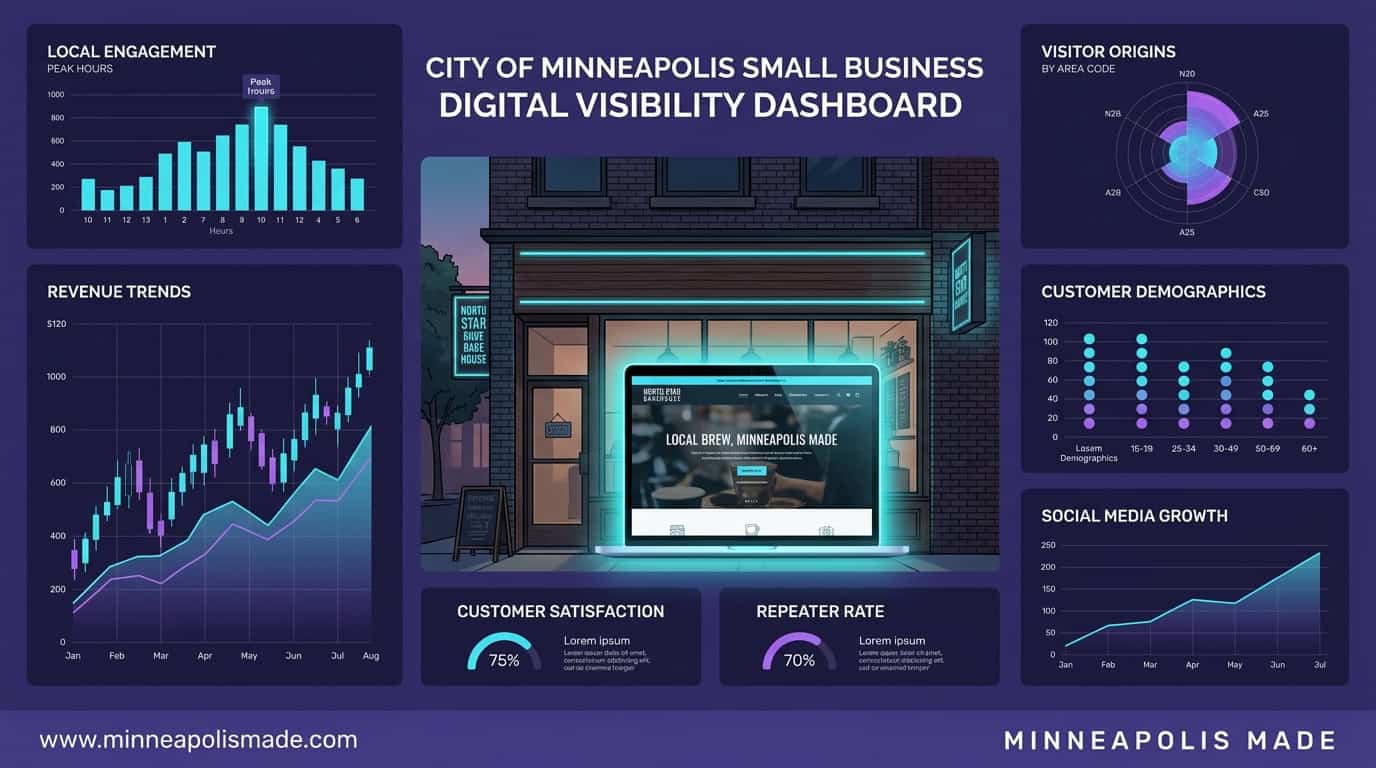
According to Network Solutions, 73% of small businesses now have a website. That sounds like progress until you look closer. Most of those sites are slow, mobile-broken, or invisible to Google. If you’re a small business owner in Minneapolis looking for web design that actually works, you need more than a pretty template. You need a site built to convert local visitors into paying customers.
Key Takeaways
- 73% of small businesses have a website, but most underperform on mobile and local search (Network Solutions, 2025)
- 94% of first impressions are design-related, and users form opinions in just 0.05 seconds (Sweor, citing ResearchGate)
- 80% of U.S. consumers search for local businesses online every week (BrightLocal, citing SOCi 2024)
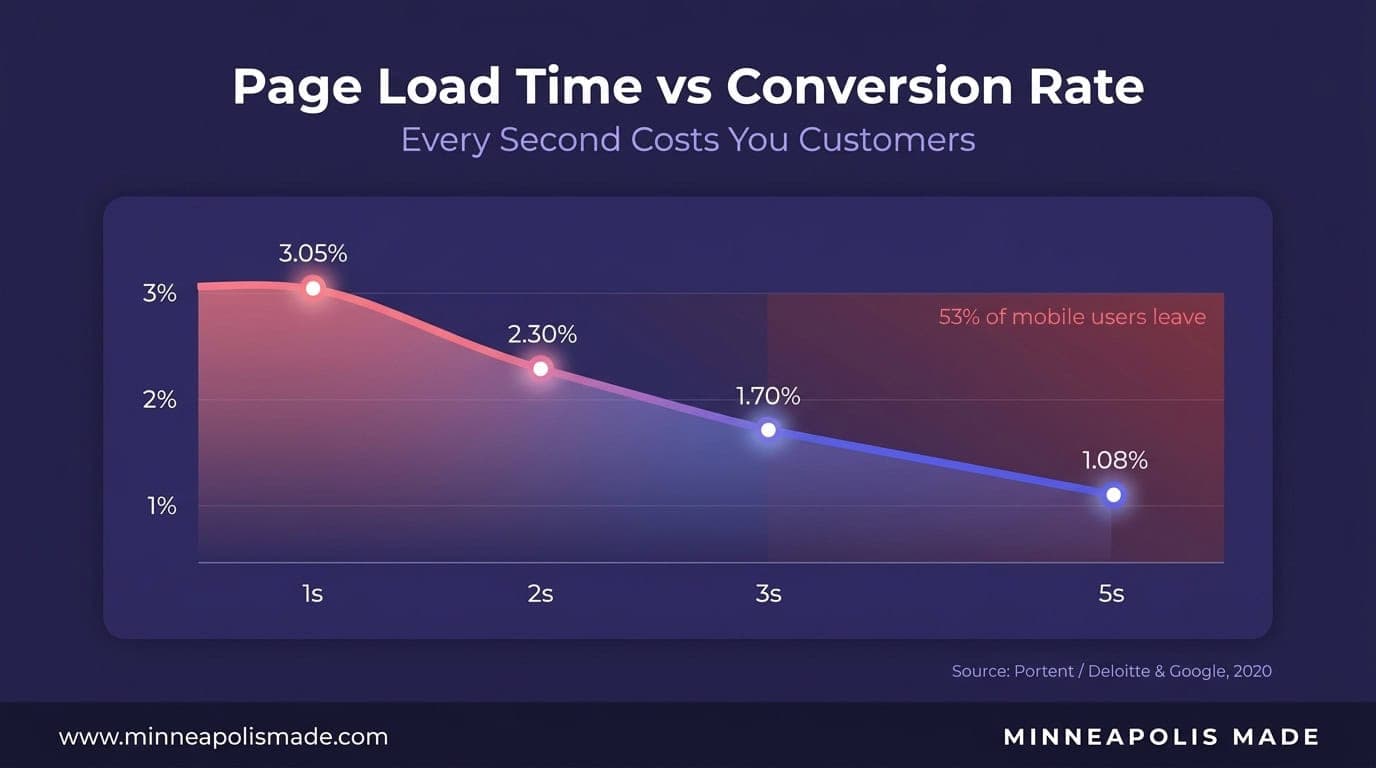
- Sites loading in 1 second convert at 3x the rate of sites loading in 5 seconds (Portent study)
Related: The Complete Minneapolis Web Design Guide
What Does Small Business Web Design Actually Include?
A ResearchGate study cited by Sweor found that 94% of first impressions are design-related. But here’s the thing: design alone doesn’t generate leads. What separates a website that converts from one that just sits there is the foundation underneath the visuals.
Real small business web design covers six non-negotiable areas:
- Custom design: Not a template with your logo dropped in. Your colors, your voice, your neighborhood identity.
- Mobile-first build: Mobile devices account for 62-64% of all web traffic globally (Statcounter, 2025). If your site isn’t built for phones first, you’re losing the majority of visitors.
- On-page SEO: Title tags, meta descriptions, header hierarchy, image alt text. All baked in from day one.
- Speed optimization: Google’s Core Web Vitals are a ranking factor. According to a Deloitte and Google study, a 0.1-second improvement in mobile load time increases retail conversions by 8.4%.
- Local SEO foundation: Schema markup, NAP consistency, Google Business Profile integration.
- CMS access: You should be able to update your own content without calling a developer every time.
Personal Experience
In our work with Minneapolis small businesses, from Uptown boutiques to Northeast contractors, the single most common problem we see isn’t bad design. It’s sites built without any local SEO foundation. The design looks fine. But Google doesn’t know the business is in Minneapolis, can’t associate it with a neighborhood, and the map pack listing is completely disconnected from the website. That disconnect costs real money.
Related: How to Dominate Local SEO with Your Google Business Profile in 2026
How Do Minneapolis Small Businesses Choose the Right Web Design Package?
According to Clutch’s 2026 pricing data (based on 79,260+ verified agencies), most small business web design projects cost less than $10,000. But the range is wide, and the right choice depends on your business stage and goals.
Here’s a quick comparison:
| Build Type | Best For | Budget Range |
|---|---|---|
| DIY Builder (Wix, Squarespace) | Testing an idea, micro-businesses | $20-$50/month |
| Freelancer | Simple informational sites | $1,500-$4,000 |
| Boutique Agency | Custom design + local SEO + strategy | $6,000-$12,000 |
| Full-Service Agency | E-commerce, complex integrations | $15,000-$48,000+ |
What matters more than the price tag is what you actually get for the money. Plenty of $8,000 sites ship without mobile optimization or a single line of schema markup. Ask what’s included before you compare prices.
Related: Web Design Cost in Minneapolis: What You Should Actually Expect to Pay
Which Package Type Is Right for Your Business?
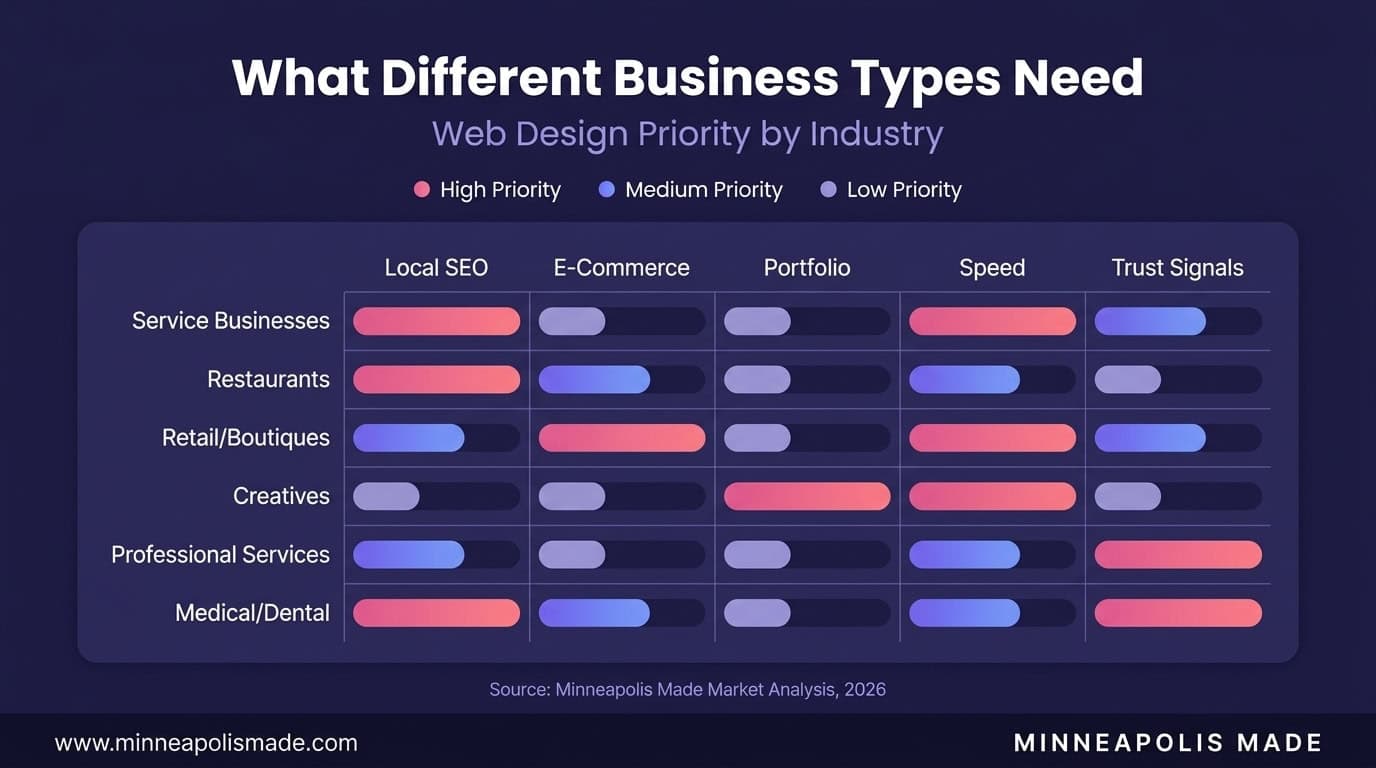
According to BrightLocal (citing SOCi’s 2024 Consumer Behavior Index), 80% of U.S. consumers search for local businesses online every week. But what each business type needs from its website varies dramatically. Here’s what we recommend based on the Minneapolis businesses we’ve worked with.
Service businesses (plumbers, electricians, HVAC, consultants)
- Local SEO and Google Business Profile integration are the priority
- Clear service pages with pricing transparency and service areas
- Fast mobile experience for people searching “near me” from their phones
Common mistake: Building a beautiful homepage but neglecting individual service pages. Google ranks pages, not websites.
Restaurants and hospitality
- Professional photography is non-negotiable. Stock food photos hurt more than they help.
- Easy-to-find menu, hours, and reservation or ordering integration
- Google Maps integration and review schema
Common mistake: Embedding the menu as a PDF instead of HTML text. Google can’t read PDFs well, and they’re terrible on mobile.
Retail and boutiques
- E-commerce functionality or strong “visit our store” local presence
- Google Shopping integration for product visibility
- Fast page loads: every extra second costs you roughly 7% in conversions
Common mistake: Adding 200+ products before optimizing category pages. Start with your top sellers.
Creatives and freelancers
- Portfolio-forward design with fast-loading image galleries
- Strong personal branding and clear call-to-action
- Simple, memorable URL structure
Common mistake: Prioritizing visual flash over load speed. A portfolio that takes 6 seconds to load loses half its visitors before they see your work.
Professional services (lawyers, CPAs, therapists)
- Trust signals: credentials, certifications, case results or testimonials
- HIPAA or compliance considerations where applicable
- Content marketing foundation for long-term organic growth
Common mistake: Generic “About Us” pages that read like they were copied from a competitor. Specificity builds trust.
Medical and dental practices
- Online appointment booking integration
- Patient portal links, insurance information, and clear contact paths
- HIPAA-compliant forms and hosting
Common mistake: Burying the “Book an Appointment” button below the fold. It should be visible in the first 2 seconds.
Unique Insight
The businesses we see get the worst ROI on their web design investment are the ones who optimized entirely for aesthetics. They paid premium prices for a visually stunning site, but nobody showed up. No keyword strategy. No local signals. No thought given to what a visitor actually needs to do when they land on the page. A beautiful site without a conversion strategy is an expensive brochure.
Not Sure What Your Business Type Needs?
We scope small business web design projects for Minneapolis companies every week. Tell us your business type and goals, and we’ll give you an honest package recommendation.
Related: How to Choose a Web Design Company in Minneapolis
What Should You Expect During a Small Business Web Design Project?
According to Clutch survey data, the average small business web project takes 4 to 8 weeks from kickoff to launch. But timelines swing wildly depending on one factor most people overlook: how prepared the client is.
Here’s what a well-run project looks like:
- Week 1-2: Discovery. Goals, audience, competitors, brand assets. This is where the strategy gets set.
- Week 2-3: Wireframes. Layout and structure before any visual design. Think blueprints, not paint colors.
- Week 3-5: Design and development. Visual design, coding, content integration, mobile optimization.
- Week 5-7: Review and revisions. Client feedback rounds, content polishing, QA testing.
- Week 7-8: Launch. DNS migration, SSL setup, speed testing, analytics configuration.
What slows projects down? Content. Almost every time. Having your copy, photos, and brand guidelines ready before kickoff can cut the timeline by 30% or more.
What should you bring to the table? At minimum: a clear description of your services, your target customers, 10-20 professional photos, login credentials for your domain registrar, and a list of 3-5 competitor websites you like (or hate).
Related: Minneapolis Made WordPress Development Services
Does Your Minneapolis Business Actually Need a Custom Site?
Sites that load in 1 second convert at 3.05%, compared to just 1.08% for sites loading in 5 seconds. That’s a 3x difference (Portent study via Blogging Wizard). Template-based sites often carry extra CSS and JavaScript for features you’ll never use, and that bloat directly impacts your conversion rate.
Does that mean templates are always wrong? No. If you’re testing a business idea, running a pop-up shop, or need something live in 48 hours, a Squarespace or Wix site is fine for now. But if you’re serious about growth and local search visibility, a properly built WordPress site hits the sweet spot: genuinely customizable, full CMS control, and the plugin ecosystem to handle everything from booking to SEO to e-commerce.
Original Data
Across the small business websites we’ve audited in the Minneapolis metro, fewer than 30% had proper LocalBusiness schema markup implemented. Fewer than 20% had consistent NAP data across their website and Google Business Profile. These are foundational local SEO signals, and they’re free to implement. The gap between businesses that have them and businesses that don’t is enormous in the map pack.
Related: WooCommerce vs. Shopify for Minneapolis Businesses
Related: Email Marketing Campaigns That Actually Convert
Ready to Talk About Your Small Business Website?
We build websites for Minneapolis small businesses every month. No pressure, no jargon. Just a straight conversation about what your business needs and what it’ll cost.
Related: Web design for small businesses in Minneapolis
Related: How a slow website is costing your small business customers
Small Minneapolis business? Get a website that pulls weight.
Most small-business sites do not convert because they were built to a template, not a goal. We start with the business outcome, then build backward.
Frequently Asked Questions
How much does small business web design cost in Minneapolis?
Most professional small business websites run $4,000 to $12,000 in 2026, depending on scope and complexity. Simpler informational sites can come in closer to $1,500 with a freelancer. E-commerce or custom builds typically exceed $12,000. For a detailed breakdown, see our Minneapolis web design cost guide.
How long does it take to build a small business website?
A well-scoped small business site typically takes 4 to 8 weeks from kickoff to launch. The biggest variable is content readiness. Coming to the project with your copy, photos, and brand assets organized can cut the timeline by 30% or more.
Do I need a custom site or will a template work?
Templates work fine for testing ideas or getting something live fast. But they create technical debt over time: slow load speeds, limited SEO control, and cookie-cutter design. For a business serious about local search rankings and long-term growth, a properly built WordPress site gives you flexibility templates can’t match.
Can a new website help my Minneapolis business rank on Google?
Yes, but only if it’s built with SEO in mind from day one. A new site with proper technical optimization, local schema markup, and content strategy typically takes 3 to 6 months to build meaningful organic rankings in a competitive market like Minneapolis.
What platform should a small business use for their website?
WordPress powers roughly 43% of all websites globally and offers the best balance of flexibility, SEO control, and long-term scalability for small businesses. Shopify is excellent if you’re primarily selling products online. Squarespace and Wix work for simple sites where you want to manage everything yourself with minimal technical knowledge.
How do I know if my current website needs a redesign?
Three clear signals: your site isn’t mobile-responsive (check by resizing your browser), your Google Analytics shows bounce rates above 60%, or your site takes more than 3 seconds to load on mobile. According to Google, 53% of mobile visitors leave a site that takes more than 3 seconds to load.