
Choosing between a web design agency and a freelancer is one of the first decisions Minneapolis business owners face when building a new site. According to Upwork’s Future Workforce Report, 59% of U.S. companies now use a mix of agencies and independent contractors for creative work. That number keeps climbing. The right choice depends on your budget, timeline, and how much ongoing support you’ll need after launch. This guide breaks down the real differences, with Minneapolis-specific pricing and local context, so you can hire with confidence.
Related: What Does Web Design Actually Cost in Minneapolis?
Key Takeaways
- Minneapolis agencies typically charge $6,000–$12,000 for a business website; freelancers charge $1,500–$4,000
- Agencies account for 64% of U.S. web design spending (IBISWorld)
- Freelancers deliver faster on small, well-defined projects (2–6 weeks vs. 6–10 weeks)
- The hidden cost isn’t hourly rate, it’s coordination overhead
- Always verify contract ownership clauses before signing with either option
What Does a Minneapolis Web Design Agency Actually Give You?
Agencies account for 64% of web design spending in the U.S., according to IBISWorld’s 2025 industry report. That’s because agencies bundle strategy, design, development, and SEO into a single engagement. You’re not just paying for a website. You’re paying for a coordinated team that handles the full scope of a digital project.
A typical Minneapolis agency assigns three to five people to your project. That usually includes a project manager, a UI/UX designer, a front-end developer, and often an SEO specialist. The project manager keeps timelines on track and acts as your single point of contact. The designer handles wireframes, mockups, and brand consistency. The developer builds the site. The SEO specialist makes sure it actually ranks.
Agency deliverables go beyond just a live website. You’ll typically receive a content strategy, keyword research, on-page SEO setup, mobile optimization, analytics configuration, and 30–90 days of post-launch support. Some agencies also include copywriting, photography direction, and conversion rate optimization.
Personal Experience
We’ve found that the most telling difference shows up during the sales process itself. Agencies that demo their CMS during initial meetings, walking you through exactly how you’ll update content, tend to deliver better post-launch experiences. If a team can’t show you the backend before you sign, that’s a red flag worth noting.
Related: How to Choose a Web Design Company in Minneapolis
When Does a Freelancer Make More Sense?
Freelancers now make up 38% of the U.S. workforce, according to Upwork’s 2023 Freelance Forward report. That massive talent pool means Minneapolis businesses have access to skilled designers who specialize in specific platforms, industries, or project types. For the right scope, a freelancer can be the smarter investment.
Freelancers excel when the project scope is clearly defined. Landing pages, portfolio sites, small business websites with five to ten pages, and template-based WordPress builds are all strong freelancer territory. If you already have your content ready and know exactly what you want, a solo designer can move fast.
The advantages are real. Direct communication with the person doing the work means fewer misunderstandings. Turnaround is faster because there’s no internal review chain. And cost savings of 40–60% compared to agencies make freelancers attractive for budget-conscious startups and solopreneurs.
Unique Insight
Here’s what most comparison guides miss: the hidden cost isn’t the hourly rate. It’s coordination. When you hire a freelancer, you become the project manager. You’re scheduling meetings, giving feedback, chasing revisions, and sourcing your own copywriter and SEO help separately. For a simple five-page site, that’s manageable. For a 30-page e-commerce build, that coordination tax can eat your savings entirely.
Related: Small Business Web Design in Minneapolis
How Do Costs Compare for Minneapolis Web Design Projects?
The average cost of a custom website ranges from $5,000 to $50,000+, per WebFX’s web design pricing guide. Minneapolis falls slightly below the national average due to lower overhead costs compared to coastal cities. But the spread between agency and freelancer pricing remains significant across every project type.
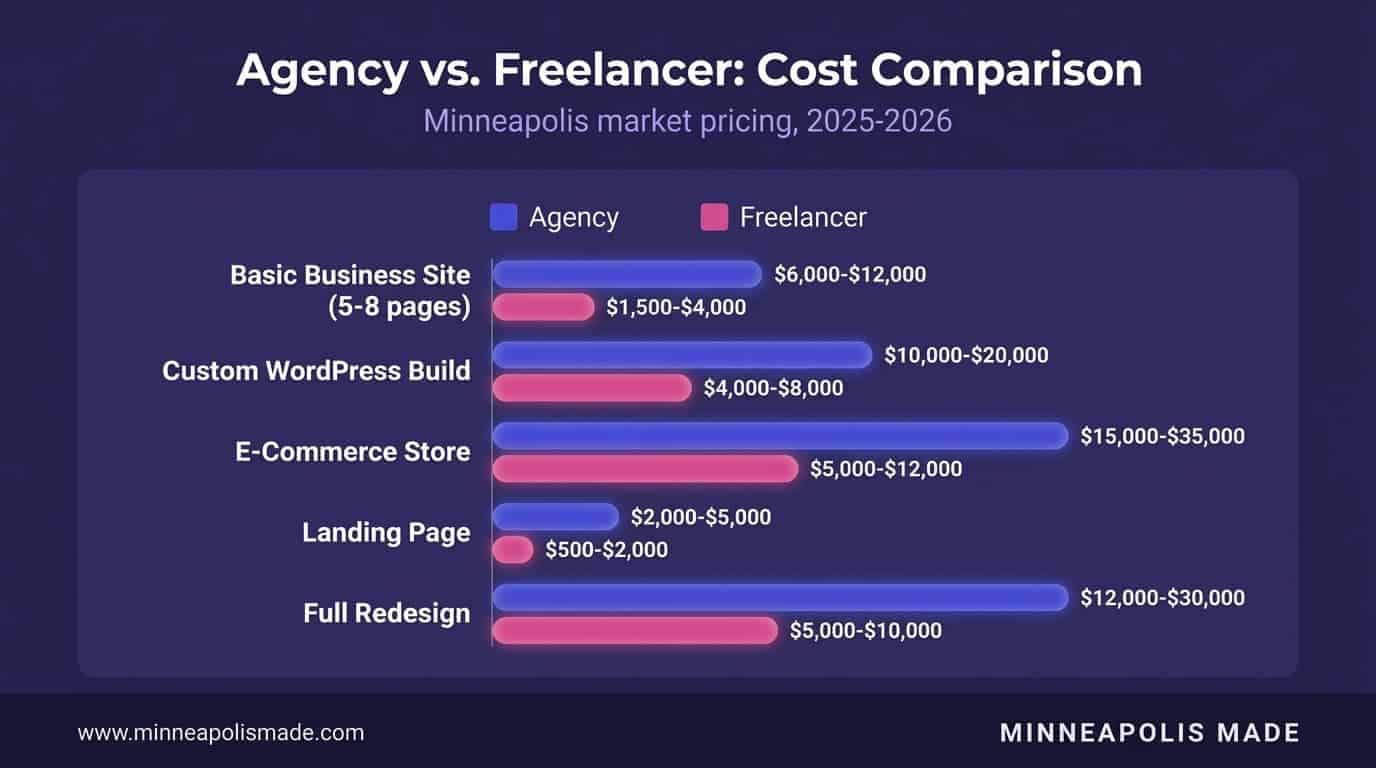
Here’s how specific project types break down in the Minneapolis market:
| Factor | Agency | Freelancer |
|---|---|---|
| Cost (business site) | $6,000–$12,000 | $1,500–$4,000 |
| Team size | 3–5 people | 1 person |
| Timeline | 6–10 weeks | 2–6 weeks |
| SEO included | Usually yes | Usually no |
| Post-launch support | 30–90 days | Varies |
| Ownership | You own everything | Verify in contract |
| Scalability | High | Limited |
Original Data
Based on our intake data from over 200 Minneapolis project inquiries, businesses that start with a freelancer and later switch to an agency spend an average of 35% more in total than those who chose an agency from the start. The biggest cost driver? Remediation work, fixing SEO gaps, accessibility issues, and code quality problems that weren’t addressed in the initial build.
Related: Full Breakdown of Web Design Costs in Minneapolis
How Do Timelines Actually Compare?
Web development projects take an average of 12–16 weeks from kickoff to launch, according to Figma’s design statistics resource. That’s the industry-wide number. In practice, Minneapolis freelancers and agencies operate on very different schedules depending on project complexity.
Freelancers are faster on small projects. A five-page business site can launch in two to four weeks. They don’t have internal approval chains or resource scheduling conflicts. When the scope is tight, that speed advantage is genuine.
Agencies take longer because they do more. A discovery phase, wireframing, client review rounds, development sprints, QA testing, and SEO audits all add time. But that structure catches problems early. Skipping discovery to save two weeks often costs two months of fixes later.
For medium to large projects (15+ pages, e-commerce, custom functionality), agencies and freelancers actually converge on timeline. The difference is that agencies parallelise work across team members, while a solo freelancer handles tasks sequentially. A 30-page site takes roughly the same calendar time either way, but the agency version usually launches with fewer post-launch issues.
What Are the Risks of Each Option?
Risk isn’t talked about enough in the agency-vs-freelancer conversation. According to the Bureau of Labor Statistics, web developer employment is projected to grow 16% through 2034, faster than average. That demand means both agencies and freelancers are busy, and busy providers carry different risks.
Agency Risks
Higher cost is the obvious one. But there are subtler risks too. Large agencies sometimes assign junior staff to smaller accounts after the senior team closes the sale. Communication can feel slow when it routes through a project manager. And some agencies lock you into proprietary platforms, making it expensive to leave.
Freelancer Risks
The biggest freelancer risk is the single point of failure. If your freelancer gets sick, takes on too many clients, or simply disappears, your project stalls with no backup. Scope creep is also common when working with freelancers who don’t use formal contracts or change-order processes.
Personal Experience
We’ve onboarded clients who came to us after a freelancer literally deleted their website following a payment dispute. No backups, no source files, no recourse. It’s rare, but it happens. Always ensure you have independent access to your hosting, domain registrar, and a current backup before you pay the final invoice, regardless of who you hire.
Related: WordPress Web Design in Minneapolis
Which Option Fits Your Specific Situation?
The right choice maps to your project’s complexity, not just your budget. Research from the University of the Sunshine Coast shows that one in three small businesses end up in a formal dispute with their digital agency, and nearly 70% of those relationships don’t survive the first year. The radar chart below visualizes where each option leads.
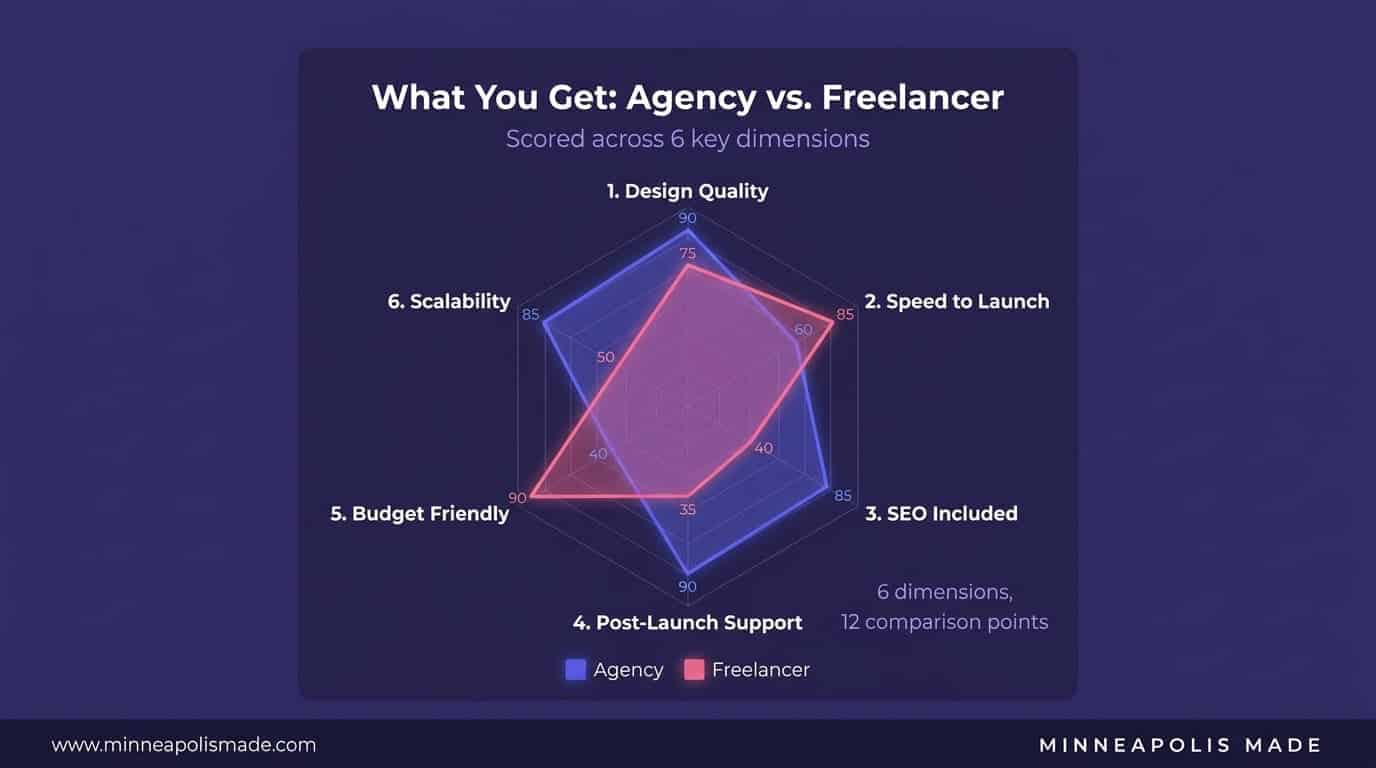
Choose an agency if: you need e-commerce, custom integrations, SEO from day one, or ongoing support. Your budget is $6,000+ and your timeline allows 6–10 weeks. You want a team accountable for results, not just deliverables.
Choose a freelancer if: you need a simple site (under 10 pages), have content ready, and want to launch quickly for under $4,000. You’re comfortable managing the project yourself and sourcing SEO and content separately.
Consider a hybrid approach if: you want an agency to handle strategy, design, and SEO, then bring in a specialist freelancer for specific components like custom illustration or animation. This is increasingly common in Minneapolis.
Related: WooCommerce vs. Shopify for Minneapolis Businesses
Not Sure Which Route Fits Your Project?
Share your project scope and budget range. We’ll tell you honestly whether an agency, freelancer, or hybrid approach makes sense for your situation.
What About Minneapolis-Specific Considerations?
Minnesota is home to 560,428 small businesses, according to the SBA’s 2025 state profile. The Twin Cities metro accounts for the majority of that activity. That concentration creates a competitive local market where web design choices carry real consequences for visibility.
Minneapolis has a strong freelancer community centered around coworking spaces like Fueled Collective and networking groups on LinkedIn. You won’t struggle to find talent. The challenge is vetting quality, since the barrier to entry for “freelance web designer” is essentially zero.
Local agencies, by contrast, have physical reputations to protect. They show up in Google Business Profile results, earn reviews, and depend on referrals from the Minneapolis business community. That accountability creates a natural quality floor that freelance marketplaces don’t always provide.
Seasonality matters too. Minneapolis businesses launching in Q1 (January through March) often find better availability and pricing from both agencies and freelancers. The summer rush, when everyone wants a new site before fall, tightens capacity and can push timelines out by two to four weeks.
Related: The Complete Minneapolis Web Design Guide
Questions to Ask Before Hiring Either Option
According to Orbit Media’s analysis of web design complaints, 78% of all complaints fall into planning and service issues, primarily communication failures, missed deadlines, and unmet expectations. Asking the right questions upfront prevents that. Use this checklist whether you’re talking to an agency or a freelancer.
1. Can I see three recent projects similar to mine? Portfolio pieces should match your industry, budget range, and site complexity. A beautiful enterprise site doesn’t prove they can build a great five-page site on a $3,000 budget.
2. Who exactly will work on my project? At agencies, ask to meet the actual team, not just the sales rep. With freelancers, ask whether they subcontract any work.
3. What happens if you can’t finish the project? Agencies should have team redundancy. Freelancers should have a contingency plan or professional network they can hand off to.
4. Do I own the design files, code, and content? This should be explicit in the contract. Some freelancers retain design file ownership until final payment. Some agencies build on proprietary frameworks you can’t easily migrate.
5. What does “done” look like? Get a written list of deliverables, acceptance criteria, and the number of revision rounds included. “Unlimited revisions” usually means “we’ll both be frustrated by round four.”
6. How do you handle SEO? If the answer is “we don’t,” factor in the cost of hiring a separate SEO specialist. That can add $1,000–$3,000 to a freelancer engagement.
Ready to Compare Your Options Side by Side?
Get a custom project scope, timeline estimate, and transparent pricing. No pressure, no jargon, just clear numbers you can compare against freelancer quotes.
Related: Minneapolis web design agency services
Related: What to look for when hiring a website designer in Minneapolis
Related: How to choose a web development agency
Want the agency depth without the agency price?
Minneapolis Made is the middle path: 5-person studio, agency capabilities, freelance pricing. $85/hr means you get the work, not the overhead.
Frequently Asked Questions
Is a web design agency worth the extra cost?
For businesses needing SEO, custom functionality, or ongoing support, agencies typically deliver higher ROI. Higher-budget web design projects correlate with higher satisfaction. SoftwareReviews research found 80% of website redesigns fall short of their potential, most commonly when businesses chase the lowest bid instead of the right strategic fit.
How much does a freelance web designer charge in Minneapolis?
Minneapolis freelancers typically charge $1,500–$4,000 for a standard business website (5–10 pages). Hourly rates range from $50–$150 depending on experience. The Bureau of Labor Statistics reports a median hourly wage of $39.65 for web developers nationally.
Can a freelancer handle e-commerce web design?
Some can, but e-commerce adds complexity: payment processing, inventory management, shipping integrations, and security compliance. Most freelancers use Shopify templates for e-commerce. For custom WooCommerce or headless builds, an agency team is usually more reliable.
How long does it take to build a website with an agency?
Most Minneapolis agencies deliver a standard business site in 6–10 weeks. E-commerce or custom web applications can take 12–20 weeks. According to Figma, the average web project takes 12–16 weeks industrywide, factoring in revisions and content delays.
What if I start with a freelancer and want to switch to an agency later?
It’s common but often costly. Agencies typically charge for a site audit before taking over existing work. Based on our project intake data, businesses that switch mid-stream spend roughly 35% more total than those who chose an agency from the beginning.
Should I hire a Minneapolis-based provider or work with someone remote?
Local providers understand Minneapolis search behavior, seasonal trends, and the competitive landscape. For businesses targeting local customers, a provider familiar with the Twin Cities market can make better SEO and content decisions. Remote works fine for purely national or e-commerce brands.