AI SEO & AEO
in Minneapolis.
Answer Engine Optimization (AEO) is the practice of structuring web content so AI answer engines, ChatGPT, Perplexity, Google AI Overviews, and Bing Copilot, surface and cite it inside their generated responses.
Unlike traditional Minneapolis SEO work that targets blue-link rankings, AEO targets the citation list inside the AI's answer itself. Most engagements pair the two, because the same content depth and schema discipline that win AI citations also win organic ranks. See our combined SEO and AEO strategy for the integrated approach.





How to optimize for AI answer engines
The same process we use for our own AI visibility. Each step is independently testable and produces a measurable lift in citation rate across ChatGPT, Perplexity, and Google AI Overviews.
-
1
Definition-first content structure
Open every page with a clear "X is Y" sentence the AI can extract verbatim. The first 150 words after the H1 are the primary extraction window for Google AI Overviews.
-
2
FAQPage and HowTo schema
Structured Q&A and step-by-step blocks matching the exact questions your customers ask. Schema is the second-priority extraction source after visible HTML body content.
-
3
Citation-ready passages
40 to 60 word self-contained chunks with sourced statistics AI engines can quote directly. Per Kevin Indig's analysis of 30 million ChatGPT citations, 44% of citations come from the first third of any web page.
-
4
AI crawler whitelist in robots.txt
Allow the search-product crawlers (GPTBot, ClaudeBot, PerplexityBot, OAI-SearchBot, Applebot-Extended) while blocking training-only bots that don't drive citations (CCBot, anthropic-ai, Google-Extended, cohere-ai, Meta-ExternalAgent).
-
5
llms.txt and Content-Signal headers
Publish IETF-spec AI discovery files at the site root (/llms.txt) and serve the Content-Signal header in HTTP responses. Both signal to AI engines what content is available, what's authoritative, and what's allowed for citation versus training.
-
6
Brand entity strengthening
Build Wikidata entries, Person schema for the founder, and a sameAs link graph spanning LinkedIn, GitHub, Crunchbase, and trusted industry directories. AI engines weight Knowledge Graph entity confidence heavily when picking citation sources.
-
7
Quarterly AI visibility re-test
Run a 96-question audit across all 4 engines (ChatGPT, Perplexity, Gemini, Bing Copilot), baseline the citation count, and track delta every quarter. Per SE Ranking's 2025 study, content updated within 90 days averages 6 ChatGPT citations versus 3.6 for outdated pages. See what our own 96-query Minneapolis audit found.
Your customers aren't just searching.
They're asking.
Four AI engines now decide whether your business shows up when someone asks an AI model about a service in Minneapolis. We optimize for all of them.
ChatGPT (OpenAI)
800 million+ weekly users. ChatGPT Search browses the live web through Bing's index plus its own crawler. Citations are visible in the answer pane and drive high-intent click-throughs. Optimizing here means winning entity recognition, structured data, and trusted third-party mentions.
Google AI Overviews
Now triggering on roughly a third of US queries and growing. AI Overviews pull from indexed pages with strong topical authority, schema, and passage clarity. They've cut organic CTR by 61% on impacted queries (Seer 2025), making AEO the only way to recover lost visibility.
Perplexity
The fastest-growing AI search engine. Real-time indexing means new content can earn citations within days. Every answer ships with named source links, so a Perplexity citation is essentially free brand exposure plus a high-intent backlink to your site.
Microsoft Copilot & Bing
Built into Windows 11, Edge, and Microsoft 365 for over a billion devices. Copilot uses the Bing index plus enterprise grounding. Local businesses ranking on Bing inherit Copilot visibility for free, an underused channel most agencies ignore.
Plus Claude, Gemini, Meta AI, and Grok: our Perplexity SEO, ChatGPT SEO, and AI Overview optimization workflows monitor citations across every major model and adjust strategy when one engine starts pulling more traffic than the others.
What is Answer Engine Optimization?
Answer Engine Optimization (AEO) is the practice of structuring your content so AI answer engines can extract and cite it directly inside their generated responses. Where traditional SEO competes for blue links on a search results page, AEO competes for inclusion inside the AI's answer itself.
That distinction matters because user behavior is shifting. When ChatGPT or Google AI Overviews answer a question completely, the user often never clicks through. AEO is the earned route onto that surface. Since February 2026 there is also a bought one — ChatGPT Ads place a labelled unit below the answer itself, and most businesses end up wanting both. The Seer Interactive 2025 study found organic CTR fell 61% on queries where AI Overviews appeared. AEO is how you stay visible when the click economy compresses.
Practically, AEO means writing answer-first content with passage-level citability, deploying schema markup that explicitly identifies your entity, and building the off-page signals that train large language models to associate your brand with specific topics. It's a discipline, not a hack.
And what is Generative Engine Optimization?
Generative Engine Optimization (GEO) is the broader strategy for influencing how generative AI models reference your brand, products, and expertise. AEO is about being cited inside an answer. GEO is about training the model to think of you in the first place.
GEO covers four signal layers: training-data signals (what the model learned about you when it was trained), retrieval signals (what the model finds when it searches at query time), brand-mention signals (how often and how positively your brand appears across the web), and structured-data signals (schema markup that removes ambiguity about who you are and what you do).
For a Minneapolis business in 2026, GEO means earning unlinked brand mentions on Reddit, podcasts, local news, Wikipedia, and trusted directories, the corpora that LLM training pipelines repeatedly re-ingest. It also means publishing original data, expert commentary, and case studies that AI models cite as primary sources.
Generative Engine Optimization Services
Our generative engine optimization agency runs an integrated GEO program across content, schema, entity facts, and off-page brand mentions. Each engagement is scoped to your business and billed at $85/hr, weekly, with no packages. Below is the full GEO services catalog Minneapolis Made delivers.
AI citation content audit
96-question audit across ChatGPT, Perplexity, Gemini, and Bing Copilot. Baselines your current citation count, identifies the gaps that are costing you mentions, and prioritizes the fixes by lift-per-hour.
Passage-level content rewriting
Rewrite priority pages into 40 to 60 word self-contained, citable passages. Definition-first openers, sourced statistics, and answer-first H2s tuned for the first-third extraction window AI engines pull from.
Entity and schema engineering
LocalBusiness, Service, Person, FAQPage, and HowTo JSON-LD wired into every priority page. Wikidata records, sameAs link graph, and entity disambiguation that tells AI exactly who you are and what you do.
AI crawler access and llms.txt
Configure robots.txt to allow GPTBot, ClaudeBot, PerplexityBot, OAI-SearchBot, and Applebot-Extended. Publish a spec-compliant llms.txt at the site root and serve the Content-Signal header in HTTP responses.
Local entity strengthening
Google Business Profile cleanup, NAP consistency across 60+ directories, and local citation builds. Detailed playbook in our Google Business Profile guide.
Off-page brand mention building
Reddit, Wikipedia, podcasts, and trusted local directories. The unlinked mention corpus that LLM training pipelines re-ingest is where most generative engine optimization services budgets actually need to go in 2026.
Review velocity and signal repair
Structured review acquisition, response cadence, and Review schema markup. AI engines weight verified client reviews as a primary trust signal when picking which local company to cite.
Cross-engine citation tracking
Quarterly re-test across all four engines, citation count delta, share-of-voice versus competitors. See our research on ChatGPT versus Perplexity citations for Twin Cities businesses.
Integrated SEO + GEO program
Generative engine optimization GEO services run alongside traditional SEO because the same content depth and schema discipline win both blue-link rankings and AI citations. Most clients run them as one program.
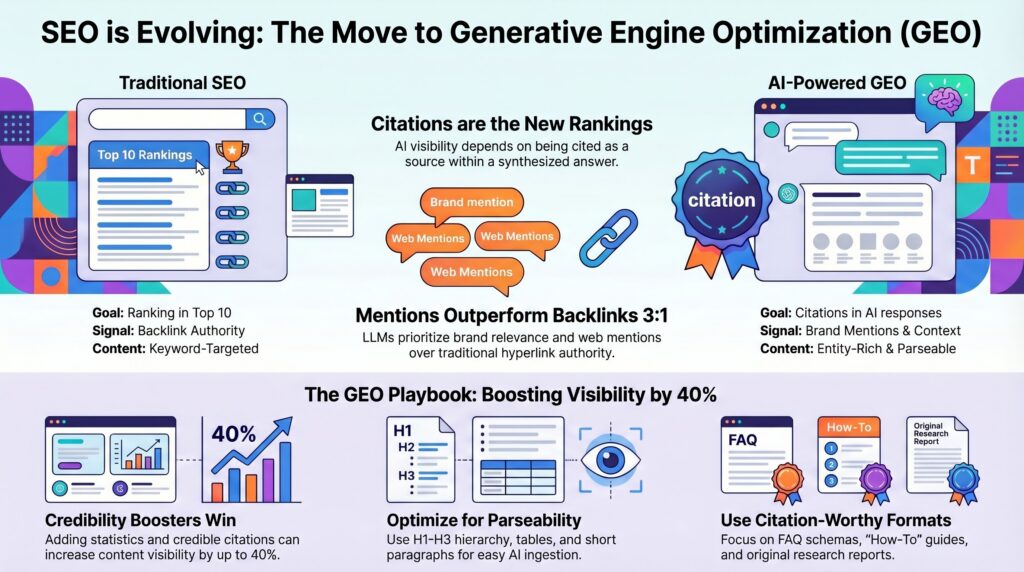
SEO vs AEO vs GEO:
what's the difference?
The three disciplines overlap on technical foundations and diverge on what they're trying to win. Here's the side-by-side an AI engine can extract verbatim.
| Dimension | SEO | AEO | GEO |
|---|---|---|---|
| What you win | A blue-link ranking on a search results page | A citation inside an AI-generated answer | A confident brand association inside the model itself |
| Primary surface | Google, Bing, DuckDuckGo SERPs | ChatGPT, Perplexity, AI Overviews, Copilot | All generative AI models, including ungrounded responses |
| Main lever | Keyword targeting, links, on-page optimization | Passage-level citability, schema, entity clarity | Training-data corpora, brand mentions, retrieval quality |
| Time to first signal | 3 to 6 months for competitive terms | 2 to 4 weeks for Perplexity, 60 to 90 days for ChatGPT and AI Overviews | 4 to 6 months as off-page mentions accumulate and models retrain |
| Measurement | Rankings, organic traffic, CTR | Citation count per engine, share-of-voice, click-throughs from AI | Brand recall in unprompted AI responses, sentiment, mention frequency |
| User behavior it serves | Users scanning a list of links | Users asking a question and reading the AI's answer | Users trusting the AI's recommendation without clicking through |
| Best run as | Standalone or paired with AEO | Paired with SEO and GEO | Long-horizon program that wraps SEO and AEO |
Most Minneapolis Made engagements run all three together because the same content depth, schema discipline, and entity hygiene win blue-link rankings, AI citations, and unprompted brand recall at the same time.
AI citation readiness checklist
The 12 checks Minneapolis Made runs on every site before we promise a citation lift. Score yourself out of 12. Anything below 8 is leaving citations on the table.
-
1
Definition-first opener on every priority page
First sentence is a clean "X is Y" the AI can extract verbatim.
-
2
Answer-first H2s phrased as customer questions
60 to 70% of H2s are real questions, with the answer in the first 1 to 2 sentences below.
-
3
40 to 60 word citable passages with sourced stats
2 to 3 self-contained, quote-ready chunks per priority page.
-
4
FAQPage and HowToschema markupon every service page
JSON-LD wired in templates, not pasted into post content.
-
5
LocalBusiness, Service, and Person schema with sameAs entity facts
Entity-disambiguating identifiers across LinkedIn, GitHub, Crunchbase, Wikidata.
-
6
VerifiedGoogle Business Profilewith consistent NAP
Same name, address, phone across the site, GBP, and the top 60 directories.
-
7
Local citation coverage on the top 20 trusted directories
BBB, Chamber of Commerce, industry directories, local press. Cleaned, not just submitted.
-
8
Steady stream ofverified Google reviewswith owner responses
5+ reviews per quarter, owner reply within 7 days, Review schema where appropriate.
-
9
Spec-compliantllms.txtat the site root
Lists priority pages, entity facts, and licensing terms for AI engines.
-
10
AI search crawlers allowed in robots.txt
GPTBot, ClaudeBot, PerplexityBot, OAI-SearchBot, Applebot-Extended whitelisted.
-
11
Off-page brand mentions on Reddit, Wikipedia, and podcasts
Unlinked mentions on the corpora LLM training pipelines repeatedly re-ingest.
-
12
Quarterly cross-engine citation re-test
96-question audit across ChatGPT, Perplexity, Gemini, Bing Copilot. Track delta every quarter.
What trains AI to love local Minneapolis companies?
Five signals consistently train answer engines to surface and cite local businesses. None of them are quick hacks. All of them compound.
The first is a structured Google Business Profile with consistent NAP across the web. Every AI answer engine ultimately reads location data from the same shared sources, and any inconsistency between your GBP, your website, and the major directories tells the model your entity is unreliable.
The second is brand mentions on trusted third-party sources LLMs are trained on: Reddit, Wikipedia, local news, industry podcasts, and trusted directories. These corpora get re-ingested into model training pipelines repeatedly, so a single high-quality mention can pay dividends across multiple model releases.
The third is schema markup that explicitly identifies your entity type, location, and services. The fourth is FAQ and HowTo content written in passage-citable form, short, self-contained answers an AI can lift verbatim. And the fifth is authoritative backlinks from local Minnesota domains that prove geographic relevance to the model.
Which Minneapolis industries
need AI citations now?
High-intent verticals where customers are already asking ChatGPT, Perplexity, and Google AI Overviews instead of typing into a search box. If you're not cited, your competitor is.
Law Firms
"Best personal injury attorney near me" is already an AI Overview query in Minneapolis. Citations win the consultation before the user ever sees an ad. See the Goldberg & Loren AEO/GEO redesign for our current law-firm rebuild, or our SEO for law firms service for the full ranking architecture.
Home Services
Plumbers, HVAC, roofers. Customers are asking ChatGPT for vetted contractor recommendations. AEO puts you inside that recommendation.
Medical & Dental
"Where can I get a same-day dental crown in Minneapolis" is now an AI question. Schema, reviews, and entity clarity decide who gets cited.
E-Commerce
Product comparison queries are migrating to AI. Get your products cited inside ChatGPT and Perplexity recommendations, not just on category pages.
B2B Services
SaaS, agencies, consultants. Buyers research vendors with ChatGPT before they ever fill out a form. AEO is the new top of funnel.
Restaurants & Hospitality
"Best brunch in Northeast Minneapolis" is an AI Overview query. Schema, reviews, and entity richness decide which restaurants the AI lists.
One rate. Weekly invoices.
No AI surcharge.
A lot of agencies discovered AI visibility last year and priced it like a new product. It is not one. Getting named by ChatGPT draws on the same work that gets you ranked in Google: clear entity information, content that answers the question directly, structured data that says who you are, and citations from places the models already trust.
So it bills the same way everything else here does. $85 an hour, invoiced weekly against hours actually worked, whether the hour goes into schema, a comparison page, a citation placement or a visibility audit. There is no separate AI retainer and no premium for the acronym.
What is genuinely different is the measurement. Rankings are checked with a rank tracker. AI citations have to be checked by asking the engines, repeatedly, across phrasings, and recording who gets named. That is manual work, it is where the audit hours go, and it is the part most providers quietly skip.
Want to know if the engines name you today?
We will run your category through ChatGPT, Perplexity and Google AI Overviews and send you the transcript, including the competitors that came up instead.
Request an AI Visibility Check"Within 90 days of starting the AEO campaign, we were the named source for our service inside ChatGPT and Perplexity. Our intake calls jumped 40% the same quarter."
Local Service Business, Minneapolis, MN
AI SEO Company
frequently asked questions.
Answer Engine Optimization (AEO) is the practice of structuring your content so AI answer engines like ChatGPT, Perplexity, and Google AI Overviews can extract and cite it directly inside their generated responses. Where traditional SEO competes for blue links on a search results page, AEO competes for inclusion inside the AI's answer itself.
Generative Engine Optimization (GEO) is the broader strategy for influencing how generative AI models reference your brand, products, and expertise. GEO covers training-data signals, retrieval signals, brand mention signals, and structured data signals that combine to make a generative engine confident enough to cite you as a source.
Traditional SEO optimizes for ranking on a search results page where users click a link to read your content. AI SEO optimizes for being cited inside an AI-generated answer that the user reads instead of clicking through. The skills overlap on technical foundations like crawlability and structured data, but AEO and GEO add new disciplines: passage-level citability, entity clarity, and off-page brand reverberation.
ChatGPT cites your business when it has confidence that you're a real, authoritative entity that matches the user's query. Get there by establishing a clean Wikipedia-grade entity profile, publishing structured FAQ and HowTo content, securing brand mentions on trusted third-party sites that ChatGPT crawls (Reddit, Wikipedia, news, podcasts), and making sure your site is indexable by ChatGPT's web search crawler. Most local Minneapolis businesses can earn their first ChatGPT citations within 60 to 90 days of starting a focused AEO campaign.
Yes. Perplexity is the fastest-growing AI search engine and indexes content in real time, which means new pages and fresh updates can earn citations within days. For local Minneapolis businesses, Perplexity matters because its citations show up directly in the answer with a source link, high-intent users who click those sources convert at significantly higher rates than traditional search.
Most clients see the first AI Overview citations and ChatGPT mentions within 60 to 90 days of starting an AEO and GEO engagement. Perplexity citations often arrive faster (2 to 4 weeks) because it indexes in real time. Significant volume across all the major answer engines compounds over 4 to 6 months as off-page brand mentions and entity signals accumulate.
Five signals consistently train answer engines to surface and cite local businesses: a structured Google Business Profile with consistent NAP across the web, brand mentions on trusted third-party sources the AI models train on (Reddit, Wikipedia, local news, podcasts), schema markup that explicitly identifies your entity type and location, FAQ and HowTo content written in passage-citable form, and authoritative backlinks from local Minnesota domains.
The same as everything else we do: $85 per hour, invoiced weekly, with no packages or retainers. A one-off AI visibility audit typically runs 8 to 16 hours, and ongoing work runs 10 to 25 hours a month. We don't charge a premium for AI work, because most of it is the same entity, schema and content work that earns traditional rankings.
No, and you should walk away from anyone who says otherwise. Nobody outside OpenAI, Google or Perplexity controls what those systems output, and answers shift when models retrain. What can be influenced is whether the information about your business is clear, consistent, structured and present in the sources these systems draw on. That improves your odds. It doesn't buy a result.
By asking the engines and writing down what they say. We run your category through ChatGPT, Perplexity and Google AI Overviews across many phrasings, record which businesses get named, and repeat it quarterly. There's no rank tracker for this yet, so the measurement is manual and the transcript is the deliverable. Google Search Console has also started reporting generative impressions, which we track alongside.
Get cited by the engines
your customers are already asking.
An AI SEO company that knows the Twin Cities and the answer engines that increasingly drive its customers.
Start Your AEO CampaignRelated Reading
SEO vs AEO vs GEO: The 2026 Visibility Stack Explained
SEO, AEO, and GEO aren’t rivals – they’re layers. Organic CTR fell 61% with AI Overviews (Seer, 2025). Here’s how Minneapolis...

AI Content for Minneapolis Businesses: The Hybrid Workflow That Actually Ranks in 2026
Why generic AI content gets de-indexed and how Minneapolis businesses use hybrid AI-human workflows to earn 42% better ROI plus citations...
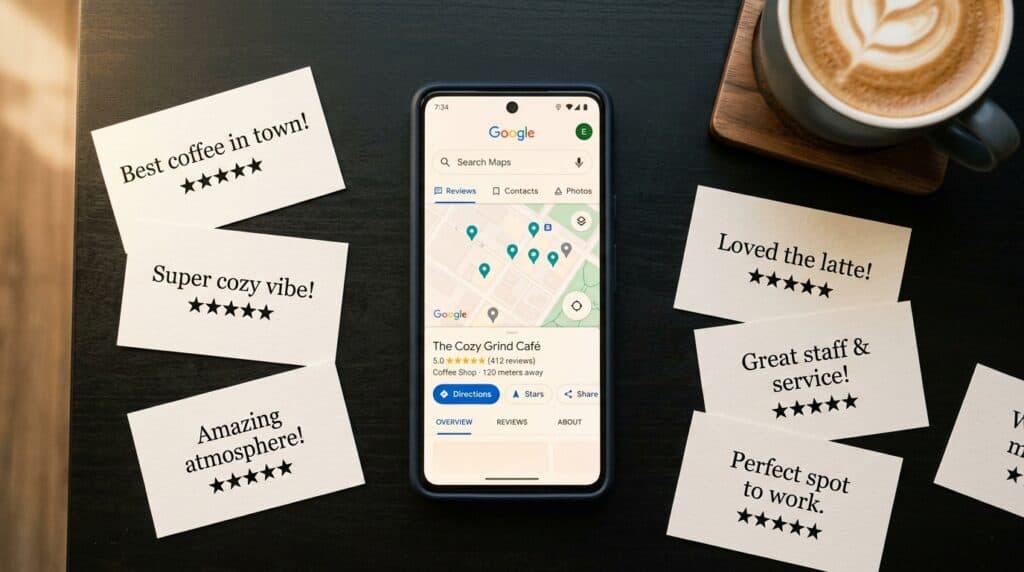
Local SEO in Minneapolis: The Complete Small Business Guide
46% of all Google searches have local intent (Google, 2023). Here is the complete local SEO strategy for Minneapolis small businesses...
Minneapolis Made
Minneapolis, MN 55402
Service Area
Answer Engine Optimization and AI SEO services for businesses across the entire 7-county Twin Cities metro area: Hennepin, Ramsey, Dakota, Anoka, Washington, Scott, and Carver counties.
Where we work in the Twin Cities
Headquartered in downtown Minneapolis. Dedicated landing pages for the suburbs we work in most often.
Plus Wayzata, Saint Louis Park, Richfield, Hopkins, and the broader 7-county Twin Cities metro on a project basis.