
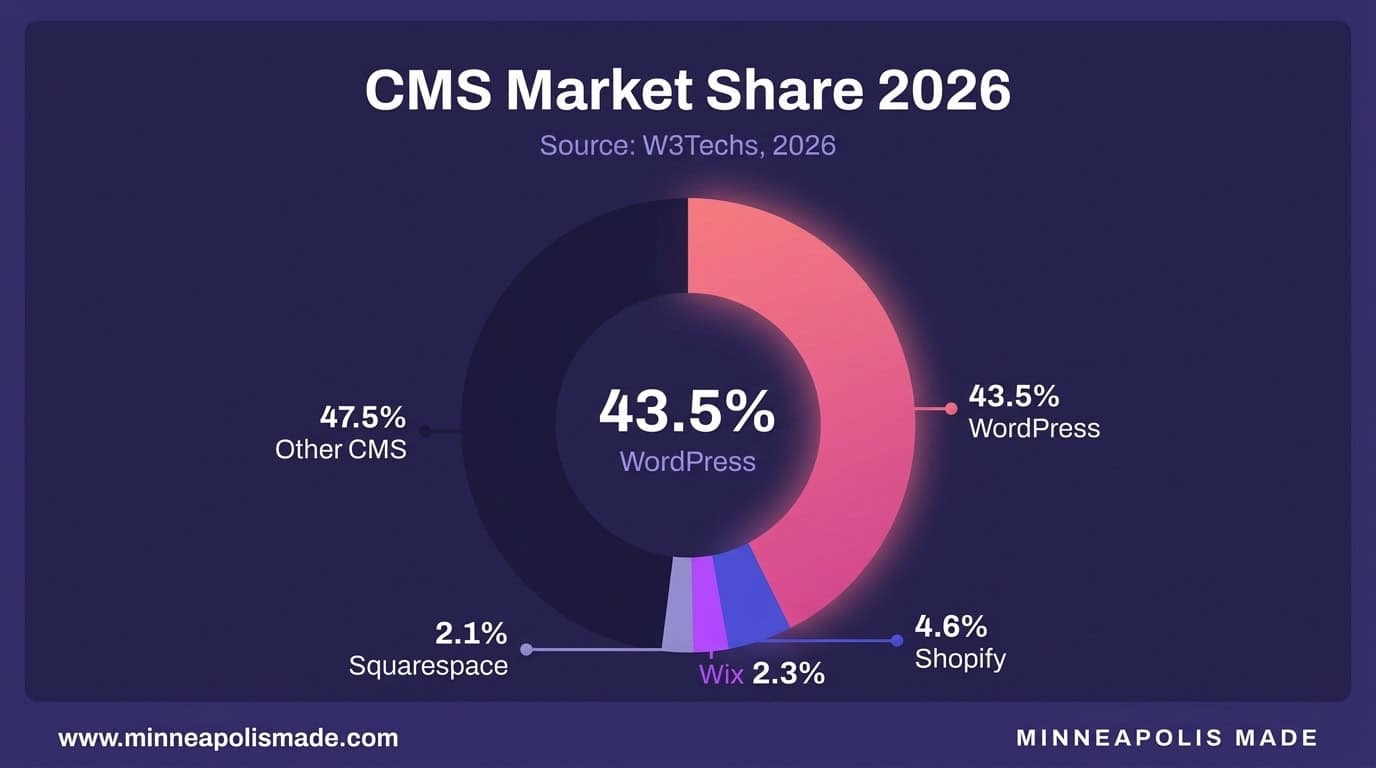
WordPress powers 43.5% of all websites on the internet, according to W3Techs. That’s not a niche tool. It’s the foundation of nearly half the web. For Minneapolis businesses looking for a site that performs, ranks, and actually belongs to them, WordPress custom builds remain the go-to choice. But “WordPress web design” means different things to different agencies. This guide breaks down what custom WordPress development looks like in 2026, what it costs locally, and how to find the right developer.
Key Takeaways
- WordPress holds 43.5% global CMS market share (W3Techs, 2026).
- Custom WordPress builds in Minneapolis typically run $7,500–$15,000.
- WooCommerce powers 36% of all online stores (BuiltWith).
- Clients migrating from page builders see 1.2s average LCP improvement.
- WordPress offers full code ownership, unlike SaaS platforms with monthly lock-in.
What Does Custom WordPress Web Design Actually Mean?
Only 30% of WordPress sites use fully custom themes, according to Colorlib’s 2024 WordPress statistics compilation. The rest rely on pre-built templates with minor tweaks. That distinction matters because it determines how your site performs, how it looks, and whether you actually own the design.
A “custom” WordPress build starts with brand discovery. Your developer learns your goals, audience, and competitors before writing a single line of code. From there, the process moves through wireframes, a bespoke theme built from scratch, and performance tuning. There’s no ThemeForest template underneath.
In practice, custom WordPress web design in Minneapolis means your theme is coded specifically for your content. Developers use tools like Advanced Custom Fields (ACF) to create editable content blocks. You get a page builder experience without the bloat of Elementor or Divi. Your pages load faster, your markup stays clean, and your SEO foundation is solid from day one.
Template-based builds have their place. If you need a brochure site on a tight budget, a well-configured theme works fine. But if you’re investing in SEO, running paid ads, or building a brand that needs to stand out, custom is the only approach that scales without technical debt piling up.
Related: What Does Web Design Cost in Minneapolis?
Is WordPress Still the Right Choice in 2026?
WordPress powers 43.5% of all websites globally, per W3Techs’ April 2026 data. Its nearest competitor, Shopify, sits at 4.6%. That gap hasn’t narrowed. If anything, WordPress has widened its lead as Gutenberg matures and headless architecture gains traction.
The Gutenberg block editor has come a long way. In 2022, many developers avoided it. By 2026, it’s a legitimate site-building tool with full-site editing support. Custom blocks let developers create reusable components that clients can edit without touching code. That’s the balance most businesses need.
Headless WordPress is the other big shift. In this setup, WordPress handles content management while a separate front end (built in React, Next.js, or similar) handles the display. Large organizations and media companies use this pattern for speed and flexibility. It’s overkill for most small businesses, but it proves WordPress scales to any level.
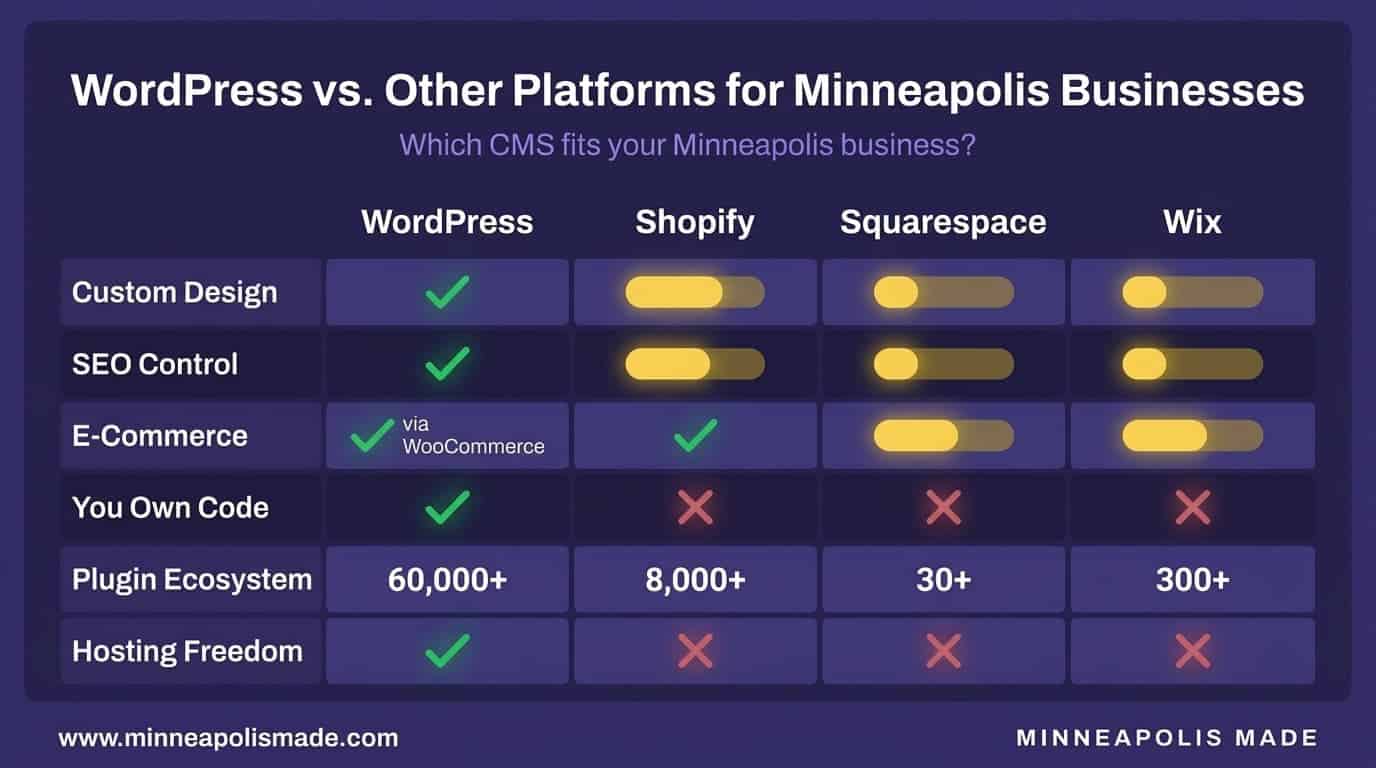
What about the alternatives? Squarespace and Wix are fine for solopreneurs who need something fast. Shopify dominates pure e-commerce. But none of them give you code ownership. When you build on WordPress, you own every file. You can move hosts, switch developers, or rebuild your front end without losing your content. That portability is worth more than most businesses realize upfront.
How Much Does WordPress Web Design Cost in Minneapolis?
Custom WordPress projects in the U.S. range from $5,000 to $50,000+, according to WebFX’s web development pricing guide. Minneapolis falls in line with those national averages, though local agencies tend to price slightly below coastal markets. Your final cost depends on scope, timeline, and how much custom functionality you need.
Here’s how pricing typically breaks down in the Minneapolis market:
| Scope | Cost Range | Timeline | What’s Included |
|---|---|---|---|
| Basic theme customization | $2,000–$5,000 | 2–4 weeks | Pre-built theme, brand colors, content upload, basic SEO setup |
| Custom WordPress build | $7,500–$15,000 | 6–10 weeks | Custom theme, ACF fields, responsive design, speed optimization, SEO foundation |
| Enterprise / complex builds | $15,000–$50,000+ | 10–20 weeks | Multi-site, WooCommerce, custom plugins, API integrations, headless architecture |
What drives the price up? E-commerce functionality, membership systems, third-party integrations, and multi-language support all add complexity. A 10-page service business site sits at the lower end. A WooCommerce store with 500 products, payment gateways, and shipping calculators pushes toward the higher end.
Don’t confuse upfront cost with total cost. A $3,000 Squarespace site with $400/year in platform fees costs $7,000 over ten years before you add any apps or plugins. A $10,000 WordPress site on $30/month hosting costs $13,600 over the same period, but you own the code and can switch hosts anytime.
Related: Complete Minneapolis Web Design Guide
What Should You Look for in a Minneapolis WordPress Developer?
According to Google’s Web Vitals business impact studies, sites meeting Core Web Vitals thresholds see up to 24% lower bounce rates. Your WordPress developer’s technical knowledge directly affects whether your site hits those benchmarks. Not every agency that says “WordPress” actually builds custom.
Here’s what to evaluate before hiring:
Custom theme experience
Ask to see themes they’ve built from scratch, not configured from a marketplace. Look at the page source. If you see Elementor, Divi, or Avada in the code, it’s not custom. A true custom theme is lightweight and purpose-built.
Performance knowledge
Run their portfolio sites through Google PageSpeed Insights. Custom WordPress builds should score 90+ on mobile. Ask them about Core Web Vitals, specifically LCP, CLS, and INP. If they can’t explain those acronyms, keep looking.
SEO-aware development
Good WordPress developers understand semantic HTML, schema markup, and crawlability. They’ll set up proper heading hierarchies, optimize images, and configure XML sitemaps before handoff. SEO shouldn’t be an afterthought bolted on with a plugin.
Security practices
Ask about their update schedule, firewall setup, and backup strategy. WordPress itself is secure, but neglected plugins and weak hosting create vulnerabilities. A responsible developer has a maintenance plan, not just a launch plan.
Ongoing support options
Websites aren’t “done” at launch. You’ll need plugin updates, content changes, and occasional feature additions. Find out if the agency offers monthly retainers and what their response time looks like.
Personal Experience
We’ve found that the fastest way to evaluate a WordPress developer is to ask for a CMS demo. Have them walk you through how you’d update a page, add a blog post, or change a hero image. If the editing experience feels clunky or requires developer intervention for basic changes, the build wasn’t designed with you in mind. The best custom WordPress sites feel intuitive to manage from day one.
Related: How to Choose a Web Design Company in Minneapolis
Not Sure If Your Current WordPress Site Is Holding You Back?
We’ll run a free performance audit covering Core Web Vitals, SEO structure, and mobile usability. You get a detailed report whether we work together or not.
Does WordPress Scale for Growing Minneapolis Businesses?
WordPress powers sites handling millions of monthly visitors, including TechCrunch, BBC America, and The White House, according to WordPress.org. Scale isn’t a concern. The question is whether your hosting and development team can support growth as it happens.
For local businesses expanding into multiple locations, WordPress Multisite lets you manage separate sites from a single dashboard. Each location gets its own content while sharing themes, plugins, and user management. It’s cleaner than maintaining five separate installs.
WooCommerce handles e-commerce at scale. Stores with thousands of products run on WooCommerce with proper hosting and caching. Membership sites, learning platforms, and booking systems all work within the WordPress ecosystem through well-maintained plugins.
The REST API opens WordPress to headless builds where the front end runs on a JavaScript framework. Media companies and SaaS businesses use this for speed and flexibility. Your content team works in the familiar WordPress editor while the customer-facing site runs on a blazing-fast front end.
Original Data
Across client projects where we’ve migrated businesses from Wix or Squarespace to custom WordPress, we’ve measured an average 1.2-second improvement in Largest Contentful Paint (LCP). That’s the difference between a “needs improvement” and “good” Core Web Vitals rating. Faster load times correlate with lower bounce rates and higher conversion rates, according to Google’s own case studies.
Related: When Is It Time for a Website Redesign?
How Does WordPress Handle Security and Maintenance?
WordPress is the target in 90% of all hacked CMS-based websites, according to Sucuri’s 2023 Hacked Website Report. That sounds alarming, but context matters. WordPress runs 43.5% of all sites, making it the biggest target by volume. The platform itself is secure when properly maintained.
Most WordPress vulnerabilities come from three sources: outdated plugins, weak passwords, and cheap shared hosting. The fix is straightforward. Keep WordPress core, themes, and plugins updated. Use strong passwords with two-factor authentication. Choose managed WordPress hosting from providers like WP Engine, Flywheel, or Cloudways.
A solid security setup includes:
- Web application firewall (Sucuri, Wordfence, or Cloudflare)
- Automated daily backups stored off-server
- SSL certificate (free through Let’s Encrypt on most hosts)
- Login attempt limiting and bot protection
- File integrity monitoring
Personal Experience
In our experience, the biggest security risk isn’t WordPress itself. It’s abandoned plugins. We’ve audited sites running 30+ plugins where half hadn’t been updated in over a year. Every unused or outdated plugin is an attack surface. We recommend auditing your plugin list quarterly and removing anything that isn’t actively needed.
Monthly maintenance plans from Minneapolis WordPress developers typically run $75–$200/month. That covers updates, backups, uptime monitoring, and minor content changes. It’s a small price compared to recovering from a hack, which averages $3,000–$5,000 for small businesses.
Related: Small Business Web Design in Minneapolis
How Does WordPress Compare for Minneapolis E-Commerce?
WooCommerce powers 36% of all online stores globally, according to BuiltWith’s 2026 e-commerce data. Shopify holds 28%. Both are strong platforms, but they serve different needs and come with very different ownership models.
WooCommerce is a free plugin that turns any WordPress site into a store. You pay for hosting, a payment gateway, and any premium extensions you need. Total annual costs for a small store run $500–$2,000. You own the code, control the checkout experience, and can customize anything.
Shopify charges $39–$399/month for its platform, plus transaction fees unless you use Shopify Payments. It’s faster to set up and easier to manage for non-technical owners. But you’re renting. Shopify controls your checkout, limits customization, and charges more as you scale.
Unique Insight
The real cost difference between WooCommerce and Shopify isn’t the monthly fee. It’s lock-in. A Shopify store with 1,000 products, custom integrations, and three years of data is expensive to migrate. You’re not just paying $39/month. You’re paying for the switching cost you’ll face when Shopify raises prices, changes terms, or removes a feature you depend on. WordPress and WooCommerce don’t have that leverage over you because you own the files.
For Minneapolis businesses selling physical products with complex shipping needs, WooCommerce’s flexibility wins. For solopreneurs selling a handful of digital products who want the simplest possible setup, Shopify works. But if you’re already on WordPress, adding WooCommerce is almost always the smarter move.
Related: WooCommerce vs. Shopify for Minneapolis Businesses
Planning a WordPress E-Commerce Build?
We’ll map out your product catalog, payment flow, and shipping logic before writing any code. Get a custom WooCommerce plan built around your actual inventory.
Related: WordPress development services in Minneapolis
Related: How WordPress can help grow your business
Related: Critical WordPress security mistakes to avoid after launch
Building or rebuilding on WordPress in Minneapolis?
Custom themes, headless WordPress, security hardening, ShortPixel + Cloudflare optimization — 25 years of WordPress for Twin Cities businesses.
Frequently Asked Questions
How long does a custom WordPress website take to build?
Most custom WordPress builds take 6–10 weeks from kickoff to launch. Simple theme customizations can finish in 2–4 weeks. Enterprise-level sites with e-commerce, custom plugins, or API integrations may take 10–20 weeks. Timeline depends on content readiness, revision rounds, and project complexity.
Is WordPress free to use?
The WordPress software is free and open source. Your costs come from hosting ($10–$50/month for managed WordPress hosting), a domain name ($12–$20/year), premium plugins, and developer time for custom design work. There are no platform licensing fees.
Can I update my WordPress site myself after launch?
Yes. A well-built custom WordPress site includes intuitive editing through the block editor and custom fields. You should be able to update text, swap images, and publish blog posts without developer help. More complex changes like layout shifts or new features may need your developer.
Do I need a maintenance plan for WordPress?
Strongly recommended. WordPress core, themes, and plugins release regular security updates. Monthly maintenance plans ($75–$200/month in Minneapolis) cover updates, backups, uptime monitoring, and minor edits. Skipping maintenance increases your risk of security issues and plugin conflicts.
Should I choose WordPress or Shopify for my online store?
Choose WooCommerce (WordPress) if you want full code ownership, deep customization, and lower long-term costs. Choose Shopify if you want the simplest setup possible and don’t mind platform fees. WooCommerce powers 36% of online stores globally (BuiltWith), giving it the larger ecosystem.
What’s the difference between WordPress.com and WordPress.org?
WordPress.org is the free, self-hosted software that professional developers use. WordPress.com is a hosted platform run by Automattic with limited customization on lower plans. When agencies say “WordPress web design,” they mean WordPress.org. That’s the version that gives you full control.