
Type "best plumber near me" into Google today and you'll still get the map, same as always. But ask it a slightly different way, like "how do I pick a good plumber," and something new happens: an AI-written answer takes over the top of the screen, names a few businesses, and quietly decides who gets the call. Here's the unsettling part: when SOCi analyzed roughly 350,000 local business locations, ChatGPT recommended just 1.2% of them (SOCi, 2026). For almost every local business, the AI simply leaves you out. If you run one, that should stop you cold.
Here's the shift in one line: customers used to find you by scrolling a list of links. Now they increasingly ask a machine, and the machine hands them a short list of names. This guide maps the five places customers actually find local businesses in 2026, shows you the real data on how much has changed (and how much is hype), and gives you a plain plan for staying on that short list.
Key Takeaways
- 45% of consumers used an AI tool like ChatGPT, Gemini, or Perplexity to find a local business in the past year, up from just 6% a year earlier, according to BrightLocal's 2026 Local Consumer Review Survey.
- When Google shows an AI Overview, clicks to the number-one result drop 58%, per Ahrefs' December 2025 analysis of 300,000 keywords. AI Overviews now appear on roughly 68% of local business queries (Whitespark).
- Your Google Business Profile still matters. 68% of consumers will only use a business rated 4 stars or higher, and 97% of people who use AI for recommendations at least sometimes double-check it against real reviews (BrightLocal, 2026).
- This isn't a reason to panic. 95% of Americans still use traditional search every month (SparkToro). It's a reason to widen where you show up, and to start measuring whether AI is sending you customers at all.
Is AI really taking over local search, or is this just hype?
It's real, but it's uneven. AI Overviews appear on about 68% of local business searches, according to a 2025 Whitespark study of 540 queries across six industries and three US cities. When one appears, Ahrefs found clicks to the top organic result run 58% lower than when no AI Overview is present (December 2025 data), and Seer Interactive measured organic click-through sliding from 1.76% to 0.61% on pages with an AI answer. The ground under local search genuinely moved.
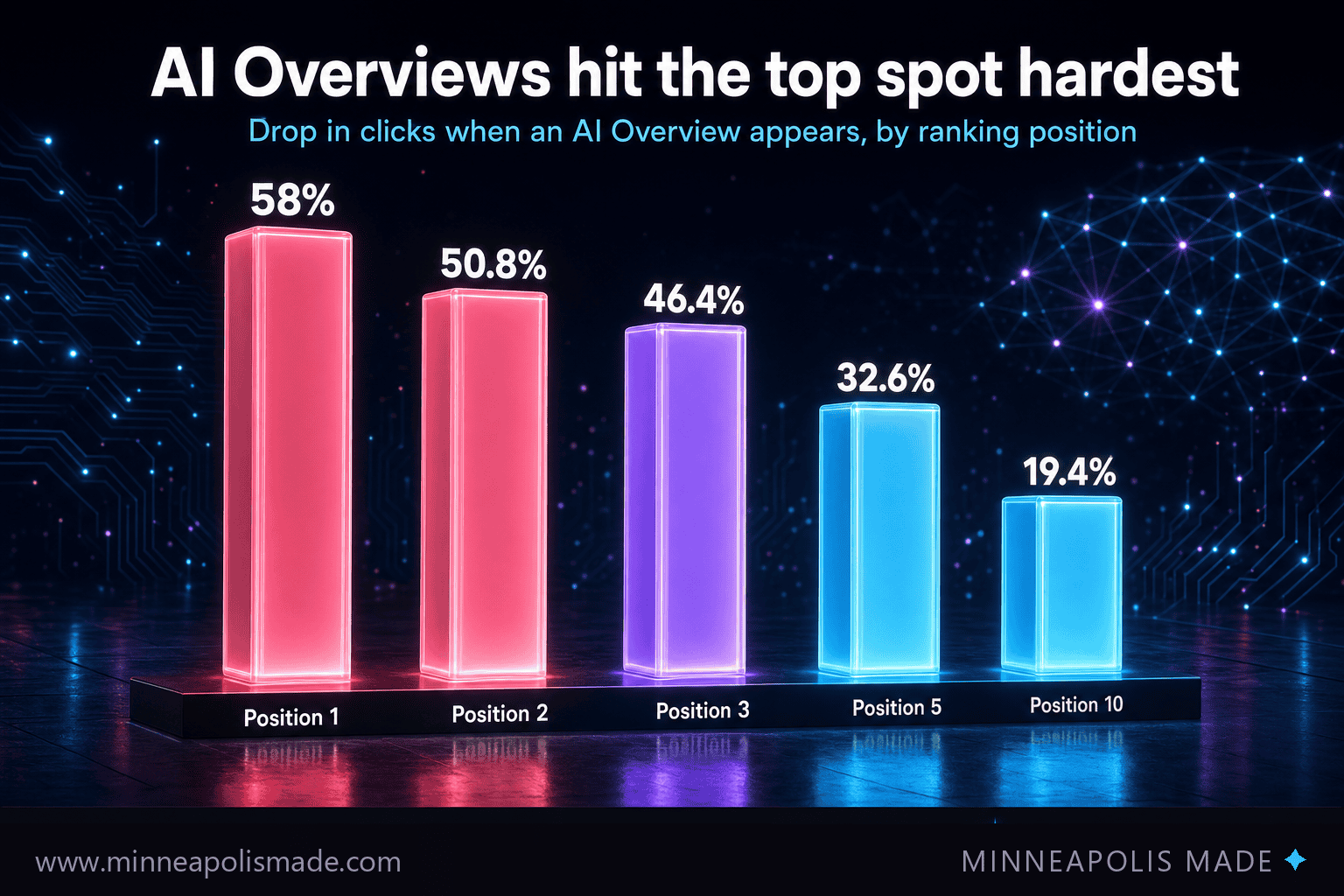
But the panic headlines miss an important nuance: AI Overviews and the classic map pack mostly show up on different kinds of questions. Whitespark found AI Overviews appear on just 15% of pure "near me" searches, where the local pack still shows 93% of the time. Flip to a research-style question like "how to choose a good roofer," and the AI Overview appears 92% of the time while the pack nearly vanishes. AI isn't erasing the map. It's intercepting the questions people ask before they're ready to pick a name.
So the honest answer is this: the map pack isn't dead, but it's no longer the only door. And the newer doors, the AI ones, are the fastest-growing part of how people shop for a local business.
Where do customers actually find local businesses now? The 5-surface map
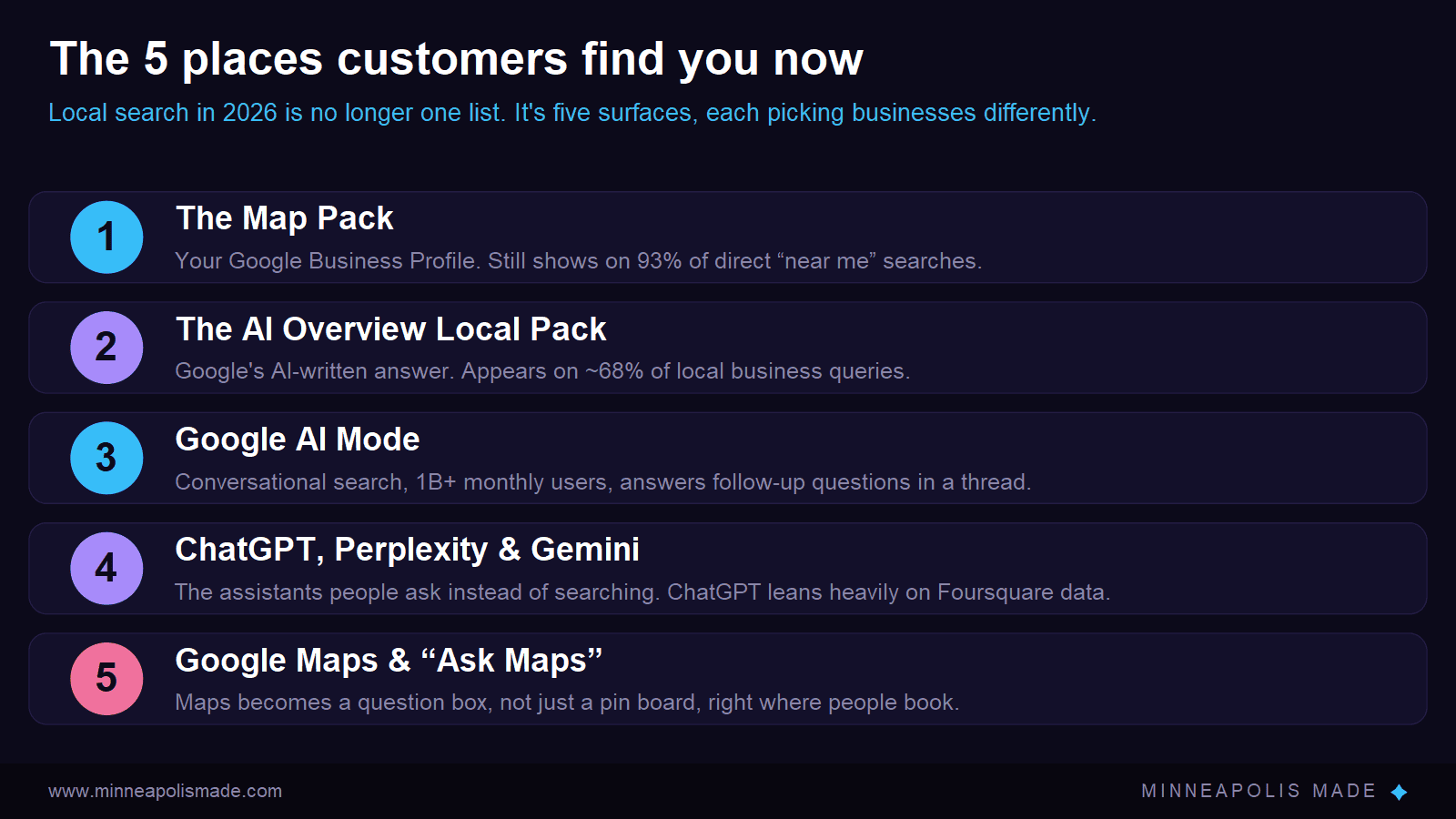
There are now five distinct places a customer can land on your name. Most local owners obsess over the first one and ignore the other four. Here's how each surface picks businesses, and the one move that helps you show up on it.
| Surface | How it picks businesses | Your one move |
|---|---|---|
| The map pack | Proximity, reviews, and a complete Google Business Profile | Fill out your profile and keep reviews coming |
| AI Overview | Reviews, web mentions, and directories, not distance | Build authority across the web, not just Google |
| Google AI Mode | What your website plainly answers in words | Put plain-text answers to buyer questions on your site |
| ChatGPT, Perplexity & Gemini | Foursquare, Yelp, and your reputation across the web | Claim and fix your non-Google listings |
| Google Maps | A complete, reviewed Maps profile | Treat your Maps profile like a mini-website |
1. The classic map pack (your Google Business Profile)
Still the workhorse. On direct "near me" searches, the three-business pack shows 93% of the time (Whitespark, 2025). Google picks it from your Business Profile: proximity, relevance, reviews, and how complete your listing is. Your move: keep the profile fully filled out, post fresh photos, and keep reviews coming, because reviews feed every other surface too.
2. The AI Overview local pack
The AI-written answer at the very top. It composes a list rather than ranking one, pulling names from reviews, web mentions, and directories. One counterintuitive finding: in a Local Falcon study of 4,423 businesses, physical distance had almost no correlation with appearing in the AI answer (a correlation of 0.001). Your move: build the kind of authority AI reads, reviews, consistent listings, and genuine web mentions, not just a pin close to the searcher.
3. Google AI Mode
Google's full conversational search, which passed 1 billion monthly users a year after launch, per Google's own I/O 2026 keynote. It answers follow-up questions in a thread, so a customer might go from "best taco place" to "which one's open late and takes reservations" without a single link click. Your move: make sure your website plainly answers the specific questions buyers ask, in words, not just a menu.
4. ChatGPT, Perplexity, and Gemini
The assistants people now open instead of a search bar. They don't use Google's index. ChatGPT leans heavily on Foursquare's business data for local results, and independent tests suggest it's a primary source. If your Foursquare, Bing Places, and Apple Maps listings are wrong or missing, you're invisible to a whole channel. Your move: claim and clean up those non-Google listings this month.
5. Google Maps itself (and "Ask Maps")
Maps is becoming a question box, not just a pin board. Google is rolling AI into Maps so people can ask conversational questions right where they navigate and book. Your move: treat your Maps profile as a mini-website, complete, reviewed, and answering the "does this place fit my need" question at a glance.
Personal ExperienceWhen we ran this kind of test at scale, asking AI the same buyer questions 96 times across eight Minneapolis industries, we never got the same list of businesses twice. You can see a smaller version yourself in an afternoon: search "best plumber near me," "affordable roofer," and "how to choose an HVAC company," then compare Google's AI Overview, the map pack, and ChatGPT. Each one hands you a different set of names for the same need. Three surfaces, three answers.
Not sure which of the five surfaces you're missing?
We'll run your business through Google's AI Overview, the map pack, and the major AI assistants and show you exactly where you show up and where a competitor takes your spot.
Why is AI recommending your competitor instead of you?
Because AI visibility is far scarcer than a map ranking, and it rewards different signals. In SOCi's 2026 Local Visibility Index, which analyzed roughly 350,000 local business locations, Google's three-pack surfaced a given location 35.9% of the time, while ChatGPT recommended just 1.2% of them, Perplexity 7.4%, and Gemini 11%. Getting named by an AI assistant is roughly 30 times more selective than ranking in the pack, so the businesses that earn it tend to be the ones with the deepest, most consistent trail of proof across the web.
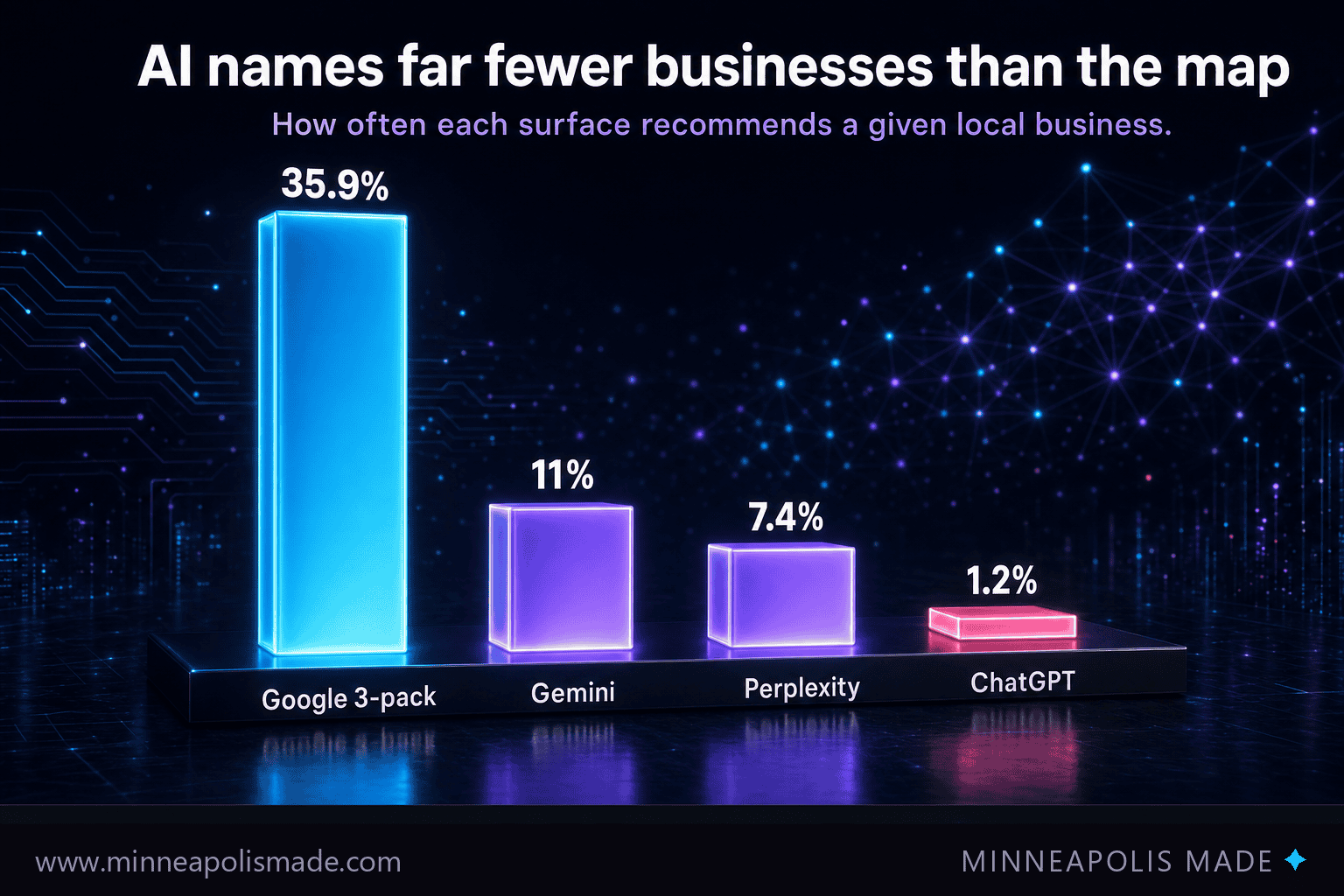
The takeaway isn't "AI hates you." It's that AI is reading a much wider set of signals than your Google profile, and if your reputation is thin everywhere except Google, you're easy to leave out.
Related: We asked AI 96 times who the best Minneapolis businesses are, and never got the same answer twice
Does your Google Business Profile still matter?
Yes, more than ever, because it feeds every other surface. 68% of consumers now only consider a business rated 4 stars or higher, up from 55% a year earlier, and 74% want to see reviews from the last three months, per BrightLocal's 2026 survey. Even when an AI makes the recommendation, 97% of AI users at least sometimes double-check it against real reviews. Your profile is both a ranking signal and the trust layer that closes the sale the AI started.
In our own client work across Twin Cities home-services businesses, the pattern is consistent: the shops with steady, recent, replied-to reviews are the ones we see quoted back inside AI answers. The AI isn't inventing trust. It's repeating the trust your customers already built for you in public.
Related: The complete guide to optimizing your Google Business Profile for local search
Related: The full Google Business Profile optimization checklist, ranked by what actually moves rankings
What actually gets you cited by AI in local search?
Five things, in rough order of impact, based on what the 2025-2026 studies and live tests keep surfacing. None of them require a big budget, just consistency most competitors won't bother with.

- Reviews, fresh and plentiful. They feed the map pack, the AI Overview, and the assistants. Ask every happy customer, and reply to each one.
- Consistent listings beyond Google. Same name, address, and phone on Foursquare, Bing Places, Apple Maps, and Yelp. ChatGPT leans heavily on Foursquare for its local answers, so a stale listing there makes you invisible to that channel.
- Niche and industry directories. AI Overviews increasingly point people to Thumbtack, Houzz, and Angi for home services. If your competitors are active there and you're not, the traffic flows to a place your business doesn't exist.
- Answer-style content on your own site. Pages that plainly answer "how to choose a good roofer" or "what does an affordable plumber cost" are exactly what AI pulls quotes from. Most local sites have nothing like this.
- Genuine web mentions. Local news, community sites, and even Reddit threads now shape who the AI names. Being talked about off your own site is the authority signal AI trusts most.
If that list sounds like the modern version of local SEO, that's because it is. AI didn't replace the fundamentals. It raised the reward for doing them consistently across the whole web instead of just on Google.
Related: Generative engine optimization: the step-by-step playbook for getting cited by AI
How do you know if AI is actually sending you customers?
Almost no one measures this, which is exactly why it's your edge. AI referral traffic is still small, under 2% of most sites' referrals, but it converts at roughly 18%, the highest-converting traffic source in Search Engine Land's analysis of 13 months of client data. A trickle of AI visitors can outperform a flood of ordinary ones, so it's worth knowing whether the trickle is reaching you.
Three simple checks any owner can run this week:
- Watch your referral traffic. In Google Analytics, look for visits from chatgpt.com, perplexity.ai, and gemini.google.com. Even a handful is a signal you're being cited.
- Ask the assistants yourself. Once a month, ask ChatGPT, Gemini, and Perplexity the questions your customers ask ("best HVAC company in [your city]") and note whether you appear. It's crude, but it's real data.
- Track branded searches. A rise in people searching your business name directly often means AI or an AI Overview introduced you first.
Here's the trap: because AI traffic is small today, it's easy to dismiss. But it's growing fast, LLM referral traffic roughly tripled over 2025 (Search Engine Land), and it converts like nothing else. Ignoring it now is like ignoring mobile search in 2010 because "no one buys on their phone." The businesses measuring it early are the ones who'll own it.
What should a Minneapolis business do about all this?
Start where the customers already are and work outward. AI adoption for finding local businesses peaks with 30-to-44-year-olds at 64% (BrightLocal, 2026), the exact age band that hires plumbers, roofers, HVAC techs, and electricians. If you run a plumbing, roofing, HVAC, or electrical business, your buyers are the ones adopting AI search fastest, so this isn't a someday problem.
A realistic 30-day plan:
- Fill out your Google Business Profile completely and set a weekly review-request habit.
- Claim and fix your Foursquare, Bing Places, Apple Maps, and Yelp listings so AI assistants read you correctly.
- Get listed and active on the niche directory that matters for your trade.
- Publish two or three plain-English "how to choose" or "what it costs" pages for your service and city.
- Set up the three measurement checks above so you can see AI traffic arriving.
Want to be the name AI recommends in the Twin Cities?
Minneapolis Made builds local visibility across all five surfaces, the map pack, AI Overviews, and the AI assistants your customers now ask. We handle the reviews, listings, and answer-content that get you cited.
Related: AI visibility vs. traditional SEO in 2026: what every business owner needs to know
Is local SEO dead now that AI answers questions directly?
No. It changed jobs. Google's share as consumers' go-to source for business reviews slipped from 83% to 71% in a year (BrightLocal, 2026), and the discovery it lost moved to AI assistants and AI Overviews, which read the very same signals local SEO has always built: reviews, accurate listings, and useful content. The work didn't disappear. It got more valuable, because the same effort now pays off across five surfaces instead of one.
Frequently Asked Questions
What is a Google AI Overview, and how is it different from the local pack?
An AI Overview is the AI-written summary Google shows at the top of results for many searches. Unlike the local pack, which lists three nearby businesses ranked from your Google Business Profile, the AI Overview writes a paragraph and names businesses it pulls from reviews, listings, and web mentions. They often appear on different query types, so a business can be in one and not the other.
Will AI replace Google Maps and the local three-pack?
Not soon. On direct "near me" searches, the map pack still appears 93% of the time (Whitespark, 2025), and 95% of Americans still use traditional search monthly (SparkToro). AI is being added alongside these surfaces, not replacing them, but it's capturing more of the early research questions customers ask before they choose.
How do I get my business recommended by ChatGPT?
ChatGPT draws heavily on Foursquare for its local business data, alongside web mentions and reviews. Claim and correct your Foursquare, Bing Places, and Apple Maps listings, keep your reviews strong on Yelp and Google, and earn mentions on reputable local sites. Consistent information across the web is what makes an assistant confident enough to name you.
Do reviews still matter if AI is making the recommendation?
More than ever. 68% of consumers only use businesses rated 4 stars or higher, and 97% of AI users at least sometimes double-check an AI recommendation against real reviews (BrightLocal, 2026). Reviews feed both the AI's choice and the customer's final decision, so they work twice.
Is my local business losing traffic to AI Overviews?
Possibly, on informational searches. When an AI Overview appears, clicks to the top result drop 58% (Ahrefs, December 2025). But those are mostly research queries, not ready-to-buy "near me" searches, where the pack still dominates. The fix is to appear inside the AI answer, not just below it.
How do I track whether AI is sending me customers?
Check your Google Analytics referral traffic for chatgpt.com, perplexity.ai, and gemini.google.com, ask the assistants your customers' questions each month to see if you appear, and watch for a rise in branded searches. AI traffic is small but converts around 18%, the highest-converting channel in Search Engine Land's 2026 analysis, so it's worth tracking.
Which businesses are most affected by AI in local search?
Home services and consumer services feel it first, because their buyers skew toward the 30-to-44 age group that adopts AI search fastest, at 64% (BrightLocal, 2026). Plumbers, roofers, HVAC companies, electricians, and similar trades should treat AI visibility as a current priority, not a future one.
What's the single most important thing to do first?
Fix your listings and reviews everywhere, not just on Google. Consistent name, address, and phone across Foursquare, Bing, Apple Maps, and Yelp, plus a steady flow of recent reviews, is the foundation every AI surface reads. It's the highest-impact, lowest-cost move available to most local businesses.