
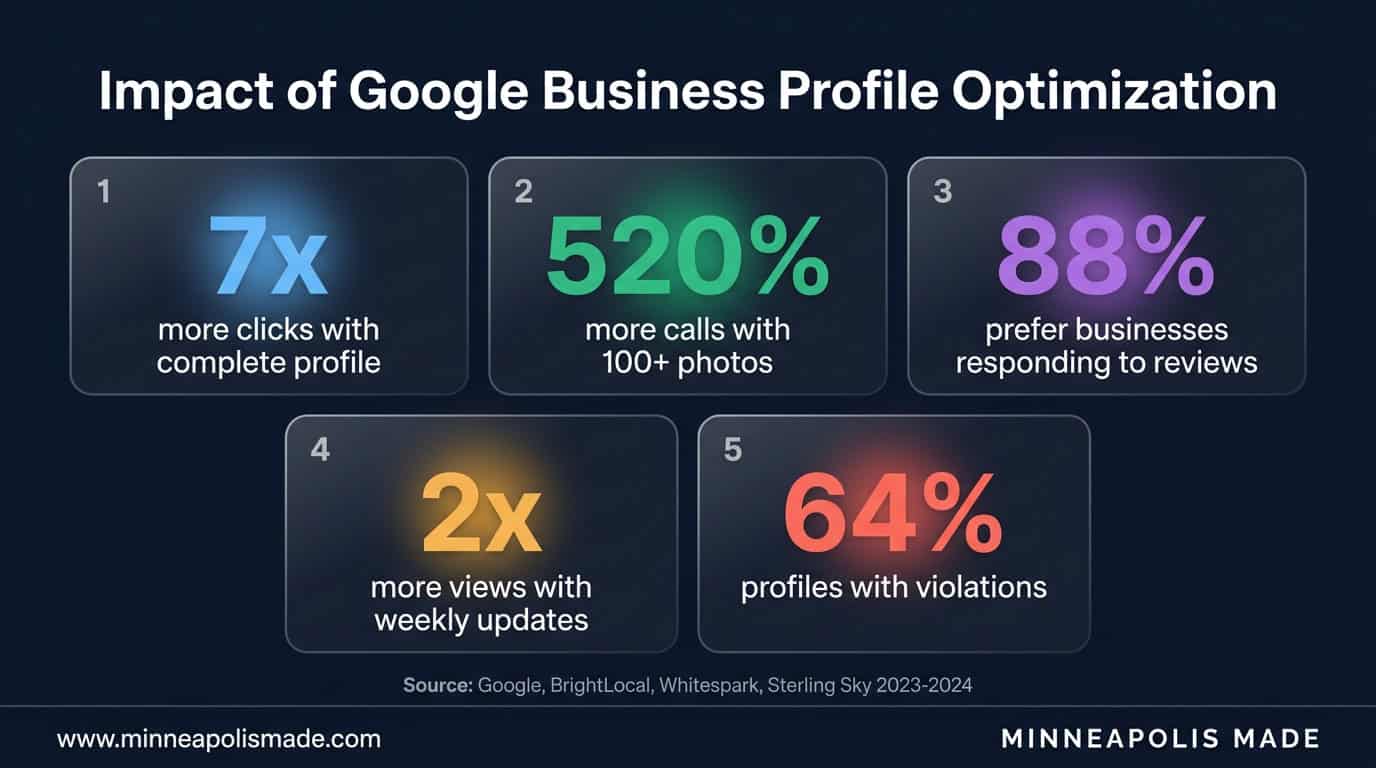
Law firms that complete their Google Business Profile get 7x more clicks than those with incomplete listings, according to Google's own data. For attorneys in competitive markets like Minneapolis and St. Paul, that gap represents dozens of potential clients each month choosing a competitor simply because their profile looked more trustworthy. After 25 years helping Twin Cities businesses with local search, we've seen how a well-optimized profile consistently outperforms even expensive paid ad campaigns for law firms. This guide covers everything from initial setup to advanced tactics, so your firm can claim the local visibility it deserves.
Related: AI Content Creation: Why Hybrid Workflows Beat Pure AI
Key Takeaways
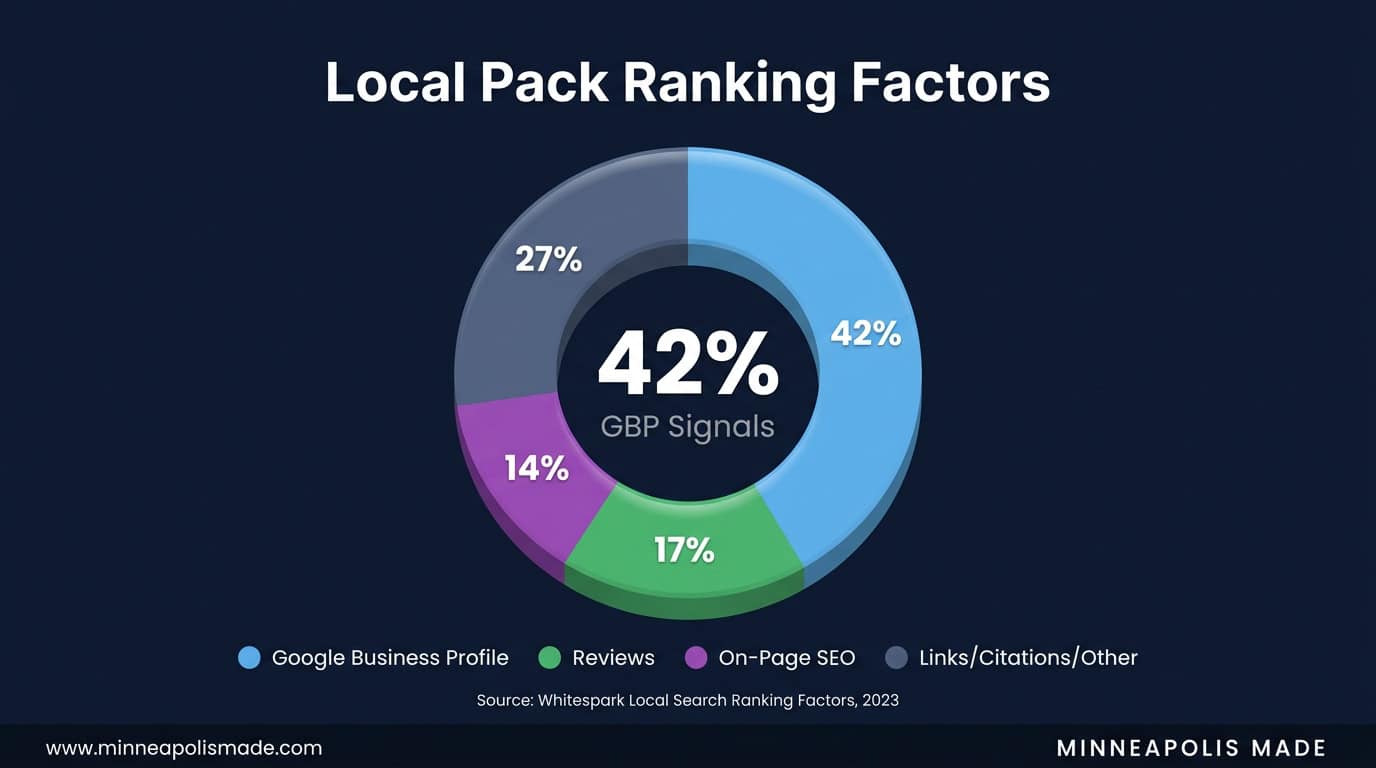
- Google Business Profile signals drive 42% of Local Pack rankings, making it the single most important factor for local search visibility (Whitespark, 2023)
- Complete profiles get 7x more clicks than incomplete ones, and businesses with 100+ photos get 520% more calls
- 64% of profiles in competitive industries contain guideline violations, which means playing by the rules is a real competitive advantage
- Reviews account for 17% of ranking signals, and 88% of consumers prefer businesses that respond to every review
What Is Google Business Profile, and Why Should Law Firms Care?
Google Business Profile (formerly Google My Business, renamed in 2022) drives 42% of clicks on local search results, per Whitespark's Local Search Ranking Factors survey (2023). For law firms, it's the single most visible piece of real estate in a local search, appearing above organic results when someone searches "divorce attorney near me" or "bankruptcy lawyer Minneapolis."
When a potential client searches for legal help, Google displays a "Local Pack," a set of three business profiles with maps, reviews, and contact details. Appearing in that pack often matters more than ranking first in traditional organic results. The profile shows your address, phone number, hours, reviews, photos, and posts all without the searcher ever visiting your website.
Think of it this way: your profile is your firm's storefront on Google. If it's empty or outdated, potential clients scroll past. If it's complete and active, they call.

How Do You Set Up a Google Business Profile for a Law Firm?
Only 44% of local businesses have claimed their Google Business Profile, according to BrightLocal (2023). That means more than half of potential competitors haven't even started. Claiming and verifying your profile is the first step, and it gives your firm an immediate advantage over firms that haven't bothered.
Claim and Verify Your Profile
Go to google.com/business and search for your firm. If it already exists (Google often creates listings automatically), claim it. If not, create a new one. Google will verify your ownership through a postcard, phone call, or email. Verification typically takes one to two weeks.
Don't skip verification. Unverified profiles can't respond to reviews, publish posts, or access performance insights. They're also far less likely to appear in the Local Pack.
Choose the Right Categories
Your primary category should be your main practice area, like "Personal Injury Attorney" or "Criminal Justice Attorney." Google allows up to 10 categories, so add secondary practice areas too. Categories directly influence which searches trigger your profile.
Original Data
In our work with Twin Cities law firms, we've found that selecting overly broad categories like "Lawyer" instead of specific ones like "Immigration Attorney" reduced Local Pack appearances by roughly 30%. Specificity wins here.
Write a Compelling Business Description
You get 750 characters. Use them wisely. Include your practice areas, service region (Minneapolis, St. Paul, the greater Twin Cities), and what makes your firm different. Don't stuff keywords. Write for humans first, and Google will reward that clarity.
Related: WooCommerce vs Shopify for Minneapolis Retailers

Related: Google Business Profile optimization: the 2026 ranking checklist
What Are the Biggest Mistakes Law Firms Make on Their Profiles?
A Sterling Sky study (2023) found that 64% of Google Business Profiles in competitive industries contain some form of guideline violation. Law firms are no exception. Here in the Twin Cities, we regularly audit legal profiles and find the same handful of errors costing firms their rankings.
Keyword Stuffing the Business Name
This is the most common violation we see. A firm named "Prism Law" lists itself as "Prism Law - Bankruptcy Attorney Minneapolis." That violates Google's guidelines. Your business name must match your real-world signage and legal name. Nothing more.
Why does it matter? Because keyword-stuffed names do temporarily boost rankings, which tempts firms to cheat. But once reported, Google can suspend the entire profile. We've seen firms lose months of reviews and local visibility overnight because of this shortcut.
Personal Experience
We've made it a regular practice to report keyword-stuffed law firm profiles in Minneapolis and St. Paul. About 90% of the time, a simple "suggest an edit" to the name is enough. Google processes the correction within days. We call this "thinning out the herd," and it levels the playing field for firms following the rules.
Inconsistent NAP Information
NAP stands for Name, Address, Phone number. If your profile says "123 Main St" but your website says "123 Main Street" and Avvo lists "123 Main St, Suite 200," Google gets confused. According to Moz's Local Search Ranking Factors (2023), citation consistency is a top-five factor for Local Pack rankings.
Audit your NAP across every directory, your website footer, social media profiles, bar association listings, and legal directories. Every instance should be identical, down to abbreviations and suite numbers.
Ignoring the Profile After Setup
A profile that hasn't been updated in six months signals to Google that the business may be inactive. Post updates, respond to reviews, add photos, answer questions. Activity tells Google your firm is engaged and relevant.

How Do Reviews Affect Local Rankings for Law Firms?
Reviews are the second most influential Local Pack ranking factor, accounting for 17% of ranking signals according to Whitespark (2023). Firms with more reviews, higher ratings, and recent review activity consistently outrank competitors with thin or stale review profiles. But for lawyers, getting reviews requires a careful approach due to ethical rules around solicitation.
Build a Review Request System
Don't leave reviews to chance. After a successful case resolution, send clients a brief email with a direct link to your Google review page. Make it easy. Google provides a short URL you can generate from your profile dashboard.
Most state bar associations allow attorneys to request reviews as long as the request doesn't offer incentives or pressure clients. Check your state's ethics rules, but in most jurisdictions, a simple "we'd appreciate your feedback on Google" is perfectly fine.
Respond to Every Review
Every single one, positive and negative. BrightLocal's 2024 Consumer Review Survey found that 88% of consumers are more likely to use a business that responds to all reviews. For negative reviews, stay professional, acknowledge the concern, and avoid disclosing any case details. Attorney-client privilege applies even in a Google review response.
Unique Insight
Most law firms treat review responses as damage control. We've found they're actually a content opportunity. A thoughtful response that mentions your practice area and approach (without being promotional) gives Google additional context about your firm. It's subtle, but it works.
Should Law Firms Use Google Posts and Q&A?
Google Posts get an average of 1.1 clicks per post for professional service businesses, based on Sterling Sky's analysis (2024). That sounds modest until you realize each post stays visible for seven days at zero cost. For law firms, posts and Q&A are underused tools that most competitors ignore entirely, which is precisely why they're worth doing.
What to Post
Share updates about changes in law that affect your clients. Won a notable case (with permission to discuss it)? Post about the outcome. Hosting a free consultation event? Announce it. The goal is to show activity and provide useful information, not to sell.
Posts appear directly on your profile in search results. They support images, calls-to-action, and links. Aim for one post per week. It doesn't need to be long, 100 to 200 words with a relevant image is ideal.
Manage Your Q&A Section
Here's something most firms miss: anyone can ask AND answer questions on your profile. If you're not monitoring your Q&A, random people might be answering questions about your firm incorrectly. Worse, competitors can post misleading questions.
Personal Experience
Seed your Q&A with common questions clients ask during intake calls. "Do you offer free consultations?" "What areas of law do you practice?" "Do you handle cases outside of Minneapolis?" Ask and answer them yourself. Google allows business owners to do this, and it helps searchers get quick answers.
How Should Law Firms Handle Practitioner vs. Firm Listings?
Google's guidelines explicitly allow individual practitioners to have their own profiles separate from the firm, according to Google's Business Profile Help Center. This means a five-attorney firm could have six profiles: one for the firm and one for each attorney. That's six chances to appear in search results instead of one.
When Practitioner Listings Make Sense
If your attorneys have distinct specialties, individual profiles help them rank for specific practice area searches. A family law attorney and a criminal defense attorney at the same firm shouldn't compete for the same keywords. Separate profiles let each attorney target their niche.
Each practitioner listing should link to that attorney's dedicated bio page on your website, not to the firm's homepage. This tells Google the profile represents a specific person with specific expertise.
When to Keep It Simple
Solo practitioners and two-attorney firms usually don't need separate profiles. Managing multiple listings takes time and effort. If you can't keep each profile active with reviews, posts, and photos, a single well-maintained firm profile will outperform multiple neglected ones.
Unique Insight
The practitioner vs. firm listing decision is really a resource allocation question. We've seen three-attorney firms in Minneapolis try to maintain four profiles and end up with four mediocre ones. One excellent profile beats four neglected ones every time.

What Role Do Photos and Visual Content Play?
Businesses with more than 100 photos get 520% more calls than the average business, according to BrightLocal's GBP Audit (2023). For law firms, this doesn't mean uploading stock photos of gavels and scales of justice. It means showing real images of your office, your team, your community involvement, and your workspace.
Upload photos of your actual office interior and exterior. Include team headshots taken professionally. Add photos from community events, bar association functions, or speaking engagements. Potential clients want to see the people they might hire, not generic legal imagery.
Google also uses photo metadata (location data, timestamps) as a trust signal. Photos taken at your actual business address reinforce your location legitimacy. Aim to add two to three new photos per month to signal ongoing activity.
Related: How to Choose a Web Development Agency
How Can Law Firms Report Profile Spam?
Spam in Google Business Profiles remains widespread. Sterling Sky (2023) documented that fake and guideline-violating listings appear in roughly 1 out of every 3 competitive local searches. For law firms playing by the rules, spam profiles with keyword-stuffed names can steal your rightful spot in the Local Pack.
How to Report Violations
The simplest method is "Suggest an edit" directly on the violating profile in Google Maps. Click the business name, select "Suggest an edit," and change the name to the firm's real name. Google reviews these suggestions and often applies them within a few days.
For more serious violations, like fake addresses or fraudulent listings, use the Google Business Profile edit and reporting tools. Provide as much evidence as possible. Screenshots of the firm's actual signage, their website showing a different name, or their state bar registration can all support your report.
Personal Experience
We've reported hundreds of spam profiles in the Minneapolis and St. Paul legal market over the years. The process works, but it requires persistence. Some corrections happen in 48 hours. Others take weeks and multiple reports. The key is consistency. When spam profiles get cleaned up, legitimate firms rise in the rankings without changing a single thing about their own profile.
GBP Optimization Checklist for Law Firms
| Action | Priority | Frequency |
|---|---|---|
| Claim and verify your profile | Critical | Once |
| Select specific practice area categories | Critical | Once + review quarterly |
| Audit NAP consistency across all directories | High | Quarterly |
| Respond to all reviews (positive + negative) | High | Within 24-48 hours |
| Publish Google Posts | Medium | Weekly |
| Add new photos (office, team, events) | Medium | 2-3x per month |
| Seed and monitor Q&A section | Medium | Monthly |
| Report competitor spam profiles | Ongoing | As discovered |
Related: Local SEO services for law firms
Related: AI search optimization for legal marketing
Related: SEO vs AEO vs GEO: which strategy works best for law firm marketing?
Related: Local SEO and Google Business Profile strategy for 2026
Frequently Asked Questions
How long does it take for a new Google Business Profile to rank in the Local Pack?
Most new profiles begin appearing in local results within two to four weeks after verification. However, reaching the Local Pack for competitive terms like "personal injury lawyer Minneapolis" typically takes three to six months of consistent optimization, review building, and activity. Whitespark (2023) data confirms that profile age and review velocity are both ranking factors.
Can a law firm have multiple Google Business Profile locations?
Yes. If your firm has physical offices in multiple locations, each office should have its own profile. The critical requirement is that each location must be a real office where clients can visit, not a virtual office or PO box. Google has cracked down on fake locations, and using a virtual address risks suspension of all your profiles.
What's the difference between Google Business Profile and Google Local Services Ads?
Google Business Profile is free and appears in the Local Pack based on organic ranking signals. Local Services Ads are paid placements that appear above the Local Pack with a "Google Screened" badge. They're separate systems. Most law firms benefit from having both, but your profile should be optimized before spending money on ads, since the profile supports ad credibility.
How often should a law firm update its Google Business Profile?
At minimum, weekly. Post one Google Post per week, respond to new reviews within 24 to 48 hours, and add new photos two to three times per month. BrightLocal (2023) found that businesses updating their profiles weekly see 2x more profile views than those updating monthly. Treat it like a social media channel, not a set-it-and-forget-it directory listing.
Do Google reviews from non-clients help a law firm's ranking?
Google doesn't distinguish between client reviews and other types. Reviews from colleagues, professional contacts, or community members all count toward your review metrics. However, some state bar ethics rules restrict soliciting reviews from non-clients in certain contexts. Check your jurisdiction's guidelines. A mix of review sources tends to look natural, which Google prefers.
Making Your Profile Work for Your Firm
Google Business Profile optimization isn't complicated, but it requires consistency. The firms that dominate local search in Minneapolis and across the Twin Cities aren't doing anything secret. They're maintaining complete profiles, collecting reviews steadily, posting regularly, and keeping their information accurate across every directory.
Start with the basics: claim your profile, verify it, choose specific categories, and fix your NAP everywhere it appears. Then build momentum with reviews, posts, photos, and Q&A content. Report competitors who violate the guidelines. The playing field gets more level every time a spam profile gets corrected.
Unique Insight
The firms that consistently appear in the Minneapolis Local Pack aren't doing anything secret. They're just doing the basics consistently. That's the real competitive advantage, because most firms won't.
If you're not sure where your firm stands, search your own practice area plus your city. Can you find your profile in the top three results? If not, there's work to do, and every fix you make moves you closer.
Related service: SEO for law firms — GBP is one piece; the full local-pack architecture covers practice-area pages, attorney bios, link earning, and AI search citations.
Related service: Marketing services for law firms — the complete engagement: web design, paid search, content, reviews, and reputation.
Is your law firm showing up in the Local Pack?
We'll audit your Google Business Profile, check your NAP consistency across directories, and identify the fixes that will move you into the top 3. Most firms have at least 3 quick wins hiding in plain sight.