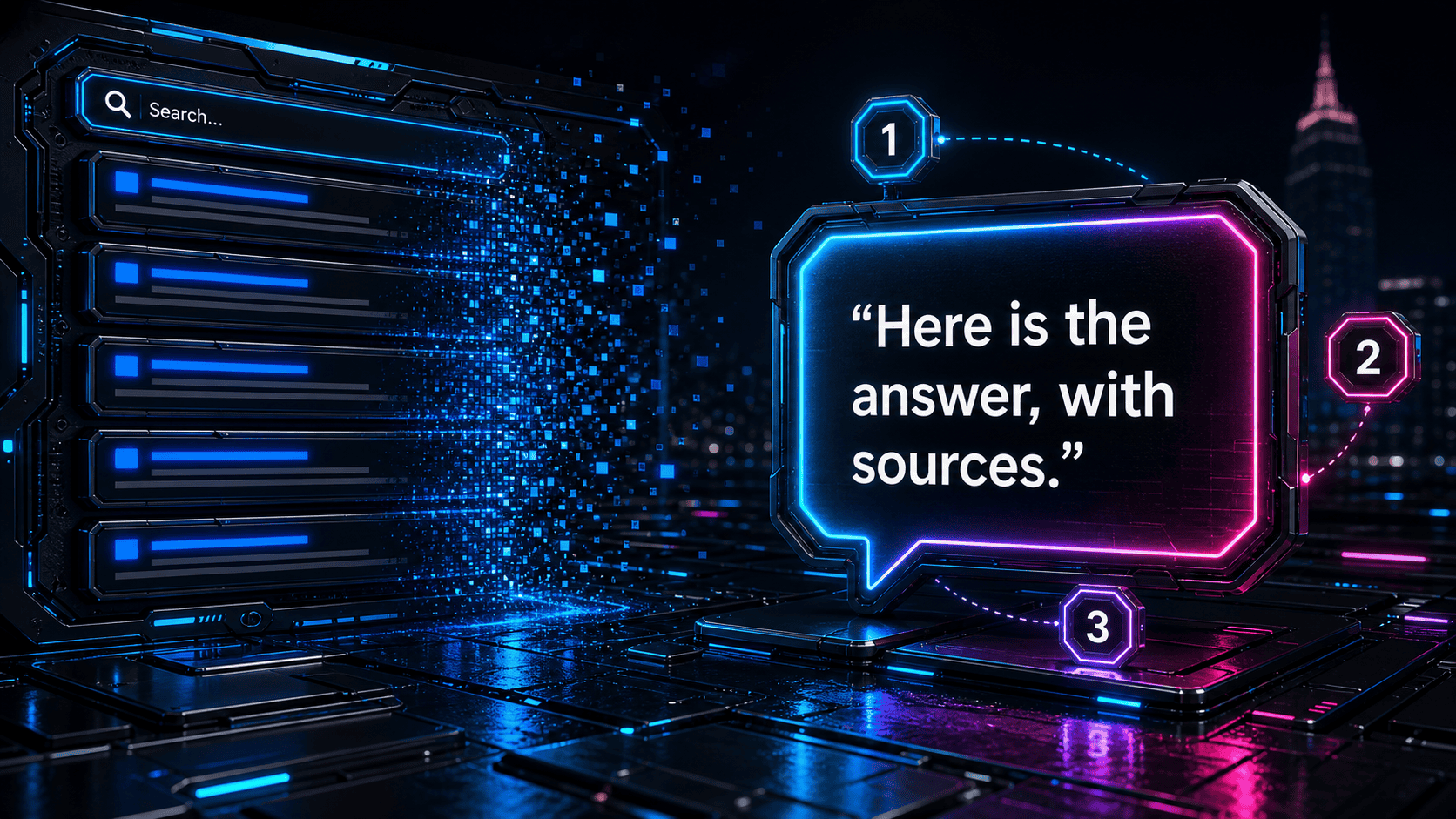
If you run a business and you've noticed your Google traffic looks fine but your phone has gone quiet, or you've started hearing the phrase "AI visibility" thrown around and you're not sure whether it's real or hype, this post is for you. In 2026 search isn't one thing anymore. It has fractured into a dozen surfaces — Google's blue links, Google's AI Overviews, Google's new AI Mode, ChatGPT search, Perplexity, Bing Copilot, voice assistants, and increasingly agentic browsing tools that buy and book on a customer's behalf — and the rules for showing up in each of them are different.
This post breaks down what AI visibility actually means, how it differs from traditional SEO, why the rise of Generative Engine Optimization (GEO) and Answer Engine Optimization (AEO) has scattered SEO across so many moving targets, why the whole discipline is still genuinely in its infancy, and what is actually working right now to win attention across the new landscape.
Key Takeaways
- Traditional SEO targets a ranked list of blue links. AI visibility (also called GEO or AEO) targets being quoted inside the AI's answer, often with no click at all.
- Google AI Overviews now appear on roughly 48% of all queries and reduce click-through on the top organic result by an average of 58% when present.
- The overlap between a site's Google top-10 rankings and the sources cited in AI answers has collapsed from about 70% to under 20%, meaning ranking on Google no longer guarantees you'll be cited by AI.
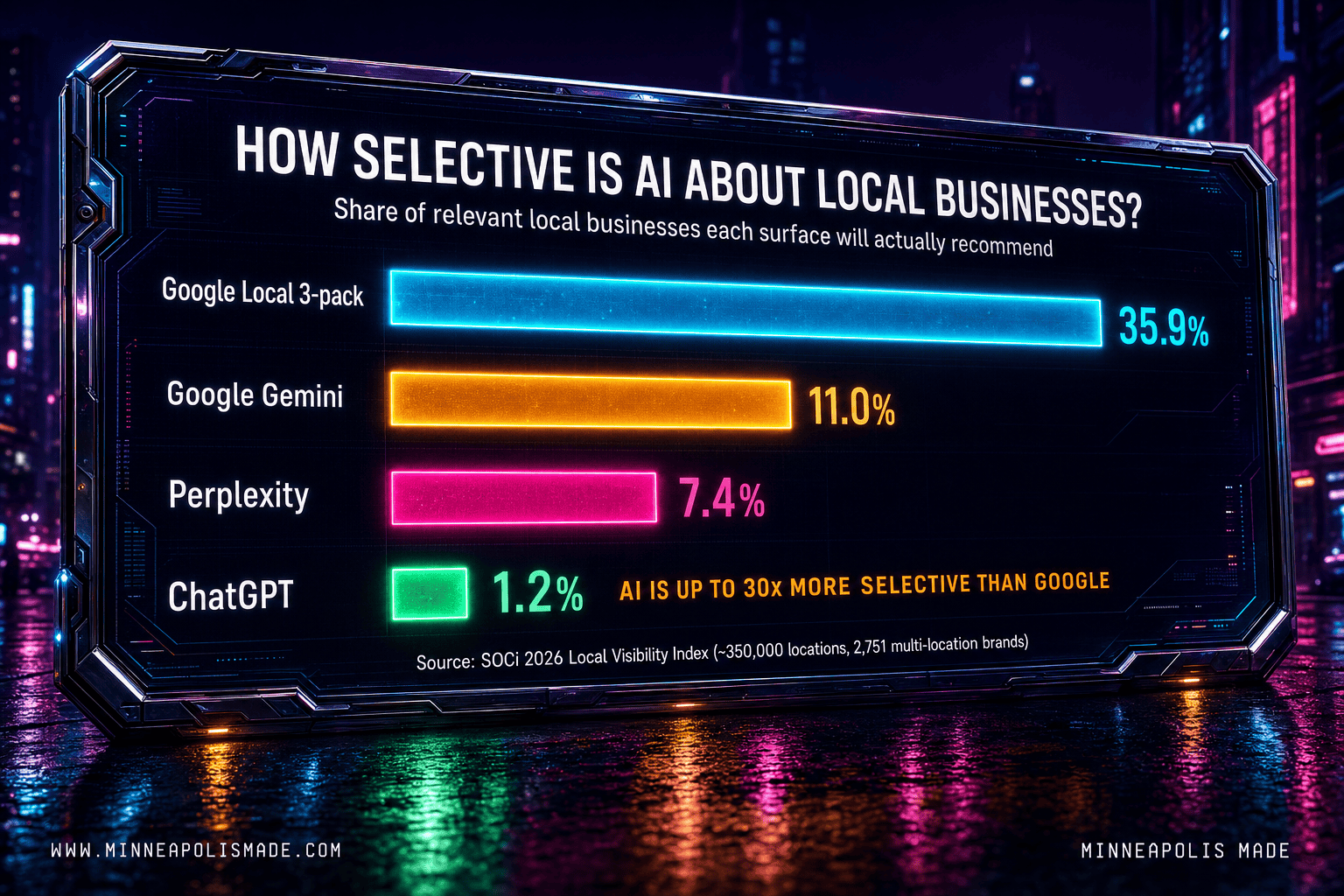
- AI is also dramatically more selective locally: Google's 3-pack recommends about 35.9% of relevant local businesses; ChatGPT recommends just 1.2%, Perplexity 7.4%, Gemini 11%.
- The discipline is in its infancy. AI citation outputs are probabilistic, no platform shares "prompt volume" data, and any single AI visibility score is noise. Treat best-practice guidance as a probability bet, not a recipe.
- Reviews and third-party trust signals are the hidden foundation. Every major AI engine — ChatGPT, Perplexity, Copilot, Gemini, AI Overviews — leans heavily on reviews, ratings, and independent mentions when deciding which businesses to recommend or cite.
- The 2026 stack that wins: original data + answer-first structure + entity reinforcement + brand mentions and reviews across the open web, executed against both Google rankings and AI citation share at the same time.
What is AI visibility and how is it different from traditional SEO?
Traditional SEO is the practice of getting a URL to rank in the ten blue links on Google or Bing. The unit of success is a position. AI visibility — sometimes called Generative Engine Optimization (GEO) or Answer Engine Optimization (AEO) — is the practice of getting your brand, product, or specific passage quoted inside an AI-generated answer in ChatGPT, Perplexity, Claude, Gemini, Google AI Overviews, AI Mode, or Bing Copilot. The unit of success is a citation.
The two overlap, but they are not the same job.
Unique InsightRanking #1 on Google in 2026 no longer guarantees you'll be cited by Google's own AI Overview. AI systems re-rank candidate passages on factors Google's organic algorithm doesn't weight heavily, including direct-answer formatting, named-entity clarity, freshness, and source diversity. A page that ranks #6 with a clean, quotable paragraph regularly gets cited over the page that ranks #1 with a 2,500-word essay.
Why did search suddenly fracture into so many surfaces?
For twenty years, optimizing for search meant optimizing for Google. There was effectively one highway. In 2026 that highway has become a delta — the same intent water still flows, but it runs through many channels, and you have to be visible in each tributary because none of them carries all the traffic anymore.
Here is what the modern search surface actually looks like for a typical small or mid-sized business:
- Google's classic ten blue links — still the largest single channel by a wide margin.
- Google AI Overviews — the synthesized box at the top of a results page, now appearing on roughly half of all queries.
- Google AI Mode — the standalone conversational interface, which Google announced at I/O 2026 had crossed 1 billion monthly active users, with queries roughly 3x longer than classic search.
- ChatGPT search — increasingly used as a first-step research and shortlist tool, especially for considered purchases.
- Perplexity — research-grade AI search with heavy citation use, popular with analysts and professionals.
- Bing Copilot — Microsoft's AI search across Bing, Edge, and Windows.
- Voice and assistant surfaces — Siri, Alexa, Google Assistant, increasingly AI-powered.
- Agentic browsers and tools — early-stage agents that book, compare, and purchase on the user's behalf.
- Social and community discovery — Reddit, YouTube, TikTok, and LinkedIn, where AI engines pull a surprising share of their training and live citation signals.
This is why so many business owners feel like SEO has gotten harder. It hasn't gotten harder so much as it has gotten wider. The same content has to do more jobs.
Personal ExperienceThe shift we've seen across Minneapolis Made clients in 2026 is that the highest-converting buyers increasingly arrive having already formed a shortlist in ChatGPT or Perplexity before they ever type your brand name into Google. The Google visit is the verification step, not the discovery step. If you're not in the AI-generated shortlist, the Google ranking only catches the customers who already knew about you.
Why does my Google traffic look fine while my leads are dropping?
This is the single most common question we hear from business owners in 2026, and the answer is almost always the same: the wrong pages are getting the traffic, and the AI surfaces are quietly siphoning off the highest-intent moments.
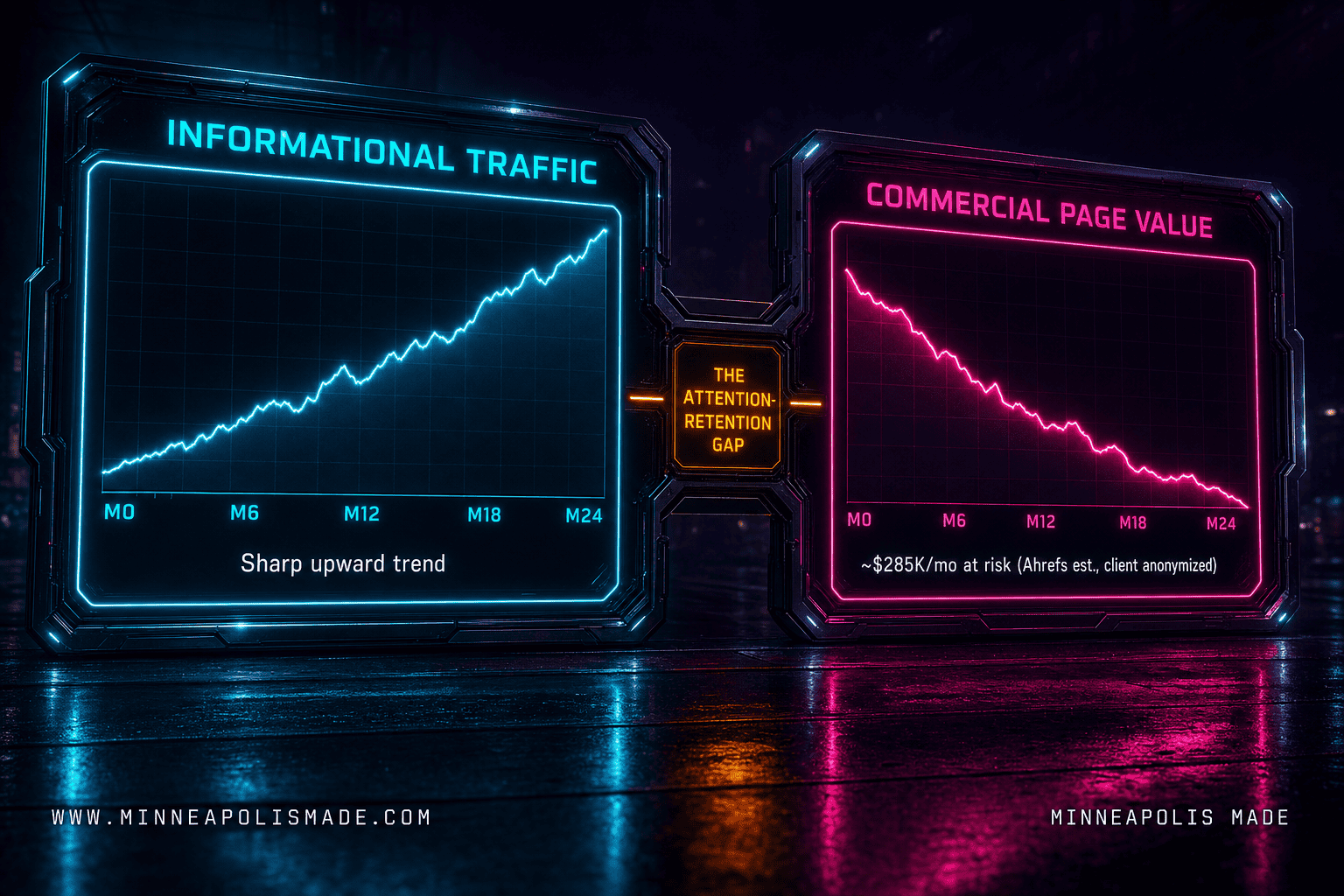
Original DataIn a recent competitive intelligence review of a multi-state personal injury firm, we found the firm's informational pages (amusement park accident statistics, weird state laws, elevator fall data) were pulling thousands of monthly visits and significant AI citation volume, while the commercial pages that actually generate cases were quietly declining. The Portland car accident attorneys page alone represented an estimated $285,059 in monthly traffic value (Ahrefs Site Explorer estimate, client anonymized), and it was on a downward trend, with no internal links from the informational pages capturing the same audience.
This is the modern SEO failure mode in one sentence: attention without retention. Top-of-funnel content earns clicks and AI mentions, but if it does not deliberately bridge users into commercial intent, those clicks evaporate.
How do ChatGPT, Perplexity, and Google AI Overviews actually pick sources?
Every major AI search system runs roughly the same three-step pipeline, even though their training data and rankers differ:
- Retrieval. The system pulls a candidate set of pages, usually from a live web index (Bing for ChatGPT and Copilot, Google for AI Overviews and AI Mode, a hybrid index for Perplexity).
- Passage selection. Instead of grading the whole page, the model extracts specific passages and scores each on relevance, clarity, and confidence.
- Citation assembly. The model stitches selected passages into a synthesized answer and attaches source links to the passages it actually used.
The implication is huge: pages structured as long flowing essays lose to pages structured as a series of self-contained, quotable answer blocks. This is why FAQ blocks, citation capsules, and clear definition paragraphs outperform feature-length thought pieces in AI citation tests, even when the long-form piece ranks higher on Google.
Related: See the data: 96 identical AI queries returned up to 77 different Minneapolis companies
What signals do AI engines weight most?
- Direct-answer formatting — the first sentence of an H2 should literally answer the H2.
- Entity clarity — named people, places, products, and brands with consistent spelling and Schema.org markup.
- Source diversity and primary data — AI systems prefer original data and primary sources. Aggregator-style content that summarizes other pages gets passed over.
- Recency for time-sensitive queries — Perplexity and AI Mode aggressively prefer content updated within the last 90 days for trending or news-adjacent topics.
- Brand mention frequency across the open web — AI engines triangulate trust by counting how often an entity appears in trusted third-party sources, not just by your own site's claims.
What's actually working for AI citations in 2026?
Personal ExperienceAcross roughly 40 Minneapolis Made client pages we've optimized specifically for AI citations since early 2025, five patterns consistently produce results. Pages that adopt at least three of the five start getting cited in ChatGPT or Perplexity within 4 to 8 weeks. Pages that adopt none stay invisible to AI no matter how well they rank on Google.
1. Answer-first H2 structure
Every H2 should be a real question a buyer would type, and the first paragraph beneath it should answer that question in 40 to 80 words. AI systems extract that block almost verbatim. This is the single highest-lift change you can make, and it costs nothing.
2. Original data and primary sources
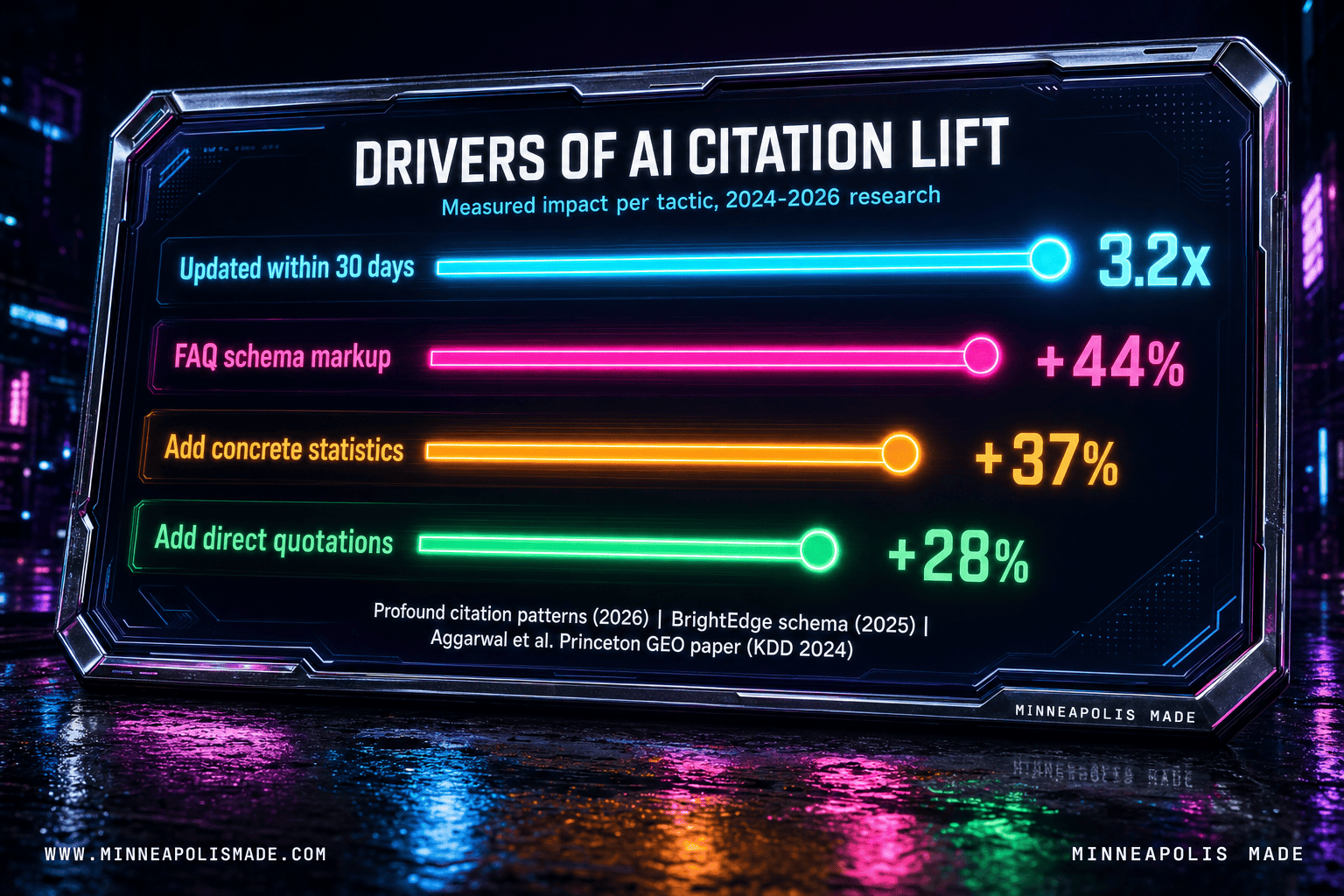
One proprietary number outperforms ten secondhand citations. A Carnegie Mellon University study cited in Search Engine Land's 2026 GEO guide tested nine GEO tactics and found that adding statistics, citations, and direct quotations produced the largest measurable lift in LLM citation rate. The Minneapolis web design speed report we published in 2026 benchmarked 21 agencies on Core Web Vitals; it gets cited regularly in AI answers about local agency quality because no other source has the same dataset.
3. Structured Schema.org markup
FAQPage, HowTo, Product, LocalBusiness, and Article schema give AI systems a confidence boost on entity extraction. JSON-LD is the only format Google and Bing reliably parse. Google's own AI optimization guide (which is the closest thing the industry has to an official GEO standard) explicitly directs publishers toward this approach rather than any new "AI schema."
4. Brand entity reinforcement off-site
Quotes in industry press, podcasts, expert roundups, original research syndication, and Wikipedia or Wikidata presence all train AI models that your brand is the authority on a topic. This is where digital PR and AI visibility now overlap completely.
5. Maintained freshness
Pages with a visible "last updated" date and a real content delta within the last 90 days get cited at roughly twice the rate of static pages on the same topic.
Why reviews and trust signals are the hidden foundation of AI visibility
If there is one signal the industry consistently underweights when it talks about GEO and AEO, it's reviews. Reviews, ratings, and independent third-party mentions are not a local-business afterthought in 2026 — they are foundational input to every major generative AI engine, across every vertical from SaaS to law firms to home services to B2B agencies.
Unique InsightThe reason is structural. AI engines need a way to grade trust before they're willing to recommend or cite a business. They cannot evaluate trust from your own marketing copy because every business says the same thing about itself. So they triangulate using independent signals: Google reviews, Trustpilot, G2, Capterra, Yelp, BBB, industry-specific platforms, Reddit threads, YouTube comments, and editorial press coverage. The more of those signals you have, the more recent they are, and the more consistent the sentiment, the higher your confidence score in the AI's retrieval layer.
What AI engines actually do with review data
- They pull review counts and average ratings as a baseline credibility check. A business with 8 reviews almost never gets recommended over one with 800, regardless of website quality.
- They mine the language inside reviews. Specific phrases your customers use ("fast turnaround," "great with first-time home buyers," "fixed it the same day") become the exact language the AI uses to describe you in an answer. This is why review content is now content.
- They weight recency. A burst of reviews in the last 90 days carries more weight than a static pile from 2022. Ongoing review velocity matters.
- They evaluate response behavior. Businesses that respond to reviews — especially negative ones — read as more legitimate to AI engines, the same way they do to humans.
- They cross-reference platforms. Strong Google reviews paired with strong Trustpilot or industry-platform reviews build a much stronger entity signal than depth on one platform alone.
- They pull from communities. Reddit threads, YouTube comments, and Hacker News discussions are increasingly cited as primary trust evidence, especially by Perplexity and ChatGPT. A single well-regarded Reddit thread about your brand can outweigh a dozen ordinary backlinks.
Why this is the hardest moat to copy
Competitors can hire a writer to copy your blog structure. They can buy your schema patterns from any agency. They cannot fake five years of authentic reviews, a real Reddit thread, an honest Trustpilot history, or a community of customers who mention them by name on forums. This is why trust signals end up being the most durable AI visibility advantage a business can build — and why most of the businesses winning AI citations in 2026 are the ones who quietly invested in real review programs years ago.
If you're starting today, the playbook is simple but slow:
- Pick the two or three review platforms that matter most in your industry and commit to consistent, ongoing collection — not a one-time push.
- Respond to every review, positive and negative, within 48 hours. The response text itself becomes AI-readable content.
- Encourage reviewers to be specific about the service, the outcome, and the timeframe. Specifics get cited; generic praise gets ignored.
- Pursue authentic third-party coverage — podcast guest spots, expert quotes in trade press, original data syndication — not paid placements.
- Treat your presence on industry directories and review platforms as a small but real content channel that needs the same maintenance as your website.
How AI search is reshaping local and service-business visibility
If you run a local service business — a law firm, contractor, dental practice, agency, accountant, anything where customers come from a defined geographic radius — AI search is hitting you in a specific way: it is dramatically more selective than Google ever was.
Meanwhile, the demand side has shifted faster than most local businesses realize. BrightLocal's 2026 Local Consumer Review Survey found that 45% of consumers now use AI tools to find local services, up sharply from low single digits a year prior. That's a one-year jump that most local marketing budgets have not caught up to.
What this means in practice for a service business:
- Your Google Business Profile is still the foundation. AI engines pull heavily from it for local queries, so categories, services, photos, and review depth all still matter.
- Third-party authority sites matter more than your own site. AI engines triangulate local trust through reviews, directory profiles, news mentions, and editorial coverage — not from your homepage copy.
- One service / one city / one page still beats programmatic location-page templates. AI engines refuse to cite thin, near-duplicate pages.
- Reviews and review responses are now content. Both Google's AI surfaces and ChatGPT pull review excerpts directly into local recommendations.
What's no longer working (and may actively hurt you)?
Black-hat and PBN backlinks
Generic definition pages competing with national directories
If you are a local firm trying to outrank Justia, Avvo, FindLaw, Healthgrades, or G2 for broad definitional queries, you are spending money to lose. National aggregators hold thousands of referring domains you cannot match. Win on local specificity and proprietary data instead.
Thin programmatic location pages
The "[Service] in [City]" template page, mass-generated for 50 cities with one paragraph swapped, used to rank. It now triggers Google's site reputation abuse signals and gets quietly deindexed. AI systems also refuse to cite them because there is no unique passage to extract.
Tactics that boost a single "AI visibility score" without underlying authority
Many of the new GEO tooling vendors will sell you a dashboard with one big number. As the next section explains, that number is mostly noise. Optimizing for the score itself rather than the underlying signals (real authority, real data, real entity clarity) is a 2026 version of keyword-stuffing.
Why this whole discipline is still in its infancy
It is worth saying out loud: GEO, AEO, and AI visibility are real, but the practice of measuring and engineering them is genuinely immature. Anyone who tells you they have a deterministic playbook is overstating what is currently knowable.
Six honest caveats every business owner should hold in mind in 2026:
- AI outputs are probabilistic. The same prompt returns different citations on re-run. Any tool reporting a single "AI visibility score" is reporting a random variable. Search Engine Land put it well in May 2026: "AI visibility is a distribution, not a single-point outcome."
- All current "AI rank tracking" is synthetic. No AI platform shares prompt-volume or impression data the way Google Search Console does for organic search. Every tool fills the gap by generating its own prompts on a schedule, which means the vendor's methodology determines the score more than reality does.
- Definitions are still shifting. SEO, GEO, AEO, LLMO, and AIO all blur into each other and the boundaries change every quarter. Anyone selling you a rigid taxonomy is selling certainty that doesn't exist yet.
- No causal proof yet. Tactics like adding statistics, schema, and freshness correlate with higher citation rates, but the industry hasn't isolated whether those tactics cause the lift or whether already-authoritative sites happen to do them more often.
- The numbers move. Click-through rates on AI Overview queries dropped sharply through 2025, then partially rebounded from 1.3% to 2.4% between December 2025 and February 2026. Doom-narrative numbers from one quarter often look very different the next.
- Local recovery patterns are unstable. Local businesses have seen wider swings than national brands. Tactics that worked in Q1 2026 are already being re-tested in Q2.
The right posture for a business owner in 2026: invest in fundamentals that benefit you across all surfaces (original content, real authority, structured data, brand mentions), but don't bet the budget on any one vendor's promised metric. Treat AI visibility tooling as directional, not diagnostic.
How should I blend SEO, GEO, and AEO in 2026?
The honest answer is that you cannot pick one. Google still drives the majority of click-through traffic, AI engines are increasingly where buyers form a shortlist before they ever search Google, and each AI engine has its own ranking logic. A modern strategy treats them as overlapping layers of one funnel rather than separate channels.
The blended playbook
- Defend your commercial pages first. Audit which money pages are bleeding rank and traffic value. Refresh those before publishing anything new.
- Restructure existing high-traffic informational pages with answer-first H2s, FAQ schema, and visible internal links to the relevant commercial page. This is the highest-ROI work most sites are ignoring.
- Publish original data once a quarter. A single original benchmark or survey post outperforms ten opinion pieces for AI citation purposes.
- Build off-site authority deliberately. Quotes in industry press, podcasts, expert roundups, and unique data syndication build the brand mentions AI engines triangulate trust from.
- Clean your backlink profile. Pull a full backlink export, disavow obvious spam, and resubmit through Google Search Console.
- Track AI citations as a directional metric. Tools like Profound, SE Ranking AI Visibility, and direct prompt testing in ChatGPT and Perplexity let you watch the trend, but treat the absolute numbers as noise.
- Verify your entity across the open web. Schema.org sameAs links, Wikidata entries, consistent NAP, and authoritative profile pages all train AI models on who you are.
Want to see which of your pages are getting cited by AI (and which are bleeding)?
We'll run a free AI visibility scan against your top 25 commercial pages, show you exactly where ChatGPT and Perplexity are quoting your competitors instead of you, and hand you a prioritized fix list.
A real example: a $285,000 traffic-value bleed hidden by trivia traffic
Related: ChatGPT vs. Perplexity: Which AI is Actually Citing Twin Cities Businesses
A recent competitive intelligence audit of a multi-state personal injury firm illustrates the modern SEO failure mode perfectly. The firm had built what amounted to an inadvertent informational media empire: pages on the "10 most terrible amusement park accidents," weird Wisconsin laws, and elevator-fall statistics were pulling thousands of monthly visits and showing up in AI citations across Perplexity and Google AI Overviews.
Meanwhile, the actual commercial pages — Portland car accident attorneys, Bakersfield employment lawyer, Boise medical malpractice — were quietly losing ranking ground to regional competitors. The Portland car accident page alone represented an estimated $285,059 in monthly traffic value (Ahrefs Site Explorer estimate, client anonymized), on a downward trend, with zero internal links from the high-traffic informational pages funneling readers toward it.
The fix isn't more content. The fix is three changes, in this order:
- Refresh the declining commercial pages with current local data, recent case results, and proper schema.
- Add explicit, contextual internal links from every high-traffic informational page to the most relevant commercial page (with a real CTA, not a footer link).
- Disavow the toxic backlinks before the next core update demotes the entire domain.
None of that requires publishing a single new article. It is pure reallocation of attention from where it is wasted to where it converts. That is the same logic a modern business needs to apply across the new AI surfaces: the work isn't necessarily more content; it's content that bridges the right surfaces to the right destination.
Related: The GEO playbook: how to get quoted by ChatGPT, Perplexity, and Google AI Overviews
Related: How AI is reshaping Google local search, and what local businesses should do about it
Frequently Asked Questions
Is SEO dead in 2026 because of AI?
No. Google still drives the majority of click-through traffic for commercial queries, and AI engines themselves use Google and Bing indexes to find candidate sources. SEO is changing, not dying. The pages that win in AI are usually pages that also rank well organically, just structured differently.
What is the difference between SEO, GEO, and AEO?
SEO (Search Engine Optimization) targets ranked positions on traditional search engines. GEO (Generative Engine Optimization) targets being cited inside AI-generated answers. AEO (Answer Engine Optimization) is a closely related term that emphasizes structuring content as direct, extractable answers for any answer engine — featured snippets, voice assistants, and AI chats. In 2026 practice, the three overlap heavily and the boundaries shift quarterly.
How do I know if my site is being cited by ChatGPT or Perplexity?
Run direct prompt tests in each AI for the queries you want to win. Tools like Profound, SE Ranking AI Visibility, and Otterly track citation share across multiple AI engines over time. There is no equivalent to Google Search Console yet, so manual prompt testing is still the most reliable baseline, and any single tool score should be treated as directional.
Should small local businesses invest in AI visibility?
Yes, especially because BrightLocal's 2026 survey shows 45% of consumers now use AI tools to find local services and the competitive bar in most local markets is currently low. Original location-specific content, proper LocalBusiness schema, real review depth, and consistent NAP across the web are the foundations. Don't try to compete with national directories on broad definitions — win on local specificity.
How long does it take to start getting cited by AI?
For pages that adopt answer-first structure, primary data, and proper schema, we typically see first ChatGPT or Perplexity citations within 4 to 8 weeks. Google AI Overviews tend to lag by another 4 to 6 weeks because the index refresh cadence is slower.
Are backlinks still important for AI search?
Yes, but quality matters more than ever. AI engines use brand mention frequency across trusted third-party sources as a trust signal, which functionally rewards the same kinds of editorial links that have always mattered. Black-hat link networks can now trigger both algorithmic demotion and AI source exclusion.
Do reviews really affect whether AI engines recommend my business?
Yes, and arguably more than any other single signal in 2026. ChatGPT, Perplexity, Copilot, Gemini, and Google AI Overviews all lean heavily on reviews, ratings, and independent third-party mentions when deciding which businesses to surface. AI engines use review data three ways: as a baseline credibility filter (volume and rating), as language input (the words your customers use become the words AI uses to describe you), and as a recency signal (consistent recent reviews carry more weight than a stale pile). Reviews on independent platforms — Google, Trustpilot, G2, Capterra, industry-specific sites — count more than testimonials on your own website because they're harder to fake.
Will agentic browsers and AI shopping assistants change this again?
Almost certainly. Agentic search — where an AI agent visits, compares, and transacts on a user's behalf — is the next major layer being built on top of GEO and AEO. The fundamentals (structured data, clear entities, original content, real authority) carry forward, but expect new optimization sub-disciplines to emerge over the next 12 to 24 months.
Related: What Is SEO in 2026? A Working Definition for Business Owners
Related: Minneapolis SEO Services: How We Approach Modern Search
Related: Minneapolis Web Design Speed Report 2026
Ready to stop bleeding leads to AI search?
Minneapolis Made is a hybrid studio that builds and optimizes sites for both Google rankings and AI citation share. We work hourly at $85/hr, no packages, no lock-in. Book a 20-minute call and we'll walk you through your top three AI visibility gaps live.