
Ask ChatGPT "who's the best web designer in Minneapolis?" and you won't get ten blue links. You'll get a short paragraph that names a few companies and cites a handful of sources. Generative engine optimization decides whether your business is one of the names in that paragraph, or invisible.
Generative engine optimization (GEO) is the practice of structuring your content and online presence so AI answer engines quote you in their responses. This guide explains what GEO is, how it differs from traditional SEO, and the research-backed tactics that get you quoted. We also ran a live test, asking ChatGPT and Perplexity real buyer questions about Minneapolis businesses, and the results tell you exactly where the citations come from.
Key Takeaways
- Generative engine optimization (GEO) is the practice of structuring your content and online presence so AI engines quote you in their answers. The goal isn't a ranking, it's a citation.
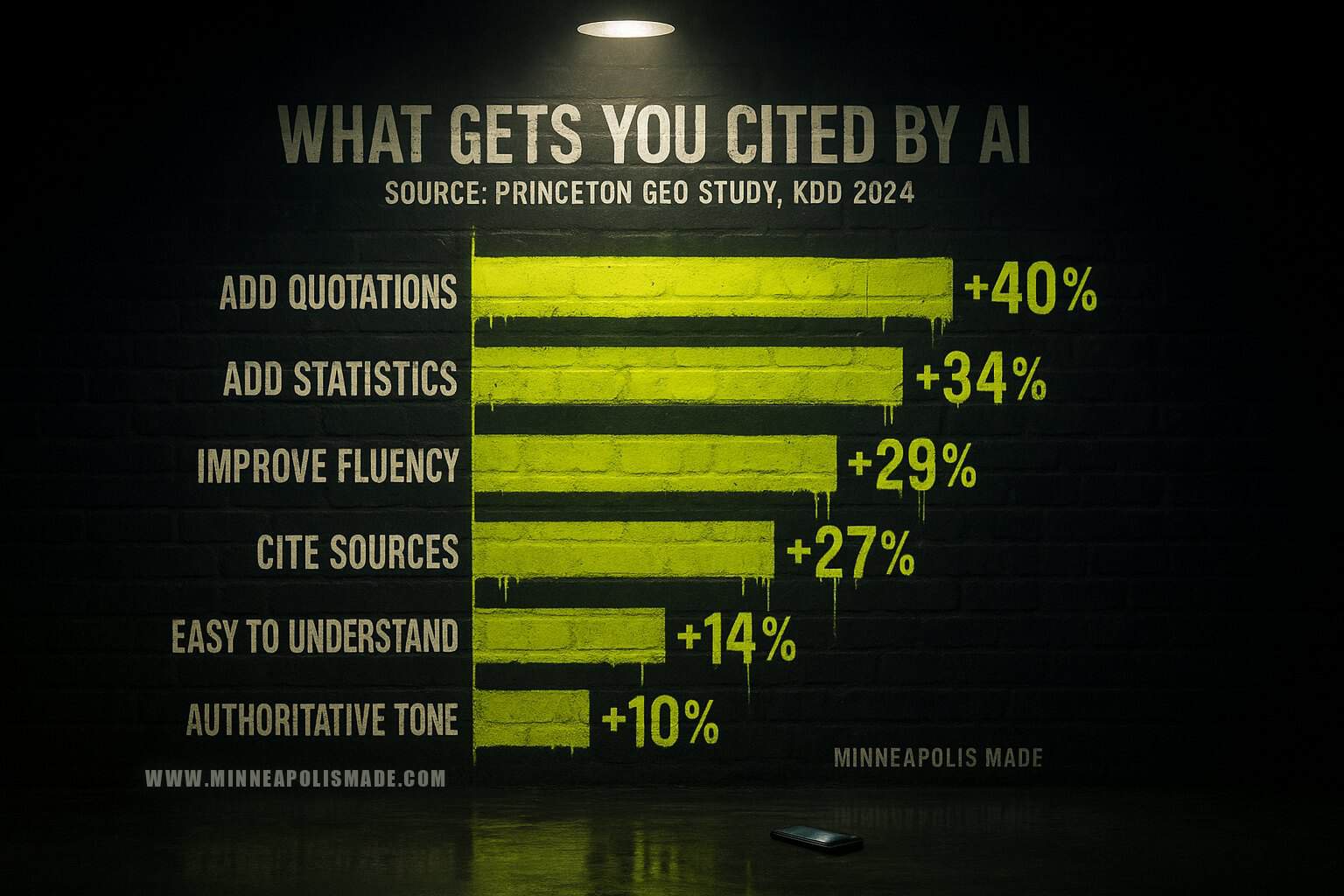
- In peer-reviewed research (Princeton and IIT Delhi, KDD 2024), adding quotations to a source lifted its visibility in AI answers by up to 40%, adding statistics by 34%, and citing sources by 27%, while keyword stuffing made results worse.
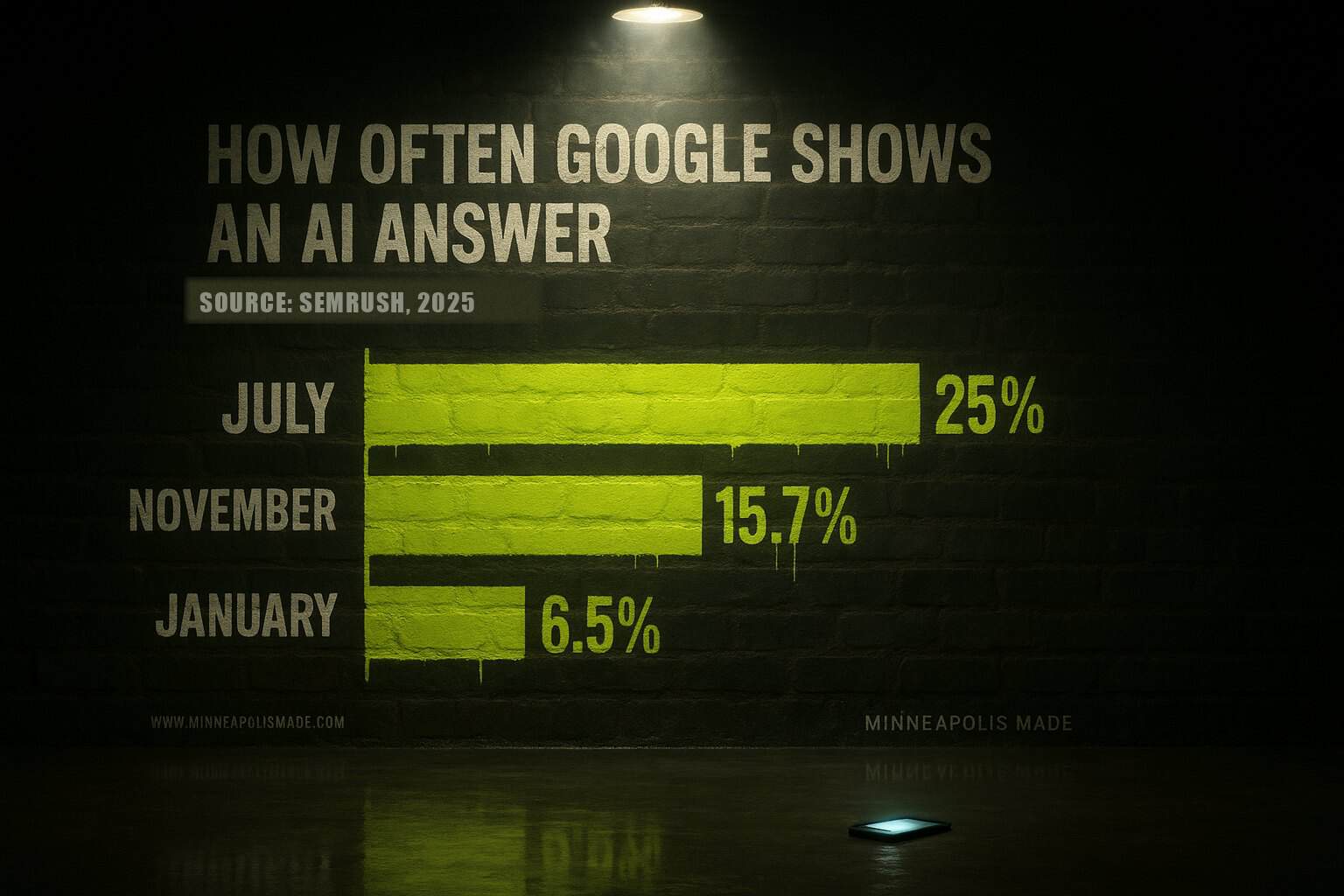
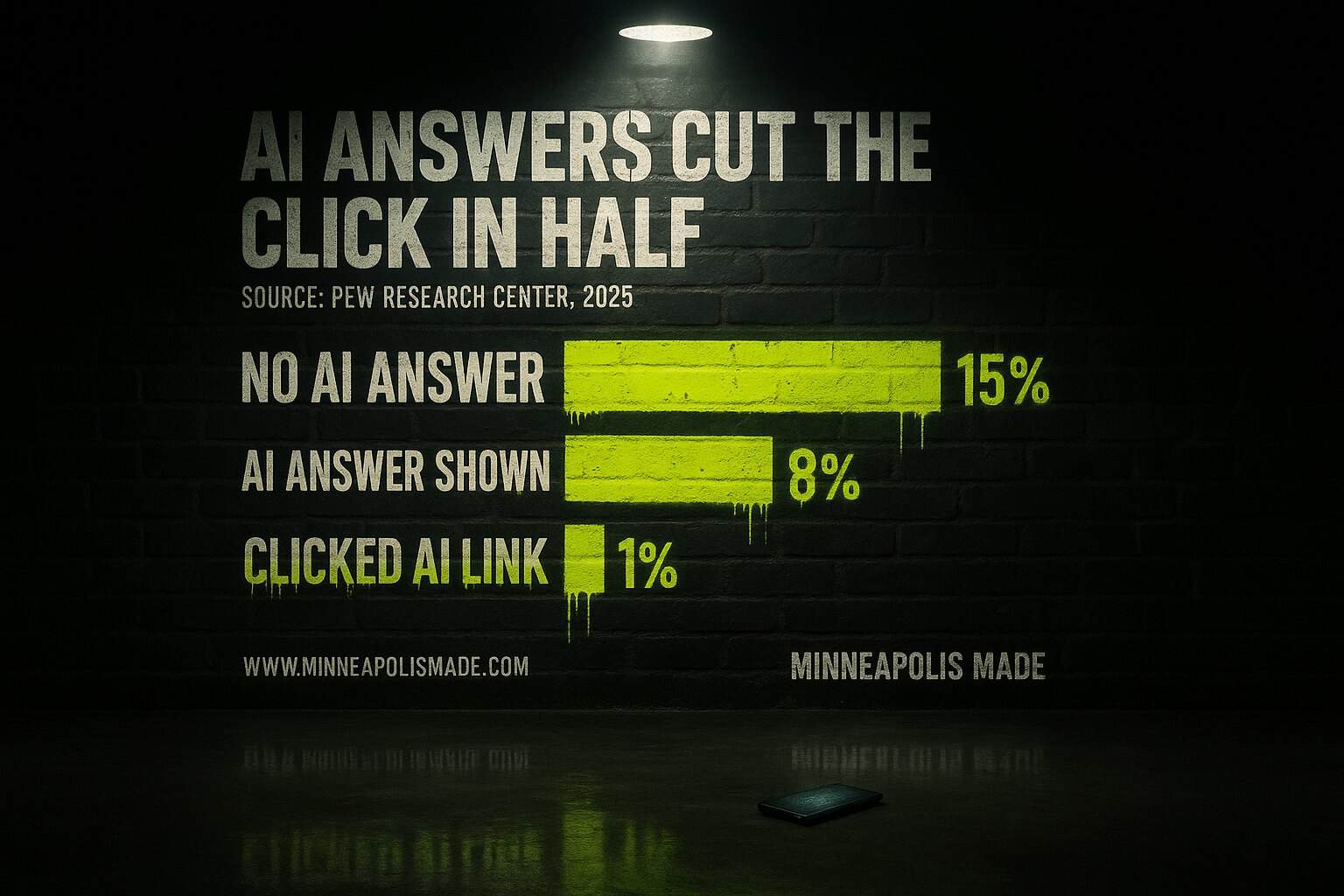
- Google AI Overviews settled at about 15.7% of keywords by November 2025, and when an AI summary appears, users click a traditional result only 8% of the time versus 15% without one (Pew Research Center).
- GEO does not replace SEO. SEO gets you crawled and ranked; GEO gets you quoted. They compound.
- When we asked ChatGPT for the best web designers in Minneapolis, its entire answer was pulled from a single editorial roundup. Perplexity, asked the same thing, leaned on directories like Clutch and Yelp plus Reddit. Different engines cite different sources.
What is generative engine optimization?
Generative engine optimization (GEO) is the practice of structuring content and online presence so that AI engines, like ChatGPT, Perplexity, Google's AI Overviews, and Gemini, cite it when they generate an answer. The term comes from a 2024 research paper by Aggarwal and colleagues at Princeton and IIT Delhi, presented at the KDD conference, which is the closest thing the field has to an academic foundation.
The difference from old-school search is simple. Traditional search hands you a list of links and lets you pick. A generative engine reads dozens of pages, writes a single answer, and quotes only the few sources it trusts. GEO is how you become one of those quoted sources.
Unique InsightGEO quietly levels the field for small local businesses. AI engines reward clear, well-structured, genuinely useful content over raw domain size, so a five-person Minneapolis studio can get quoted in the same answer as a national brand, as long as the content is built the way the engines read. This is the opposite of the old backlink arms race, where the biggest domain almost always won.
Why does GEO matter right now?
GEO matters because AI answers are already eating the clicks that used to reach your website. According to a July 2025 Pew Research Center study of nearly 69,000 real searches, when Google showed an AI summary, users clicked a traditional search result only 8% of the time, compared with 15% when no summary appeared. Just 1% clicked a link inside the AI summary itself.
Those AI summaries are not rare anymore. Semrush's AI Overviews study tracked their spread across 2025: from 6.5% of keywords in January, to a peak near 25% in July, settling around 15.7% by November. The box that intercepts your customer before they reach your site now shows up on roughly one in six searches.
Meanwhile the traffic that does arrive from AI is unusually valuable. Adobe Analytics found that visitors arriving from generative-AI sources browsed 12% more pages, engaged 8% longer, and bounced 23% less than other visitors. These are researched, high-intent buyers, and AI decided who to send them to.
The shift is not just theoretical. For balance, it is worth noting the effect size is still debated: Semrush's matched-keyword method found zero-click rates rose only modestly, from 33.75% to 31.53%, after AI Overviews appeared, a smaller swing than Pew's session-level numbers. And Gartner's widely quoted prediction that search volume will drop 25% by 2026 is a forecast, not measured data, and one some SEOs openly dispute. The honest read: AI answers are clearly reshaping clicks, but anyone selling you a single doom number is overselling what's known.
GEO vs SEO: what's the difference?
SEO optimizes to rank a page; GEO optimizes to be quoted in an answer. That's the whole difference in one sentence. SEO's unit of success is a position in a list. GEO's unit of success is a citation inside a generated response, often with no click at all.
They overlap, because both need content that is crawlable, accurate, and authoritative. But they reward different things. SEO has long rewarded keyword targeting, backlinks, and page authority. GEO rewards clarity, quotable passages, cited evidence, and a clean entity footprint across the web. A page can rank sixth on Google and still be the source an AI quotes, because it answered the question in a cleaner, more extractable way than the page ranked first.
So will GEO replace SEO? No. SEO is how engines find and trust you in the first place; several AI engines build their answers on top of Google's and Bing's own indexes. GEO is how you get chosen once they've found you. You need both, and the good news is the work compounds: the structural fixes that help AI quote you also tend to help you rank.
Google itself frames it the same way. On the company's Search Off the Record podcast, Search Liaison Danny Sullivan put the alphabet soup of new acronyms in its place:
“This whole AEO, GEO, whatever it is that people are thinking about … to me, I'm defining those as a subset of SEO.”— Danny Sullivan, Google Search Liaison, on Search Off the Record (2025)
In other words, the fundamentals do not change. GEO is a new surface to be found on, not a new rulebook that throws out everything SEO taught you.
Related: AI Visibility vs. Traditional SEO in 2026: What Every Business Owner Needs to Know
How do AI engines decide who to cite?
AI engines favor content that quotes sources, includes statistics, and reads clearly, and the effect is measurable. In the GEO study, adding relevant quotations to a source boosted its visibility in AI-generated answers by up to 40%. Adding statistics gave a 34% lift, improving fluency 29%, and citing sources 27%. Keyword stuffing, the reflex that defined a generation of SEO, produced negative results.
That is the single most important thing to understand about GEO: the tactics that win are almost the opposite of the tactics that won early SEO. You don't game the engine by repeating a phrase. You earn the citation by being the clearest, best-evidenced, most quotable answer on the page.
How do you get cited by AI? A 7-step GEO playbook
You get cited by making each passage a clean, sourced, self-contained answer, then reinforcing your brand everywhere AI engines look for trust. Here is the practical checklist we use, in plain English.
- Answer the question in the first two sentences. Under each heading, state the answer directly before you explain it. AI engines lift that opening block almost word for word.
- Cite named sources with real numbers. A sentence with a statistic and a link is far more quotable than an opinion. This is the highest-lift tactic in the research.
- Add original data or direct quotes. One number nobody else has beats ten summaries of other people's work. Original data is what makes a page the primary source.
- Use structured data (schema). FAQ, Organization, and LocalBusiness markup in JSON-LD helps engines understand who you are and what each passage means. It's the label that tells the machine what it's reading.
- Build mentions on sites AI trusts. Reviews, directories, and editorial coverage across the open web train engines that your brand is real and recommended. AI triangulates trust from third parties, not from your own marketing copy.
- Keep it fresh and factually clean. A visible update date and current numbers help; stale or wrong facts get a page skipped.
- Make sure AI crawlers can actually read you. If your content only renders in JavaScript or hides behind scripts, engines may never see it. Clean, server-rendered HTML wins.
Related: Single-Page Application SEO: Making Sure Crawlers Can Read Your Site
Want to know if AI is quoting you or your competitors?
We'll test your top buyer questions across ChatGPT, Perplexity, and Google AI Overviews, show you exactly who's getting cited instead of you, and hand you a prioritized fix list.
What did AI actually say about Minneapolis businesses?
To see GEO in the wild, we ran a small test in July 2026: we asked ChatGPT and Perplexity real buyer questions about Minneapolis web design and SEO and recorded exactly which sources each engine cited. The finding was clear, and a little surprising, the two engines behave nothing alike.
Personal ExperienceWhen we asked ChatGPT (with web search on) "who are the best web design companies in Minneapolis?", its entire answer was built from a single editorial roundup, and it happened to be one of ours. ChatGPT quoted our "best web design companies in Minneapolis" post, pulled its list of firms, and even appended a tracking tag to the link. One well-structured roundup became the source the engine trusted. That is GEO working exactly as the research predicts: a clear, list-structured, genuinely useful page got quoted verbatim.
Perplexity, asked the identical question, did the opposite. It cited a spread of eight-plus sources, leaning on third-party directories like Clutch, DesignRush, and Yelp, a Reddit thread, and the firms' own websites. When we asked Perplexity to recommend an SEO agency for a small Twin Cities business, it again pulled from directories and aggregators (Clutch, OnToplist, Semrush's agency listing) rather than any single article.
The takeaway for any local business is concrete: there is no one "AI" to optimize for. ChatGPT rewarded a strong editorial roundup. Perplexity rewarded presence across directories, review sites, and community threads. To be cited across both, you need your own well-structured content and a real footprint on the third-party sites each engine trusts.
Do you need special GEO tools?
Not to start. Most "GEO tools" on the market today are AI-visibility trackers that repeatedly prompt the engines and chart how often your brand appears, useful for monitoring a trend, but not a substitute for the underlying work. For a small business, the most honest first step is free: open ChatGPT, Perplexity, and Google, ask the questions your customers ask, and write down who gets cited. That manual prompt audit tells you where you stand before you spend a dollar on software.
Treat any single "AI visibility score" as directional, not precise. Because AI answers are probabilistic, the same prompt can return different citations on different runs, so watch the trend over weeks rather than obsessing over one number.
Related: How AI is changing Google local search: the five surfaces customers now use to find you
Frequently Asked Questions
Will GEO replace SEO?
No. GEO and SEO compound rather than compete. SEO gets your pages crawled, indexed, and ranked, and several AI engines build their answers directly on top of Google's and Bing's indexes. GEO determines whether those engines quote you once they've found you. With AI Overviews now on about 15.7% of keywords (Semrush) and traditional search still driving the majority of clicks, you need to win on both surfaces at once.
What is generative engine optimization?
Generative engine optimization (GEO) is the practice of structuring content and online presence so AI answer engines, such as ChatGPT, Perplexity, Google AI Overviews, and Gemini, cite it in their responses. The term was formalized in a peer-reviewed 2024 study (Aggarwal et al., KDD 2024). Where SEO targets a ranking position, GEO targets a citation inside the AI's answer.
Is generative engine optimization a real thing?
Yes. It is grounded in peer-reviewed research (the KDD 2024 GEO paper benchmarked nine tactics across 10,000 queries) and backed by measurable traffic: Adobe Analytics reported that U.S. retail traffic from generative-AI sources jumped 1,200% between mid-2024 and early 2025. The tactics are documented and testable, even if the discipline is still young.
How do I get cited by ChatGPT?
Answer questions directly in the first two sentences of each section, back claims with statistics and cited sources, publish original data, add FAQ and Organization schema, and build mentions on the third-party sites ChatGPT reads. In our own testing, ChatGPT favored a well-structured editorial roundup, so clear, list-based, genuinely useful pages are quoted most often.
How is GEO different from AEO and SEO?
Barely, and that's the point. Answer engine optimization (AEO) and generative engine optimization (GEO) are essentially the same discipline under different names, and Google's Search Liaison, Danny Sullivan, calls them "a subset of SEO." Traditional SEO gets your pages found, indexed, and ranked; GEO and AEO aim that same work at being quoted inside AI-generated answers. The fundamentals, clear content, real evidence, and technical accessibility, stay the same.
How do I get cited by Perplexity?
In our July 2026 testing, Perplexity built its answers from many third-party sources rather than any single article, leaning on directories like Clutch, DesignRush, and Yelp, plus Reddit threads and the businesses' own sites. To earn Perplexity citations, invest in a strong, consistent presence across reputable directories and review platforms, not just your own content. That is the opposite of ChatGPT, which favored one well-structured editorial roundup.
Does schema markup help with GEO?
Yes, indirectly. Structured data (Schema.org JSON-LD) such as FAQ, Organization, and LocalBusiness markup helps engines understand who you are and what each passage means, which makes your content easier to parse and attribute. Schema alone will not guarantee a citation, but it removes ambiguity that can keep an engine from quoting you. Treat it as a supporting signal alongside clear, well-sourced content.
How do you measure GEO success?
You measure GEO by citations, not rankings. Prompt the target engines, ChatGPT, Perplexity, and Google AI Overviews, with the questions your customers actually ask and record whether your brand is named or linked. Track that over several weeks rather than a single run, since AI answers are probabilistic, and watch for AI-referral traffic in your analytics. A classic keyword rank position will not tell you whether AI is quoting you.
Related: What ChatGPT and Perplexity Say About Minneapolis Businesses
Related: Do You Still Need SEO in the Age of AI?
Related: What Is SEO in 2026? A Working Definition for Business Owners
Ready to get your business quoted by AI?
Minneapolis Made is a hybrid studio that builds and optimizes sites for both Google rankings and AI citations. We work hourly at $85/hr, no packages, no lock-in. Book a 20-minute call and we'll walk through your top three GEO gaps live.