
Right now, somewhere in Minneapolis or St. Paul, a potential customer is opening ChatGPT or Perplexity and asking for the best lawyer, dentist, plumber, or restaurant in town. The AI is about to recommend a few businesses. Maybe yours is on the list. Probably it isn't.
We wanted to know exactly how AI tools pick which Twin Cities businesses to recommend, so we ran our own audit. We asked ChatGPT and Perplexity 96 questions about local businesses across 8 industries. The results were eye-opening. The two AI tools recommend almost completely different businesses, and the ones they consistently pick share four specific traits.
Here's what we found, what it means for your phone calls and bookings this quarter, and exactly what to do about it. By the end of this article you'll know whether your business is showing up, and what to fix if it isn't.
Updated July 2026: We re-ran this audit and built a companion leaderboard showing who AI names as the best in each Minneapolis industry, and how wildly the picks change run to run. See Who Does AI Recommend in Minneapolis? We Asked 96 Times.
 ChatGPTOpenAI
 PerplexityPerplexity AI
 GeminiGoogle
 ClaudeAnthropic
 GrokxAI
 CopilotMicrosoft
 Meta AIMeta
Related: Best Web Design Companies in Minneapolis [2026 Rankings]
Key Takeaways
- Customers are using AI to find Twin Cities businesses right now. ChatGPT alone reaches 900 million weekly users, up from 800 million in October 2025.
- ChatGPT and Perplexity recommend almost completely different businesses. Across our latest 8-industry Twin Cities retest, only 6.5% of source citations overlapped between the two platforms (down from 8.6% a few months prior).
- For restaurants, the overlap was 0%. The two AI tools cited zero sources in common.
- AI-referred shoppers convert 31% more often than other traffic sources, per Adobe's 2025 holiday recap.
- The businesses that consistently show up in both AI tools share four traits we lay out in the 6-step playbook below.
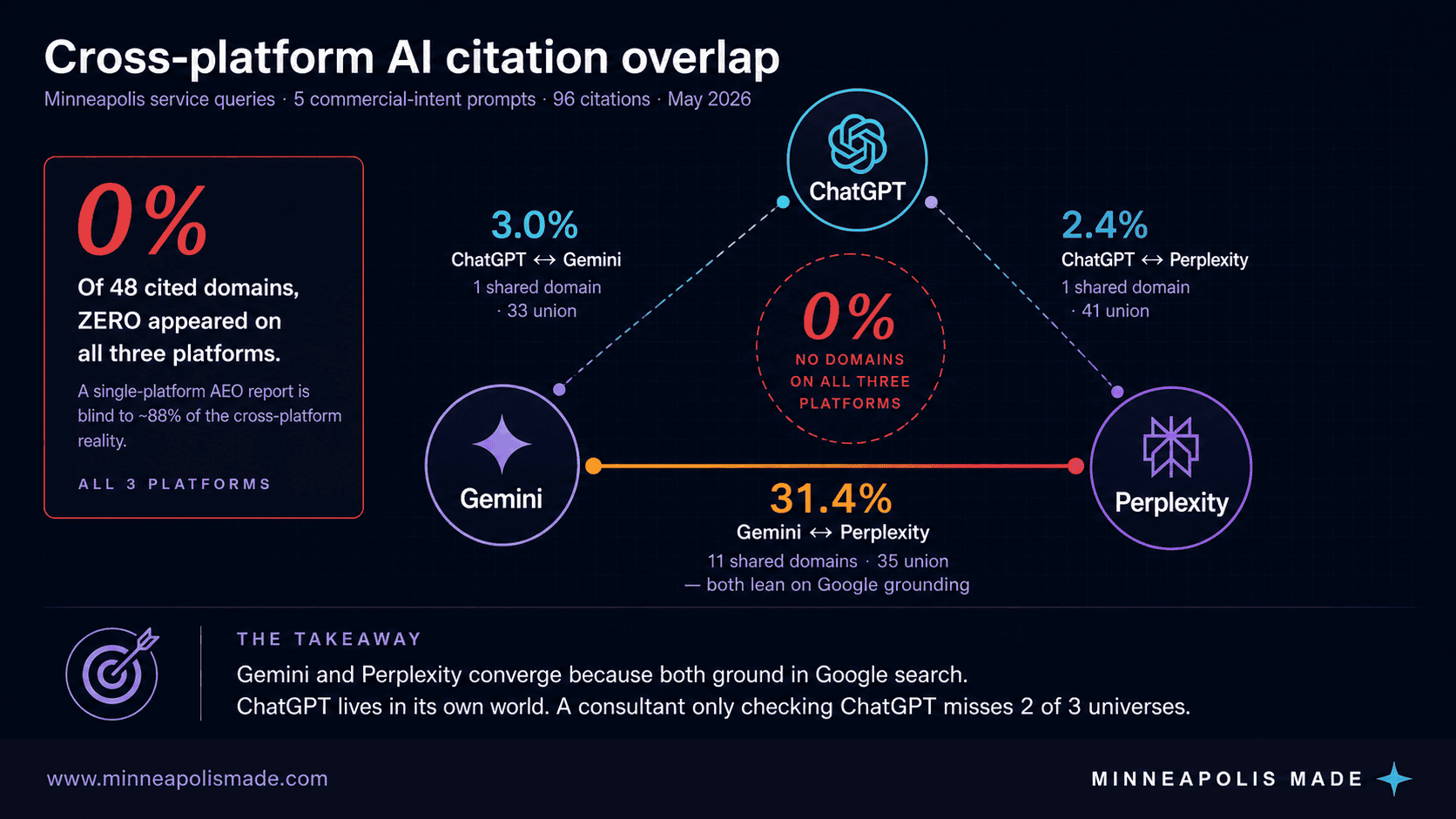
- We re-ran the audit in May 2026 with Gemini added. Across 3 AI platforms and 5 commercial-intent Minneapolis prompts, zero domains were cited by all three. Single-platform AEO reports are blind to roughly 88% of cross-platform reality.
Why should your business care about ChatGPT and Perplexity?
The simple version: ChatGPT now reaches 900 million people a week, and a growing share of them are using it the way they used to use Google. They type a question, they read the answer, and they trust the names that come back. When the question is "where should I get my deck stained in Minneapolis," your business name had better be in the answer.
Here's the part that changes the math. Customers who arrive at a business through ChatGPT spend more and convert at higher rates than customers from any other source we measure. Adobe's 2025 holiday shopping recap showed AI-referred shoppers converting 31% more often than other traffic sources, with a 54% lift on Thanksgiving alone. Translate that into your monthly numbers. If you currently turn 1 in 20 website visitors into a phone call, every visitor sent by ChatGPT is worth roughly 2 phone calls under the same conditions.
Unique InsightThe reason the conversion is higher is simple. Someone Googling "best dentist near me" is at the start of comparison shopping. Someone who asked ChatGPT "I'm new to Edina, who should I trust with my kids' teeth?" is being handed three names by what they consider a trusted advisor. They show up pre-sold. The work you put into ranking on Google still matters. What's changed is that there's now a whole second motion that produces warmer, easier-to-close customers, and most Twin Cities businesses are completely missing it.
The flip side is just as important. If your business doesn't show up in ChatGPT or Perplexity, you're invisible to that whole channel. The customer asks the AI, gets recommended your competitors, and never even sees your name. They're not shopping any more. They're already on their way to a meeting with a competitor.
How did we figure out who AI picks?
We built a simple test. We came up with 48 unique questions a customer might ask, like "what's the best web design agency in Minneapolis" or "recommend a dentist in St. Paul." We covered 8 industries: restaurants, dentists, lawyers, accountants, plumbers, real estate agents, marketing agencies, and web design. We sent each question to both ChatGPT and Perplexity and recorded every business and source they recommended in their answer. That gave us 96 results to compare side by side, with hundreds of cited businesses and websites in the responses.
We then sorted out which businesses each AI tool kept recommending, where each AI was getting its information, and where the two AIs agreed and disagreed. The data is what's behind every chart and stat below. We're committed to running this same test every 90 days for the rest of 2026, so we can track who's climbing in the rankings and who's slipping.
Personal ExperienceHonestly, we expected the two AI tools to mostly agree. When the test finished and we ran the overlap number first, 8.6% felt wrong. We re-counted by hand for one industry, then re-checked the math, then pulled ten random questions and verified the results manually. The number was real. ChatGPT and Perplexity genuinely don't agree about who matters in the Twin Cities, and that has real consequences for your marketing.
Why don't ChatGPT and Perplexity recommend the same businesses?
Across our May 2026 retest of 8 Twin Cities industries, only 6.5% of source citations appeared on both ChatGPT and Perplexity. Not 80%, not 50%. Closer to 1 in 16. ChatGPT and Perplexity are operating on largely separate worlds of who matters in the Twin Cities, and which industries overlap the most has shifted noticeably between audits.
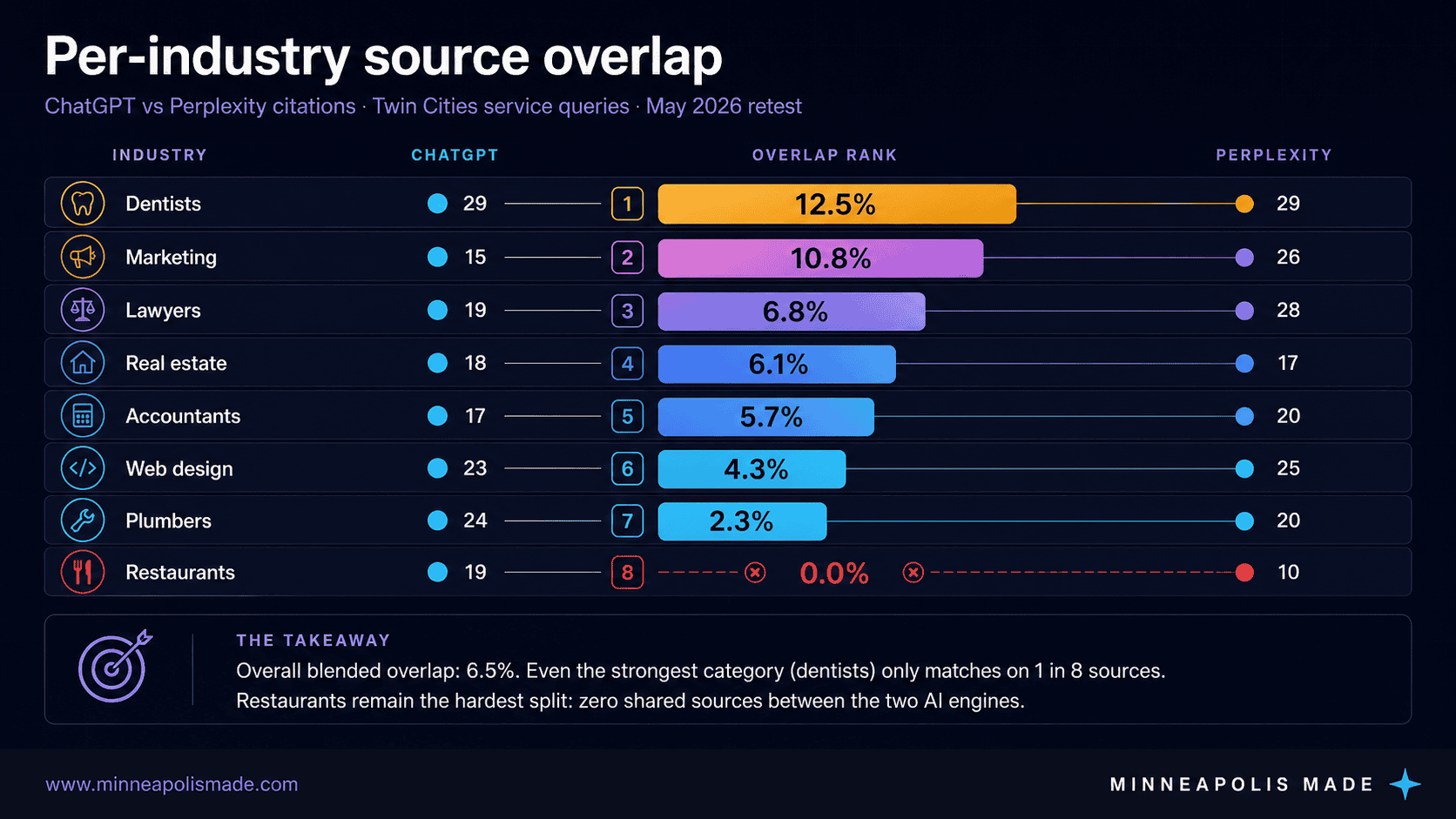
Dentists and marketing agencies came in with the most overlap (12.5% and 10.8%), while plumbers and restaurants came in lowest (2.3% and 0%). Notably, the categories that led the original audit (real estate and lawyers, both above 12% in our first pass) have dropped under 7% in the retest, with dentists and marketing taking the top spots. The two AI tools are not just different from each other; the way they differ shifts category by category and audit by audit.
This isn't unique to Minneapolis. A Yext study that analyzed 17.2 million AI citations across Q4 2025 found that the four major AI engines (Gemini, Claude, Perplexity, SearchGPT) draw from largely non-overlapping source mixes, with each platform showing a distinct "information personality." Our local pass came in more divergent still.
The per-industry breakdown is where the picture gets sharper. Real estate agents and lawyers showed the most overlap at about 13%. Restaurants showed exactly zero overlap. Not a single source in common.
Why does ChatGPT think like a reporter and Perplexity like a shopper?
Look at what each AI cited that the other didn't, and a clear pattern jumps out. ChatGPT pulled from Reddit, MSP Magazine, Eater Twin Cities, Forbes, the James Beard Foundation, Axios Twin Cities, and Minnesota state government sites. Pretty much all editorial, news, civic, and community sources. Perplexity pulled from Thumbtack, BBB, Tripadvisor, the Minnesota Society of CPAs, individual business homepages, and YouTube. Pretty much all directories, review sites, and the businesses themselves.
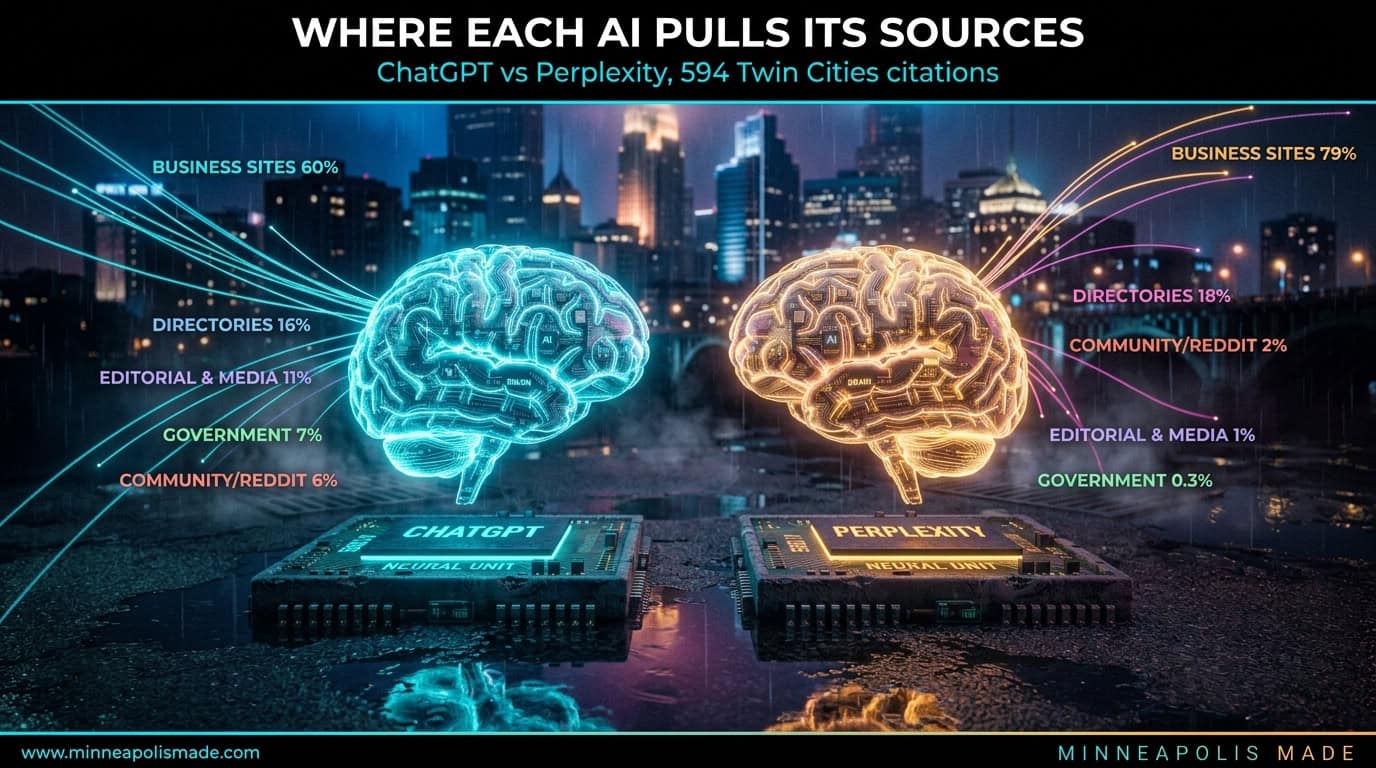
Think of it this way. ChatGPT is a journalist with a search bar. It looks for editorial coverage, government data, and Reddit consensus before it makes a recommendation. If you've been written about by a credible local outlet, or if there's a strong Reddit thread mentioning your business, ChatGPT considers you trustworthy. Perplexity is a comparison shopper with a clipboard. It checks the directory listings, reads the reviews, and clicks through to see what your actual business website says. If you have rich profiles on Yelp, Tripadvisor, and Thumbtack, plus a substantive website, Perplexity considers you worth recommending.
Unique InsightThis is the most important takeaway in the whole article. Optimizing for one of these AI tools doesn't help you with the other. They live in different information universes. Most Twin Cities businesses we work with are doing zero work for either platform, which means even basic moves can put you ahead of competitors who are also doing nothing. The handful of businesses that show up on both AI tools (we'll get to who they are in a minute) all do two separate things in parallel.
Why did restaurant queries show 0% overlap?
This was the most extreme finding in the whole audit, and it has held up under retesting. We asked the two AI tools six different versions of "what's the best restaurant in Minneapolis" or "in St. Paul" or "in the Twin Cities." ChatGPT and Perplexity cited zero of the same sources across every version. We re-ran the test in May 2026 with three fresh prompts and got 0 of 15 unique domains shared. Not a single source in common.
Original DataWhat did change between our original audit and the May 2026 retest is what ChatGPT cites. In our first pass, ChatGPT leaned on editorial food media (Eater Twin Cities, MSP Magazine, James Beard Foundation, Reddit). In the retest, it had shifted toward individual restaurant websites and Google Maps cards: Spoon and Stable, Nixta, Gainoi, and Wrecktangle Pizza were the names that came back. The editorial sources didn't appear at all. Perplexity continues to pull from the directory side: Tripadvisor, OpenTable, Resy, Minnesota Monthly, Visit Saint Paul, plus a handful of food blogs and YouTube clips.
The two AI tools never overlap on a source, but the kind of source they each prefer also moves over time. ChatGPT in particular has gotten more comfortable citing the actual restaurant's homepage instead of an editorial roundup, which means restaurants with thin website content are getting skipped now where they might have been mentioned a year ago. The lesson: your own restaurant website matters more for AI visibility than it did even a few months back.
One important note for restaurants specifically: Google's AI Overview does not currently trigger for "best restaurants" queries in our market. Our SERP test for "best restaurants in Minneapolis" returned a local pack, organic results, People Also Ask, and Discussions and Forums modules, but zero AI Overview blocks. So for restaurant discovery, the AI search game right now is ChatGPT and Perplexity. Google's AI is sitting it out.
If you run a Twin Cities restaurant, the practical takeaway is sharp. ChatGPT now wants to cite your restaurant's own website, so make sure that website actually says what you serve, where you are, what hours you keep, and what your story is. Perplexity wants you to be visible across Tripadvisor, OpenTable, Resy, and the food-publication sites it's already trusting. The work to win on one platform doesn't help you on the other. A restaurant doing one well and ignoring the other is missing roughly half of its AI-discovery audience.
Where do ChatGPT and Perplexity actually agree?
The handful of businesses both AI tools recommend share an interesting pattern. The top consensus picks were Clutch, Zillow, SuperLawyers, JAK CPA, Schwebel Law Firm, Angi, and MVP Design. Clutch alone was cited 19 times across our 96 questions, by both AI tools, more than any other source.
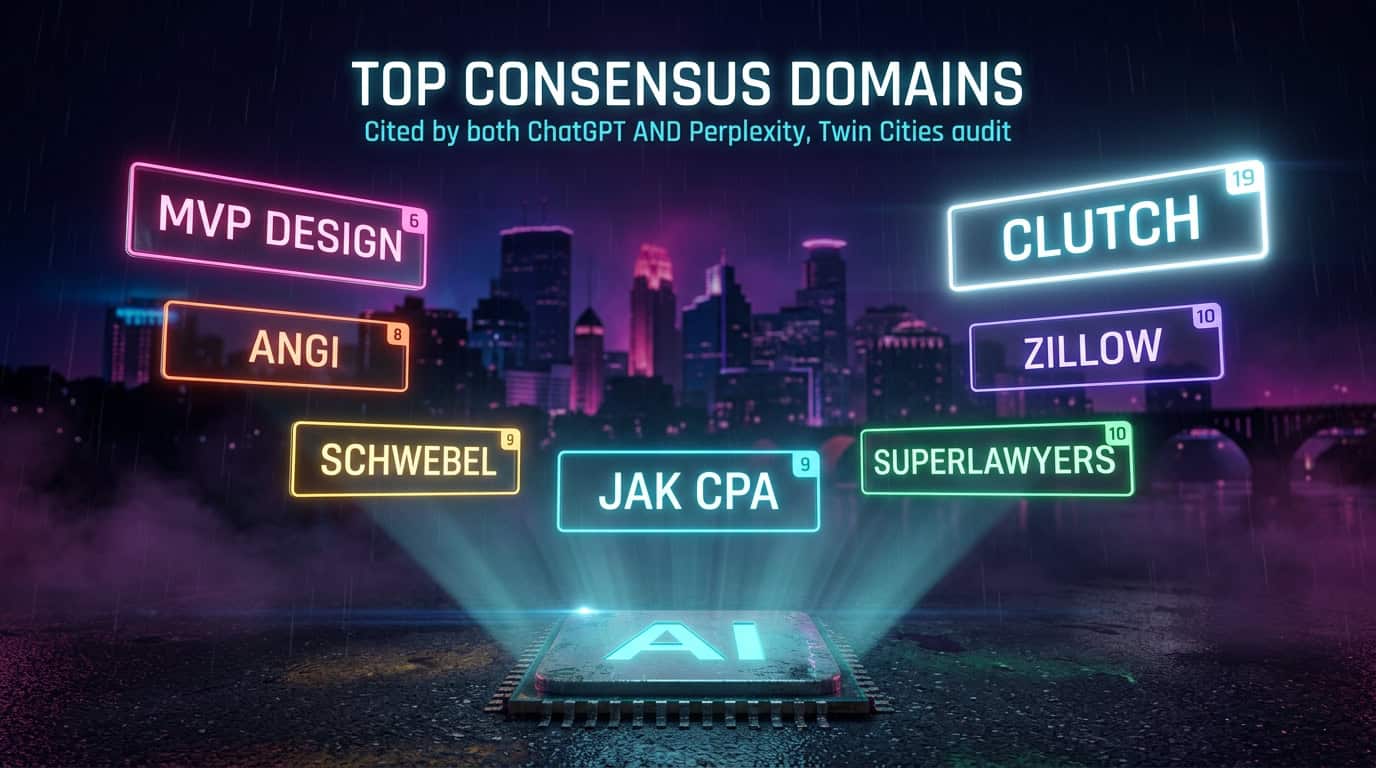
Look at the list and a pattern jumps out. Most of the consensus picks are intermediaries: third-party directories and ranking sites like Clutch (web design rankings), SuperLawyers (legal directory), Angi (home services), and Zillow (real estate). The few actual operating businesses on the consensus list (JAK CPA, Schwebel Law Firm, MVP Design) all share three traits. Each has been around for decades. Each has been written about by editorial outlets in the Twin Cities. And each maintains active, complete profiles on the directories. They've won both motions, the journalist motion AND the shopper motion.
This means there's a real lever you can pull. The directories that both AI tools agree about are where your dollar of effort goes the furthest. You don't need to outrank the agencies and law firms that have been featured on local TV for twenty years. You need to be on Clutch, on Yelp, on the right industry directory for your trade. That's the move with the most return.
Update: we added Gemini to the audit. Here's what changed.
When we first published this study we left Google's AI tools out of the data because their citations all redirect through a Google-owned wrapper that hides the real source. In May 2026 we figured out how to unwrap those redirects, pulled the actual cited domain, and re-ran the methodology against three platforms instead of two: ChatGPT, Gemini, and Perplexity. The headline number got worse, not better.
Original DataAcross 5 commercial-intent prompts about Minneapolis service businesses, our three-platform pass produced 96 citations across 48 unique domains. Zero of those 48 domains were cited by all three AI tools. Not one. The pairwise numbers are equally stark: ChatGPT and Perplexity overlapped on 2.4% of cited domains, ChatGPT and Gemini on 3.0%, and Gemini and Perplexity on 31.4%. Gemini and Perplexity converge because both lean on Google's search index for grounding. ChatGPT lives in its own world.
The bigger surprise: each platform has a different bias toward directories
When we tagged each cited domain as either an actual operating agency or a directory or listicle (Clutch, GoodFirms, DesignRush, Webdesignrankings, etc.), the platforms diverged sharply. ChatGPT cited 100% agencies, with zero directory citations across all 30 of its results. Gemini cited 31% directories and 65% agencies. Perplexity sat in the middle at 22% directories and 75% agencies.
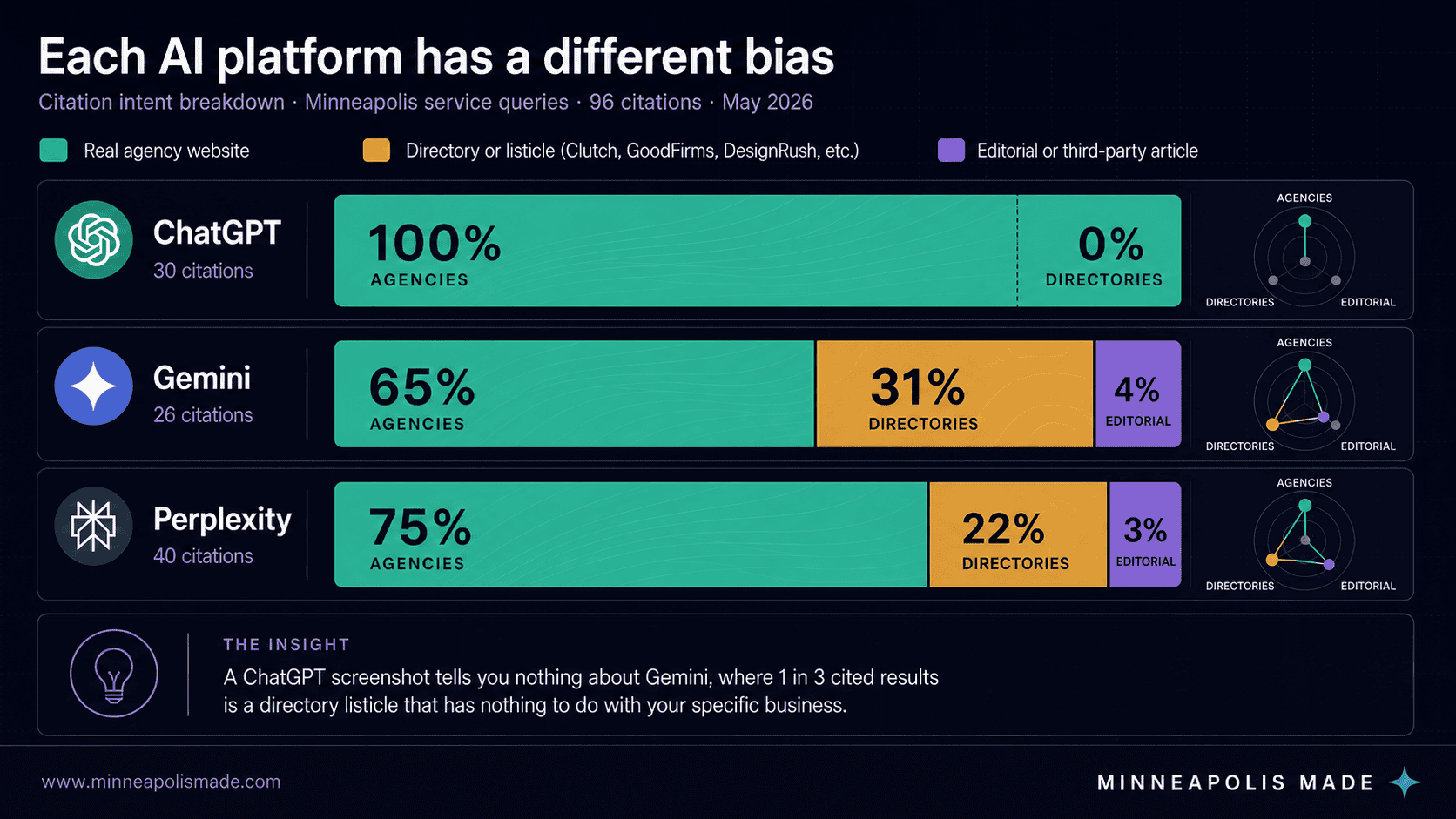
This matters more than the raw overlap number for one reason. If your AEO consultant only checks ChatGPT and shows you a screenshot of you appearing in a top-3 list, that screenshot says nothing about whether you'll appear in Gemini, where 1 in 3 cited results is a directory listicle that has nothing to do with your business. The optimization to win on ChatGPT (be a real agency website with strong topical authority) is genuinely different from the optimization to win on Gemini (have your name on the directory listings ChatGPT ignores).
Why your AEO consultant probably can't show you this data
Real multi-platform citation tracking costs money. Otterly and Peec AI start around $30 to $200 a month per platform. Profound starts closer to $500. Brandlight and Conductor's AI Search module are enterprise pricing, often $1,000 to $2,000 a month per platform. A consultant tracking three platforms across decent tools is carrying a tool bill of several hundred to a couple thousand dollars a month before they pay themselves anything. Most freelancers and small agencies don't carry that line item, so they screenshot one ChatGPT result, call it a "win," and bill the retainer.
The cheap-but-real alternative most providers ignore is DataForSEO's ai_optimization/llm_responses endpoints, which run roughly $0.03 per ChatGPT prompt and $0.006 per Perplexity prompt. The 5-prompt, 3-platform audit you just read cost us 38 cents to run end to end. There's no reason an AEO consultant charging $1,500 a month can't produce this kind of data on demand.
Of the 96 citations our audit produced for the five Minneapolis service prompts, Minneapolis Made appeared exactly once: ChatGPT cited us via a Google Maps redirect for "Minneapolis SEO company for small business." Zero citations on Gemini. Zero on Perplexity. Zero on the other four prompts. We are publishing that number because it's the truth, because most agencies are hiding the same truth from their clients with cherry-picked screenshots, and because we just put it on the work board for our next 90-day cycle. Anyone selling AEO services who isn't this transparent about their own coverage is selling something other than measurement.
The 5-step audit you can run on your consultant in 30 minutes
You don't need to wait for a monthly report. You can run the verification pass yourself this afternoon.
- Pick 5 commercial-intent prompts. Use the formula
[descriptor] [your service] in [your city]. Avoid branded prompts because a citation for "what is [your brand]?" is worth nothing. Examples that work: "best web design agency in Minneapolis," "Minneapolis SEO company for small business," "who builds e-commerce sites in the Twin Cities." - Query each prompt on three platforms. ChatGPT (web search mode on), Perplexity (free tier is fine for spot checks), and a Google search with AI Overview enabled. If you have access to Gemini's grounded-search mode, add it as a fourth.
- Log every cited domain in a spreadsheet. Three columns: prompt, platform, cited domain.
- Classify each citation by intent. Is it a real competing business, a directory like Clutch or GoodFirms, or an editorial article? A directory citation is not the same as a brand citation. Drop branded-navigational results entirely.
- Compare against what your consultant has reported. Any gap larger than 50% between what they showed you and what you found is a red flag. A consultant who can't reproduce your numbers within 24 hours is selling a different service than the one they invoiced.
What a real monthly AEO report contains
Five components, in this order:
- The exact prompt list tested, with any changes since the previous month flagged
- The platform list checked, with at least 3 platforms covered
- The cited brands per prompt per platform, raw data not summary
- The commercial-intent classification for each citation: agency vs directory vs editorial vs branded-navigational
- A month-over-month delta showing what improved, what slipped, and the working theory for why
If your current monthly report is missing any of these five components, ask for them. The request itself is the test. Most providers can't produce them because they aren't actually measuring AI visibility.
Want to know if AI is recommending your business?
We'll run the same test we ran for this article, scoped to your specific industry, and send you a free report within 48 hours. You'll see exactly which AI tools mention your business, what they say, and which competitors are eating your lunch.
How do you get your business picked by both ChatGPT and Perplexity?
Here are the six things we do for our clients to get them recommended on both AI tools. We've ranked them in order of impact. The first three are foundational. The last three compound on top of them.
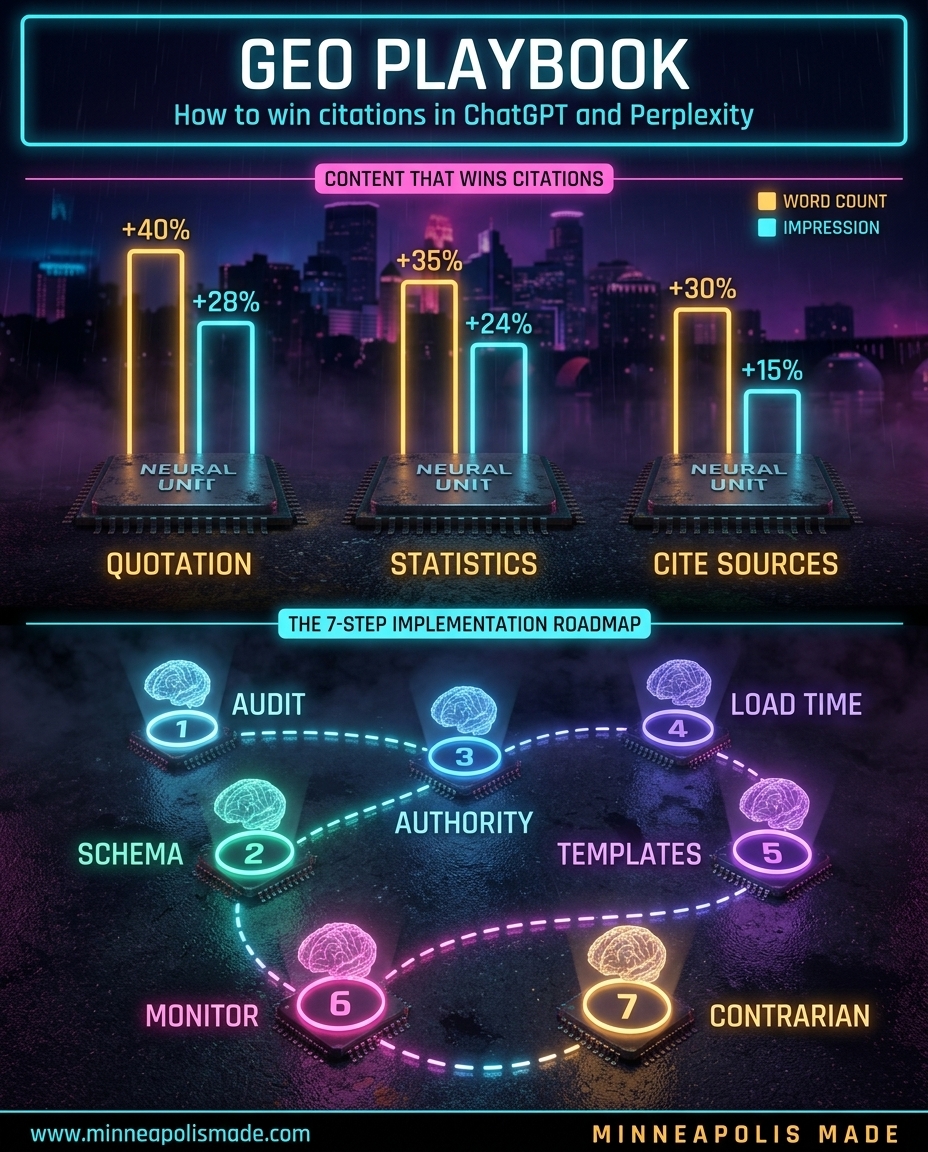
Method ranking based on Aggarwal et al, "GEO: Generative Engine Optimization" (KDD 2024), which reports the best GEO methods boost source visibility by up to 41% on Position-Adjusted Word Count and up to 28% on Subjective Impression across the GEO-bench benchmark.
Related: This is the same playbook our Answer Engine Optimization service runs for Twin Cities businesses every month.
1. Claim every directory both AIs agree about
The single highest-impact move you can make today. Get your business onto Clutch (or your industry's equivalent), Angi, BBB, Yelp, the relevant trade association directory, and SuperLawyers if you're a law firm. The same SE Ranking study found businesses with profiles on Trustpilot, G2, Capterra, Sitejabber, and Yelp are three times more likely to be cited by ChatGPT than businesses without those profiles. This isn't optional any more.
2. Get to 50+ Google reviews (and respond to every one)
Fifty reviews is roughly the floor where both AI tools start to consider you worth mentioning. Get below that and you're invisible. Above it, every additional review compounds. Every review needs a response from the business owner, even the negative ones. Both AIs read response patterns as a signal of an active, well-run business.
3. Make Bing happy, not just Google
Here's the secret nobody talks about. Seer Interactive's 2025 analysis found 87% of ChatGPT and SearchGPT citations match Bing's top 10 organic results. Only 56% match Google's top 10. Bing, not Google. Most Twin Cities agencies optimize entirely for Google and treat Bing as an afterthought. Submit your sitemap to Bing Webmaster Tools, audit your Bing rankings the same way you audit Google rankings, and you'll be ahead of basically every competitor in your industry.
4. Build out your directory listings (don't just claim them)
This is the one most Twin Cities businesses get wrong. They claim their Yelp page and stop. Perplexity rewards complete, photo-rich, owner-managed profiles. A barebones Yelp listing that's been claimed but never built out is almost as invisible as a missing one. Add 30+ photos. Write a real business description. Respond to every review. Pin your top categories.
5. Put your answer in the first paragraph of every page
Kevin Indig's analysis of 30 million ChatGPT citations found 44% come from the first third of any web page. Whatever your customer is going to ask, answer it directly in the first paragraph after each section heading. Don't bury the answer in paragraph four. The AI doesn't read paragraph four.
6. Update your content every 90 days
SE Ranking's November 2025 study of 216,000 pages found content updated in the past three months averages 6 ChatGPT citations versus 3.6 for outdated pages. Refresh your headline, swap one stat, replace one image, update the date. Small changes signal "this business is still active" to both AI tools, and active businesses get recommended.
Why most Twin Cities agencies can't help you with this
Two reasons. First, almost nobody has actually run this kind of audit for Minneapolis and St. Paul specifically. Most local agencies are working from generic national advice that doesn't reflect what AI tools actually do when asked about businesses here. Second, the work is split across two separate playbooks. The skill set to get you written up by Eater Twin Cities is fundamentally different from the skill set to dominate Yelp. Most agencies do one well and the other badly. A few do neither.
Unique InsightWe built Minneapolis Made specifically to handle both motions for Twin Cities businesses. We do the directory build-outs. We run the Bing optimization. We manage the editorial PR. We handle the content updates. And we re-test your AI visibility every quarter, so you can see what's working. We're the only Twin Cities agency we know of that publishes its raw audit data, commits to a 90-day refresh cadence, and tracks your specific business's mentions over time.
If your business is in any of the 8 industries we audited (or any other Twin Cities industry, since the methodology applies anywhere), the very next move is to find out what the AIs are currently saying about you. We'll run that test at no cost. Twelve questions in your specific industry. A clear report you can read in five minutes. No commitment to work with us afterward, although most businesses who see the report want to.
Related: Google Business Profile for Law Firms: The Complete Guide to Local Search
Related: Do you still need SEO in the age of AI?
Related: How generative engine optimization gets your business cited by AI
Frequently Asked Questions
Should I optimize for ChatGPT or Perplexity first?
Both, but if you're forced to pick one, start with ChatGPT. It accounts for roughly 9 out of every 10 visits we see arriving from AI search across all of our clients. Perplexity converts at higher rates per visitor, but it reaches fewer people. The good news is that the foundational moves (claiming directories, building reviews, putting answers up front) help both AI tools at the same time.
Did you ever add Google's AI to the audit?
Yes. We added Gemini to a follow-up pass in May 2026 once we figured out how to unwrap Google's grounding-redirect URLs and pull the real cited domain. The findings are in the "Update: we added Gemini to the audit" section above. Short version: cross-platform overlap collapsed to 0% across all three AI tools, and Gemini turned out to lean on directory listings far more than ChatGPT does.
How do I verify whether my AEO consultant is actually getting me cited?
Run the 5-step DIY audit in the verification section above. Pick 5 commercial-intent prompts in your industry. Query them on ChatGPT, Perplexity, and Gemini. Log every cited domain. Classify each as agency, directory, or editorial. Compare against the screenshots and reports your consultant has sent you. Any gap larger than 50% is a red flag. A real AEO audit costs about $0.30 to $1.50 in API spend and takes 30 minutes. A consultant who can't reproduce those numbers on demand isn't measuring AI visibility.
How often should I check my AI visibility?
Every 90 days is the right cadence for most businesses. Pages and directory profiles that haven't been touched in 3 months drop out of AI recommendations fast. Active businesses get recommended; inactive-looking ones get skipped. We re-run our Twin Cities audit quarterly and have already scheduled the next one for July 2026.
Will the same business show up if I ask the AI the same question twice?
Mostly yes. Both ChatGPT and Perplexity are stable when asked the same question repeatedly, with less than 1% variation. The much bigger source of variation is asking different AI tools the same question, where we measured only 8.6% overlap between ChatGPT and Perplexity. The within-tool consistency is high. The between-tool consistency is very low.
Is this just SEO with a new name?
Both, kind of. The traditional SEO work that gets your business onto Bing's first page already gets you a lot of the way to ChatGPT recommendations. Perplexity needs different moves: directory presence, long-form content, and frequent updates. The good news is that the 6-step playbook we laid out above stacks on top of any existing SEO work. You don't replace your strategy. You add a parallel track alongside it.
The two-playbook reality for Twin Cities businesses
Most local businesses think of AI search as one thing to optimize for. Our 96-question audit proved it isn't. ChatGPT reads the editorial press and the Bing search results. Perplexity reads directories, review sites, and your business's own pages. The two AI tools agreed on less than 9% of source citations across the whole audit. For restaurants, the source overlap was zero.
The strategic move for you is two parallel motions, not one. The editorial side and the directory side. Most agencies will tell you to pick one and do it well. We think that's old advice. The Twin Cities businesses winning at AI search right now are running both. We'd be glad to show you exactly where you stand and what to do next.
Related: The 21-Agency Minneapolis Web Design Speed Report
Related: How to Choose a Web Design Company in Minneapolis
Make Minneapolis Made your AI search authority.
We're the Twin Cities agency that's already done the work, has the data, and re-tests every quarter. Whether you want a free 12-prompt audit or a full AI search engagement, the next conversation takes 30 minutes.