If you searched "do I still need SEO in the age of AI" and landed here, you aren't alone. Small business owners across the Twin Cities are asking the same question after every quarter where their organic traffic dipped and their AI Overview impressions climbed. The short answer is yes, and not in the soft "of course, dear" way the SEO industry usually says it. AI search engines literally read your SEO signals to decide who they cite. Skip the SEO, and you skip the AI visibility too.
Key Takeaways
- AI search engines (ChatGPT, Perplexity, Google AI Overviews, Copilot) depend on the same crawl + index + ranking signals that classic SEO has always used.
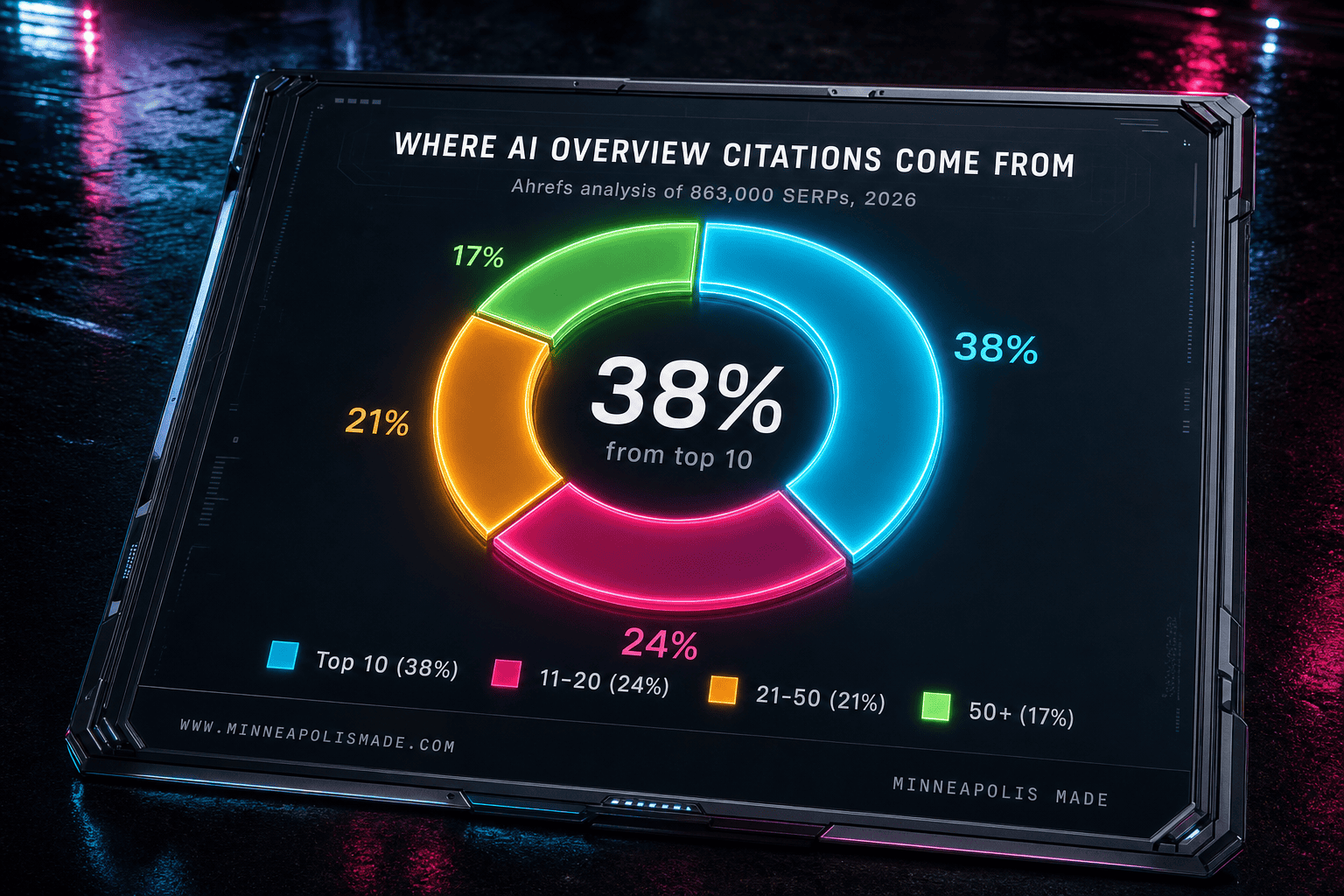
- 38% of AI Overview citations still come from top-10 organic results (Ahrefs, 863K SERP study, 2026).
- Position-1 CTR for AI Overview queries fell 58% (Ahrefs, 2025), but total search-driven business inquiries are up when AI citation traffic is counted.
- Bad SEO produces invisible businesses across both Google and every AI engine at the same time. One decision, two channels lost.
Is SEO dead, or did it just change shape?
Forbes ran a headline in August 2025 called "SEO Is Dead" claiming that AI search had wiped out $74 billion in marketing budgets (Forbes, Kevin Kruse, August 2025). It was a great headline. It was also a measurement issue, not a marketing one.
Here's what actually happened. Organic click-through rates on queries where Google shows an AI Overview did collapse, falling from 1.41% to 0.64% in early 2025 per Seer Interactive's tracking. But by February 2026 those rates had recovered to 2.4% as Google adjusted the visual layout and users learned the new interface (Seer Interactive, AIO Impact on Google CTR: 2026 Update, February 2026). The "death of SEO" headline was real for one quarter, then less real, then mostly wrong.
Unique InsightThe shops that actually lost money in 2025 weren't the ones doing SEO. They were the ones who had been ranking on thin pages with no clear topical authority. AI search rewards substance and punishes filler more aggressively than classic search ever did. The same algorithm shift that "killed" weak SEO made strong SEO more valuable per impression, not less.
Does AI actually use your SEO when it picks what to quote?
Yes, and not in some hand-wavy way. Ahrefs studied 863,000 SERPs in early 2026 and found that 38% of AI Overview citations still pull directly from the top 10 organic results (Ahrefs, 2026). That number was 76% in July 2025, so AI is reaching further down the rankings than it used to, but a top-10 organic position is still by far the strongest predictor of getting cited.
Here's why. Under the hood, every AI search product on the market (ChatGPT Search, Perplexity, Google AI Overviews, Microsoft Copilot, Claude with web search) works the same way. A crawler visits your site. A search engine indexes what it found. When someone asks the AI a question, the AI raids that index for candidate sources, then writes an answer quoting the best ones. No SEO, no crawl, no index, no candidate pool. You're out of the running before the round even starts.
The chain in plain terms
Bot crawls your site. Search engine indexes it. AI search uses that index. AI cites you in answers. Break any link in that chain and the next link can't fire. Most small businesses think they only care about the last step. The damage actually happens at step one.
What happens to your business if you skip SEO now?
AI Overviews appeared on roughly 18% of all Google searches as of March 2025 (Pew Research Center, July 2025), and BrightEdge's tracker put the share above 40% by mid-2026. If your site isn't crawled, indexed, and ranking somewhere in the top 50 for a query, you have effectively zero chance of being cited in the AI answer that appears above the organic results.
Picture the small-business version. A homeowner in Edina opens ChatGPT at 9 pm and asks, "best plumber in Minneapolis for a burst pipe right now." ChatGPT comes back with three companies cited by name. If your plumbing shop isn't one of them, you don't exist in that moment. The customer isn't going to scroll past the AI answer to find you. They're going to call one of the three companies the AI named.
Personal ExperienceA Twin Cities home-services client we audited this spring had been off Google's first page for two years because of a slow site and no schema markup. When we asked ChatGPT and Perplexity for service recommendations in their city, the AI never named them. Not once across thirty test queries. Six weeks after we fixed schema, Core Web Vitals, and Google Business Profile completeness, both engines started citing them by name. Same business, same trucks, same crew. The only thing that changed was the SEO foundation.
How do AI Overviews and ChatGPT pick what to quote?
Four signals do most of the work. Search engine optimization in 2026 is mostly about getting these four things right (Storyblok, Why SEO Still Matters in the Age of AI Search, August 2025). The good news is that none of them are new. The bad news is that AI systems weigh them more strictly than classic Google ever did.
The four signals that matter most in 2026
1. Crawlable, well-structured content. If a bot can read your site cleanly and identify what each page is about, you're halfway there. Heavy JavaScript that hides content from crawlers, missing meta tags, and broken internal links all break this signal.
2. Real backlinks from trusted sites. AI engines use link signals the same way Google does, as a proxy for which sites other people trust. Bought links and link farms still get penalized; earned links from local news, industry directories, and reputable partners still count.
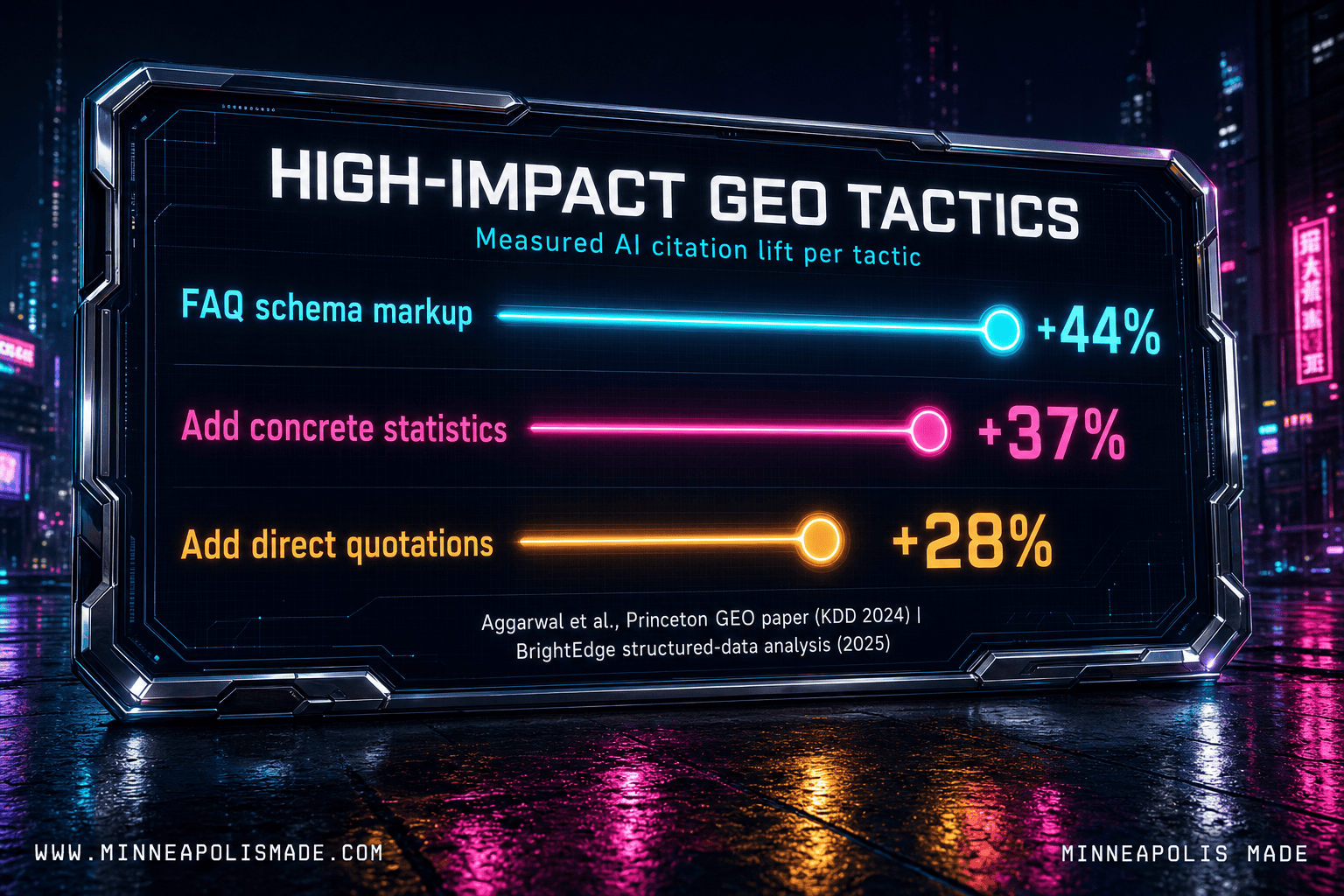
3. Schema.org markup. LocalBusiness, Service, FAQPage, and Person schema feed the entity graphs that AI systems use to understand who you're and what you do. A BrightEdge analysis published in 2025 measured a 44% citation lift for pages adding FAQPage schema compared to pages without it (BrightEdge, 2025).
4. Brand mention volume across the web. AI doesn't just read your site. It reads everywhere your business name shows up: press, directories, social, reviews, podcast transcripts. The more places confirm what your business does, the higher AI weights you as a trustworthy source.
Unique InsightThe Princeton GEO paper (Aggarwal et al., KDD 2024) measured exactly how much each tactic moves the citation needle for generative engines. Adding concrete statistics to a page produced roughly a 37% lift in AI citation rate. Adding direct quotations produced about a 28% lift. Adding cited sources produced lifts ranging from 28% on already-top-ranked content all the way to 115% on lower-ranked content where the citation gap was widest. The point: the cheap fixes (statistics, quotations, citations, schema) work, and they work hardest for sites that don't already rank in the top three. For our own field-side audit of these patterns across Twin Cities small businesses, see our analysis of ChatGPT vs Perplexity citation behavior.
Want to see which AI engines are citing your business?
We run a free AI visibility audit for any Twin Cities business. Three queries across ChatGPT, Perplexity, and Google AI Overviews. You see exactly where you show up and where competitors steal the citation. No follow-up sales call unless you ask.
What about the "SEO is dead" people?
Most of the loudest "SEO is dead" voices in 2025 and 2026 turned out to be selling AI tools or AI-content services. Read the headlines, then read the byline. The Forbes piece that made the rounds was written by the founder of an AI training company. The pattern isn't new. "X is dead" is what people who sell the alternative to X say in October every year.
The honest version of the story is this. Position-1 CTR fell for queries where AI Overviews appear, then partially recovered. The total addressable search market grew because AI search created a new surface for citations. Sites with strong SEO captured most of the new citation traffic. Sites with weak SEO lost both their old organic clicks and their share of the new citation flow.
Why do most AI and GEO consultants miss the foundation?
Most of the people selling "AI search optimization" or "GEO services" in 2026 have never written a line of HTML in their lives. They're rebadged SEO consultants who learned the new vocabulary three months ago and are pitching small business owners on ranking promises they can't deliver. The reason their work doesn't move the needle is the same reason most "SEO" work didn't move the needle a decade ago: they don't understand the website itself.
Unique InsightAI visibility starts with web design. Not "SEO." Not "content strategy." Web design, the actual code, markup, structure, load speed, accessibility. The technical foundation that decides whether a crawler can read your site in the first place. If the bot can't fetch your page in under three seconds, can't parse what your business does from your markup, and can't understand the hierarchy of your content, no amount of AI optimization rituals will get you cited.
Personal ExperienceThe audit pattern is brutal and we see it every week. A home-services company hires a "GEO consultant" who charges $2,000 a month, sends them a monthly "AI visibility report" with screenshots of search results, and produces zero cited mentions in any AI engine after six months. We pull up the site and the foundation is broken: JavaScript-rendered content the bots can't see, no schema, no Core Web Vitals discipline, missing Open Graph metadata, broken internal linking, a sitemap that hasn't updated in two years. The GEO consultant never looked at any of it. They were running keyword spreadsheets while the building was on fire.
This is the hidden cost of cheap SEO and AI services. You aren't just spending money on something that doesn't work. You're also filling the time and budget that could have gone to actually fixing the foundation. The fly-by-night consultant promises rank improvements that never come, and meanwhile the site itself stays unreadable to the engines that matter.
Here's the honest test for anyone pitching AI or GEO services. Ask them to audit your Core Web Vitals on the call. Ask them what your current Schema.org markup says. Ask them which AI crawlers your robots.txt allows today. If they can't answer in real time, they're selling you the vocabulary, not the work. The people who understand AI visibility are the same people who understand web design fundamentals, because one can't exist without the other.
What does good SEO for AI actually look like?
It's classic SEO plus three new disciplines layered on top. The foundations haven't moved: crawlability, mobile-first design, Core Web Vitals under 2.5 seconds, schema markup, internal linking, earned backlinks, complete Google Business Profile. What's new is what you build on top of that foundation.
Passage-level writing. Each paragraph on your site should be able to stand alone as a quotable answer. AI systems extract single passages, not whole pages. Write so the answer to a question is in one self-contained chunk, not spread across a section.
Entity disambiguation. Make sure AI knows what your business IS, not just what it does. That means consistent NAP (name, address, phone) across the web, schema.org markup that names your business explicitly, and brand mentions that reinforce one canonical identity.
AI crawler access. The robots.txt file on most older websites still blocks GPTBot, PerplexityBot, ClaudeBot, and Google-Extended by default. Open those bots up. Without crawler access, you can't be cited by the engine the crawler belongs to.
Related: Our Generative Engine Optimization service page walks through the full method we use for AI citation work.
How does your Google Business Profile actually decide its rank?
Most small business owners think the GBP listing and the website are two separate channels. They aren't. Google Business Profile runs on a local-focused, smaller version of the main Google algorithm, and one of its strongest ranking inputs is the keywords and content found on your linked website. The polished GBP listing with the great photos can't rank for "plumber Edina" if your website never mentions plumbing in Edina.
This is the mechanic almost no SEO or AI consultant explains correctly. Google's local algorithm crawls your site looking for entity-defining keywords, service mentions, city names, and the contextual proof that you actually do the thing your GBP says you do. When those signals are clear and consistent on the website, your GBP rises in the map pack. When they're missing or scattered across a few thin pages, your GBP plateaus regardless of how well-optimized the profile itself looks.
Unique InsightAnd here's the part agencies are sleeping on. For AI search, this is direct, and it's coming faster than most agencies realize. Google AI Overviews already pull from local-pack results for "near me" queries, which means the same keyword-on-website signals that feed your GBP rank are already feeding the local AI Overview pick. ChatGPT, Perplexity, and Claude are all building toward live local-business integration. When those integrations ship, the input will be the same Google-style local algorithm reading the same website signals. The foundation that ranks you in the map pack today is the foundation that will get you cited in AI local answers next year.
The action item is the same as everything else in this post: the website is the load-bearing structure. Your GBP rank, your AI citations, your organic rankings, and the local-AI integrations coming next year all sit on top of the same foundation. Home-services marketing and law-firm marketing both live or die on the website-and-GBP feedback loop more than on any single channel.
How is SEO for AI different from old-school SEO?
Three things changed and the rest stayed the same. Knowing the difference is what separates the agencies still selling 2018 SEO playbooks from the ones doing 2026 work.
What changed. Click-through rates cratered on AI Overview queries, then clawed back partway. Brand mentions on third-party sites suddenly mattered a lot more, because AI synthesizes from everywhere, not just your domain. Schema.org markup went from nice-to-have to non-negotiable. It's how entities get recognized in the first place.
What stayed. Quality content still wins. Backlinks from trusted sources still rank. Local SEO (Google Business Profile completeness, NAP consistency, review velocity) still drives the map pack, and now drives local AI Overview answers too. Site speed and mobile-first design are still table stakes.
Unique InsightHere's the part nobody is writing about. For small businesses, local SEO inputs (the boring stuff like making sure your GBP categories are right, your hours are accurate, and your reviews are recent) directly determine inclusion in local AI Overview answers. When ChatGPT or Perplexity is asked for "best [service] in [city]," the local-pack-grade signals do most of the ranking work. Most "SEO in age of AI" articles miss this because they're written for enterprise marketing teams, not for shop owners trying to fill a dispatch board.
What should a small business owner do this week?
Six things. Mostly free. Do them in order. If you only do one part of this whole article, make it this one.
- Test your own AI visibility right now. Open ChatGPT, Perplexity, and Google. Search your service plus your city. Write down which businesses got cited. If you're not in the list, now you've got a baseline.
- Audit your Google Business Profile for completeness. Categories, hours, photos, services, attributes, and at least 20 reviews. Anything less than 90% complete is leaking AI visibility daily.
- Add LocalBusiness and Service schema to your homepage. If your developer can do it in an hour, ship it today. Schema is the single highest-leverage SEO-for-AI fix.
- Update robots.txt to allow AI crawlers. Specifically GPTBot, PerplexityBot, ClaudeBot, and Google-Extended. Without this you're literally invisible to those engines.
- Rewrite one passage per service page to directly answer a customer question. Use the exact wording a customer would type. One paragraph, 40-60 words, self-contained.
- Ask three customers for a Google review this month. Review velocity is one of the strongest local AI ranking signals. Three reviews per month, every month, beats one big push.
For the full hands-on checklist see our guide to AI visibility for Minneapolis small businesses.
Related: Deep dive: How generative engine optimization (GEO) gets your business cited by AI
Related: AI is not only reshaping search, it is quietly automating the busywork inside Minneapolis businesses
Frequently Asked Questions
Is SEO dead now that AI search exists?
No. Not even close. AI search engines like ChatGPT, Perplexity, and Google AI Overviews run on the same crawl-and-index plumbing SEO has always relied on. Ahrefs found that 38% of AI Overview citations come from top-10 organic results, and even pages outside the top 10 need to be crawled, indexed, and ranked to be considered.
Can I just use AI to write SEO content and rank?
AI-written content can rank if it's accurate, well-structured, and adds real information. Google has said point-blank they don't penalize AI content. They do penalize vague, unsourced, lazy content, which is what AI produces when nobody edits it. Use AI to draft, but a human has to verify every claim and add real expertise.
Which AI engines actually drive business traffic in 2026?
Five matter: ChatGPT (with Search), Google AI Overviews, Perplexity, Microsoft Copilot, and Claude. Each one cites sources differently. Perplexity is the most generous with click-through citations. Google AI Overviews is the most opaque. ChatGPT Search sits in the middle. Tracking citations across all five is the new SEO reporting.
What's the difference between SEO and GEO?
Generative Engine Optimization (GEO) is the subset of SEO focused specifically on getting cited by AI engines. It uses classic SEO foundations plus three new disciplines: passage-level writing for extractable answers, entity disambiguation through schema and NAP consistency, and AI-crawler access via robots.txt rules.
How long until I see results from SEO work in 2026?
Local AI citation visibility moves in 60-90 days if your foundations are halfway decent. Organic ranking on competitive queries takes 6-9 months. AI citations actually move faster than classic organic because the engine indexes update more frequently and the ranking signals are more responsive to recent changes like new reviews or fresh schema.
The simple version
AI search reads your SEO. Bad SEO equals invisible business across both Google and every AI engine at once. Good SEO equals citations in both classic rankings and AI answers, plus the brand-search lift that follows when AI introduces a customer to your business by name.
The work has shifted. The fundamentals haven't. If you've been treating SEO as something you'd "get to next year," the AI search era just made next year a lot more expensive.
Ready to find out where you stand?
Fifteen minutes on the phone with the senior strategist. We walk your site, your GBP, and your AI citation visibility in real time. $85/hour if you decide to work with us. Always free for the call.
Related reading: AI visibility vs SEO in 2026 · What SEO actually is in 2026 · Generative Engine Optimization service