
SEO (Search Engine Optimization) is the practice of optimizing a website to rank higher and earn citations across two surfaces: Google's organic search results and AI answer engines like ChatGPT, Perplexity, and Google AI Overviews.
Key Takeaways
- AI Overviews now show up on 15.69% of Google searches and roughly halve organic click-through, from 15% to 8% on queries where they appear (Semrush; Pew Research).
- ChatGPT crossed 900 million weekly active users in February 2026, more than doubling in 12 months (Search Engine Land).
- In our 144-prompt Twin Cities AI Citation Audit (April 2026), 83.9% of cited domains appeared on only ONE AI platform. You can't optimize for "AI generally."
- 58.5% of US Google searches end without a click (SparkToro). The value of SEO has shifted from clicks to citations.
- AI-sourced traffic to US retail grew 393% YoY in Q1 2026 (Adobe Analytics). The discipline isn't dying. It's forking.
 ChatGPTOpenAI
 PerplexityPerplexity AI
 GeminiGoogle
 ClaudeAnthropic
 GrokxAI
 CopilotMicrosoft
 Meta AIMeta
What Is SEO?
SEO is short for Search Engine Optimization, and as of 2026 it's the practice of being found across two surfaces, not one. According to Semrush, AI Overviews appear on 15.69% of Google queries today, after peaking at 24.61% in July 2025. That changes the job.
The 2024 definition was simple. Rank higher on Google, get more clicks, win. That model assumed one search box, one results page, one shot at the user. None of those assumptions still hold.
Today the same query can return a Google AI Overview with three citations, a Perplexity answer with five, a ChatGPT response with two, and a stack of blue links underneath. Each one is a different distribution channel with its own ranking logic.
So when we say SEO in 2026, we mean two stacked disciplines: classic SEO for the blue links, plus the work of being citable inside the AI answers that now sit above them. The acronym didn't change. The job did.
How Has the Definition of SEO Changed in 2026?
The shift is measurable. Per Pew Research, when an AI Overview appears, the organic click-through rate drops from 15% to 8%. That's a 47% relative collapse on the queries where AIO shows up. The blue link is no longer the default endpoint of a search.
Two other numbers reframe the discipline. ChatGPT hit 900 million weekly active users in February 2026, up from 400 million a year earlier. Perplexity handled 780 million queries in May 2025 alone, growing more than 20% month over month. These aren't novelty chatbots. They're search engines.
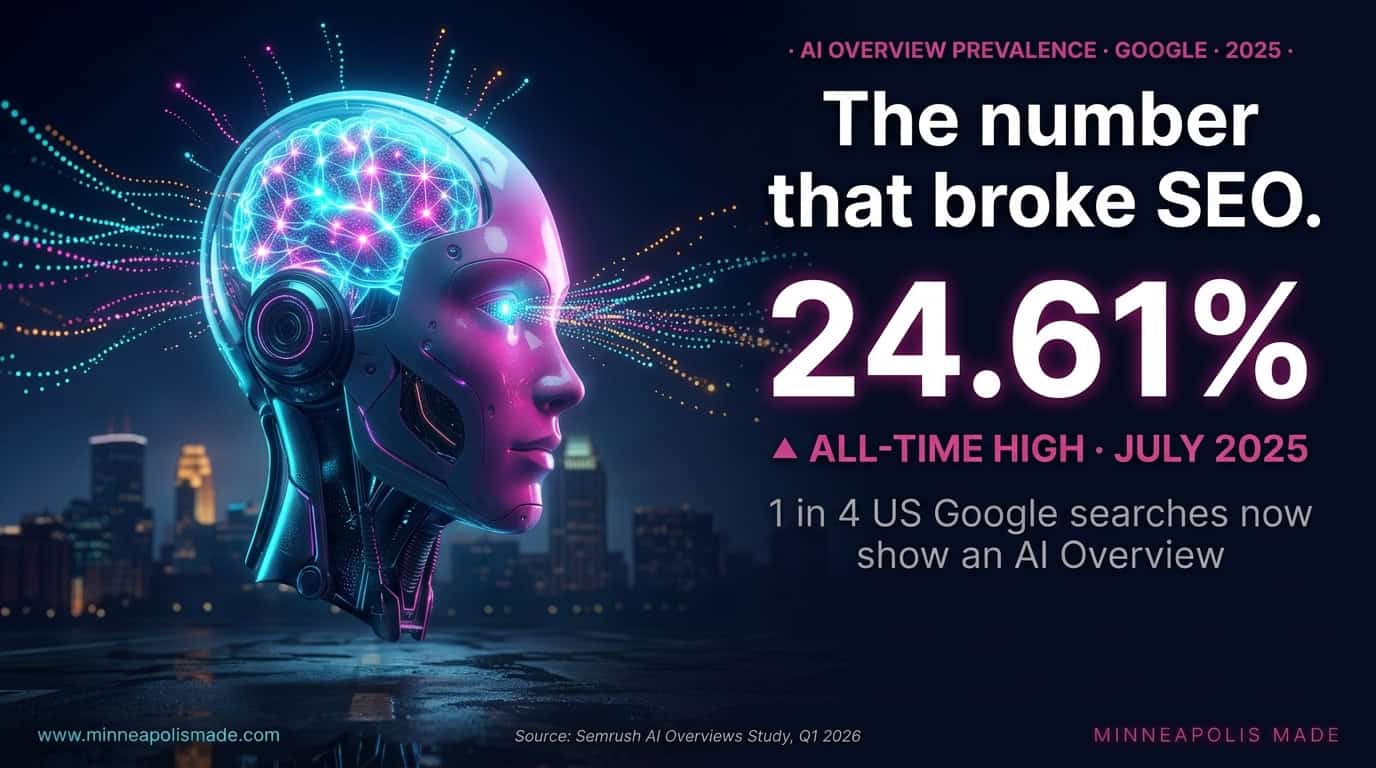
SEO didn't get killed by AI. It got forked. Most agencies are still selling 2024 SEO and calling it 2026, because the talk track is easier. But the underlying mechanics split sometime around mid-2025, when AI Overviews moved from experiment to default surface and ChatGPT search became a real referrer. From that point on, the work needed two lanes: one for Google's traditional ranking algorithm, one for the LLMs that now sit on top of it.
The honest 2026 frame is this. SEO is no longer a single discipline producing a single result. It's a parent discipline with two child surfaces. The same content, the same site, the same brand, evaluated by two different systems with overlapping but non-identical rules.
Related: our full Twin Cities AI citation audit with the methodology behind every original number in this post.
How Does SEO Work in 2026?
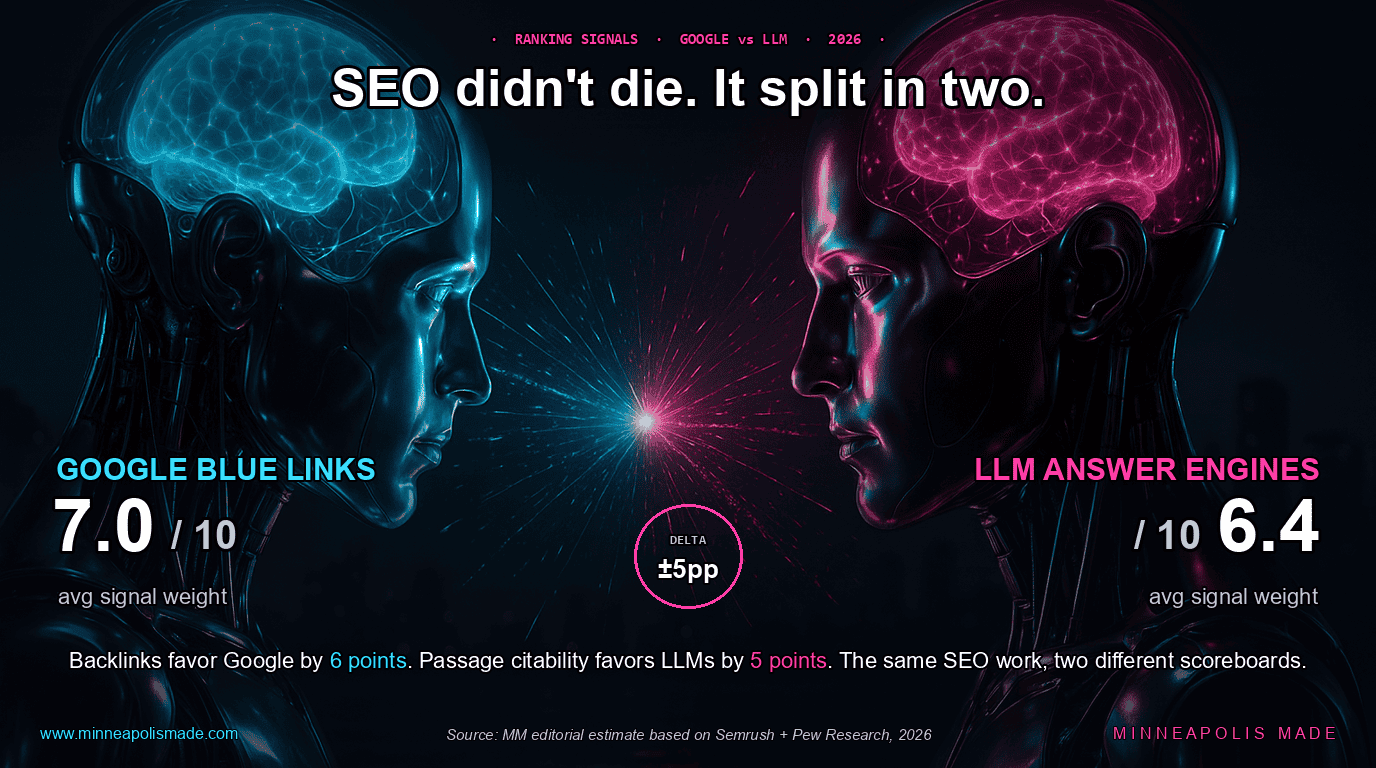
SEO works by signaling three things to two different audiences: relevance, authority, and clarity, broadcast simultaneously to Google's ranking algorithm and to the large language models that build AI Overviews and chatbot answers. The signals overlap. The weighting doesn't.
Think of it as three pillars, each with two lanes.
Technical foundation
For Google, technical SEO means crawlability, mobile-friendliness, and page speed signals like Core Web Vitals. For LLMs, it means clean HTML structure, semantic headings, and machine-readable claims. The overlap is high. A site that's well-structured for Google is usually parseable by a retrieval system. A site that fails Core Web Vitals usually fails LLM extraction too.
Content
For Google, content SEO is about depth, intent matching, and helpful-content signals. For LLMs, it's about passage-level citability: short, factually dense statements that read well when extracted in isolation. A 2,000-word essay can rank on Google. A 40-word answer-first paragraph inside that essay is what gets quoted in an AI Overview.
Authority
For Google, authority still rides on backlinks and brand mentions. For LLMs, it rides on consensus across the open web: how many independent sources say the same thing about your business, in similar terms, across BBB, Yelp, Reddit, local news, and trade publications. Backlinks help both. But for AI engines, mentions matter even when they're unlinked.
SEO vs GEO vs AEO: What's the Difference?
Three acronyms, three target surfaces. SEO targets blue links. GEO (Generative Engine Optimization) targets being cited by generative AI tools. AEO (Answer Engine Optimization) targets the zero-click answer surfaces: featured snippets, People Also Ask boxes, and AI Overviews directly. They're related, not interchangeable.
The cleanest way to see the differences is side by side.
| Discipline | Target Surface | Goal | Primary Lever | Measurement |
|---|---|---|---|---|
| SEO | Google blue links | Rank top 10 organic | Backlinks, content depth, technical health | Position, organic clicks |
| GEO | LLM training data and retrieval | Be cited by ChatGPT, Perplexity, Gemini, Claude | Passage citability, brand mentions, schema | Citations per prompt, share of voice |
| AEO | Featured snippets, PAA, AI Overviews | Win zero-click answers | Answer-first formatting, FAQ schema, Q&A structure | Snippet wins, AI Overview citations |
Most agencies still sell SEO and pretend it covers all three. It doesn't. The signal stack is different on each surface, and the proof is in the citation data.
Original DataWhen we ran 144 prompts across ChatGPT, Perplexity, and Gemini in April 2026, covering 8 industries across the Twin Cities metro, we found that 83.9% of cited domains appeared on only ONE AI platform (n=230 unique domains). ChatGPT-only domains made up 39%. Perplexity-only made up 44%. Just 16% of domains earned citations on more than one engine. That single number kills the idea that "AI search optimization" is one job. It's at least three (MM Twin Cities AI Citation Audit, April 2026).
If you want to compete on the blue links, you need traditional SEO services. If you want to be the firm ChatGPT recommends when someone asks for a Minneapolis CPA, that's AEO and AI search optimization work. They share inputs. They produce different outputs.
Want to know which AI engines are citing your business right now?
We'll run your business through the same 144-prompt audit framework we used for the Twin Cities study and show you exactly where you appear on ChatGPT, Perplexity, and Google AI Overviews.
Can You Do SEO Yourself?
Yes, partially. The 2026 difficulty curve has split. Beginner-friendly content SEO is more accessible than ever, because AI tools help with drafting and on-page basics. Technical SEO and AI search optimization, on the other hand, require more specialist knowledge than they did in 2024, not less.
Here's the honest split.
What you can DIY
- Title tags and meta descriptions on your top 10 pages. A weekend's work. The single biggest CTR lever still under your direct control.
- Google Business Profile. Claim it, fill out every field, post weekly, respond to every review. We've watched this single workflow move local rankings more than $5,000 of link building.
- Internal linking between related pages on your site, with descriptive anchor text.
- Content writing for service pages, blog posts, and FAQ sections, especially with an AI assistant editing for clarity.
- Search Console and Bing Webmaster Tools setup, plus weekly monitoring of indexation and click data.
What you probably can't DIY
- Schema markup implementation beyond the most basic LocalBusiness blocks.
- AI search readiness, because it requires testing across multiple platforms with prompts your customers actually use, then iterating on passage-level content structure.
- Competitive content strategy, which depends on tooling (Ahrefs, Semrush, DataForSEO) most small businesses won't license.
- Link earning through digital PR, original research, and journalist outreach.
- Technical migrations, Core Web Vitals remediation, and JavaScript rendering audits.
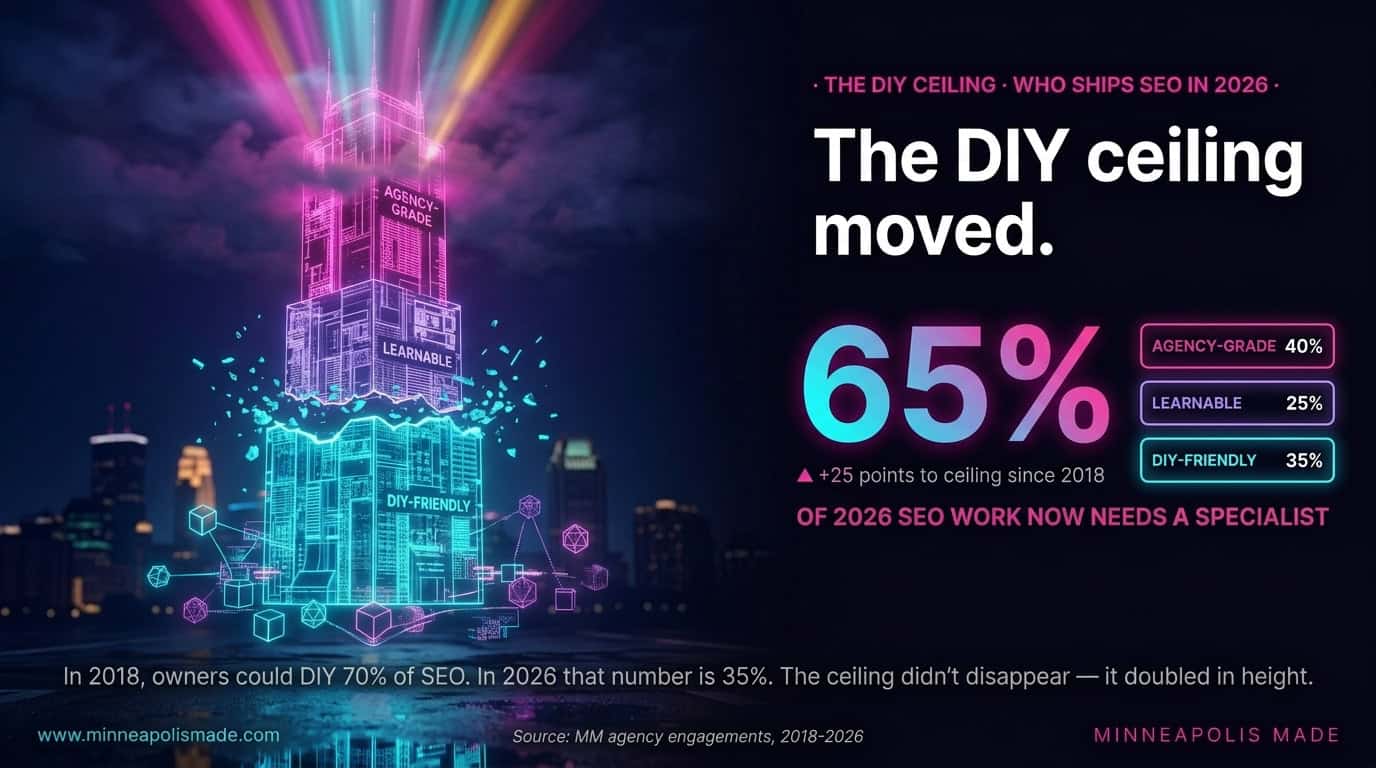
When we audit Minneapolis businesses, we see the same pattern. Every site has "SEO" as a line item in their marketing budget. Almost none have a separate line for AI search visibility. The owners doing their own SEO are usually doing the right things on the content and GBP side, then losing months on the technical and AI-readiness work because nobody told them those were now separate disciplines. The DIY ceiling moved. Most owners haven't noticed.
How to Do SEO as a Beginner
Start with the three highest-leverage moves any beginner can make in a single weekend. Claim your Google Business Profile, write or rewrite title tags for your top 10 pages, and add FAQ-structured Q&A blocks to those same pages. That's the foundation. Everything else builds on it.
Here's the full 5-step beginner sequence we walk new clients through.
1. Claim and fully optimize your Google Business Profile
This is non-negotiable for any local business. Verify ownership, fill every category and attribute, upload at least 10 photos, post weekly updates, respond to every single review (good or bad). GBP is the single fastest path to local visibility on both Google and the AI engines, because most LLMs pull local business data from Google's index as a primary source.
2. Audit and rewrite your title tags and meta descriptions
Open your top 10 pages in a spreadsheet. Each title should be under 60 characters, include the main keyword, and earn the click. Each meta description should be 150 to 160 characters, include a benefit, and end on a complete clause. This is the single SEO change you'll make where the impact is visible inside two weeks.
3. Add structured Q&A blocks to your top pages
Identify the 5 questions your customers actually ask before they buy. Write a 40-to-60-word answer for each. Put those Q&A pairs on your service pages with proper heading structure. This is the single biggest lever for getting cited in AI Overviews and ChatGPT answers, because LLMs love passage-level extraction.
4. Set up Google Search Console and Bing Webmaster Tools
Both are free. Both take 20 minutes. Bing Webmaster Tools matters more than it used to, because Bing's index now powers ChatGPT search. If your site isn't indexed in Bing, you're invisible to roughly half the AI search world.
5. Build a weekly monitoring habit
Twenty minutes every Monday. Check Search Console for indexation issues, GBP for new reviews, and run two or three prompts about your business through ChatGPT and Perplexity to see if the citations are still pointing at you. That's it. The discipline of looking is half the battle.
What's an SEO Example?
Here's a real one from our audit data. When a Twin Cities resident asks ChatGPT to "recommend a CPA in Minneapolis," the AI cites jakcpa.com in 3 of 4 prompt variations. JAK CPA didn't pay for that placement. They earned it through structured firm pages, consistent NAP data across BBB, Yelp, and Google, plus an "Areas We Serve" section that ChatGPT can extract cleanly.
The counter-example is more instructive. Another Twin Cities CPA firm of comparable size, with strong organic rankings on Google (position #4 for the same query) gets cited zero times by ChatGPT for that prompt. Same industry. Same metro. Same Google footprint. Different AI footprint, because the second firm's site is built for human readers, not for passage extraction.
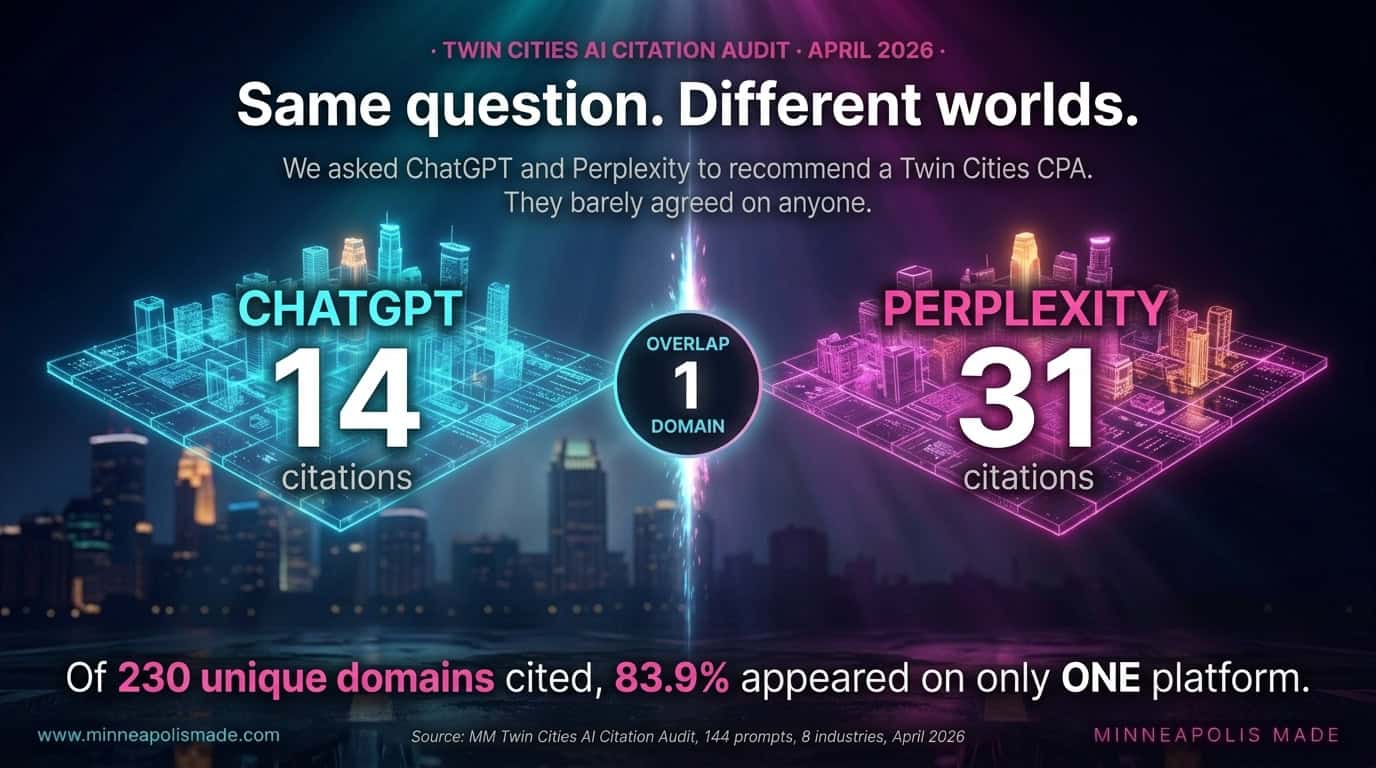
The interesting wrinkle: Perplexity cites a completely different set of CPA firms for the same prompt. Reddit threads. State Department of Revenue pages. Two firms whose websites barely rank on Google but get linked from BBB and the MN Society of CPAs site. Same query, totally different answer set.
That's the 2026 SEO example in one frame. Two surfaces. Two winners. The work to win each one overlaps but doesn't duplicate.
How Has AI Search Changed SEO?
Per Adobe Analytics, AI-sourced traffic to US retail sites grew 393% YoY in Q1 2026, after a 693% YoY surge during the 2025 holiday season. SEO didn't shrink. The traffic source diversified. The work changed shape.
The tactical evolution looks like this. In 2018, SEO was about backlinks, content length, and exact-match anchor text. In 2024, it was about E-E-A-T, helpful content, and search intent matching. In 2026, it's about passage-level citability, schema as machine-readable claims, brand mentions across surfaces, and recency. The discipline keeps incorporating new signals without retiring the old ones, which is why nobody's day job is getting easier.
Related: YMYL and E-E-A-T, quoted from Google’s own guidelines
Related: Our 96-query study on which businesses AI names as the best in Minneapolis
What signals actually matter now
- Passage citability. Can a 40-word block from your page stand on its own as an answer, with the source attribution intact? If yes, LLMs will quote it.
- Schema as claims. Don't think of schema as "ranking signal." Think of it as the machine-readable version of what your page says. The more legible, the more often you're cited.
- Cross-surface brand mentions. If three independent sites say the same thing about your business in similar terms, the LLMs treat that as consensus. Linked or unlinked.
- Recency. Both Google and the AI engines now weight publication date and modification date heavily for evergreen topics. A 2024-dated guide on AI search reads as obsolete to both surfaces.
Is SEO Still Worth It in 2026?
Yes, but the ROI shape has changed. Less of the value comes from raw organic clicks (those have eroded). More of it comes from being the citable source AI engines reach for at the moment of decision. Per SparkToro, 58.5% of US Google searches already end without a click. That number is going up, not down.
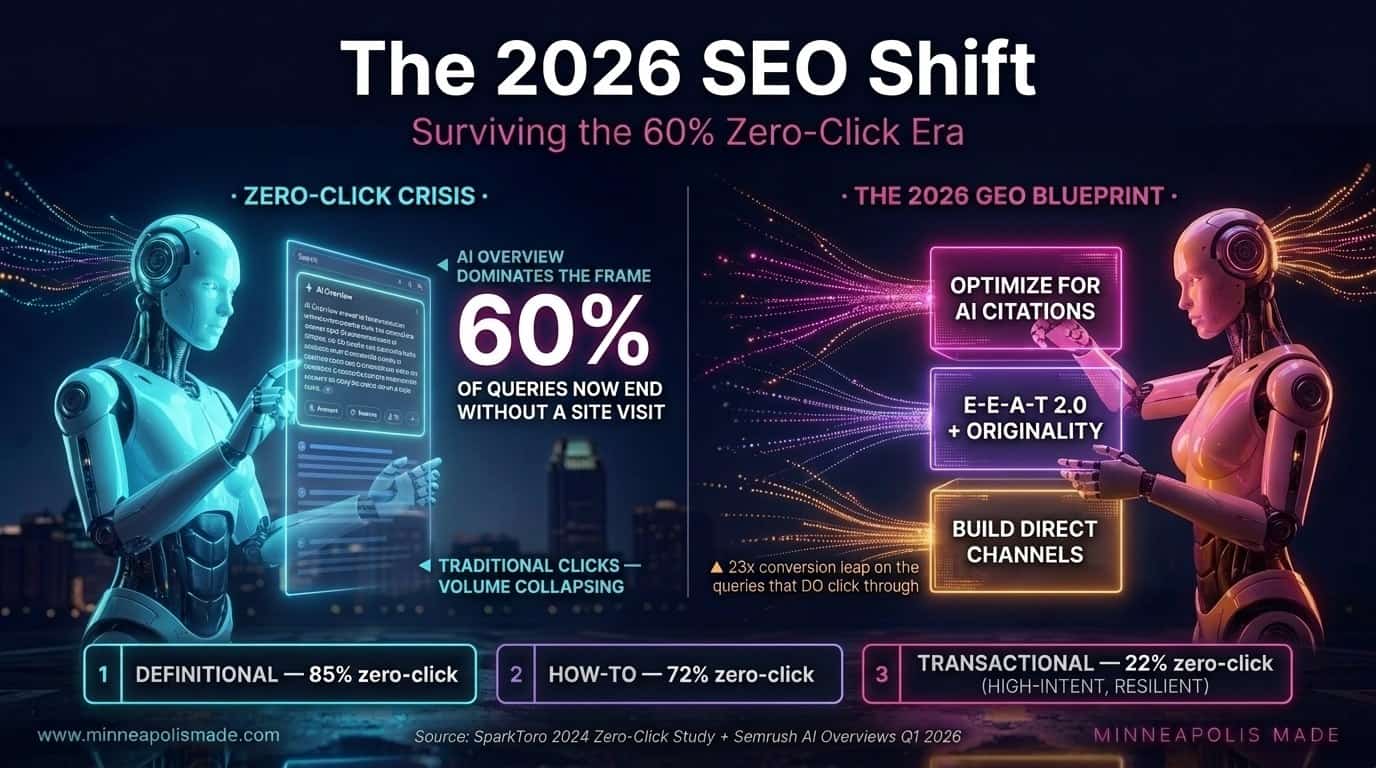
So the right question isn't "is SEO worth it." It's "what should I expect to get from SEO in 2026 that's different from what I got in 2024." The answer is fewer clicks per ranking, more brand mentions per piece of content, faster citation indexing on AI engines (typically 1 to 2 months versus Google's 3 to 6), and a steeper drop-off for businesses who skip the work.
The closing case is short. Businesses that skip SEO, GEO, and AEO in 2026 are invisible on both surfaces. Both are now table stakes. The cost of doing nothing went up sharply when AI search hit search-scale.
Related: What is generative engine optimization (GEO)?
Related: SEO is one of eight channels, and most small businesses need two
Related: Do you still need SEO in the age of AI?
Frequently Asked Questions
What is SEO and how does it work?
SEO (Search Engine Optimization) is the practice of helping search engines and AI answer engines understand and recommend your website. It works by signaling relevance, authority, and clarity to Google's ranking algorithm and to LLMs that build AI Overviews. Per Semrush, AI Overviews now show on 15.69% of Google queries, so SEO has to optimize for both surfaces.
Can you do SEO by yourself?
Yes for parts of it. Beginners can confidently handle title tags, meta descriptions, Google Business Profile, internal linking, and content writing. Most owners can't realistically DIY schema, AI search readiness, link earning, or technical migrations. The DIY ceiling on SEO has moved. Per SparkToro, 58.5% of searches end without a click, which raises the bar on the work that's left.
How to do SEO for beginners?
Start with three weekend moves: claim and optimize Google Business Profile, rewrite title tags on your top 10 pages, and add structured Q&A blocks to those pages. Then set up Google Search Console and Bing Webmaster Tools. Bing now powers ChatGPT search, per Search Engine Land, so missing Bing means missing roughly half the AI search world.
What is an SEO example?
In our Twin Cities audit, asking ChatGPT to "recommend a CPA in Minneapolis" cited jakcpa.com in 3 of 4 prompts because the firm earned it through structured pages, consistent NAP data, and clean "Areas We Serve" sections. A higher-ranked Google competitor got cited zero times. That's the 2026 SEO example: same metro, same industry, two different surfaces, two different winners (MM Twin Cities AI Citation Audit, April 2026).
What does SEO stand for?
SEO stands for Search Engine Optimization. The 2026 working definition extends that to include "and the practice of being citable by AI answer engines built on top of search." Per OpenAI's reported numbers, ChatGPT alone reaches 900 million weekly active users, which makes it search-scale, not chatbot-scale.
What's the difference between SEO and GEO?
SEO targets Google's blue links and uses backlinks, content depth, and technical health to win position in the organic results. GEO (Generative Engine Optimization) targets being cited by ChatGPT, Perplexity, Gemini, and Claude, and it uses passage citability, brand mentions, and schema as the primary levers. Same site, two different scoring systems. In our audit, only 16% of cited domains earned citations across multiple AI engines.
Is SEO dead in 2026?
No. Per Adobe Analytics, AI-sourced traffic to US retail grew 393% YoY in Q1 2026 and 693% YoY during the 2025 holiday season. The discipline isn't shrinking. It's adding a second surface to optimize for. The businesses calling SEO dead are the ones who didn't update their definition when the surface count doubled.
How is SEO different in 2026 vs 2024?
The two-surface model is the difference. In 2024, SEO meant ranking higher on Google. In 2026, it means ranking on Google AND being cited by AI answer engines, which together now answer the majority of consumer queries before any blue link gets clicked. Per Pew Research, AIO presence cuts organic CTR from 15% to 8% on queries where it appears.
The Bottom Line
The 2024 definition of SEO ("rank higher on Google") still describes part of the job. It just doesn't describe all of it anymore. AI Overviews changed the click math. ChatGPT and Perplexity changed the surface count. Our own audit data shows 83.9% of cited domains live on a single AI engine, which means the work to win each one is genuinely separate.
Five things to take with you. SEO now optimizes for two surfaces, not one. AI Overviews appear on 15.69% of Google queries and cut organic CTR by 47% when they show. ChatGPT runs at 900 million weekly users, which is search-scale. 58.5% of US Google searches already end without a click. The discipline isn't dying, it's forking, and the businesses that ignore the fork lose visibility on both halves.
Related: see how a holistic marketing approach ties traditional SEO, AEO, and GEO into a single workflow that doesn't double-bill the same content twice.
See how your business shows up across Google, ChatGPT, and Perplexity
We're the Twin Cities agency that's already mapped the AI citation landscape for 8 industries across 144 prompts. The next conversation takes 30 minutes, and you'll walk out knowing exactly where the gaps are.