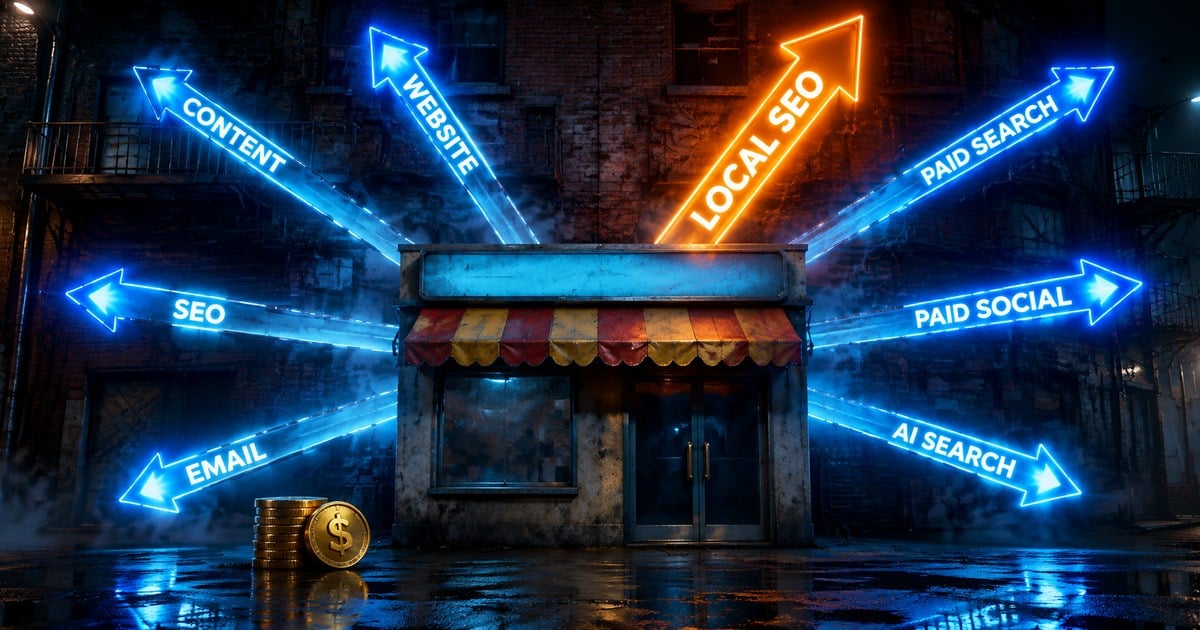
Digital marketing is about eight distinct services, and almost no small business needs all eight. The useful question isn't what the category contains. It's which two pieces will pay you back first, and that depends less on your industry than on whether you're capturing demand that already exists or trying to create new demand.
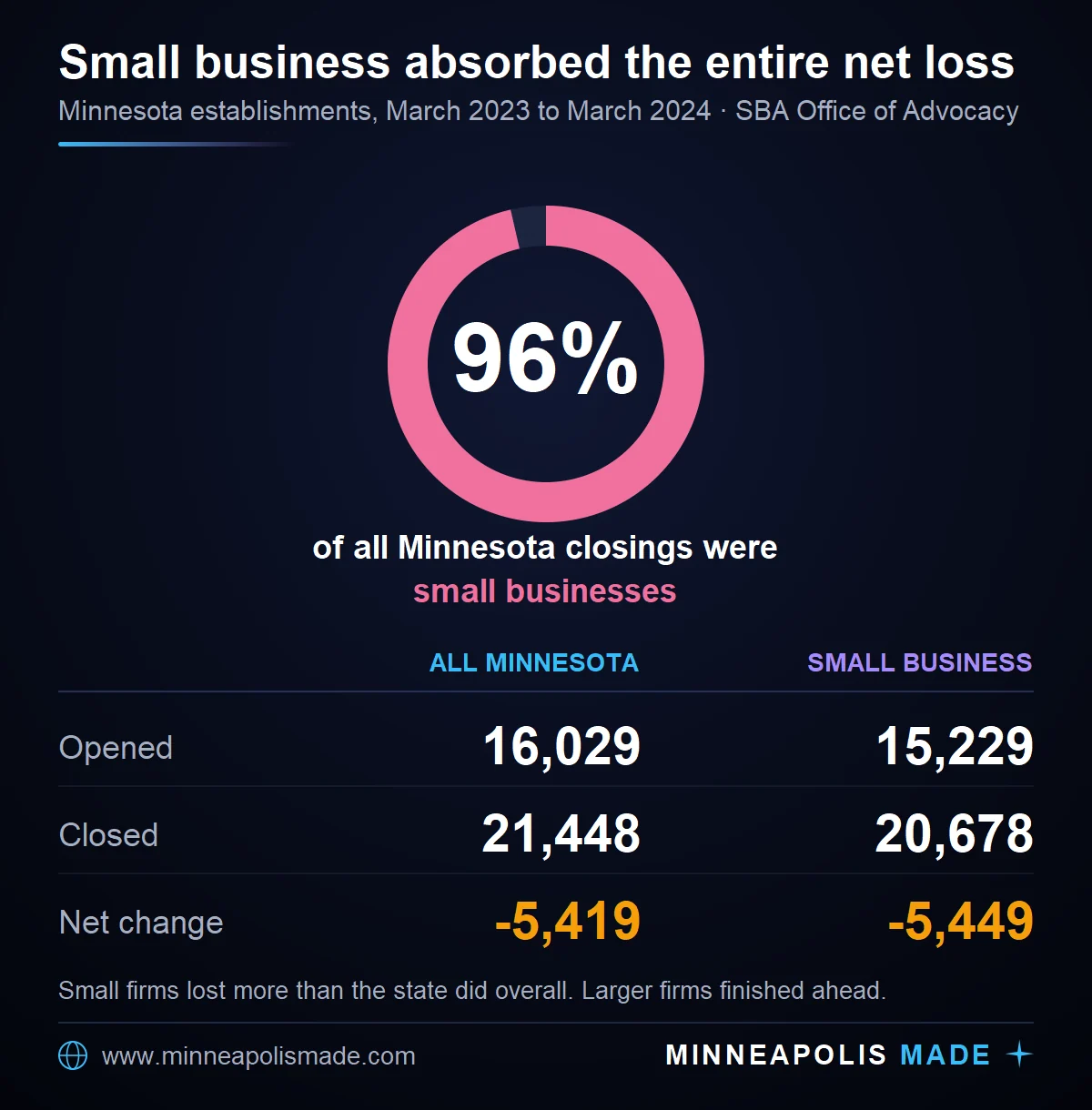
There's a reason to get this right rather than guess at it. Between March 2023 and March 2024, Minnesota businesses closed faster than they opened. The SBA Office of Advocacy's 2025 Minnesota profile counts 16,029 establishments opening and 21,448 closing, a net loss of 5,419. Small businesses accounted for 15,229 of those openings and 20,678 of the closings.
Run that subtraction and you get something worth sitting with. Small businesses lost a net 5,449 establishments while the state as a whole lost 5,419. Every bit of the decline, and then some, came from businesses under 500 employees. Larger firms finished the year slightly ahead.
Nobody closes a business because they picked the wrong marketing channel. But plenty of good businesses stay invisible to the people already looking for them, and invisible is a slow way to lose. This is a plain guide to what digital marketing actually covers, what each piece does, and how to tell which of it you need.
Key Takeaways
- Digital marketing is an umbrella term for about eight distinct disciplines. Almost no small business needs all eight.
- The Twin Cities metro holds 377,176 small businesses, roughly two-thirds of Minnesota's total, per the SBA's 2025 metro profile.
- Four in five Minnesota small businesses have no employees at all: 442,345 of 560,428. Advice written for companies with a marketing department does not apply to them.
- The channels differ in one way that matters more than cost: how long they take to pay back. Paid search works in days. Organic search works in months.
- Start with the channel that captures demand you already have, not the one that creates new demand.
What is digital marketing?
Digital marketing is every method a business uses to reach customers through connected devices: search engines, websites, email, social platforms, maps, video, and now AI assistants. It's a category, not a tactic, in the same way "transportation" is a category that contains both a bicycle and a freight train.
The term gets used interchangeably with internet marketing and online marketing. There's no meaningful difference between the three, and anyone insisting otherwise is selling something. What matters is the layer underneath: the specific disciplines, which behave very differently from one another.
What services does digital marketing actually include?
Eight disciplines cover nearly everything sold under the digital marketing banner. Here's what each one actually does, in the order a local business usually encounters them.
Your website. Not a channel so much as the destination every other channel points at. It's the only asset on this list you own outright, and the only one nobody can change the rules on. If it loads slowly or reads badly, every other line item on your invoice works harder for less.
Related: What a slow website actually costs in lost customers
Search engine optimization. Earning visibility in Google's unpaid results for the things people type when they need what you sell. Slow to start, compounding once it moves, and the closest thing to an appreciating asset in this list.
Local SEO and Google Business Profile. A separate discipline from regular SEO, with its own ranking factors and its own failure modes. This is what puts you in the map results when somebody searches for a plumber near them. For a business with a service area or a storefront, it's usually the highest-return work available.
Related: How to optimize a Google Business Profile
Paid search. Buying position at the top of results. Turns on in a day, turns off in a day, and stops producing the moment you stop paying. That immediacy is precisely why it's useful: it's the only channel that can answer "does anyone actually search for this?" in a week.
Paid social and display. Ads on Meta, LinkedIn, YouTube, and the wider web. Unlike search, these interrupt rather than intercept. Nobody on Instagram was looking for a roofer. That makes them better for building awareness than for capturing intent.
Email marketing. The only channel on this list where you own the audience list. Cheap per contact, and the returns depend almost entirely on whether the list was earned or bought.
Related: Email campaigns that actually convert
Content. Articles, guides, video, and tools that answer questions your buyers are already asking. Content is the fuel most other channels run on, which is why it's usually mispriced as a line item.
AI search visibility. The newest of the eight. When somebody asks ChatGPT or Google's AI Overview for a recommendation, something decides whether your business gets named. That process overlaps heavily with SEO but isn't identical to it.
Related: SEO, AEO, and GEO: what's actually different
Unique InsightThe eight get sold as a bundle far more often than they should be. A bundle makes sense when channels feed each other, which happens at a certain scale. Below that scale, buying all eight means funding six things badly instead of two things well. The question isn't which agency offers the most services, it's which two disciplines match how your customers actually find you.
How does digital marketing help a business make money?
It does one of two jobs, and confusing them is the most expensive mistake in this field.
Capturing demand means being present when somebody is already looking. Search, maps, and reviews do this. The person typing "emergency plumber Minneapolis" at 11pm has already decided to buy. The only question is from whom. Capture work is cheaper, faster to prove, and easier to measure, because the intent already exists and you're competing for it rather than manufacturing it.
Creating demand means reaching people who weren't looking. Social ads, video, and most content do this. It's slower, harder to attribute, and necessary once you've saturated the demand that already exists.
Nearly every struggling marketing budget I've seen has these backwards: money going into creating demand while the existing demand walks to a competitor who simply showed up in the map results.
Why does this look different in the Twin Cities?
The SBA's 2025 metro profile for Minneapolis-St. Paul-Bloomington (page 61) counts 377,176 small businesses, which is 99.3 percent of all businesses in the metro, employing 843,368 people. Set that against the state total of 560,428 and roughly two-thirds of every small business in Minnesota sits inside this metro.
Two numbers from that profile change how the advice should read.
The first is composition. Statewide, 442,345 of Minnesota's 560,428 small businesses have no employees. That's about four in five operating without a single hire. Most marketing writing assumes a marketing manager, a budget line, and someone to run the campaigns. For four out of five businesses here, all three of those are the owner, at night.
The second is the industry mix. The metro's largest small-business category by count is Professional, Scientific, and Technical Services at 61,549 firms, while the largest by employment is Health Care and Social Assistance at 149,031 people. Those two sectors buy in almost opposite ways. Professional services sell to other businesses on a considered, multi-week cycle where credentials and references decide it. Health care is regulated, trust-dependent, and heavily shaped by reviews and proximity.
Original DataOne more figure from the metro profile that nobody seems to quote: between 2012 and 2022, the number of small employers in this metro rose from 73,497 to 76,695, and their combined employment rose from 765,227 to 843,368. The metro was adding small-business jobs through the same decade in which the state was posting net establishment losses. Growth and churn at once, which means the businesses that closed weren't closing because the market vanished.
Self-employment tells the same story. The metro's self-employed share rose from 11.4 percent of private workers in 2018 to 11.8 percent in 2023, and the median income of the incorporated self-employed reached $87,538, up 34.8 percent over those five years. More people working for themselves, earning more while doing it. That's a competitive market, not a shrinking one.
Related: How AI assistants decide which Minneapolis businesses to recommend
Not sure which two channels are yours?
We'll look at how people currently find you, what you already rank for, and where the nearest unclaimed demand is. No pitch deck, just the read.
Which channel should a local business start with?
Start where demand already exists and the competition is thinnest. For most local businesses in this metro, that ordering looks like this.
First, the Google Business Profile. It's free, it's the single strongest signal in map results, and most competitors treat it as a set-and-forget listing. A profile with current hours, real photos, correct categories, and a steady trickle of reviews will outperform a neglected one from a bigger company. Nothing else on this list costs zero and moves that fast.
Second, the website, but only the parts that convert. Not a redesign. The pages people actually land on, loading fast, saying what you do and where, with a phone number that works on a phone.
Third, whichever of search or paid matches your sales cycle. If your customers buy urgently, paid search proves the demand in a week. If they research for weeks, organic search and content compound better.
Related: What SEO actually involves in 2026
Personal ExperienceThe most useful thing I've watched work wasn't a channel at all, it was a tool. A bankruptcy attorney we work with, Richard West, ranks nationally for calculator searches from a domain with a fraction of the authority of the firms above him, because the calculator itself is the thing people link to and cite. One genuinely useful asset outperformed years of conventional content. That pattern holds well outside legal. The question is what you know that's worth building into something, not how many blog posts you can schedule.
How much does digital marketing cost?
There are three pricing models and they fail in different ways.
Retainers buy a fixed monthly scope. Predictable, and the standard for ongoing SEO or ad management. The failure mode is paying for months where nothing needed doing.
Project pricing buys a defined deliverable, like a website or a technical cleanup. Clean, but it tempts everyone to scope small and change-order later.
Hourly buys attention. It's what we do, at $85 an hour, because most of the businesses in the numbers above need six focused hours rather than a twelve-month contract. The failure mode is that clients underbuy, stopping before the work compounds.
Ad spend sits outside all three. Whatever you pay someone to manage Google Ads, the ad budget itself goes to Google, and any proposal that blurs those two lines is worth a second read.
Related: What SEO actually costs in Minneapolis
How long before digital marketing works?
By channel, roughly:
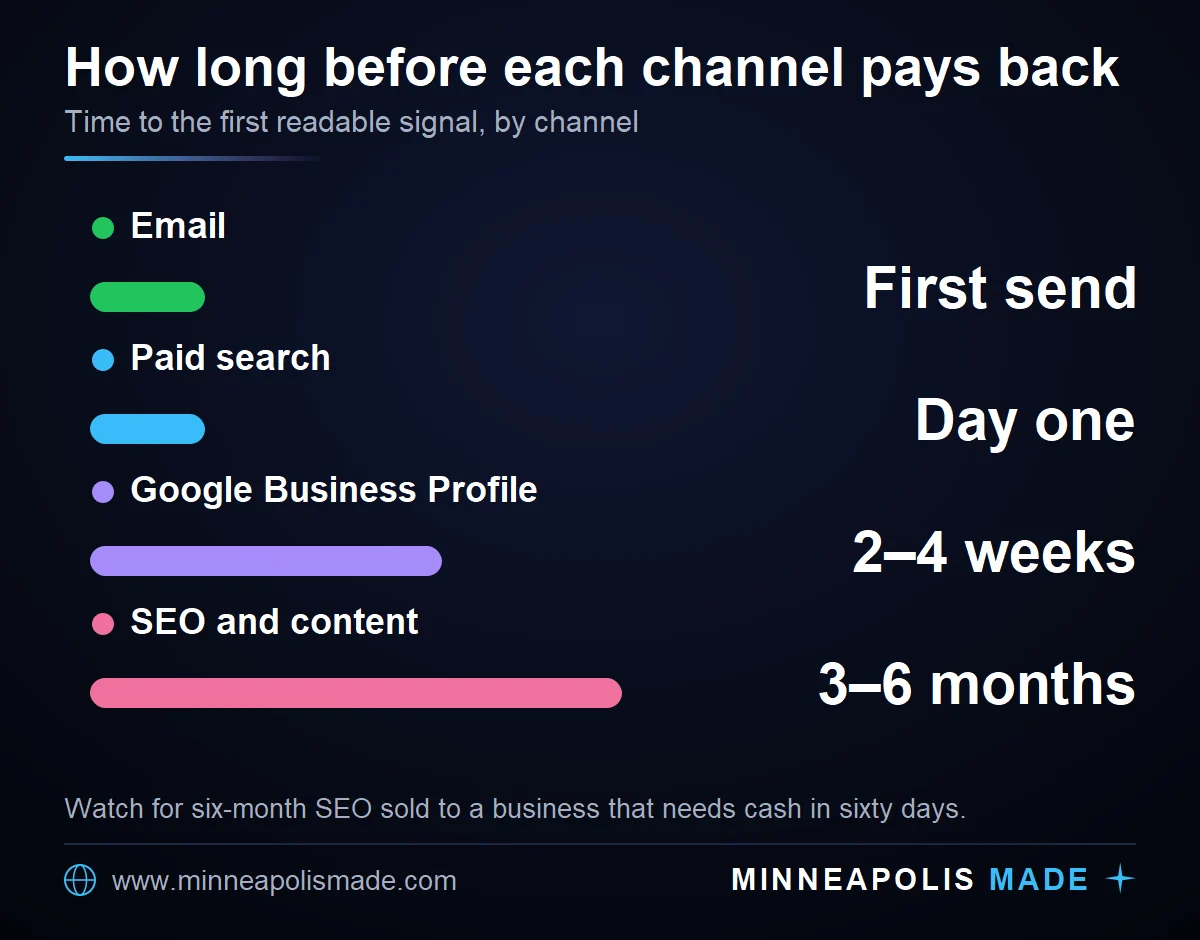
Paid search produces traffic the day it turns on and useful data within two weeks. A Google Business Profile can move in map results within a few weeks of real activity. Email performs on the first send if the list is real. SEO and content generally need three to six months before the trend is readable, and longer in competitive categories.
The mismatch to watch for is a six-month organic program sold to a business that needs revenue in sixty days. Both things are legitimate. Sequencing them wrong is what turns a reasonable budget into a bad experience.
Want the version specific to your business?
Tell us the trade and the service area and we'll tell you which channels the businesses beating you are actually using.
Frequently Asked Questions
Is internet marketing the same as digital marketing?
Yes. Internet marketing, digital marketing, and online marketing are interchangeable terms for the same category. The meaningful distinctions are between the disciplines inside the category, not between the labels.
What are the main types of internet marketing?
Eight cover nearly all of it: your website, search engine optimization, local SEO and Google Business Profile, paid search, paid social and display, email, content, and AI search visibility. Most small businesses need two or three of them done well rather than all eight done thinly.
Does a small business really need all of this?
No. With 442,345 of Minnesota's 560,428 small businesses operating without employees, most owners are the marketing department. Two channels executed consistently beat eight channels executed occasionally.
What is the cheapest place to start?
A Google Business Profile costs nothing and carries more weight in local map results than any other single free signal. Correct categories, current hours, real photos, and steady reviews will outperform most paid work at the outset.
How do I know if it's working?
Track calls, form fills, and booked jobs rather than traffic or rankings. Traffic that never becomes a conversation is a vanity number. Any provider unwilling to report on the first three is measuring the wrong thing.
The short version
Digital marketing isn't one thing you buy, it's eight things you choose between. In a metro with 377,176 small businesses where four in five have no employees, the winning move is rarely more channels. It's picking the two that intercept demand you already have, doing them properly, and leaving the other six alone until you've outgrown the first two.
Related: The full Minneapolis SEO guide and how to choose a web design company