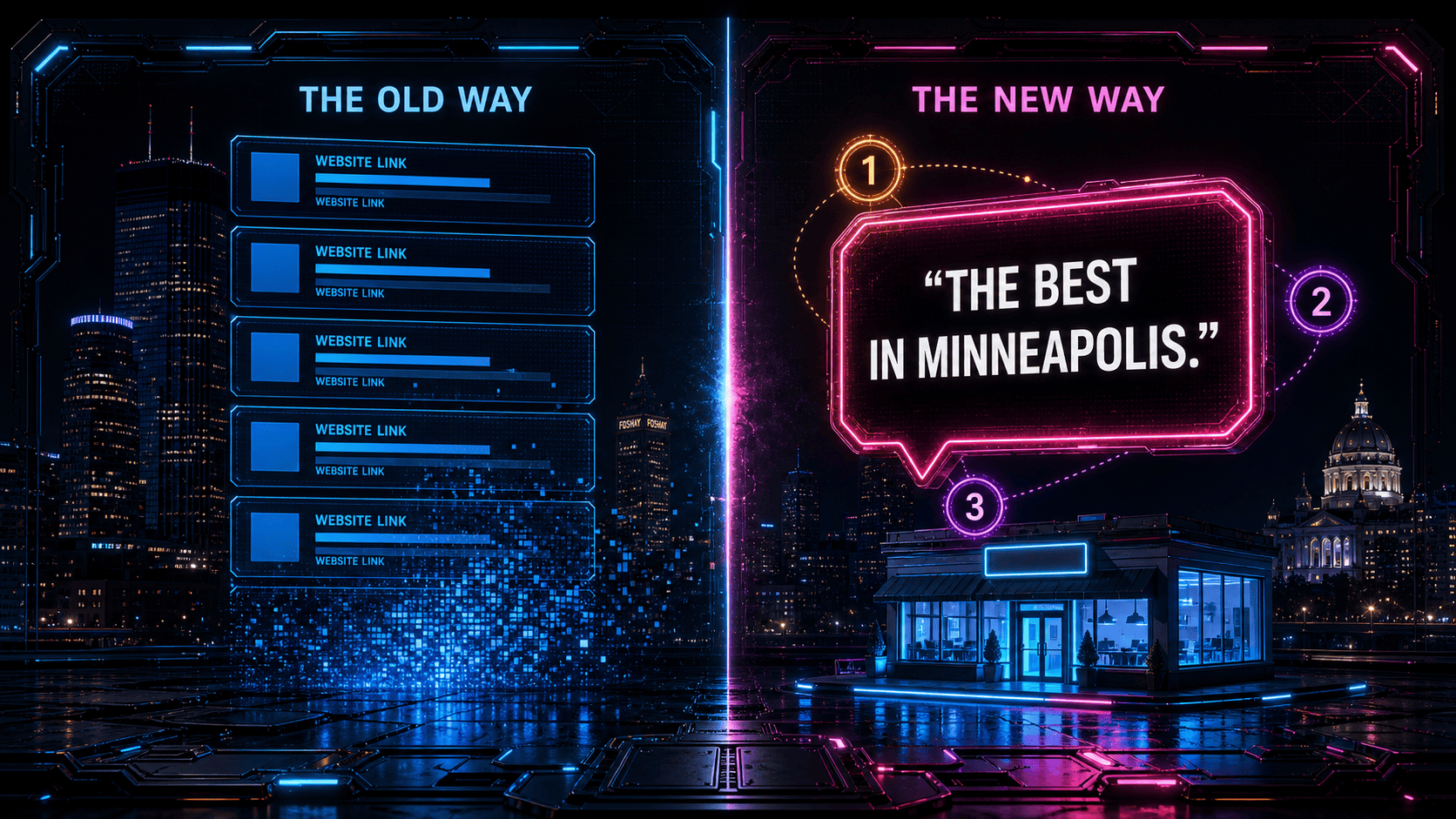
If you run a small business in Minneapolis or St. Paul and you’ve been running the same SEO playbook since 2020, your invisible competition just doubled. The rules of being found online have quietly changed. Google still matters, but it now shares the stage with ChatGPT, Perplexity, Copilot, Gemini, Google AI Overviews, and a half-dozen other surfaces where buyers are forming opinions about your business before they ever type your name.
This post defines every term you’ll hear, shows the hard data behind the shift, surfaces eleven hidden gems most local agencies are not talking about yet, and ends with a clear next step for any Twin Cities owner who wants to be the answer instead of the asterisk.
Key Takeaways
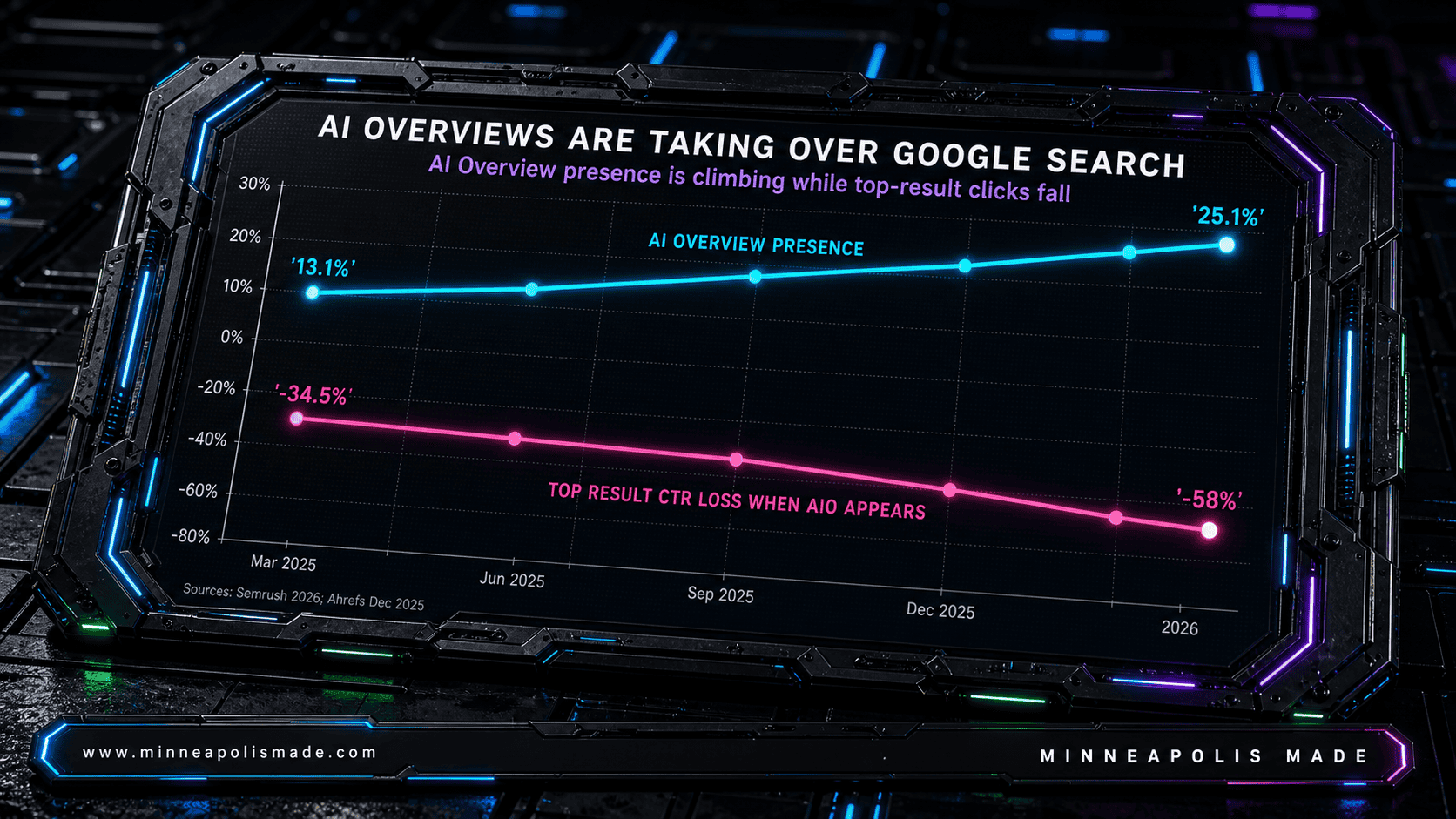
- Google AI Overviews now appear on roughly 25% of all searches (Semrush, 2026), and about 83% of those searches end with zero clicks.
- Brands cited inside an AI Overview earn roughly 35% more organic clicks than competitors who aren’t cited (Seer Interactive).
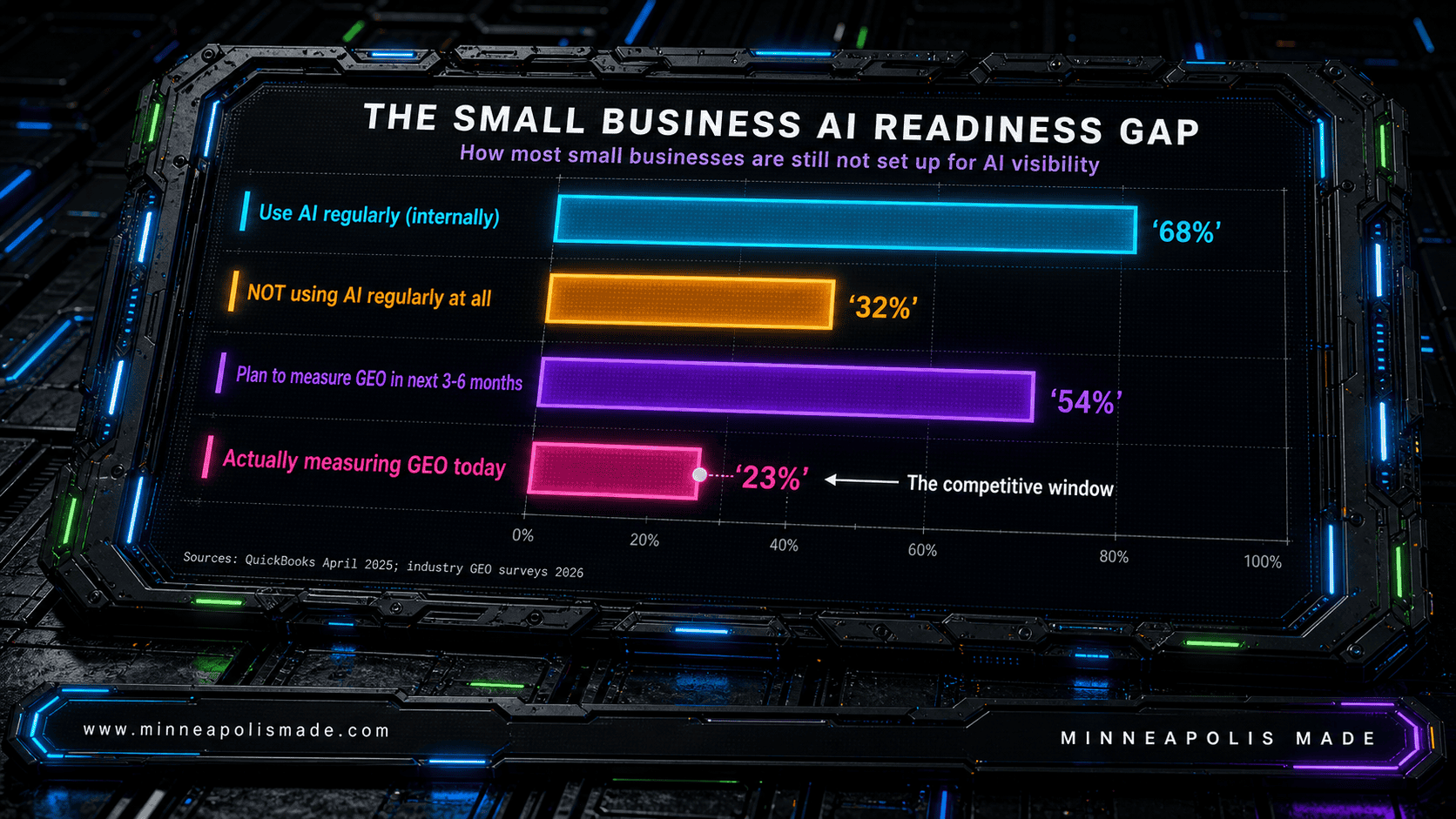
- 68% of US small businesses now use AI regularly, up from 48% in mid-2024 (QuickBooks April 2025 survey) — but most are using it for back-office tasks, not for being found.
- Only about 23% of marketers currently measure GEO performance while 54% plan to start in the next 3 to 6 months. The window to be early is now.
- YouTube has overtaken Reddit as the top social citation surface in AI answers (39.2% vs. 20.3% as of December 2025). Most local agencies are still chasing Reddit threads.
- A Carnegie Mellon and Princeton research team showed that GEO tactics can boost a brand’s visibility in AI answers by up to 40.6%.
What’s actually changed? The shift from SEO to generative search
Search has not just gotten harder. It has gotten wider. The same content now has to do more jobs across more surfaces, and the surface that matters most for the consideration stage of a buying decision is increasingly not Google’s blue links at all.
Those numbers describe a real shift, not a doom narrative. The flip side is just as important: brands that are cited inside the AI Overview earn an estimated 35% more organic clicks than non-cited competitors (Seer Interactive). The new “rank #1” is being one of the four or five sources the AI Overview decides to mention.
And Google is only one front. ChatGPT search, Perplexity, Bing Copilot, Google’s standalone AI Mode, voice assistants, and early agentic browsers are now all distinct surfaces, each with its own ranking logic, each with a steadily growing share of how buyers research a Twin Cities plumber, a Minneapolis attorney, a St. Paul accountant, or any other small business.
What does AI visibility actually mean for a small business?
Traditional SEO targets a position on a list of links. AI visibility targets being quoted inside the AI answer a buyer is reading instead. For a small business, the practical difference is who shows up in the moment a prospect is forming a shortlist.
Personal Experience
Across the Twin Cities clients Minneapolis Made has audited in 2026, the highest-converting buyers increasingly arrive having already formed a shortlist in ChatGPT or Perplexity before they ever type the business name into Google. The Google visit is the verification step, not the discovery step. If a business is not in the AI-generated shortlist, the Google ranking only catches the people who already knew about that business by name.
Think of search in 2026 less as a highway and more as a river delta. The same intent water still flows, but it now runs through many channels: Google blue links, AI Overviews, AI Mode, ChatGPT, Perplexity, Copilot, Gemini, voice assistants, and emerging agentic tools that book and buy on a customer’s behalf. You cannot be visible in every tributary, but if you are invisible in the AI-discovery layer entirely, you only catch the buyers who already know your name.
Definitions: every term a Twin Cities owner needs in 2026
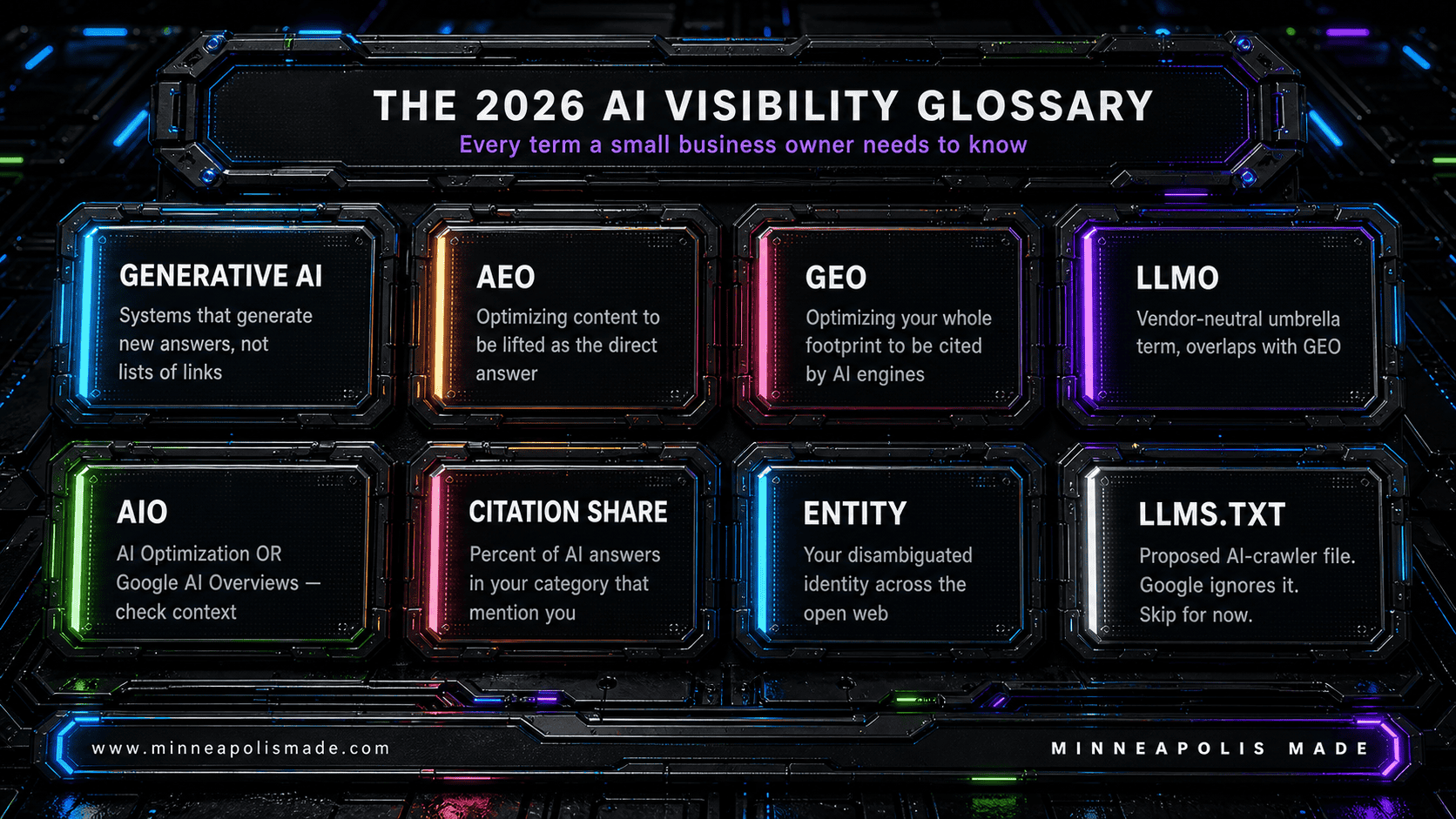
Most of the new vocabulary you’re hearing describes the same shift from different angles. Here is a clean glossary, each term written so it answers the question directly.
Generative AI
Systems like ChatGPT, Claude, Gemini, Copilot, and Perplexity that generate new answers from learned patterns rather than returning a list of links. They write, summarize, recommend, and increasingly act on a user’s behalf.
AEO (Answer Engine Optimization)
The practice of structuring content so it can be lifted as the direct answer to a question. AEO is the older, narrower term, originally focused on featured snippets and voice assistants. It now covers any “answer engine” surface, including AI chats.
GEO (Generative Engine Optimization)
The practice of structuring your entire digital footprint so generative AI engines retrieve, cite, and recommend your brand. GEO is broader than AEO — it covers content, schema, entity clarity, reviews, and off-site mentions, not just the answer paragraph.
LLMO (Large Language Model Optimization)
A vendor-neutral umbrella term that overlaps heavily with GEO. Used most often in B2B and enterprise circles to describe optimizing for both AI training corpora and inference-time retrieval.
AIO
This acronym is used two ways and you should always check the context. “AIO” can mean (1) AI Optimization as a broad umbrella, or (2) Google’s specific “AI Overviews” feature — the synthesized box at the top of a results page.
Citation share
The percentage of AI answers in your category that mention your brand as a cited source. In 2026 this is the metric that most directly correlates with new business pipeline from AI search.
Entity and knowledge graph
Your business’s disambiguated identity across the web — Wikidata entries, Google Knowledge Panel, LinkedIn, and the `sameAs` links in your schema. AI engines use this connective tissue to confirm “who” you are before they will recommend you.
llms.txt
A proposed `/llms.txt` Markdown file meant to guide AI crawlers, similar in spirit to robots.txt. Reality check: Google’s Gary Illyes confirmed in July 2025 that Google does not use llms.txt, and adoption across the web is only about 10%. Don’t spend cycles here yet.
How prepared are small businesses for this shift?
Not very. The gap between what AI engines now reward and what most small business websites are set up to deliver is the largest competitive opening Minneapolis Made has seen in a decade.
The readiness gap is wider when you look at what AI engines actually need to find and cite a small business:
- Schema markup is the table stakes most sites skip. Pages combining FAQPage, Article, and BreadcrumbList schema get cited 2.5 to 2.7 times more often in AI answers than pages with no schema at all (BrightEdge). The majority of small business sites we audit still have none of the three.
- Only about 23% of marketers currently measure GEO performance, while 54% plan to start in the next three to six months. Almost no one knows yet whether their work is moving the needle, because almost no one is watching.
- Google’s AI local pack surfaces roughly 68% fewer businesses than the traditional 3-pack in some categories (ScaledOn). The local visibility pie is consolidating around a smaller number of winners.
- Only about 10% of domains have an llms.txt file — proof, not of how essential the file is (Google ignores it), but of how genuinely early the entire field still is.
Original Data
Minneapolis Made is currently auditing Twin Cities small business websites for AI readiness as part of an in-progress dataset. Early read across the first batch: fewer than one in five locally-owned sites in Minneapolis and St. Paul have answer-first H2 structure, valid FAQPage schema, and consistent entity markup. Most are still optimized for the 2018 version of Google. The owners moving in 2026 will define which businesses get recommended by AI in the Twin Cities for the next five years.
Google Hidden Gems: what AI engines quietly reward in 2026
The advice flooding small business owner inboxes is mostly recycled SEO 101. The data points below are the ones the most-cited 2026 GEO research is surfacing that almost no local agency is talking about yet.
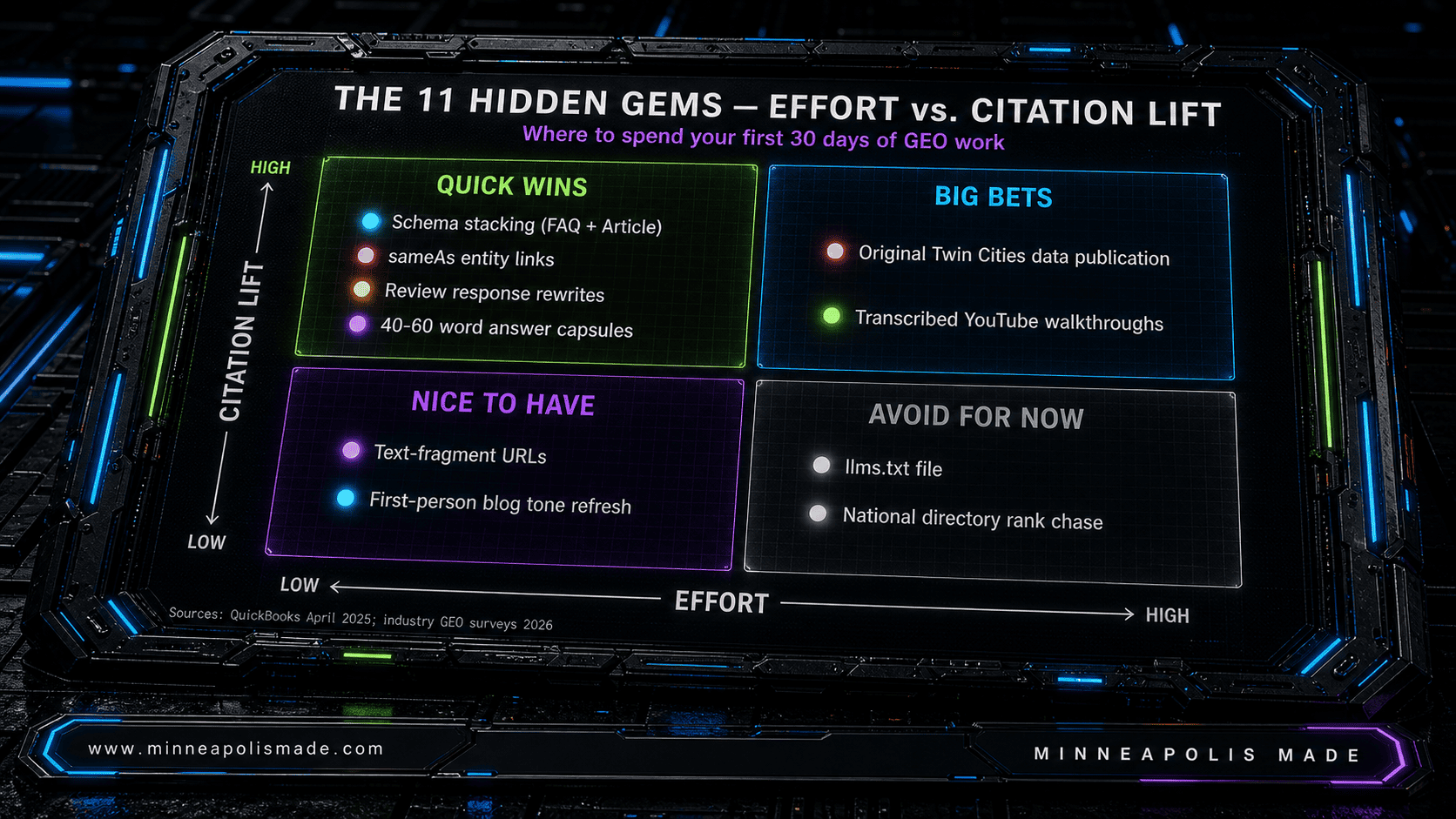
Hidden Gem #1 — YouTube has overtaken Reddit as the #1 social citation source
According to a 2026 Adweek analysis covered by Search Engine Land, YouTube’s share of social citations in AI answers jumped from about 18.9% in August 2025 to 39.2% in December 2025. Reddit’s share fell from 44.2% to 20.3% over the same period. Most local agencies are still chasing Reddit threads.
Hidden Gem #2 — Perplexity and Google AI Overviews drive most YouTube citations
Perplexity and Google AI Overviews together account for the large majority of YouTube AI citations. Gemini and Copilot rarely cite YouTube. The practical implication: a single short, transcribed walkthrough video on YouTube can punch far above its weight in the AI surfaces that matter most for local intent.
Hidden Gem #3 — Google’s “Hidden Gems” and Helpful Content updates favor first-person experience
Google’s 2023 “Hidden Gems” announcement and the subsequent Helpful Content updates explicitly elevate authentic, first-person, experiential content over polished generic blog copy. AI engines reward the same signal: original experience outperforms recycled summary every time.
Hidden Gem #4 — Entity disambiguation via sameAs is a 30-minute, high-leverage job
Adding `sameAs` links inside your Schema.org markup that point to Wikidata, LinkedIn, Crunchbase, Google Knowledge Panel, and authoritative profile pages directly trains AI engines on who you are. Few local sites bother. The ones that do show measurable lift in entity-driven AI citations within weeks.
Hidden Gem #5 — Text-fragment URLs deep-link to your best passages
The `#:~:text=` URL syntax lets AI engines and human readers deep-link directly to a specific quoted passage on your page. Almost no small business site uses these, but the ones that do see higher citation precision because the AI can pinpoint and lift a clean passage cleanly.
AEO and GEO Hidden Gems: the tactical levers no one is using yet
Unique Insight
The single most important academic source for current GEO practice is the Princeton and CMU paper “GEO: Generative Engine Optimization” (Aggarwal et al., KDD 2024). Its headline finding: targeted GEO tactics — primarily adding citations, statistics, and quotations to existing content — can boost a brand’s visibility in AI engine responses by up to 40.6%. Almost no Twin Cities small business is applying this paper’s recommendations to their own pages yet.
Hidden Gem #6 — Schema stacking outperforms any single schema type
BrightEdge research shows pages combining FAQPage, Article, and BreadcrumbList schema are cited 2.5 to 2.7 times more often in AI answers than pages with no schema. FAQ-structured content alone shows about a 44% citation lift versus plain prose. JSON-LD is the only format Google and Bing reliably parse.
Hidden Gem #7 — Short answer capsules outperform long ones
The best AI citation results in 2026 come from leading each section with a 40 to 60 word answer capsule directly under a question-formatted H2. This is the pattern AOK Marketing and most current AEO benchmarks point to. Long lead paragraphs lose to crisp, quotable lead capsules even when the overall page is the same length.
Hidden Gem #8 — Google Business Profile reviews now influence the AI Overview, not just the Local Pack
Gemini parses review sentiment and the specific words customers use, then uses that data when deciding which businesses to surface in both the Local Pack and the AI Overview. Your reviews are now AI content. This is the highest-leverage local GEO lever most small businesses are leaving on the table.
Hidden Gem #9 — Skip llms.txt. Double down on schema, sameAs, and structured FAQs.
Google ignores llms.txt. Adoption is under 10%. The effort goes much further into the signals AI engines actually consume: schema stacking, entity sameAs links, and structured FAQ content. Don’t get pulled into the new shiny.
Hidden Gem #10 — A transcribed YouTube walkthrough can outrank larger competitors in local AI citations
For service businesses especially, a single, well-titled, transcribed YouTube walkthrough video paired with an answer-first written page on the same topic creates a multi-format cluster that Perplexity and AI Overviews disproportionately favor. The barrier is time, not budget.
Hidden Gem #11 — Review responses are indexed and cited
Most local owners write a “Thanks!” reply to reviews. The owners winning in AI search are writing three-sentence responses that reuse the customer’s own language and explicitly name the service they delivered. Review response text is content, and AI engines read it the same way they read your homepage.
What a Twin Cities small business should do in the next 90 days
The honest answer for almost any Minneapolis or St. Paul owner reading this: the work is not “publish more blog posts.” The work is restructuring what you already have so AI engines can actually read, trust, and cite it.
Days 0 to 30 — foundations
- Audit your top 10 commercial pages for answer-first H2s and FAQ schema. Restructure them.
- Verify and complete your Google Business Profile — services, categories, photos, hours, posts.
- Audit review depth on Google and one industry-specific platform. Start a steady weekly review collection cadence.
- Add `sameAs` schema linking your business to LinkedIn, Wikidata (if applicable), and trusted profile pages.
Days 30 to 60 — signal building
- Publish one piece of original local data — a survey, benchmark, or proprietary case study tied to the Twin Cities market.
- Record one transcribed YouTube walkthrough of your most-requested service.
- Rewrite your review response template into three sentences that reuse customer language and name the service.
- Pursue two genuine third-party mentions — a podcast guest spot, a quote in local trade press, or an expert roundup.
Days 60 to 90 — measurement and iteration
- Establish a manual prompt-testing baseline in ChatGPT and Perplexity for ten priority queries.
- Re-audit. Track citation appearances, not just rankings.
Why this requires a local partner, not a national vendor
National AI visibility tools are generic. The small business surface area is local. A Twin Cities partner knows the regional press landscape, the directories that move the needle here, the local review patterns that matter to Minneapolis and St. Paul consumers, and the specific competitors a Twin Cities business is actually fighting on the SERP and inside AI answers.
Minneapolis Made is the first hybrid web design, SEO, and AI visibility studio in the Twin Cities built specifically around this 2026 shift. We work hourly at $85 per hour, with no packages and no lock-in.
Twin Cities AI Visibility Service
Become the answer ChatGPT gives in the Twin Cities.
Minneapolis Made audits, restructures, and rebuilds your digital footprint across Google, ChatGPT, Perplexity, Copilot, and Gemini — so the people researching your category in Minneapolis or St. Paul see you first, not your competitors.
Free 30-minute Twin Cities AI Visibility Teardown. We’ll show you, live, which businesses AI is currently recommending in your category — and what it would take to replace them.
Book Your Free AI Visibility Teardown
Or call us directly: 612-868-9079 · Hourly engagements at $85/hr, no packages, no lock-in.
Frequently Asked Questions
What is AI visibility and why does it matter for a small business?
AI visibility is the practice of getting your business mentioned and recommended inside the answers generative AI tools like ChatGPT, Perplexity, Gemini, Copilot, and Google AI Overviews show to users. It matters because buyers are increasingly forming a shortlist inside an AI chat before they ever search Google by name. If you’re not in that shortlist, the Google ranking only catches buyers who already know about you.
What’s the difference between SEO, GEO, and AEO?
SEO targets ranked positions on traditional search engines. GEO (Generative Engine Optimization) targets being cited inside AI-generated answers. AEO (Answer Engine Optimization) is a closely related, slightly older term that emphasizes structuring content as direct, extractable answers for any answer engine — featured snippets, voice assistants, and AI chats. In 2026 the three overlap heavily and the boundaries shift quarterly.
Do AI Overviews actually hurt my Google traffic?
Yes, on average. Pages where an AI Overview appears lose about 58% of the top-result click-through rate, and roughly 83% of AI Overview searches end without a click. But businesses cited inside the AI Overview earn an estimated 35% more clicks than non-cited competitors. Being inside the box is the new ranking-1.
How do I know if ChatGPT or Perplexity is recommending my business?
Run direct prompt tests in each AI for the queries you want to win. Try category-level questions like “best [your service] in Minneapolis” or “who should I hire for [your service] in St. Paul.” Tools like Profound, SE Ranking AI Visibility, and Otterly can track citation share over time, but manual prompt testing is still the most honest baseline.
Do I need an llms.txt file?
Not yet. Google’s Gary Illyes publicly confirmed in 2025 that Google does not use llms.txt, and adoption across the web is only around 10%. The same hour spent on FAQPage schema, sameAs entity links, or a review-response rewrite will produce more measurable lift in 2026.
Are reviews really that important for AI search?
Yes — arguably more than any other single signal for a local small business. AI engines use review volume, recency, language, and response behavior to grade trust before they will recommend a business. Reviews on independent platforms (Google, Trustpilot, industry-specific sites) carry more weight than testimonials on your own website because they are harder to fake.
How long does it take a Twin Cities small business to start showing up in AI answers?
For pages restructured with answer-first H2s, FAQ schema, and `sameAs` entity links, first ChatGPT or Perplexity citations typically appear within 4 to 8 weeks. Google AI Overviews tend to lag by another 4 to 6 weeks because the index refresh cadence is slower.
Should I hire a national AI visibility agency or a local one?
For Twin Cities small businesses, a local partner has structural advantages: knowledge of the regional press, the local directories that actually move citations, the review patterns specific to Minneapolis and St. Paul, and the exact competitors you’re being compared to inside AI answers. National vendors sell tooling; local partners win local citations.
How much does AI visibility work typically cost?
Minneapolis Made works hourly at $85 per hour with no packages and no lock-in. A typical initial Twin Cities small business engagement — audit, top-10 page restructure, schema stack, review program kickoff, and a 90-day playbook — falls in the range of 15 to 40 hours depending on site size and starting point.
What’s the single first thing a small business owner should do this week?
Run your three most important commercial queries through ChatGPT and Perplexity. Note which businesses are mentioned. If you are not in the answer, you now have a clear, measurable starting point. Bring that list to a free teardown call and we will show you exactly what it would take to replace whoever is currently being recommended.
Related service: Minneapolis Answer Engine Optimization (AEO/GEO) Services
Related: SEO vs AEO vs GEO: The 2026 Visibility Stack Explained
Related: AI Visibility vs. Traditional SEO in 2026: What Every Business Owner Needs to Know
Related: ChatGPT vs. Perplexity: Which AI is Actually Citing Twin Cities Businesses
Related: Minneapolis SEO Services: How We Approach Modern Search
Related: What Is SEO in 2026? A Working Definition for Business Owners
Related: Minneapolis Web Design Speed Report 2026
The Twin Cities AI Visibility Playbook
Want the playbook delivered to your inbox?
One email a month, written for Minneapolis and St. Paul small business owners. The tactics we’re testing, the local agencies quietly winning citations, and the readiness data we’re publishing as it comes out.