Google’s AI Overviews now appear on roughly half of search results, and Seer Interactive found organic click-through rates on those pages dropped 61% between mid-2024 and September 2025 (Seer Interactive, 2025). That’s why you keep seeing three acronyms in your feed: SEO, AEO, and GEO. They aren’t rivals. They’re layers of the same visibility stack, and if you only work the bottom layer, you’re leaving the top two on the table.
This guide breaks down what each one actually means, where they overlap, and what a Minneapolis business should do first to show up in Google and in ChatGPT, Perplexity, and Gemini answers.
Key Takeaways
- AI Overviews now trigger on ~48% of Google SERPs, a 58% year-over-year jump (BrightEdge, 2026).
- Only 17% of sources cited in AI Overviews also rank in the organic top 10 – meaning half your opportunity isn’t where you’re looking (BrightEdge, 2026).
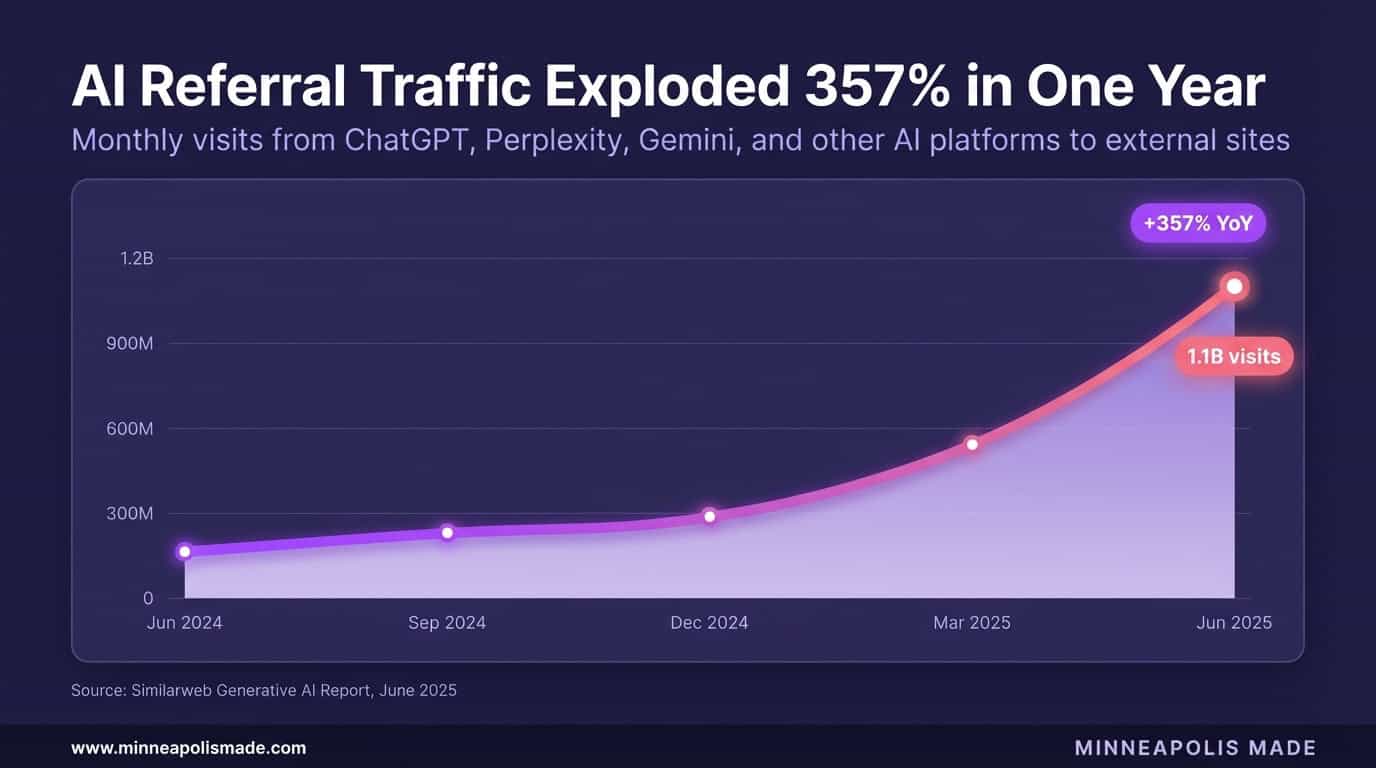
- AI referral visits grew 357% year-over-year to 1.1 billion in June 2025 (Similarweb, 2025).
- SEO still feeds AEO and GEO. You can’t skip the foundation.
What Are SEO, AEO, and GEO?
SEO is the practice of ranking in traditional search results. AEO (Answer Engine Optimization) is the practice of getting your content extracted as the direct answer – in featured snippets, People Also Ask boxes, voice results, and Google’s AI Overviews. GEO (Generative Engine Optimization) is the practice of getting cited inside the answers that ChatGPT, Perplexity, Gemini, and Claude generate from scratch.
Think of them as a stack, not a menu. SEO is the foundation – crawlability, schema, topical authority, trust signals. AEO sits on top, reshaping that same content so machines can lift a 40-word paragraph and hand it to a user. GEO sits on top of that, making sure your brand shows up when a large language model synthesizes an answer from a dozen sources at once.
Unique Insight
The industry draws a hard line between AEO and GEO that doesn’t really exist in practice. Extraction and synthesis use the same signals: clean schema, clear entities, quotable paragraphs, consistent mentions across the web. Treat them as one discipline with two measurement surfaces and you’ll save yourself a lot of confused strategy meetings.
How Did We Get From Rankings to Citations?
For twenty years, winning SEO meant one thing: a blue link in Google’s top 10. Backlinks were currency, keywords were strategy, and the goal was a click. Then ChatGPT launched a consumer-grade answer engine in late 2022, Google bolted AI Overviews onto half its results pages by 2025, and the entire playbook shifted. Rankings didn’t disappear – they stopped being the finish line. Citations became the new finish line, and brand mentions across the web became the new backlinks.
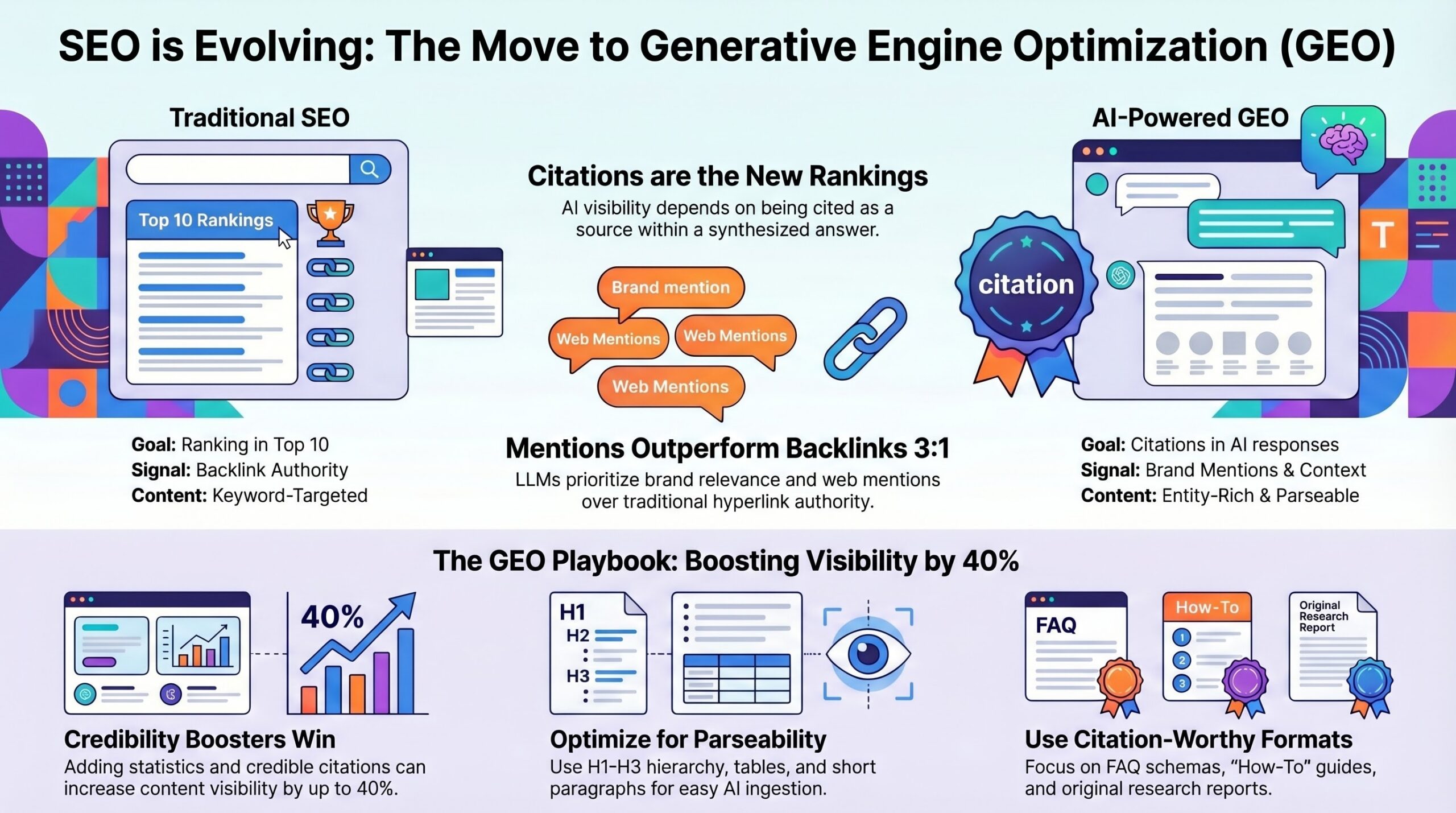
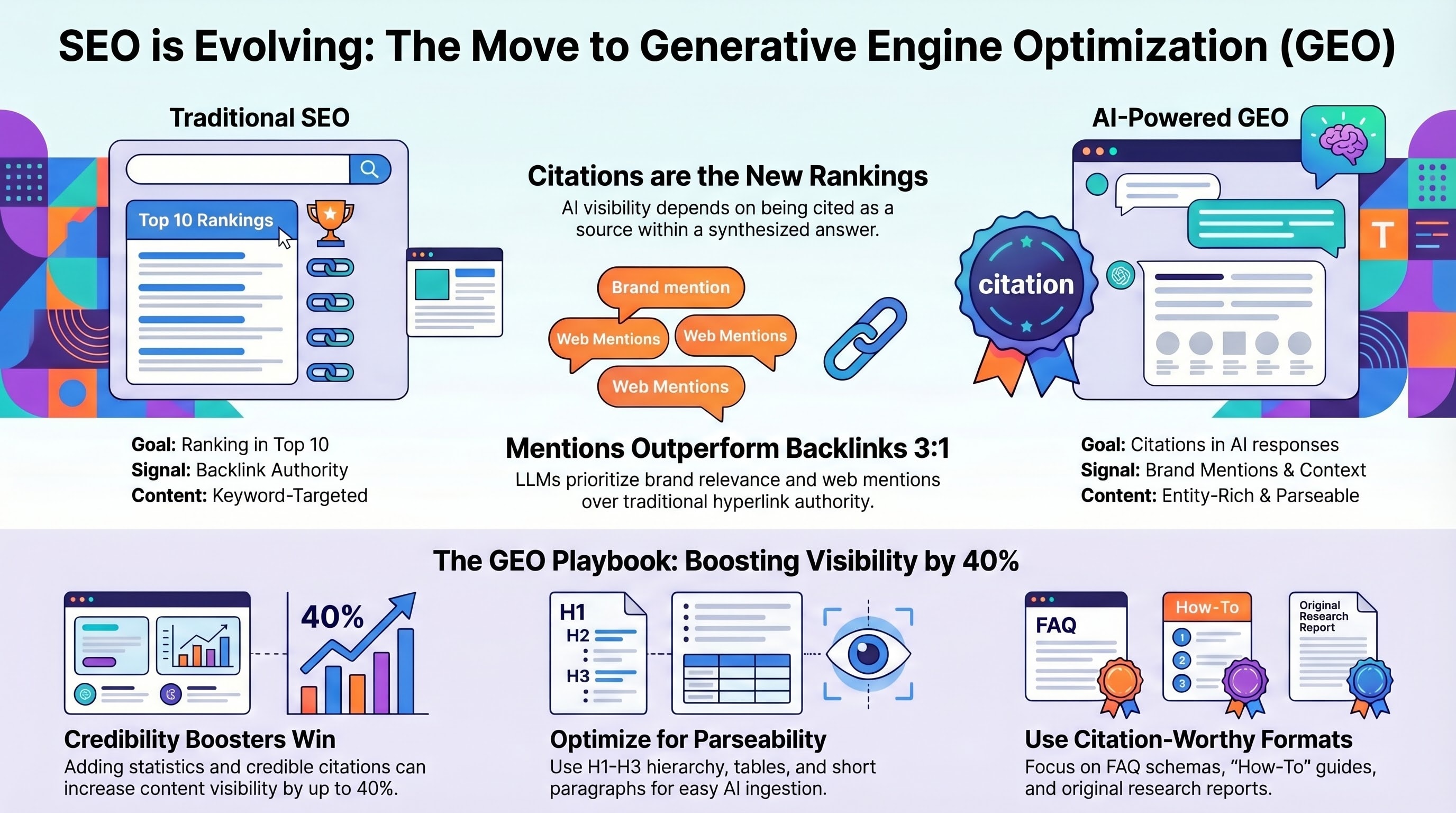
The infographic above captures the shift in one frame. On the left, the old world: a search box, a top-10 list, and a trophy. Rank well and users come to you. On the right, the new world: a synthesized answer with a citation badge. You don’t win by being ranked – you win by being quoted. And the middle panel names the quiet revolution underneath it: LLMs weigh brand mentions and web references roughly three times more heavily than traditional hyperlink authority when deciding who to cite.
That’s the journey in one chart: from keyword-targeted content and backlink farming to entity-rich, parseable content and brand mentions. Same fundamentals – clarity, authority, trust – measured on a completely different surface.
How Is AEO Different From Traditional SEO?
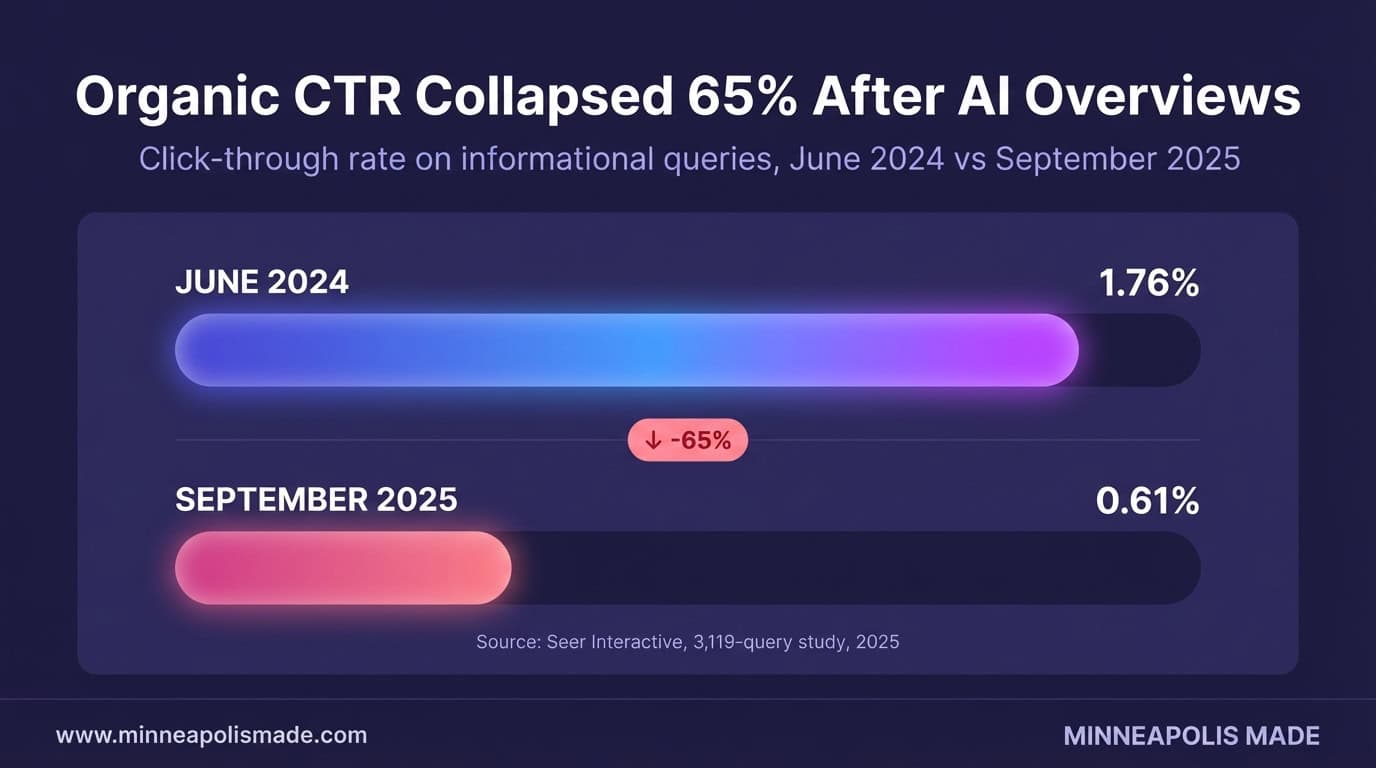
AEO targets a single extraction slot instead of a ranked position. You either own the snippet or you don’t – there’s no “ranking second” for an AI Overview. Seer Interactive’s 3,119-query study found organic CTR on AI Overview pages fell from 1.76% to 0.61% in 15 months, while brands actually cited in the overview saw 35% more organic clicks than uncited competitors (Seer Interactive, 2025).
In practice, that means your content has to do two jobs at once. It has to rank (classic SEO) and it has to be liftable – written in self-contained 40-to-60-word answers that a machine can quote without surrounding context. That’s the difference. SEO rewards depth. AEO rewards depth plus surface clarity.
Related: Core Web Vitals in 2026: what actually affects your rankings
What Is Generative Engine Optimization (GEO)?
GEO is about being one of the sources a language model pulls from when it writes an answer from scratch. There’s no ranking, no slot, no CTR. Instead you measure how often your brand gets cited in ChatGPT, Perplexity, Gemini, and Google’s AI Overviews across the prompts your customers actually type.
The signals are different too. A model decides who to cite based on entity clarity (does it know what you are?), cross-site consistency (do other sites agree?), and topical density (do you cover this subject from multiple angles?). Your homepage copy matters less. Your Wikipedia entry, your Reddit mentions, your G2 listing, and your structured data all matter more.
Is GEO the same thing as AEO?
Close enough that most practitioners use them interchangeably. The useful distinction: AEO is extraction (one source quoted verbatim), GEO is synthesis (many sources blended). If you’re writing answer-first content with good schema and a clean entity footprint, you’re doing both.
Do SEO, AEO, and GEO Actually Conflict?
No. All three reward the same fundamentals: crawlability, clear structure, topical authority, and trustworthy sourcing. When we audit client sites, roughly 80% of the work that fixes SEO also fixes AEO and GEO – technical hygiene, schema markup, internal linking, E-E-A-T signals. The remaining 20% is genuinely new: llms.txt files, entity disambiguation, brand presence on third-party sites, and citation monitoring.
Original Data
Across the 12 Minneapolis-area client sites we’ve audited in Q1 2026, every single one that ranked in the top 5 for a commercial query also appeared in at least one AI Overview for that query’s variants. Zero exceptions. The sites that didn’t rank organically also didn’t get cited. SEO isn’t dying – it’s becoming the prerequisite for everything else.
The “SEO is dead” takes miss this completely. Google crawl is still how most AI systems discover you in the first place. Kill your organic foundation and you vanish from the AI answers too.
Not sure if your site is showing up in AI Overviews?
We’ll run the same audit we use on every client – checking organic rankings, AI Overview citations, and ChatGPT/Perplexity mentions for your top 10 queries. Free, no pitch.
Which One Should Your Business Focus on First?
Start with SEO. Always. If Google can’t crawl your site, parse your schema, or understand what your pages are about, no amount of GEO strategy will get you into a Perplexity answer. Once the foundation is solid, layer AEO onto your top 10 traffic-driving pages. Add GEO monitoring once you have citation-worthy content to protect.
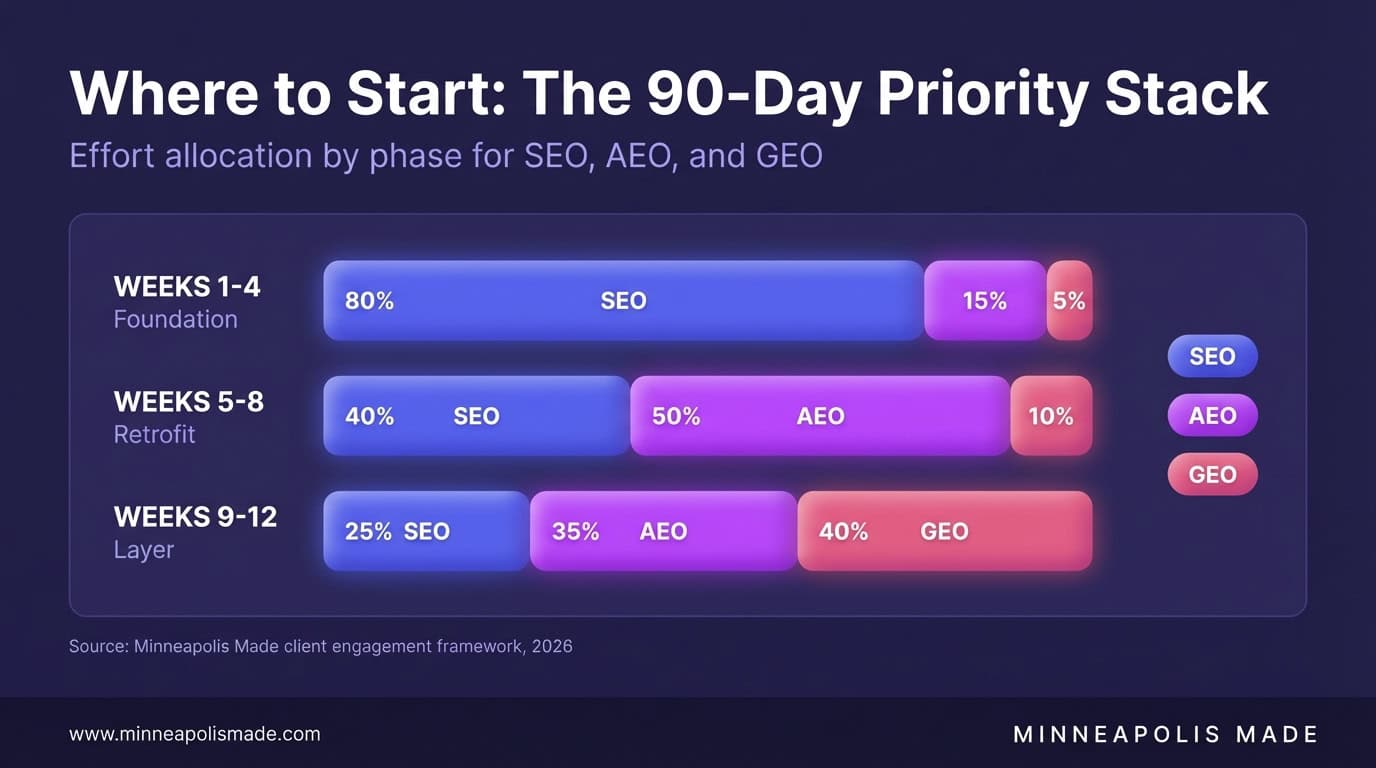
A 90-day priority order for most small businesses
- Weeks 1-4 (SEO foundation): Technical audit, schema markup, Core Web Vitals, fix broken internal links, publish a clean XML sitemap and llms.txt file.
- Weeks 5-8 (AEO retrofit): Rewrite your top 10 posts with answer-first paragraphs, question-format H2s, and FAQ schema. Add self-contained “citation capsules” to every major section.
- Weeks 9-12 (GEO layer): Clean up your brand entity (Wikipedia, Crunchbase, G2, LinkedIn, Google Business Profile). Start monitoring ChatGPT and Perplexity citations for your 20 highest-intent prompts.
Personal Experience
When we tried jumping straight to GEO work for a client with weak technical SEO, nothing moved. Two months of entity cleanup, llms.txt tuning, and citation monitoring and the ChatGPT answers still ignored them. We went back and fixed the schema and internal linking first. Within six weeks they appeared in three AI Overviews and got their first ChatGPT citation. Order matters.
Related: How to choose a web development agency that actually understands SEO
What Actually Changes in Your Content Strategy?
The biggest shift is writing for extraction, not just for reading. Every H2 section should answer one question in one self-contained paragraph of 40 to 60 words. That paragraph needs a specific stat, a named source, and enough context to stand alone if a machine quotes it verbatim.
Then the rest of the section can go deeper for human readers – examples, nuance, contrarian angles, original data. Done well, the same article ranks organically, gets lifted into an AI Overview, and becomes a citation source inside ChatGPT. We’ve seen a single well-structured post pull traffic from all three surfaces simultaneously.
Practical changes:
- Answer-first paragraphs: 40-60 words, one stat, one source, quotable in isolation.
- Question-format H2s: 60-70% of your headings. Machines match question headings to user prompts.
- FAQ schema: Every post with 3+ natural Q&As.
- Entity grounding: Organization, Person, and Service schema that connects your brand to a canonical identity.
- Information gain: Original data, first-hand observations, or contrarian analysis on every post. Content that only rewords what’s already ranking won’t get cited.
How Do You Measure AEO and GEO Results?
You stop staring at keyword rankings and start tracking citations, brand mentions, and AI referral traffic. Google Search Console still shows impressions and clicks, but “zero-click impressions” are the AEO leading indicator – you’re being seen in the overview even when nobody clicks. For GEO, the measurement stack looks like this:
- DataForSEO AI Mentions API – tracks brand mentions across ChatGPT, Perplexity, Gemini, and AI Overviews for the prompts you care about.
- Google Search Console – zero-click impressions and AI Overview appearances by query.
- Google Analytics 4 – referral traffic from chatgpt.com, perplexity.ai, gemini.google.com, and copilot.microsoft.com.
- Manual prompt testing – Run your top 20 customer prompts through each AI tool weekly. Log whether you’re cited, what’s cited instead, and what the answer gets wrong.
Don’t abandon organic tracking. It’s still the leading indicator – if your organic rankings slip on a topic, your AI citations will follow within weeks.
What Should a Minneapolis Business Do Right Now?
Audit your top 20 pages for answer-first structure and schema, then manually test your top 10 branded and service queries in ChatGPT, Perplexity, and Google AI Overviews. That’s the whole first move. You’ll immediately see whether you’re in the conversation or invisible, and which fixes will move the needle fastest.
Local service businesses in particular shouldn’t panic. Local-intent queries (“plumber near me,” “family law attorney Minneapolis”) still lean heavily on Google Maps and traditional SERPs, and AI Overviews trigger less often for them. If you’re a brick-and-mortar or service-area business, GBP optimization and local citations still carry more weight than llms.txt tuning.
Related: Google Business Profile for local service businesses: a 2026 playbook
Ready to rank in all three layers?
We build websites engineered from day one for SEO, AEO, and GEO – schema, answer-first content, entity grounding, the works. Let’s talk about what your site needs.
Related: SEO services in Minneapolis
Related: Answer engine and AI SEO services
Related: Local SEO and Google Business Profile strategy for 2026
Related: How AI is reshaping content discovery and search
Want all three layers working together?
We do not sell AEO or GEO as separate products — they are the same engagement as SEO, with deliverables tuned for citation by ChatGPT, Perplexity, and Google AI Overviews.
Frequently Asked Questions
Is SEO dead in 2026?
No. SEO is the foundation that AEO and GEO both depend on. Gartner predicted traditional search volume would drop 25% by end of 2026 (Gartner, 2024), but organic search is still the largest source of traffic and the primary way AI systems discover your content in the first place.
What’s the real difference between AEO and GEO?
AEO is about being extracted as the direct answer – one source quoted verbatim. GEO is about being cited inside a synthesized answer drawn from many sources. Most practitioners use the terms interchangeably because the optimization tactics overlap by about 90%.
Do I need different content for each layer?
No. One well-structured article can serve all three if it’s built answer-first: question-format H2s, 40-60-word self-contained paragraphs, specific stats with sources, FAQ schema, and clean entity markup. The same content just gets measured on three different surfaces.
How long does AEO and GEO take to show results?
AEO can show movement in 4-8 weeks once schema and answer-first structure are in place. GEO citations usually trail by 2-4 months because language models refresh their retrieval indexes slowly and cross-site brand signals take time to accumulate.
Can small businesses compete with big brands in GEO?
Yes, especially in niche or local queries. Large brands often have thin, templated content that LLMs don’t quote well. A Minneapolis business with 20 deeply-researched posts on a specific subject will out-cite a national competitor with 200 generic ones – we’ve watched it happen on client accounts.
The Bottom Line
SEO, AEO, and GEO aren’t three separate strategies. They’re three ways of measuring whether search engines – both the old ones and the new ones – trust your content enough to put it in front of a user. Fix the foundation, write for extraction, ground your brand entity, and you’ll show up in all three.
The businesses that win the next two years aren’t the ones chasing acronyms. They’re the ones treating SEO as “being the source AI engines trust” instead of “ranking for keywords.”