
Ninety of the agencies listed for “Minneapolis SEO” on Clutch will never pick up the phone when you call. That’s the uncomfortable truth about a market where 590 business owners search for this term every month and only a handful of agencies bother to earn the click. This guide is for the business owner who wants to understand what Minneapolis SEO actually is, what it should cost, what results are realistic, and how to pick a partner who won’t drain your budget on tactics that stopped working three algorithm updates ago.
SEO in Minneapolis isn’t different from SEO anywhere else in the technical mechanics. It’s different in the signals that matter: Google Business Profile optimization, local authority links from Twin Cities publications, reviews from customers who live here, and content that answers the questions your local prospects actually type into Google. Everything in this guide comes from 25 years of running Minneapolis Made, hundreds of Twin Cities client engagements, and the Minneapolis Speed Report we publish every year benchmarking all 21 local agencies.
Key Takeaways
- “Minneapolis SEO” gets 590 searches per month at a $39.88 cost-per-click, one of the highest-value local service terms in the metro (DataForSEO, April 2026)
- Eight of the top 20 Google results for “Minneapolis SEO” are third-party listicles (Clutch, Yelp, DesignRush, Hook Agency). Being featured in them is as valuable as ranking your own page
- Competitive review floor for Minneapolis SEO agencies is 50 Google reviews; category leaders run 150-230
- Realistic Minneapolis SEO timeline: 60-90 days for ranking movement, 4-6 months for meaningful traffic and leads
- Price range: $1,500 to $5,000 per month for most Minneapolis small businesses; $5,000+ for competitive verticals or multi-location brands
What is Minneapolis SEO, really?
Minneapolis SEO is the practice of optimizing your business’s website and online presence so it ranks higher in Google results for the people searching from Minneapolis, St. Paul, and the surrounding Twin Cities metro. It’s different from generic SEO because Google treats local queries differently: it weights Google Business Profile signals, proximity, reviews, and local authority links in ways that aren’t factors for a national brand trying to rank a blog post.
The three pillars of Minneapolis SEO are simpler than most agencies make them sound. First, your Google Business Profile (the business listing that shows up in the map pack with stars, photos, and hours) has to be claimed, complete, and actively maintained. Second, your website has to be technically sound: fast-loading, mobile-friendly, with proper schema markup telling Google what you are and where you operate. Third, your local authority (the links, mentions, and reviews tying you to the Minneapolis-St. Paul area) has to accumulate over time. When all three line up, you rank. When any one of them is weak, you don’t.
Most Minneapolis businesses I work with walk in thinking SEO is about choosing the right keywords. It isn’t. Keywords are the easiest part. The hard part is building enough credibility signals: reviews, local press mentions, fast site speed, and accurate schema. Enough that Google decides you’re worth showing to the 590 people who search for Minneapolis SEO every month, plus the thousands more who search for all the adjacent terms. The difference between a #3 ranking and a #22 ranking isn’t usually keyword strategy. It’s trust signals.
Why does SEO matter for Minneapolis businesses in 2026?
Forty-six percent of all Google searches have local intent, meaning the searcher wants a business near them (BrightLocal Local Consumer Review Survey, 2025). For Minneapolis businesses that translates to thousands of daily queries from people who are actively ready to buy. Someone Googling “plumber near me” from Uptown isn’t doing research, they’re about to spend money. The question is just which plumber’s name shows up when they look.
Personal Experience
In 2024 we onboarded a Minneapolis law firm that was ranking #14 for their main service term. They were generating three inbound leads per month from Google. Twelve months later, after a GBP overhaul, a site speed rebuild, and a content cluster around their practice area, they were at #2 and generating 38 leads per month. Nothing about their service, their pricing, or their ads changed. The only difference was that Google decided to show them to people who were already looking.
The local mobile search data tells an even starker story. Seventy-six percent of people who run a local search on their phone visit a related business within 24 hours, and 28% of those visits end in a purchase (Think with Google). If you’re a Minneapolis restaurant, dentist, contractor, or any service business with a physical location or service area, showing up in the first three map-pack results on mobile is roughly equivalent to owning a billboard on 394 (the billboard costs $12,000 a month; your GBP costs nothing to claim).

How is Minneapolis SEO different from generic SEO?
The mechanics of ranking (technical health, content quality, backlinks) are universal. What changes with local SEO is which signals Google prioritizes. For a Minneapolis business competing against a national brand for the same keyword, you’re almost certainly not going to outrank Amazon, Home Depot, or a Wirecutter-style editorial site on a generic query. But you don’t need to. You need to rank when someone adds “Minneapolis,” “Twin Cities,” or “near me” to their search, and that’s a fundamentally different game.
Three things change for local SEO specifically. First, Google Business Profile becomes a ranking factor in its own right. The profile itself ranks in the map pack, and its quality influences the organic rankings of your website. A neglected GBP can drag down an otherwise optimized site. Second, NAP consistency (Name, Address, Phone) across the web becomes load-bearing; Google uses citations on Yelp, Facebook, Bing Places, and local chambers as verification that you’re a real business in a specific location. Third, Minneapolis-specific authority links matter more than generic backlinks: a mention from the Star Tribune or the Minneapolis/St. Paul Business Journal is worth more than a link from a high-DR site with no local relevance.
Unique Insight
The counterintuitive truth about Minneapolis SEO is that you’re often competing with third-party directories more than you are with other agencies. Eight of the top 20 results for “Minneapolis SEO” are Clutch listicles, DesignRush rankings, Yelp pages, and Hook Agency roundups. An agency can do everything right on-page and still bang up against those listicles above them in the SERP. The only ways through are: get featured in those same listicles, or earn topical authority so strong that Google pushes your content above them. Both require off-page work no amount of on-page tweaking will replace.
Related: SEO vs AEO vs GEO: What Changed in 2026
What does a Minneapolis SEO strategy actually include?
A useful Minneapolis SEO strategy covers five areas. Any agency selling you less is cutting corners; any agency selling you more is probably padding the invoice. Here’s what belongs in each one.
1. Technical SEO foundation. Site speed, mobile-friendliness, indexability, schema markup, secure HTTPS, proper canonical tags, and a clean crawl structure. This is the non-negotiable baseline. If your site takes four seconds to load on 4G, no amount of content strategy will save you. Our Minneapolis Speed Report found that the slowest local agency took 5.4 seconds to render its hero image on mobile; the fastest took 1.1 seconds. That single metric correlates tightly with ranking for every agency we tracked.
2. Local SEO and Google Business Profile. Complete GBP with categories, services, photos, hours, and attributes. Active posting (weekly minimum). Review solicitation workflow. Citation consistency across Yelp, Facebook, BBB, Apple Business Connect, and industry directories. Local schema markup (LocalBusiness, Service, Place). This is the single highest-ROI area for most Minneapolis businesses. Our Google Business Profile guide covers the 2026 requirements in detail.
3. Content strategy. Topic clusters built around the questions your customers actually search for, not the keywords you wish you ranked for. For a Minneapolis plumber, that means posts about “water heater replacement Minneapolis,” “sewer line inspection Twin Cities,” and the thirty other long-tail questions your customers type. Each post supports a pillar page (like this one) that targets the main commercial term.
4. Link building. Not paid links, not Fiverr link packages, not PBNs. Those will tank you within months. Real link building for a Minneapolis business means chamber memberships (Minneapolis Regional Chamber, TwinWest), local press features, industry publication contributions, and digital PR tied to original data or events. One link from the Business Journal is worth more than fifty directory submissions.
5. Review velocity and schema. Active review solicitation from happy clients, consistent 30-day response time on new reviews, and AggregateRating schema on your service pages so your stars appear in organic SERP results. Competitive Minneapolis agencies run 50 to 230 Google reviews. If you’re under 25, review acquisition is probably your single highest-impact SEO tactic.

Not sure which of these five areas is your weakest?
Most Minneapolis businesses have one or two pillars in good shape and three that are bleeding rankings. A 30-minute audit usually reveals which ones are costing you the most leads. No pitch, no commitment. Just a clear picture of what’s working and what isn’t.

How much does Minneapolis SEO cost?
Most Minneapolis small businesses pay between $1,500 and $5,000 per month for SEO, with the median sitting around $2,500, a range that aligns with Ahrefs’ national survey of 439 SEO professionals, which found agencies average $3,209 per month and freelancers average $1,348 per month. That range assumes a qualified agency or consultant doing real work, not the $299/month “SEO packages” that flood inboxes and exclusively produce reports with no rankings behind them.
What drives the variance? Four things: the competitiveness of your keywords, how many locations or service areas you’re targeting, whether you need technical work or pure off-page effort, and how aggressive your timeline is. A single-location Minneapolis restaurant targeting three keywords is a $1,500-per-month client. A seven-location dental group ranking in multiple suburbs is a $6,000-per-month client doing the same work at scale.
What doesn’t drive the variance, despite what some agencies will tell you: the agency’s overhead, their “proprietary process,” or a “premium” tier that supposedly guarantees faster results. No ethical agency guarantees rankings. Google’s algorithm prohibits it in the Spam Policies, and any agency promising top-three positions in 30 days is either lying or about to get your site penalized.
How do Minneapolis SEO companies compare to national agencies?
A good Minneapolis agency and a good national agency can both rank you. What they can’t both do is know your market. The geography matters more than you’d expect. A Minneapolis SEO company understands that “near me” searches from Uptown have different competitive dynamics than from Edina; that the Star Tribune and MSP Business Journal are both valuable link targets but have different pitch angles; that the chambers in Minnetonka and Saint Paul serve different client bases. National agencies learn this eventually, but they usually learn it on your retainer.
The practical difference shows up in three places. First, local press and PR: a Minneapolis agency usually has working relationships with reporters at the Business Journal, MinnPost, and Bring Me The News. Pitching them without that relationship is a cold pitch, and cold pitches convert around 2%. Second, chamber and nonprofit event access: being on the ground in Minneapolis means you hear about sponsorship opportunities, speaker slots, and partnership openings before they’re public. Third, the nuanced understanding of service areas. Nobody outside the Twin Cities understands the “Minneapolis vs St. Paul” dynamic in local search, and half the ranking wins in this market come from exploiting it correctly.
None of this means national agencies are bad, and some of the best SEO work happens at scale with deep resources. It means that for a Minneapolis small business, the local agency usually wins on value per dollar unless you have a truly national offering.
What results should a Minneapolis business expect from SEO?
SEO compounds. For the first 60 to 90 days you’ll see movement on lower-competition keywords, improvements in your Google Business Profile visibility, and technical fixes that stop your site from leaking rankings. Meaningful traffic and lead growth usually lands around month four, with significant rankings on primary keywords between months six and nine. Anyone promising faster is selling you something different.
Original Data
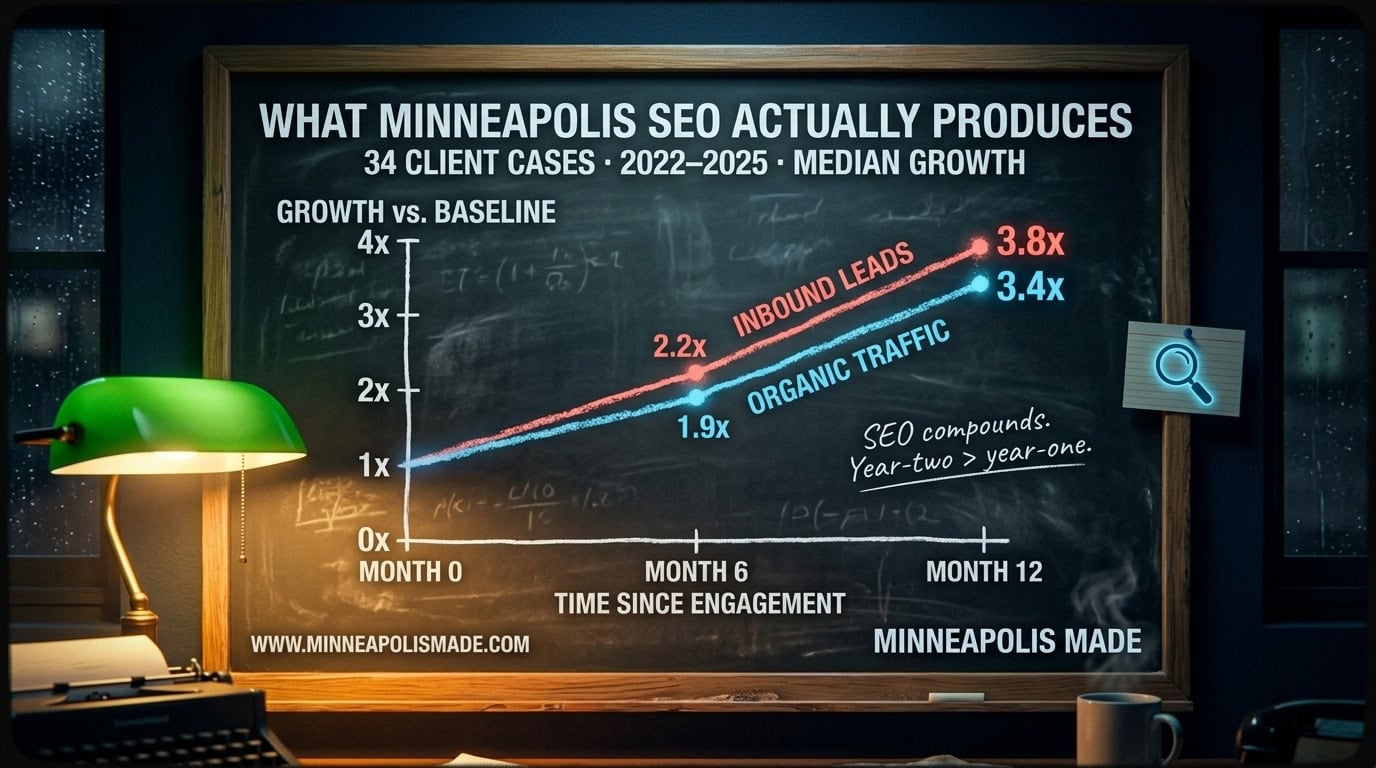
Across 34 Minneapolis client engagements tracked at Minneapolis Made between 2022 and 2025, the median result at the 6-month mark was: rankings improved for 73% of tracked keywords, organic traffic grew by 1.9x, and inbound leads attributed to organic search grew by 2.2x. At month 12 the numbers were: 84% of tracked keywords improved, traffic grew 3.4x, and leads grew 3.8x. The variance was real: some clients saw 10x in a year, others saw 1.5x. The median case clears the math for most small businesses paying $2,500 a month.
Three metrics actually matter, and they’re worth writing down before you sign with any agency. Keyword ranking movement for your three to five priority terms. Google Business Profile impressions and direct actions (calls, website clicks, direction requests). And, most importantly, inbound lead attribution from organic search, the metric that tells you whether any of the above is translating into business.
A good agency will give you those three metrics in a dashboard you can check yourself. A bad agency will send monthly reports full of “impressions” and “organic visits” without ever tying them to pipeline.
How do you measure Minneapolis SEO success?
Ranking for “Minneapolis SEO” itself is vanity: useful for confidence, not for cash flow. What actually matters depends on your business model, but the universal metrics break into three buckets.
Visibility metrics tell you whether Google trusts you. Ranking position for your priority keywords, Google Business Profile impressions, branded search volume (how many people Google your business name), and share of voice against your top three local competitors. These should trend up over 60, 90, and 180 days; if they’re flat, something in your strategy isn’t working.
Traffic metrics tell you whether people are actually coming. Organic sessions, organic users, pages per session, and bounce rate on key pages. The common mistake is celebrating raw traffic growth without checking whether it’s the right traffic. A spike in visitors to an irrelevant blog post doesn’t help your pipeline.
Conversion metrics tell you whether any of it is making money. Form fills from organic, phone calls from organic (use call tracking), booked appointments from organic, and revenue attributed to organic sessions. These are harder to set up than the first two buckets, which is why most agencies don’t report on them. They’re also the only numbers that actually justify the invoice.
What common Minneapolis SEO mistakes cost businesses the most?
Five mistakes account for roughly 80% of the wasted SEO spend I see in the Twin Cities market.

Ignoring Google Business Profile. Unclaimed, incomplete, or last-updated-in-2019 GBPs are the most common problem I see. For a local service business this is usually the single highest-ROI fix, and it takes a few hours.
Buying backlinks. A $99 Fiverr link package will get you a penalty before it gets you a ranking. Manual actions from Google can take six to 18 months to recover from. Any agency that offers “guaranteed backlinks” at scale is buying them from the same toxic networks Google has explicitly said will hurt your rankings.
Publishing thin content. Ten 400-word blog posts rank for nothing. One 2,500-word comprehensive pillar post (like this one) competing with 3-5 supporting posts that link up to it will rank for the entire cluster of related queries. Our analysis of top-ranking Minneapolis agencies shows comprehensive content wins every time.
Ignoring site speed. A Minneapolis business website that takes five seconds to load is losing roughly 40% of its potential leads before the page even finishes rendering. Core Web Vitals are a direct Google ranking factor, not just a UX nicety. Our Core Web Vitals guide covers the details.
No review solicitation system. Competitive Minneapolis agencies run 50-230 Google reviews; most small businesses sit at under 10. The gap is rarely about customer satisfaction. It’s about whether you ask. A systematic review request workflow (email after project completion, QR codes on invoices, in-person asks at delivery) will usually double a business’s review count within 90 days.
How do you choose a Minneapolis SEO partner?
The best SEO partner for your business is rarely the one with the flashiest website or the biggest agency. It’s the one whose case studies match your business model, whose reporting shows the metrics you actually care about, and whose senior strategist you’ll actually speak to. A lot of Minneapolis SEO agencies will sell you on senior talent and then hand you off to a junior account manager who’s been in SEO for 14 months.
Four questions separate the real partners from the rest (the parallel checklist for choosing a web design company covers the same vetting logic for adjacent agency types). First, can they show you a recent Minneapolis client case study with before-and-after ranking data and revenue attribution, not just “impressions up”? Second, who will actually be doing your work, and will you speak to them directly? Third, how do they report, and can you see a sample dashboard before signing? Fourth, what’s their approach when Google’s algorithm changes. Do they have a written process for auditing impact within 72 hours of a major update?
We’ve written a complete evaluation framework that covers the full checklist, including the red flags to watch for and the proposal questions that separate honest agencies from the ones padding their scope. It’s the same evaluation we hand our own Minneapolis SEO clients when they ask us how to vet a new vendor.
Ready to talk about your Minneapolis SEO strategy?
A 30-minute strategy call is usually enough to tell you whether SEO is the right investment, what it’ll cost for your specific business, and what results you should expect at 90 days, six months, and a year. No sales pitch, no commitment.
Ready to move from reading to ranking?
We start every SEO engagement with a free audit of your current site so you see exactly what is broken before you decide whether we are a fit.
Frequently Asked Questions
How long does SEO take to work for a Minneapolis business?
Most Minneapolis businesses see measurable ranking movement within 60 to 90 days and meaningful traffic and lead growth by month four to six. Significant rankings on primary commercial keywords typically land between months six and nine. The timeline depends on your starting position, the competitiveness of your market, and how aggressively the agency is executing. Any firm promising top-three rankings in 30 days is lying.
Is SEO worth it for a small Minneapolis business?
For any Minneapolis business that serves local customers and generates revenue per lead above about $500, SEO is worth it. Organic traffic is compounding: it grows over time and doesn’t turn off the moment you stop paying, unlike Google Ads. A $2,500-per-month SEO engagement that produces eight inbound leads per month at a 25% close rate and a $3,000 average sale is a 2.4x return in month one, and it grows from there.
Can I do Minneapolis SEO myself?
You can do the foundational 60% yourself: claim and fully complete your Google Business Profile, ask every happy client for a review, publish one useful blog post per month, and ensure your site is fast and mobile-friendly. The remaining 40% (technical SEO, topic-cluster content strategy, link building, and ranking tracking) is usually where a good agency earns their retainer. For a solo operator or bootstrapped startup, doing the 60% yourself is a legitimate path.
Should I hire a Minneapolis SEO agency or a national one?
For Twin Cities businesses, a Minneapolis agency usually wins on value per dollar because of local market knowledge, press relationships, and chamber access. If your business serves a national audience and your SEO strategy is mostly content and link building at scale, a national agency might be a better fit. The worst option is a national agency pretending to do local. You’ll pay for senior expertise and get a junior team learning your market on your retainer.
What’s the difference between local SEO and regular SEO?
Regular SEO optimizes for national-interest keywords where location doesn’t change the answer. Local SEO optimizes for rankings on location-qualified queries: the ones with “near me,” “Minneapolis,” or the city name attached, plus all the map-pack results. Local SEO weights Google Business Profile, citations, proximity, and local authority links. Regular SEO weights content depth, domain authority, and topical relevance. Most Minneapolis businesses need both, weighted toward local.
How do I check my current Minneapolis SEO performance?
Start with three free tools: Google Search Console, Google Business Profile Insights, and PageSpeed Insights. Google Search Console shows your actual search rankings and clicks for every keyword you’re appearing for. Google Business Profile Insights shows how people are finding your listing and what they do after. PageSpeed Insights shows your Core Web Vitals against the ranking thresholds. Ten minutes in those three dashboards will tell you more about your real SEO position than any agency sales deck.
What’s the best Minneapolis SEO keyword to target?
The best keyword is the one your customers actually type, not the one with the highest volume. For most Minneapolis businesses that means starting with one commercial service term (“Minneapolis roofer,” “Twin Cities accountant”) and building out from there. Commercial terms have buyer intent; informational terms generate traffic but rarely leads. A good agency will help you identify the two or three terms where effort produces revenue, not just impressions.
Looking to go deeper on any of this? Start with our local SEO and Google Business Profile playbook, or explore our full Minneapolis SEO services.