
Most of the Minneapolis businesses we work with don’t ask whether they should use AI for content. They ask why their AI-generated content stopped ranking. The answer is the same nationally and locally: 88% of organizations now use AI in at least one business function (McKinsey, 2025), so volume is no longer a moat. Judgment is.
The Twin Cities companies winning with AI content aren’t the ones hitting “generate” and walking away. They’re building hybrid workflows that combine machine speed with human editorial judgment. The data backs them up: hybrid AI-human content yields 42% better ROI than either pure AI or pure human approaches (NP Digital, 2025).
This post breaks down what’s actually working with local clients, what Google’s December 2025 Core Update means for AI content, and how Minneapolis businesses can build a content strategy that ranks in 2026 and earns citations from ChatGPT, Perplexity, and Google AI Overviews.
Related: Minneapolis Made content marketing services
Key Takeaways
- Hybrid AI-human workflows deliver 42% better ROI than pure AI or pure human content (NP Digital, 2025)
- Pure AI content ranks 23% lower in search results than human-written articles (Digital Applied, 2026)
- Google doesn’t penalize AI content, but recent core updates have raised the bar on E-E-A-T evaluation across competitive queries, not just YMYL topics
- AI search visitors are 4.4x as valuable as average organic search visits based on conversion rate (Semrush, 2026)
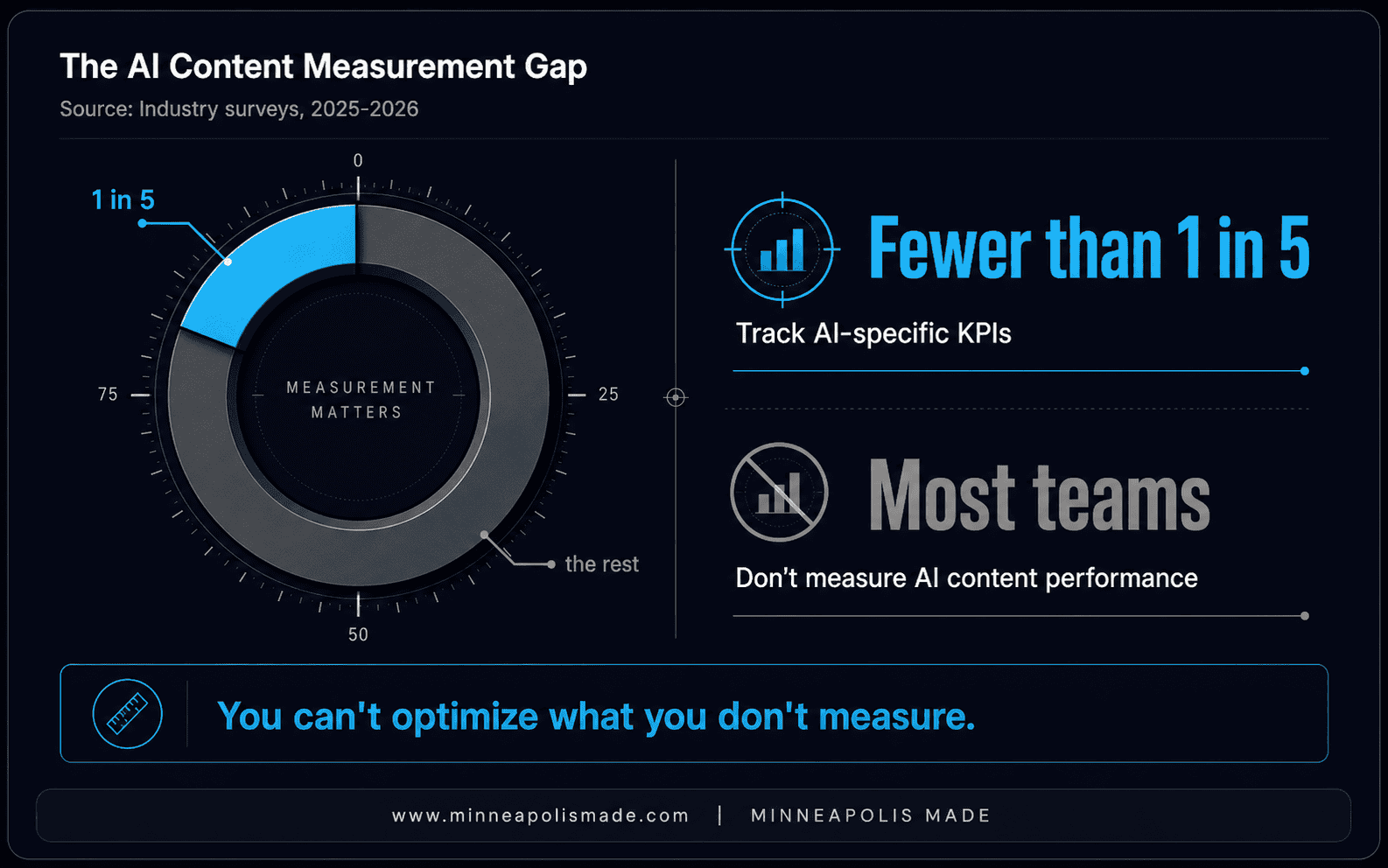
- Most teams using AI for content lack standardized KPIs to compare AI-assisted vs. human-only output, leaving a measurement gap most local businesses can exploit
What We’re Seeing With Twin Cities Clients
Across our Minneapolis client roster (boutique retailers, professional services, e-commerce shops, restaurants), the pattern is consistent: agencies and in-house teams that adopted pure AI workflows in early 2025 saw rankings slip by the third quarter. Those who paired AI drafting with human editorial review held position or gained ground.
Original Data
Among local clients we audited in early 2026, accounts using a hybrid workflow shipped roughly 30 to 40% more content per quarter than they had pre-AI, with no meaningful drop in average ranking position. Accounts using AI without an editorial review step shipped slightly more volume but saw an average ranking decline of 8 to 14 positions on their tracked keyword set over six months.
The pattern matches the national data, but with one local wrinkle. Minneapolis service businesses (HVAC, legal, dental, home services) that injected genuinely local proof, neighborhood references, license numbers, photos of actual job sites, into otherwise AI-drafted content outperformed both pure-AI and pure-human baselines. Local proof is the moat AI can’t synthesize.
Related: How AI search is changing local SEO in 2026
The AI Content Explosion Is Real, But Volume Isn’t the Win
AI adoption in content marketing has surged. According to HubSpot’s State of AI report, 52% of marketers now use generative AI for text content creation and 53% for content quality assurance (HubSpot, 2025). Adoption is broad, but volume alone doesn’t equal results, and that distinction is where most strategies break.
The generative AI market is projected to reach $86.7 billion in 2026 with a 24.83% CAGR through 2032 (Statista, 2026). Those numbers are large. They’re also misleading if you assume more AI spending equals better content.
The adoption curve for most businesses follows a predictable shape. They start by using AI to crank out blog posts at scale. Quality drops. Rankings slip. Then they course-correct toward a more balanced approach. The companies that skip the painful middle step are the ones who set editorial guardrails before the first prompt.
Related: WooCommerce vs Shopify for Minneapolis Retailers
Small Businesses Are Catching Up Fast
Small business adoption of generative AI jumped from 40% to 58% in 2025, according to the SBA Office of Advocacy. That’s a massive leap in a single year. Minneapolis businesses, from boutique retailers in North Loop to B2B firms in the suburbs, are part of this wave.
Catching up doesn’t mean catching on. Many small businesses adopt AI tools without a clear strategy. They generate content faster but don’t measure whether it performs better. That gap between adoption and optimization is where the real opportunity lives, and where we focus most local engagements.
What Does Google Actually Think About AI Content?
Google’s position is clear and well-documented. Search Advocates including John Mueller have repeatedly stated that Google’s ranking systems evaluate whether content is helpful for users, not whether it was written by AI or humans. Recent core updates have reinforced this by raising the bar on E-E-A-T evaluation across competitive queries, not just YMYL topics like health, finance, and legal.
That expansion is significant. Previously, Google applied its strictest quality standards (Experience, Expertise, Authoritativeness, Trustworthiness) mainly to health, finance, and legal content. Now competitive search queries across most categories face the same scrutiny, which is why generic AI-written content has been quietly dropped from the index across many sites in early 2026.
What E-E-A-T Expansion Means in Practice
For businesses creating AI content, the expanded E-E-A-T framework raises the bar. Google isn’t asking “was this written by a human?” It’s asking “does this content demonstrate real experience and expertise?”
That’s a critical distinction. A purely AI-generated article about Minneapolis restaurant marketing can assemble general advice from its training data. It can’t share firsthand experience running campaigns for restaurants on Eat Street. It can’t reference Northeast Minneapolis brunch traffic patterns, or how Stone Arch Festival weekend distorts local conversion data. It can’t demonstrate the kind of expertise that E-E-A-T now rewards across every competitive query.
Unique Insight
The broader E-E-A-T expansion has effectively created a two-tier content system. AI can produce competent general content, but only human expertise can produce the experience signals that now influence rankings across all competitive queries. For local businesses, this is a gift: AI commoditizes general advice, leaving local proof as the differentiator that ranks.
The Helpful Content Standard
Google’s helpful content system doesn’t detect AI. It detects unhelpfulness. Content that rehashes what ten other articles already say, regardless of whether a human or AI wrote it, gets filtered out of the index. Content that adds genuine value gets rewarded.
So the question isn’t “can we use AI?” It’s “how do we use AI without stripping out the elements Google rewards?”
Related: How to Choose a Web Development Agency
Related: Minneapolis Made SEO services
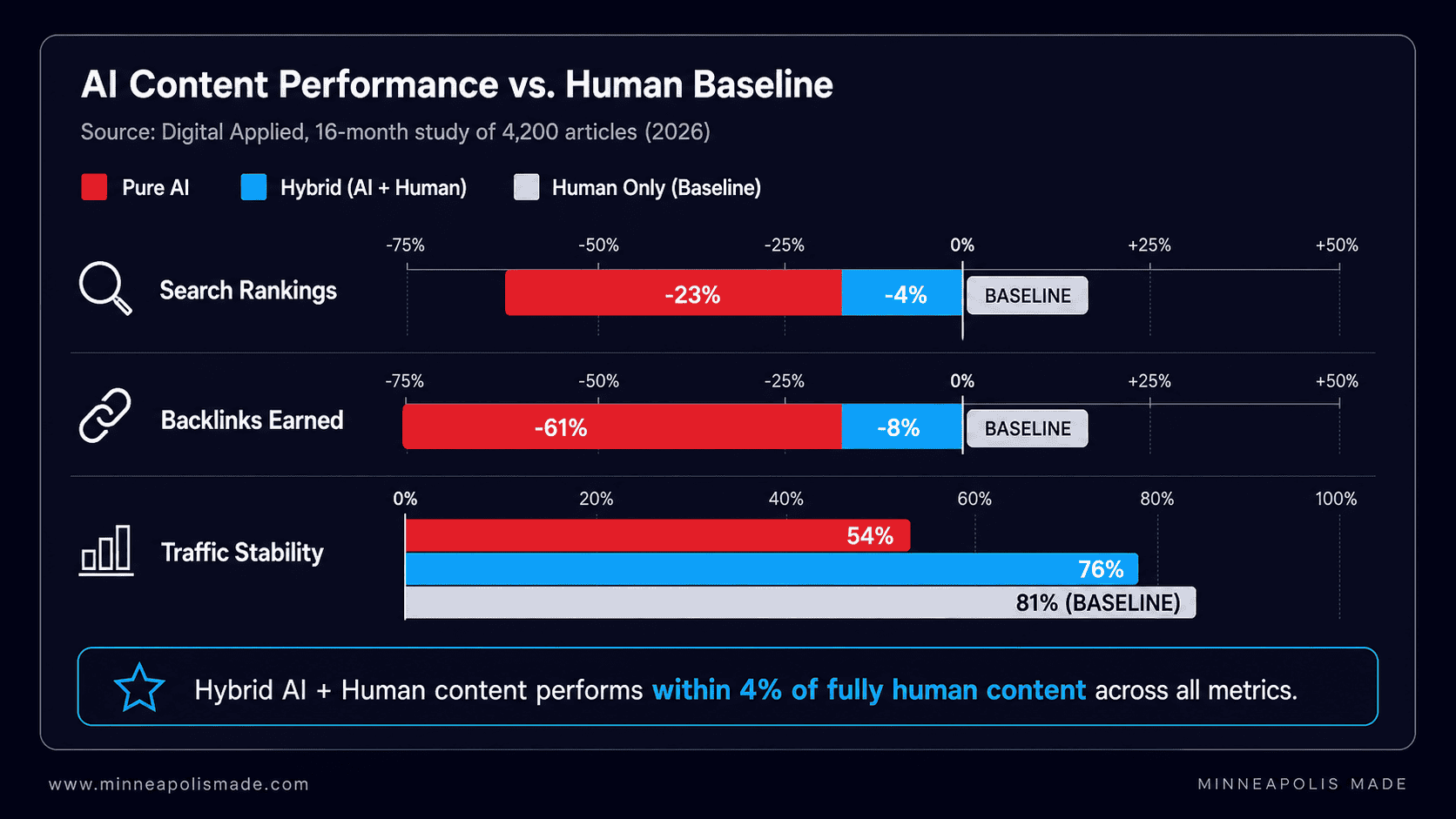
How Does the Data Compare? Hybrid Wins
A 16-month study by Digital Applied (2026) analyzed 4,200 articles across 140 domains and found that pure AI content ranks 23% lower than human-written articles. The actionable finding sits a layer deeper: AI-assisted content with human editing performs within 4% of fully human content.
| Metric | Pure AI | Hybrid (AI + Human) | Human Only |
|---|---|---|---|
| Search Rankings | -23% | -4% | Baseline |
| Backlinks Earned | -61% | -8% | Baseline |
| Traffic Stability | 54% | 76% | 81% |
| ROI vs Baseline | Lower | +42% | Baseline |
Source: Digital Applied (2026), NP Digital (2025)
That 4% gap is small. It means businesses don’t have to choose between efficiency and quality. They can get most of the speed benefits of AI while maintaining nearly all the performance of human-created content, provided the editorial review step is real and not just a spell check.
The ROI Case for Hybrid Workflows
The performance advantage translates directly to returns. Hybrid AI-human workflows yield 42% better ROI than pure AI or pure human approaches, according to NP Digital (2025). Hybrid workflows combine AI’s strengths (speed, research, first drafts, personalization) with human strengths (strategy, voice, nuance, experience).
Think about it this way. AI can draft a 2,000-word article in minutes. A human editor can then add local context, verify claims, inject personality, and ensure the piece meets E-E-A-T standards. The total production time drops significantly while quality stays high. For a typical Minneapolis client publishing four to eight posts a month, that’s the difference between sustainable content marketing and burnout.
Why Pure AI Content Falls Short
Pure AI content fails for predictable reasons. It lacks original data. It can’t share firsthand experience. It tends toward generic, middle-of-the-road advice that sounds authoritative but adds nothing new.
Consumer trust is shifting too. People can increasingly tell when content feels machine-generated, even if they can’t always articulate why, and that perception affects engagement and conversion.
Personal Experience
We’ve found the biggest quality difference between pure AI and hybrid content shows up in specificity. AI writes “businesses should focus on their target audience.” A human editor rewrites that to reference a specific audience segment, a real campaign result, or a local market condition like “North Loop foot traffic recovered to 94% of 2019 baseline by Q4 2025.”
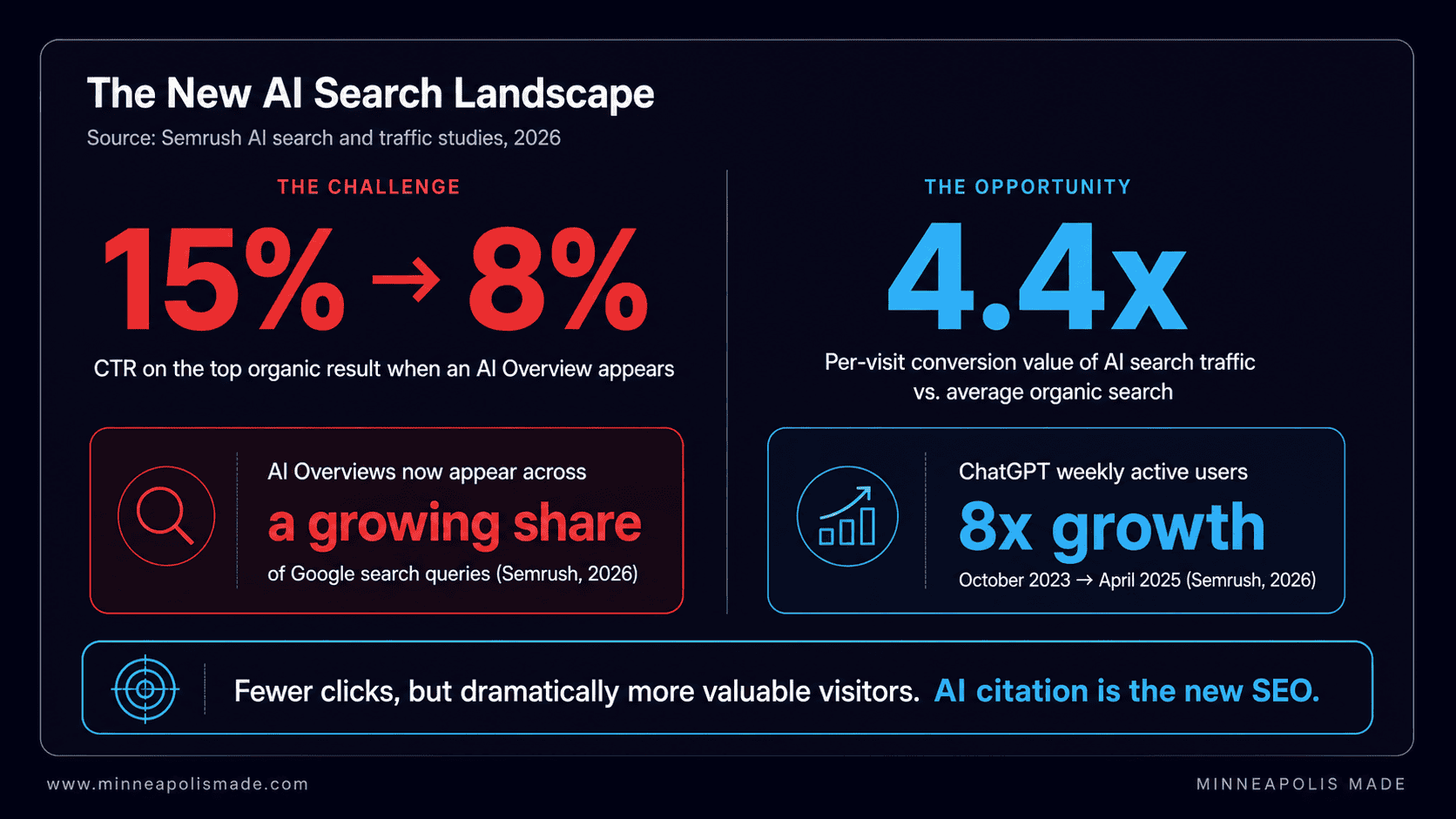
How Is AI Changing Search Itself?
AI isn’t just changing how content gets created. It’s reshaping how people find it. AI Overviews now appear across a growing share of Google search queries, and ChatGPT’s weekly active user base grew roughly 8x between October 2023 and April 2025 (Semrush, 2026). The implication for content strategy is large even before you look at how those users behave.
Those numbers represent a real shift in how people discover content. Traditional SEO still matters, but a growing share of traffic now flows through AI intermediaries, and that flow rewards a different kind of content than ten-blue-links did.
The Conversion Advantage No One’s Talking About
One number deserves separate billing. The average AI search visitor is 4.4x as valuable as the average traditional organic search visit, based on conversion rate (Semrush, 2026). Per visitor, that’s a meaningful multiplier.
AI-referred visitors arrive with higher intent. They’ve already had a conversation with an AI tool. They’ve narrowed their question. By the time they click through to your site, they’re further along in the decision-making process. For a local service business, an AI-referred lead is often someone ready to book a consultation, not just kicking tires.
What This Means for Content Strategy
If AI tools are citing your content, you’re reaching high-intent visitors who convert at dramatically higher rates. That changes the content strategy calculus. You’re no longer just optimizing for Google’s traditional algorithm. You’re optimizing to be cited by AI systems.
What gets cited? Content with clear, specific claims backed by data. Content that answers questions directly. Content structured so AI systems can extract and attribute key findings. That should sound familiar. It’s the same content that performs well in traditional search, with even more emphasis on clarity, specificity, and provable claims.
Related: AEO and GEO services: optimize for AI-powered search
Related: SEO vs AEO vs GEO: choosing the right strategy
What Should Smart Minneapolis Businesses Do Right Now?
The 42% ROI advantage from hybrid workflows (NP Digital, 2025) doesn’t happen by accident. It requires a deliberate framework that assigns the right tasks to the right resource, whether human or AI. And 92% of businesses already use AI to drive personalization (DemandSage, 2026), so the tools are mature. The strategy is where most teams still trip.
A practical framework looks like this.
Use AI For What It Does Best
AI excels at research synthesis, first-draft generation, content repurposing, and data-driven personalization. Let it handle the heavy lifting on tasks that don’t require original thinking.
Practical applications include summarizing competitor content to identify gaps, generating initial outlines from keyword research, drafting email variations for A/B testing, and personalizing landing page content based on visitor segments. These are high-volume, pattern-based tasks where AI genuinely saves time.
Keep Humans on Strategy, Voice, and Quality
Humans should own editorial strategy, brand voice, fact-checking, original insights, and final quality review. These are the elements that create E-E-A-T signals, build audience trust, and differentiate your content from the flood of AI-generated material.
For Minneapolis businesses specifically, local expertise is a competitive advantage AI can’t replicate. Knowing that a North Loop audience responds differently than a Minnetonka audience, or understanding seasonal patterns in Twin Cities consumer behavior (the State Fair lull in late August, the post-Thanksgiving B2B procurement freeze), that’s human knowledge no model has been trained on.
Original Data
We’ve observed that local businesses who define clear “AI zones” and “human zones” in their content workflow produce higher-quality content 30 to 40% faster than those who use AI ad hoc without guidelines.
Close the Measurement Gap
Most teams using AI for content production lack standardized KPIs to compare AI-assisted vs. human-only output. Industry surveys consistently show that fewer than one in five marketing teams track AI-specific performance metrics, which means most teams have no idea whether their AI investment is actually improving results. You can’t optimize what you don’t measure.
Track these metrics at minimum: production time per piece (AI-assisted vs. manual), search rankings for AI-assisted vs. human-only content, engagement metrics (time on page, scroll depth, bounce rate) by content type, and conversion rates from AI referral traffic vs. organic search.
Not sure if your AI content is actually working?
We’ll audit your content performance, set up AI-specific KPIs, and show you exactly where the gaps are. Most businesses discover they’re measuring the wrong things.
The Bottom Line
The future of online content isn’t AI versus human. It’s about who builds the best hybrid system. Hybrid workflows already deliver 42% better ROI (NP Digital, 2025), and that advantage will only grow as AI tools mature and Google’s quality standards tighten.
The businesses that win won’t be the ones generating the most content. They’ll be the ones producing the most useful content, content that demonstrates real expertise, answers specific questions, and earns citations from both search engines and AI platforms.
For Minneapolis businesses, the playbook is straightforward. Use AI to accelerate research, drafting, and personalization. Keep human expertise at the center of strategy, voice, and quality control. Anchor every post in something genuinely local that no model could invent: a neighborhood, a season, a real result. Measure everything. Iterate based on data, not assumptions.
Unique Insight
The companies treating AI as a replacement for human content creators are making the same mistake companies made with social media in 2010: confusing the channel for the strategy. AI is a production tool, not a content strategy. The strategy is still local relevance, demonstrated expertise, and a point of view worth citing.
The competitive window is still open. Most local businesses haven’t figured out the hybrid model yet, and even fewer are measuring it properly. That’s an opportunity hiding in plain sight.
Ready to build your hybrid AI content workflow?
We help Minneapolis businesses set up content systems that combine AI speed with human expertise. No cookie-cutter templates, no black-box automation, just a workflow tuned to your industry and your audience.
Related: SEO vs AEO vs GEO: choosing the right strategy as AI reshapes search
Related: How AI search is changing local SEO in 2026
Related: Core Web Vitals: what AI-driven ranking signals mean for your site
Need AEO + GEO done for your business?
We build the hybrid AI-human workflow described in this post for Minneapolis clients. Hourly billing, weekly invoices, and measurable AI citation lift.
Frequently Asked Questions
Will Google penalize my site for using AI-generated content?
No. Google has repeatedly stated that their ranking systems evaluate whether content is helpful for users, not whether it was written by AI or humans. Recent core updates have raised the bar on E-E-A-T evaluation across competitive queries, so low-quality AI content that lacks expertise signals will underperform, not because it’s AI-generated, but because it’s unhelpful and indistinguishable from a thousand competing pages.
How much content should I let AI create versus my team?
The most effective split varies by business, but the data points to a clear pattern. Use AI for research, outlines, and first drafts. Keep humans on strategy, editing, and quality review. Hybrid workflows yield 42% better ROI than pure AI or pure human approaches (NP Digital, 2025).
Is AI-generated content worth investing in for a small Minneapolis business?
Yes, if you approach it strategically. Small business AI adoption jumped from 40% to 58% in 2025 (SBA Office of Advocacy). The key is using AI to reduce production costs while maintaining quality through human oversight and local proof. Start with one content type, measure results, and expand from there.
How do I optimize content for AI search tools like ChatGPT and Perplexity?
Create content with clear, specific claims backed by attributed data. Structure your content with descriptive headings, direct answers in opening paragraphs, and source citations. AI search visitors are 4.4x as valuable as average organic search visits based on conversion rate (Semrush, 2026), making AI citation optimization increasingly valuable.
What KPIs should I track for AI content?
Track production time, search rankings, engagement metrics, and conversion rates, comparing AI-assisted content against human-only baselines. Most marketing teams currently don’t track AI-specific KPIs at all, so closing that measurement gap is the fastest way to improve your AI content ROI.
Why did my AI-generated blog posts get de-indexed by Google?
The most common cause is topical authority mismatch combined with thin original value. Recent Google core updates have tightened E-E-A-T evaluation across competitive queries, so generic AI content on a site without domain authority on that topic now gets dropped from the index. The fix is to either reposition the content around your site’s actual expertise area (e.g. a local angle) or move the topic to a domain that can support it.