
If you run a law firm, here is the short version: Google will not punish you for using AI to help write your content, but it will bury you for publishing content that is low quality, and in a field like law the bar for "quality" is about as high as it gets. The tool is not the problem. Unsupervised, unverified AI is. This guide breaks down the real pros and cons of AI-generated content for law firms, the difference between using AI safely and dangerously, and how to use it so it helps your rankings instead of quietly wrecking them.
Key Takeaways
- Google does not penalize content for being AI-made. It rewards "high-quality content, however it is produced," and its February 2023 guidance states plainly that "appropriate use of AI or automation is not against our guidelines."
- What Google does penalize is low-value content at scale. Its scaled content abuse policy applies "no matter whether content is produced through automation, human efforts, or some combination."
- Legal content is high-stakes YMYL ("Your Money or Your Life"), so it is judged against the strictest quality and trust standards, and the first-hand "Experience" in E-E-A-T is the hardest thing for AI to fake.
- Accuracy is the real danger: general AI models hallucinate on 58% to 88% of verifiable legal questions, and even purpose-built legal tools invent answers more than 17% to 34% of the time (Stanford, 2024).
- AI search is brutally selective: across nearly 350,000 business locations, ChatGPT recommended just 1.2% of them (SOCi, 2026). Earning AI citations takes original, well-sourced, authoritative content, exactly what unedited AI does not produce.
What you need to know before using AI for legal content
The bottom line is simple: AI is safe to use as an assistant and dangerous to use as an unsupervised author. Google judges the quality of the result, not the method, so AI content that a qualified person has genuinely reviewed and improved can rank perfectly well, while unedited AI filler is a liability, not because a robot wrote it, but because it tends to be generic, unoriginal, and wrong.
For a law firm the stakes are higher than for almost any other business. Legal content sits in Google's most scrutinized category, a single fabricated fact can mislead a frightened person about their rights, and an unreviewed claim can breach the rules of professional conduct. So the question isn't "should my firm use AI?" It's "how much human expertise stands between the AI and the publish button?" Everything below is about answering that well.
What are the types of AI content? (Assisted vs. enhanced vs. fully generated)
There is no single "AI content." There is a spectrum defined by how much a knowledgeable human directs and verifies the output, and where you sit on that spectrum is what determines your risk. The labels below are common industry shorthand rather than official standards, so treat them as a way to think, not a rulebook.
- AI-assisted — a person does the thinking and the writing; AI helps with narrow tasks like outlining, rephrasing a clumsy sentence, a first-pass summary, or drafting a meta description. The human is unmistakably the author. Lowest risk.
- AI-enhanced — AI produces a full first draft, then a qualified human heavily edits it: verifying every fact, correcting the law, adding real expertise and first-hand experience, and taking responsibility for what ships. Safe if the review is real.
- Fully AI-generated — a prompt goes in, an article comes out, and it is published essentially as-is. This is where nearly every horror story lives.
Notice that the labels barely matter. What matters is the amount of expert human control. A "fully AI-generated" post that a sharp attorney then rewrites end to end is safer than an "AI-assisted" post nobody checked. Don't ask which bucket your content falls into. Ask who verified it, and whether that person is qualified to catch a wrong statute or a hallucinated case.
Does Google penalize AI-generated content?
No. Google penalizes unhelpful, low-value content created to manipulate rankings, no matter who or what produced it. It does not run an AI detector and dock you for a machine's fingerprints. Its own guidance is explicit: Google is "rewarding high-quality content, however it is produced," and "appropriate use of AI or automation is not against our guidelines" (Google Search Central, 2023).
So the real question is not whether your content is AI-made, but whether it is good. And in law, "good" has a specific, unforgiving definition. When it falls short, the cost is steep: recovery from a quality-related ranking drop can take months, sometimes not landing until Google's next core update runs.

What are the signals of low-quality legal content?
Low-quality legal content is anything that misleads the reader or fails to earn trust, and Google's systems and human raters are tuned to spot it. For a law firm, the warning signs are specific and every one of them is common in unreviewed AI output.
- Wrong facts — a statistic, date, or claim that is simply incorrect.
- Wrong legal definitions — misstating what a legal term or standard actually means.
- Wrong statutes or statutory definitions — citing the wrong statute, or misstating what a statute actually says or requires.
- Fabricated or hallucinated citations — case names, statutes, or quotes that do not exist. AI invents these confidently and constantly.
- Outdated law — deadlines, damages caps, or rules that changed after the model's training data, presented as current.
- No first-hand experience — competent-sounding text with no sign a practicing attorney was ever involved.
- Thin, templated pages at scale — dozens of near-identical practice-area or city pages spun from one template.
- No named author — nothing tying the content to a real, credentialed person.
- Uncited claims — assertions of law or statistics with no authority behind them.
- Generic "AI voice" — fluent, confident, and utterly interchangeable with every competitor's page.
- Missing jurisdiction specifics — "the law says" with no state, court, or nuance, when law is intensely local.
Why does this matter? E-E-A-T and YMYL
It matters because Google holds legal content to its highest standard, and that standard is built on two ideas: E-E-A-T and YMYL. Get them wrong and no amount of keyword optimization will save the page.
Related: What Google’s rater guidelines actually say about YMYL and E-E-A-T
E-E-A-T stands for Experience, Expertise, Authoritativeness, and Trustworthiness, the qualities Google's raters use to judge whether content deserves to rank. Google added the first "E," Experience, in December 2022, defining it as whether content "was produced with some degree of experience, such as with actual use of a product, having actually visited a place or communicating what a person experienced." A language model has litigated nothing, sat with no client, and stood in no courtroom, so genuine Experience is the one thing it cannot manufacture.
When we review law-firm sites, the pages that quietly underperform are almost always the ones written to sound authoritative with no evidence a real attorney was involved. They read fine and rank nowhere. The pages that win contain the specific, lived detail only a practitioner would include, the aside that says "a human who does this work wrote this." In a YMYL field, that signal is the whole game, and it is exactly what unedited AI strips out.
What are the pros of AI-generated content for law firms?
Used as an assistant under real supervision, AI delivers genuine, defensible value. The upside is real, and every item below lives on the input side of a lawyer's review, never the output side.
- Speed and volume — AI turns a blank page into a working draft in minutes, so your team spends its hours refining and verifying instead of staring at a cursor.
- Technical SEO help — drafting meta descriptions, alt text, FAQ formatting, schema scaffolding, and internal-link suggestions across many pages, the tedious, repetitive layer that humans rush.
- A tireless first-pass editor — catching grammar, clunky phrasing, passive voice, and structure problems before a human editor even looks.
- Ideation and outlining — brainstorming angles, pulling the questions real clients ask, and building a structured outline to write against.
- Consistency — holding tone, formatting, and terminology steady across a large site.
- Repurposing — turning one reviewed article into a plain-English FAQ, an email, or a social post.
- Beating the blank page — giving a busy attorney something to react to and improve rather than create from nothing.
What are the cons of using AI content creation?
The cons are where law firms get hurt, and they are more serious here than in almost any other industry. These are the reasons AI can never be the final author of legal content.
Accuracy and hallucinations. This is the big one. Stanford found general AI models hallucinate on 58% (GPT-4) to 88% (Llama 2) of verifiable legal questions, and even purpose-built legal research tools still invent answers more than 17% (Lexis+ AI) to more than 34% (Westlaw) of the time (Stanford HAI, 2024). This is not theoretical: in Mata v. Avianca (2023), attorneys were sanctioned $5,000 for filing a brief with six court decisions ChatGPT had entirely fabricated.

Thin-content penalties. Firms tempted to auto-generate hundreds of city or practice-area pages are walking straight into Google's scaled-content-abuse policy. One company that used AI to mass-publish roughly 1,800 articles lost 99.5% of its organic traffic to a manual penalty (Ahrefs, 2024).
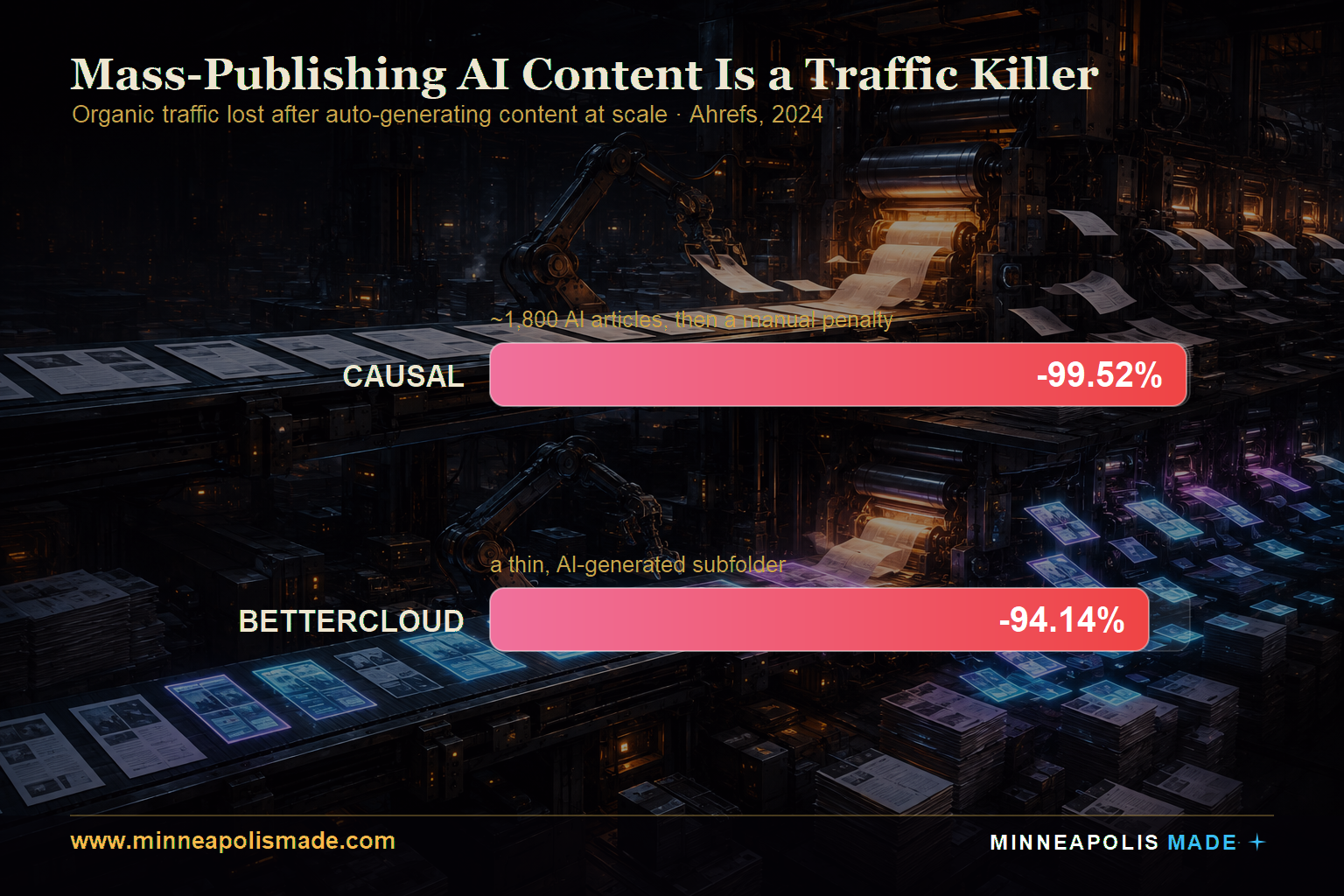
The "autopilot" trap. A whole camp of old-school SEOs bash AI content on sight, and the argument is always the same: it is thin. They are half right. Unedited AI is thin, but not because AI wrote it. It is thin because someone typed a topic, hit Enter, and published whatever came out, with no review, no expertise, and no verification. That is what thin content has always been, long before AI made it faster to produce. The real line is not human versus AI, it is directed versus dumped. Content that a qualified person shaped, verified, and stands behind is not thin, no matter what drafted the first version. The "content on autopilot" and "set-and-forget SEO" tools are dangerous precisely because they remove that person and scale the dumping, which is exactly what Google's scaled-content-abuse policy is built to catch.
It is often detectable, and that cuts both ways. On longer text, the best detectors now flag AI writing with very low error rates, while an open-source detector misclassified anywhere from 30% to 78% of genuine human writing as AI (Chicago Booth / BFI, 2025). For a law firm that means two risks at once: a client, journalist, or opposing counsel can plausibly check, and even your real human writing can get wrongly flagged. Detection is a reputation and trust problem, not proof of anything, and it is not how search engines rank.
Unique InsightHere is the counterintuitive part. AI answer engines do not reliably screen out AI-written content, one 2026 audit found that AI-generated content made up about 16% of the sources ChatGPT, Perplexity, Gemini, and Copilot cited (Allaham & Diakopoulos, 2026). So the danger of AI content was never that a machine would "catch" it. The danger is that unedited AI content is generic, unoriginal, and error-prone, and originality and authority are exactly what earns citations. You don't lose because you got detected. You lose because you blended in.
It fails E-E-A-T in a YMYL field. Unedited AI has no experience, no named expert behind it, and no verifiable trust signals, the precise qualities legal content is judged on hardest.
Professional-responsibility exposure. The American Bar Association's Formal Opinion 512 (2024) warns that "uncritical reliance" on generative AI is "almost certainly malpractice," and Model Rule 7.1 forbids any "false or misleading communication about the lawyer or the lawyer's services." An unreviewed AI post that invents a result or misstates the law is not just bad SEO, it is a potential ethics violation with your name on it.
Generic brand voice and sameness. When every firm prompts the same models, everyone publishes the same competent, forgettable page, and none of them stand out to a reader or an algorithm.
Not sure whether your content is helping or quietly hurting you?
We'll review your firm's site for thin pages, unverified claims, and missing trust signals, and show you exactly what to fix first.
What do AI search engines actually reward? (AEO and GEO)
AI answer engines reward original, well-structured, authoritative content that is easy to quote, and they do it independently of who typed it. Optimizing for them is called Answer Engine Optimization (AEO) or Generative Engine Optimization (GEO), and the research on what works is surprisingly consistent across Google's AI Overviews, ChatGPT, Perplexity, and Microsoft Copilot.
Start with how selective these systems are. Across nearly 350,000 business locations, ChatGPT recommended just 1.2% of them, Perplexity 7.4%, and Gemini 11%, while the same brands appeared in Google's local pack 35.9% of the time (SOCi, 2026). Getting named by an AI engine is far harder than ranking on Google, and classic rankings barely carry over: one analysis found only about 8% of ChatGPT's citations also ranked in Google's top ten, and roughly 80% of AI citations did not rank in Google at all for the query (Ahrefs, 2025).
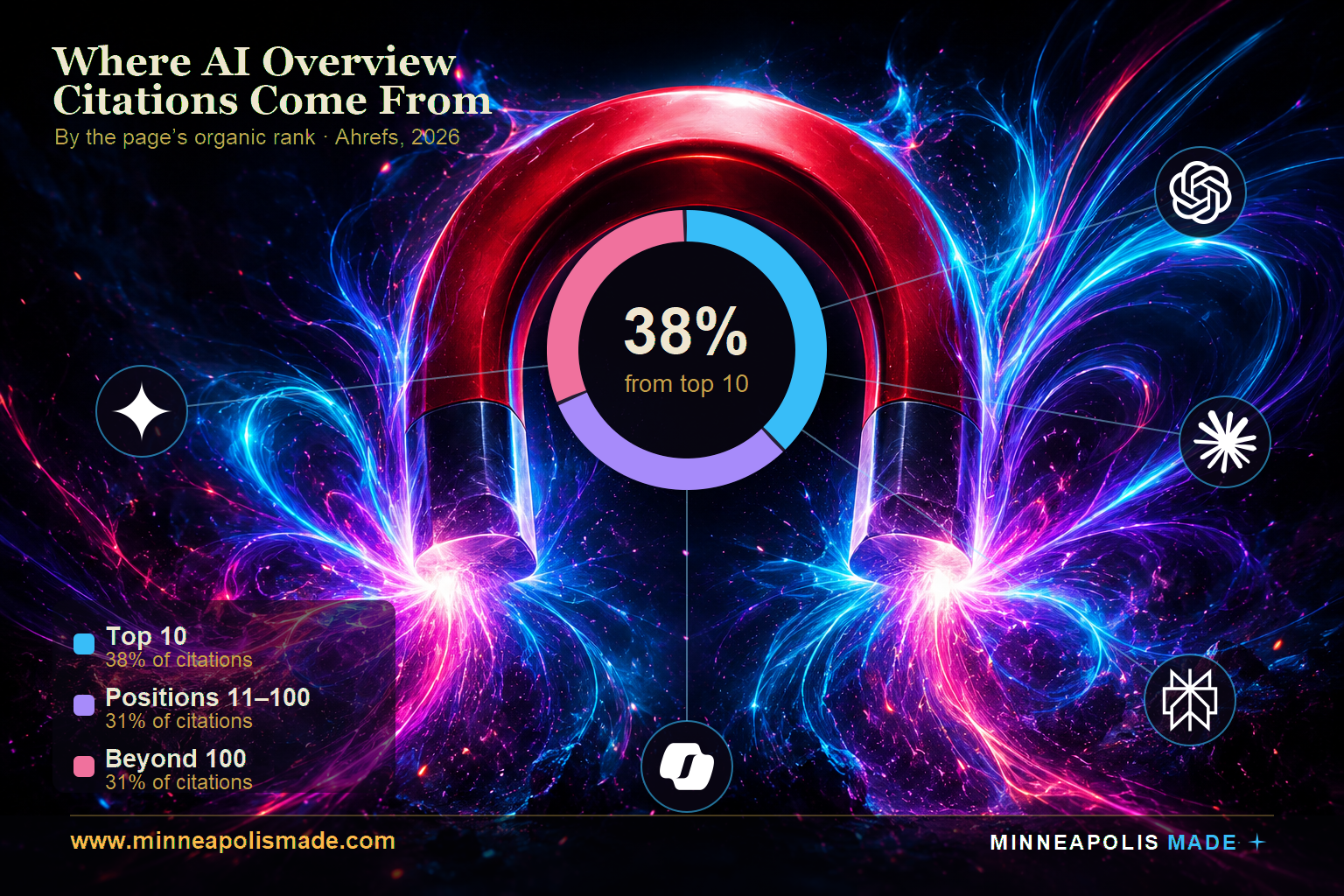
Even inside Google's own AI Overviews, a top ranking is no guarantee. Only 38% of the pages cited in AI Overviews come from the top 10 organic results, while the rest are pulled from deeper in the rankings or from pages that do not rank in the top 100 at all (Ahrefs, 2026).
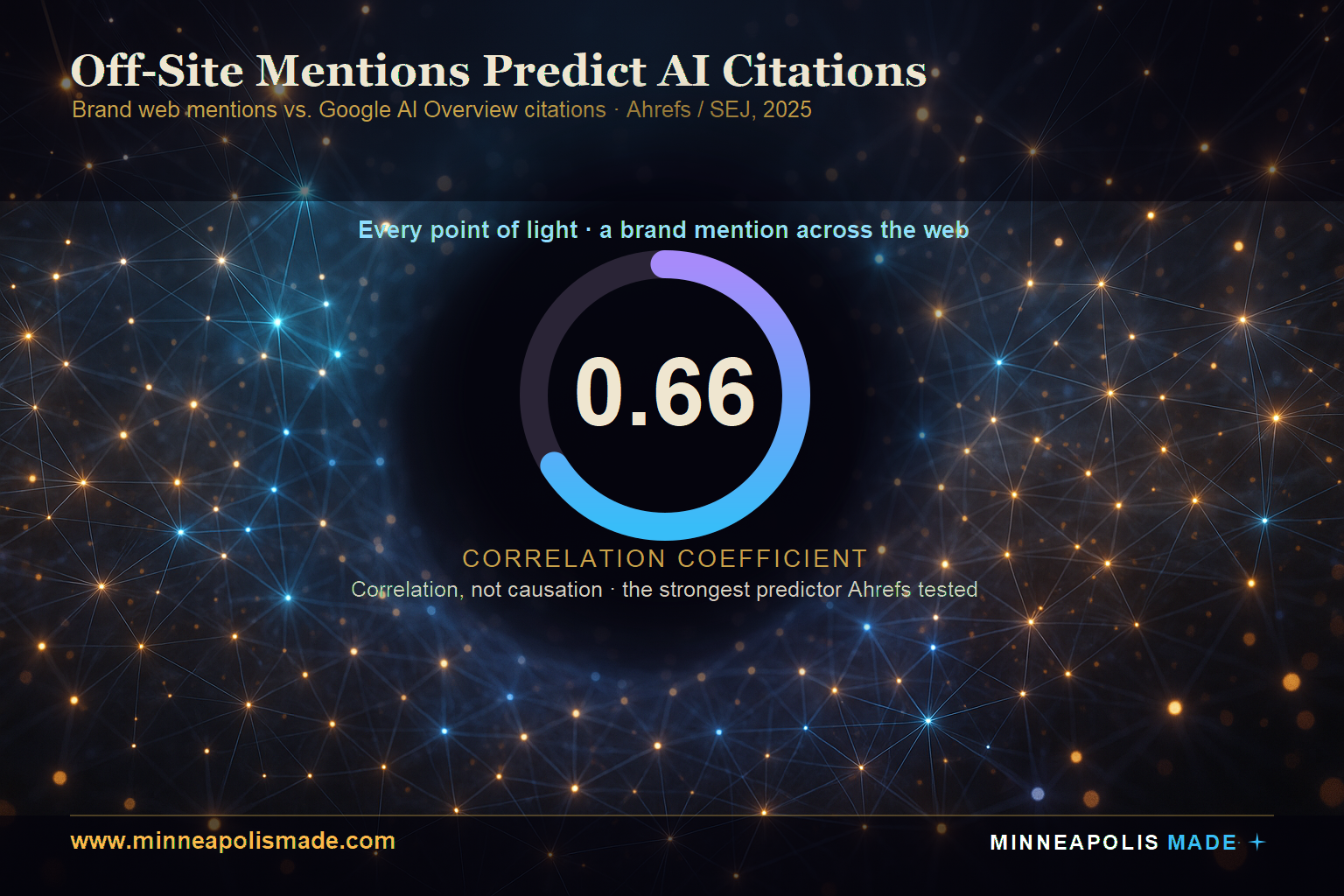
Off-site reputation matters as much as the page itself. Ahrefs found a 0.66 correlation between how often a brand is mentioned across the web and how often it is cited in Google's AI Overviews, the strongest predictor of AI visibility they measured (via Search Engine Journal, 2025). Different engines lean on different sources, ChatGPT cites Wikipedia most often, Perplexity leans on Reddit and community discussion, so being corroborated in many credible places is what gets you into the answer.
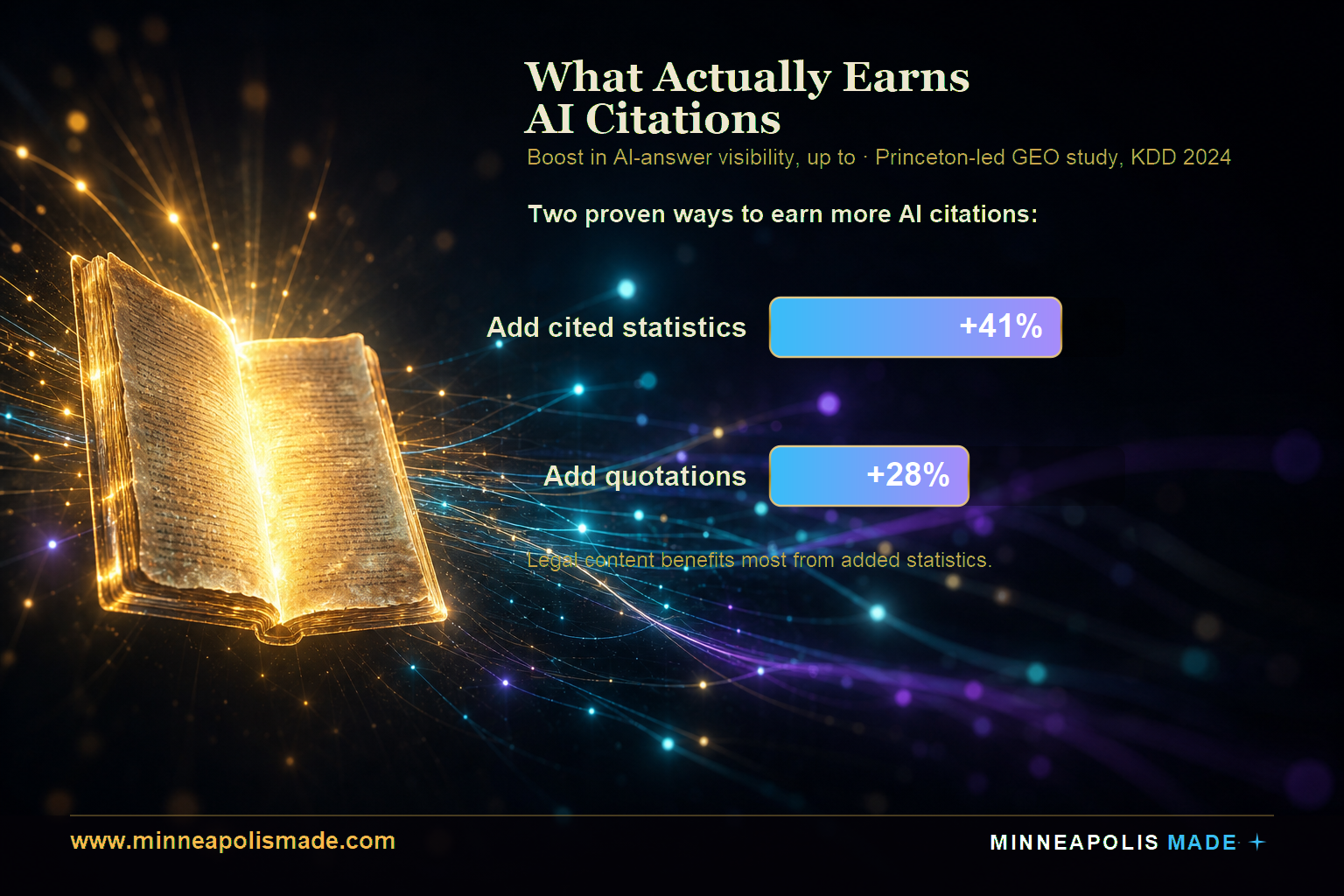
The through-line is unmistakable: AI engines reward genuine authority, original data, clear structure, and corroboration across the web. Unedited AI content, generic and unsourced by nature, is the opposite of everything on that list.
Related: Answer engine optimization · AI visibility vs. traditional SEO · what ChatGPT and Perplexity actually cite · how AI is changing local search
What is the best practice for using AI the right way?
The defensible approach is simple to state and non-negotiable to follow: AI drafts, a subject-matter attorney reviews, an editor verifies every fact and citation, and the piece publishes under a real author with real credentials. AI works the input side; a lawyer owns the output side. That single boundary separates efficient firms from penalized ones.
A safe workflow looks like this:
- Ideate and outline with AI, then have a person choose the angle and structure.
- Draft with AI, but source with humans — never let the model supply facts, statutes, case names, or numbers.
- Attorney review for accuracy — a practitioner confirms every legal claim, because the hallucination rates above are not survivable in a YMYL field.
- Editorial fact-check of every citation — each source is opened and confirmed to say what the draft claims.
- Add what AI can't — first-hand experience, original data, and cited statistics, the exact things that earn both Google trust and AI citations.
- Publish under a named, credentialed author, and space out publishing so real oversight is possible.
This is exactly how we operate at Minneapolis Made. We've written software that actually fact-checks our legal claims, verifying every fact and citation before it's published. The point isn't that we trust the machine. It's that we never do, so we built the guardrails to prove it.
Do this and AI becomes what it should be: an accelerator that helps a qualified team publish more of the accurate, original, genuinely helpful content that ranks on Google and gets cited by AI, instead of a shortcut that quietly buries your firm.
You don't have to choose between fast and safe.
We use AI the way it should be used, to accelerate the work, never to replace the lawyer or the fact-check, and every word we publish for a firm is written to survive Google's YMYL bar and the rules of professional conduct.
Frequently Asked Questions
Is AI-generated content bad for SEO?
Not inherently. Google rewards helpful, high-quality content regardless of how it is produced and explicitly permits "appropriate use of AI." What is bad for SEO is using AI to mass-produce low-value pages to manipulate rankings, which Google's scaled content abuse policy treats as spam. For a law firm, the deciding factor is whether a qualified human reviewed and verified the content before publishing.
Can Google detect and penalize AI content?
Google does not rank by running an AI detector. It has no blanket penalty for AI-written content and instead judges quality and intent. Low-value content produced at scale to game rankings can be penalized under the scaled content abuse policy, but that is about value, not authorship. A well-edited, genuinely helpful article is not penalized for having AI in its workflow.
Will AI engines like ChatGPT refuse to cite AI-written content?
No. Independent audits show AI-generated content makes up roughly 16% of the sources AI answer engines cite, so they do not reliably filter it out. The real reason unedited AI content rarely gets cited is that it is generic and unsourced, while AI engines reward original data, cited statistics, clear structure, and authority across the web.
What is the safest way for a law firm to use AI for content?
Use it as an assistant, never an unsupervised author. Let AI outline and draft, then have a practicing attorney verify every legal claim, an editor confirm every citation, and the piece publish under a named, credentialed author. Add first-hand experience and cited statistics, and never let the model supply the facts or the law.
Related: Law firm SEO · Legal marketing · Get a free SEO audit