
Google does not hold every page to the same standard. It holds some pages to a much higher one, and it has published the rules for deciding which is which since 2015. Most articles about YMYL SEO describe those rules secondhand, from a version of the document that is now a decade out of date.
This is what the current guidelines actually say, quoted from the source, plus what changed along the way and why the change matters more than the industry has noticed.
Key Takeaways
- YMYL stands for "Your Money or Your Life." Google defines it as topics where content "could significantly impact the health, financial stability, or safety of people, or the welfare or well-being of society" (Search Quality Rater Guidelines, September 11, 2025).
- It is no longer a list of categories. In 2015 it was five named page types, one of which was legal. In the current guidelines it is a spectrum of four harm types with no category list at all.
- YMYL is assessed per topic, not per website. The same law firm can have a page at the top of the spectrum and a page that is not YMYL at all.
- E-E-A-T is the measuring instrument. YMYL sets the passing score. They are not competing frameworks.
- Google explicitly says "many or most topics are not YMYL," which is the opposite of how the term gets used in SEO.
- First-hand experience can earn high E-E-A-T on a clear YMYL topic. The guidelines say so directly, and almost nobody quotes that section.
What is YMYL in SEO?
YMYL means "Your Money or Your Life," and it describes topics where bad information can hurt someone. Google's Search Quality Rater Guidelines, updated September 11, 2025, define it this way:
"Some topics have a high risk of harm because content about these topics could significantly impact the health, financial stability, or safety of people, or the welfare or well-being of society. We call these topics 'Your Money or Your Life' or YMYL."
The guidelines then break the assessment into four types of potential harm:
- YMYL Health or Safety. Topics that could harm mental, physical and emotional health, or any form of safety.
- YMYL Financial Security. Topics that could damage a person's ability to support themselves and their families.
- YMYL Government, Civics & Society. Topics affecting groups of people, public institutions, elections and voting.
- YMYL Other. Anything else that could hurt people or damage the welfare of society.
Two things are worth noticing immediately. There is no category called "legal." There is no category called "medical." The framework describes harm, not industries.
Unique InsightThe guidelines also draw a line most SEO writing ignores entirely: the harm has to come from the topic, not from a hypothetical bad actor. Google addresses this directly, noting that you could imagine a harmful page about "the science behind rainbows or shopping for pencils" by putting a virus download on it, but that "for a specific topic to be YMYL, the topic itself must potentially impact people's health, financial stability, or safety."
A page is not YMYL because someone could misuse it. It is YMYL because getting it wrong hurts people.
How do you tell if a page is YMYL?
Google publishes a two-question test, and it takes about five seconds to run. From the guidelines:
The second question is the useful one, because it rules things out. If a reader would happily ask a friend and accept the answer, the topic almost certainly is not YMYL. That single test disqualifies most of what gets labelled YMYL in SEO audits.
The guidelines illustrate the spectrum with paired examples, and the pairs are more instructive than the definition:
- "Evacuation routes for a tsunami" is clear YMYL. "Weather forecast" is not, because "people often ask family members 'what's the weather today'."
- "When to go to the emergency room" is clear YMYL. "How often to replace a toothbrush" is not, because it is "a casual health topic people commonly discuss with friends."
- "Purchasing prescription drugs" is clear YMYL. "Review of a type of car" is not, because "many people ask friends and family about cars."
Notice that health appears on both sides. Toothbrush replacement is a health topic and it is not YMYL. This is what people mean when they say YMYL is a spectrum, and it is why "we're in healthcare, so everything we publish is YMYL" is wrong.
Is YMYL a category or a spectrum?
It is a spectrum now. It was a category list before. This is the single biggest change in the concept's history, and it explains most of the confusion in the industry.

Here is the comparison, taken from both primary documents rather than from anyone's summary of them. Google's first publicly released full guidelines, dated November 12, 2015 and released that month (an abridged edition had been published in 2013), defined YMYL as a list of page types:
"Some types of pages could potentially impact the future happiness, health, or wealth of users. We call such pages 'Your Money or Your Life' pages, or YMYL. The following are YMYL pages:
- Shopping or financial transaction pages
- Financial information pages
- Medical information pages
- Legal information pages: webpages which provide legal advice or information on topics such as divorce, child custody, creating a will, becoming a citizen, etc.
- Other
Legal was its own bullet, with its own examples. It was not inferred, implied or debatable. It was printed.
In the September 2025 guidelines, that list is gone. The section is no longer called "YMYL Pages," it is called "YMYL Topics." Across 182 pages, the word "attorney" does not appear once, and the word "legal" does not appear at all. Its only three near-matches are inside the word "illegal," in a section about reporting illegal images. The 2015 edition used "legal" seven times.
The stakes language changed too. 2015 said "future happiness, health, or wealth of users." 2025 says "health, financial stability, or safety of people, or the welfare or well-being of society." Happiness came out. Society went in.
Why did Google drop the category list?
I have not found a Google statement explaining why the list was dropped, so what follows is interpretation rather than documentation, and it should be read as such. But the guidelines do explain how rater data is used, and that explanation makes a category list look like scaffolding that could eventually come down.
"No single rating can directly impact how a particular webpage, website, or result appears in Google Search, nor can it cause specific webpages, websites, or results to move up or down on the search results page. Using ratings to position results on the search results page would not be feasible, as humans could never individually rate each page on the open web. Instead, ratings are used to measure how effectively search engines are working to deliver helpful content to people around the world. Ratings are also used to improve search engines by providing examples of helpful and unhelpful results for different searches."Unique Insight
Read that carefully, because it describes a training loop, not a scoring system. Thousands of raters evaluate pages against a shared rubric. Their aggregated judgments become examples of helpful and unhelpful results. Those examples are used to improve the systems. No rater ever touches the page they rated, and no single rating moves anything.
A named category list is enormously useful when you are teaching thousands of people to apply a standard consistently. "Legal information pages are YMYL" is unambiguous and easy to train against. It is much less necessary once the systems have absorbed enough examples to infer harm from the topic itself.
The plausible reading is that the list was a teaching device that had done its job. The harm spectrum that replaced it is harder for a human to apply quickly, but far more accurate, because it catches the wrongful-death page and correctly ignores the office holiday party post on the same domain.
That reading is mine, not Google's. What is documented is the before, the after, and the mechanism. The causal story connecting them is inference.
How does rater data actually change what ranks?
Through a validation loop that runs in the opposite direction from how most people picture it. Raters are not sent out to find bad pages so engineers can build an algorithm to catch them. A change is proposed first, and raters are the instrument used to test whether it is an improvement.
Google publishes the volumes. In 2023 it ran 719,326 search quality tests, 124,942 side-by-side experiments and 16,871 live traffic experiments, which produced 4,781 launches. Roughly 150 quality tests for every change that shipped.
There are two distinct rater-facing stages, and they do different jobs. Search quality tests are the running baseline: raters assess results against the guidelines "on an ongoing basis" to measure how well Search is performing. Side-by-side experiments test a specific proposal:
"We show Raters two different sets of Search results: one with the proposed change already implemented and one without. We ask them which results they prefer and why."
Only after that does a change reach live traffic, starting at "just a small percentage of people, usually starting at 0.1%," and only then does it face "a review by our most experienced engineers and data scientists, who carefully review the data from all the different experiments to decide if the change is approved to launch." Source: Google, How Search Works: rigorous testing.
Unique InsightThis is what makes the guidelines worth reading closely even though no rater will ever touch your page. The rubric is the yardstick a proposed ranking change has to satisfy before it ships. When the guidelines say YMYL topics demand a higher standard, they are describing the criteria that hundreds of thousands of tests are scored against. Writing to the guidelines is not writing to please a rater. It is writing to the definition of improvement that every candidate change is measured by.
One distinction worth keeping straight, because these get conflated constantly: spam updates are not this pipeline. Google describes those as improvements to its "automated spam detection systems," naming SpamBrain as "our AI-based spam-prevention system." That is separate machinery from the rater-validated quality work, and a core update and a spam update are not the same event.
Does YMYL apply to a whole website or to individual pages?
To topics, which in practice means to individual pages. The 2025 heading is "YMYL Topics" where the 2015 heading was "YMYL Pages," and the shift from page types to topics is the whole point. Nothing in the guidelines assigns a YMYL status to a domain.
This matters more than it sounds. A personal injury firm's page explaining what to do in the first 48 hours after a crash sits near the top of the spectrum, because bad advice there causes real harm. That same firm's post about sponsoring a youth hockey team is not YMYL by any reading of the guidelines. Google's own framework would treat them completely differently.
The practical consequence is that "our site is YMYL" is not a useful sentence. The useful question is always which pages, and how far up the spectrum each one sits.
Not sure which of your pages Google is scrutinizing hardest?
We map every page on your site against the harm spectrum and show you where credentials, citations and author signals actually change the outcome. No guesswork, no blanket recommendations.
How does E-E-A-T relate to YMYL?
E-E-A-T is what gets measured. YMYL decides how high the bar sits. They are one system, and treating them as competing frameworks is the most common mistake in this vocabulary.
The guidelines define Experience, Expertise, Authoritativeness and Trust as "all important considerations in PQ rating," then immediately establish a hierarchy:
"The most important member at the center of the E-E-A-T family is Trust... Trust is the most important member of the E-E-A-T family because untrustworthy pages have low E-E-A-T no matter how Experienced, Expert, or Authoritative they may seem. For example, a financial scam is untrustworthy, even if the content creator is a highly experienced and expert scammer who is considered the go-to on running scams!"

Experience, Expertise and Authoritativeness are not four equal pillars. Three of them are supporting evidence for the fourth. The guidelines say it plainly: they "are important concepts that can support your assessment of Trust." And the failure condition is absolute. "If a page is untrustworthy for any reason, it has low E-E-A-T."
The connection to YMYL is stated directly in the same section, in a list of how much Trust different page types need:
- "Online stores need secure online payment systems and reliable customer service."
- "Informational pages on clear YMYL topics must be accurate to prevent harm to people and society."
- "Social media posts on non-YMYL topics may not need a high level of Trust."
Same criteria, different thresholds. That is the entire relationship. E-E-A-T applies to every page on the web. YMYL determines whether "pretty good" clears the bar or falls short of it.
And this is not only a rater instruction. Google states the same thing about its ranking systems in its own developer documentation, which is the clearest confirmation anywhere that the two concepts operate together:
"Our systems give even more weight to content that aligns with strong E-E-A-T for topics that could significantly impact the health, financial stability, or safety of people." Source: Google, Creating helpful, reliable, people-first content.
More weight, on YMYL topics, to the same E-E-A-T signals. The instrument does not change. The multiplier does.
Does YMYL content have to be written by credentialed experts?
No, and the guidelines are unusually explicit about it. This is the section the industry consistently misses, and it reverses the standard advice.
Section 3.4.1 is titled "YMYL Topics: Experience or Expertise?" and it says this:
"Pages that share first-hand life experience on clear YMYL topics may be considered to have high E-E-A-T as long as the content is trustworthy, safe, and consistent with well-established expert consensus. In contrast, some types of YMYL information and advice must come from experts."
The guidelines then give paired examples that separate the two cases. On liver cancer treatment, "a sincere and respectful forum discussion where people are describing how they're coping" is the valuable-experience column. "Different treatment options for liver cancer and the associated life expectancies under each treatment" is the must-come-from-experts column. On retirement saving, first-hand reviews of retirement services sit in the experience column, while "how much to save, what kinds of assets to invest in" sits with the experts.
Personal ExperienceIn practice the dividing line is whether the page is telling someone what to do. Describing what happened to you is experience, and on a YMYL topic it can score at the top of the scale. Telling a reader which treatment to choose, how to invest, or whether they have a case is advice, and advice needs credentials.
Most of the thin YMYL content we see on client sites fails not because the author lacks a degree, but because it is written in the voice of advice while containing nothing but restated generalities. The credential problem and the substance problem get diagnosed as one thing, and they are not.
The qualifier in that quote is doing real work, though. First-hand experience earns high E-E-A-T only when it is "trustworthy, safe, and consistent with well-established expert consensus." A lived-experience page that contradicts medical consensus does not get credit for being authentic.
What does YMYL mean for law firms, medical practices and trades?
It means the scrutiny is uneven across your own site, and the budget should be uneven to match.
Law firms lost their named category in the guidelines but not their exposure. Legal information still sits high on the harm spectrum under Financial Security and, for practice areas like criminal defense, family law and personal injury, under Health or Safety too. The 2015 examples were divorce, child custody, wills and citizenship, and none of those got safer. What changed is that the assessment now runs per topic, so a "what to do after a car accident" page and a firm news post are no longer treated as the same kind of page.
Anyone arguing that YMYL does not apply to personal injury should read the current definition, which names "health, financial stability, or safety" in a single sentence. Choosing a lawyer after an injury involves all three. Our law firm SEO and legal marketing pages cover how this plays out in practice, and we go deeper on authorship in AI content for law firms.
Medical practices have the least ambiguity of anyone. Symptoms, drugs, conditions and treatment options are the guidelines' own recurring examples, and the "must come from experts" column is full of medical scenarios. Named clinician authorship, visible credentials, a review-by line and citations to primary literature are not optional decoration on these pages.
Trades sit mid-spectrum and get overlooked. A bad roofer costs money, which is Financial Security, and some trade work carries genuine physical risk, which is Health or Safety.
The guidelines' own example of Expertise is "home electrical rewiring advice from a skilled electrician or from an antique homes enthusiast who has no knowledge of electrical wiring." That is a trades example sitting in the middle of the E-E-A-T definition. Licensing, insurance and named technicians are the trade equivalent of author credentials, and most home services sites bury all three.
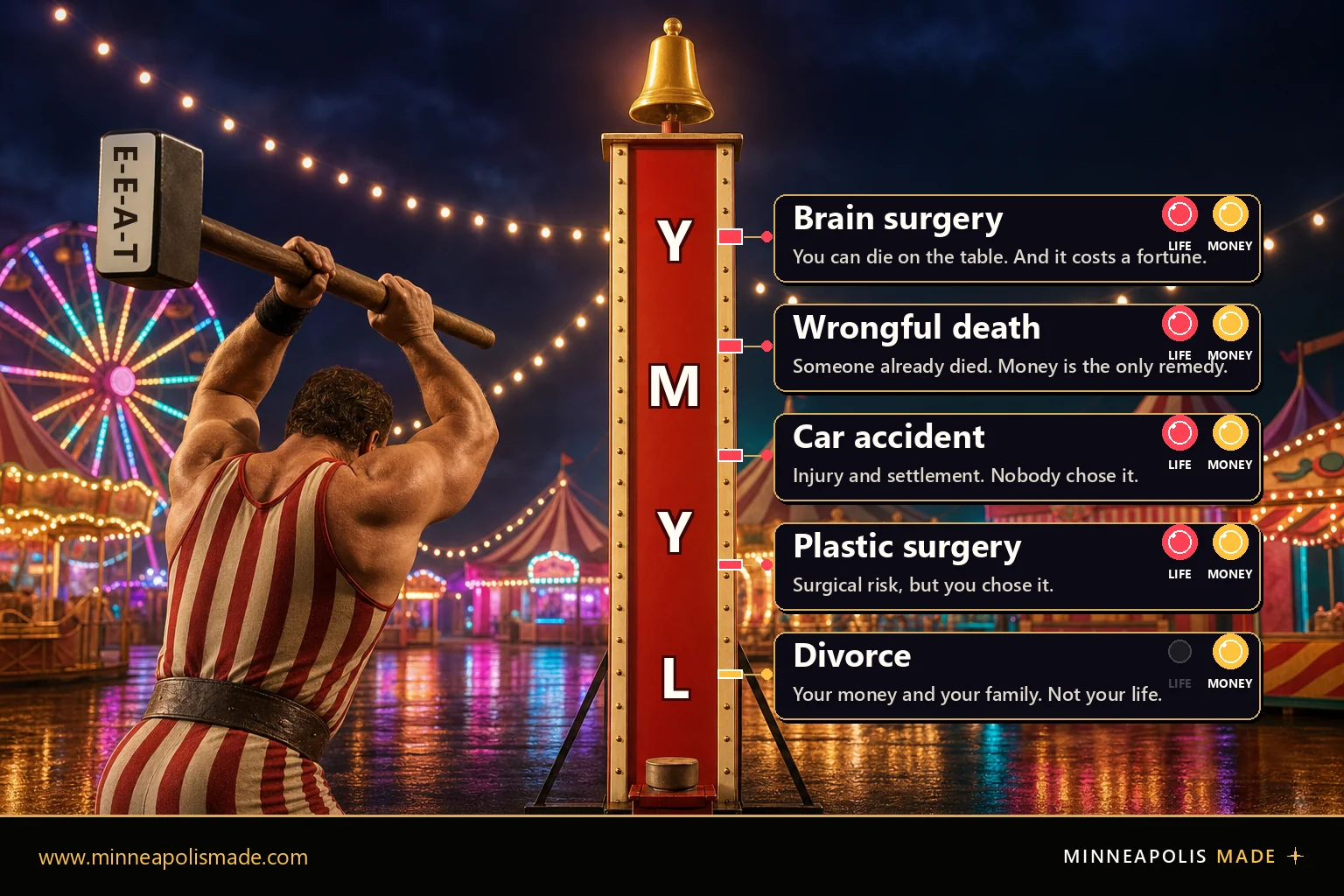
It helps to stop asking whether a topic "is YMYL" and start placing it on the scale. Buying siding is your money, so it carries real stakes, but a bad siding decision costs you a few thousand dollars and some aggravation. A bad brain surgery decision costs something you cannot get back. Both are on the spectrum. They are nowhere near each other on it.
Here is roughly how the topics most businesses publish about actually stack up. The first column follows Google's own vocabulary of harm types, and the examples in the middle band come straight from the guidelines:
| Level | Example topics | What the page must earn |
|---|---|---|
| Top Health or Safety | Brain surgery, wrongful death, prescription drugs, when to go to the ER | Credentialed named author, primary citations, review process |
| High Financial Security | Retirement investing, tax filing, bankruptcy, choosing an attorney | Professional credentials, current figures, disclosed conflicts |
| Middle Recoverable money | Siding, roofing, HVAC, choosing a contractor | Licensing, insurance, named installers, honest cost ranges |
| Low Casual | Replacing a toothbrush, car reviews, weather | Ordinary competence |
| Not YMYL | Award winners, washing jeans, your office party | Nothing special |
The trades sit in that middle band, which is the row most often misread in both directions. Contractors are told either that YMYL does not concern them, which ignores the money, or that they need medical-grade credentialing, which is overkill. What the middle band actually rewards is proof that a real, licensed, insured human did the work and will stand behind it.
Does your reputation off the site affect YMYL rankings?
Yes, and it is the most underrated part of the whole framework. Reputation research is not optional and it does not happen on your website. The guidelines are blunt about it: "reputation research is required for all PQ rating tasks."
More importantly, it is assessed by topic, which is the clearest statement anywhere in the document that YMYL is a topical spectrum rather than a category:
"Reputation research should be performed according to the topic of the page. For example, if the page contains medical information, research the reputation of the website and content creator for providing medical information. It's possible for a website to be a go-to source for one type of content (e.g., humorous videos), but an untrustworthy source for a different type of content (e.g., financial information)."
Same entity, different topic, opposite verdict. A reputation earned in one place does not transfer to a topic where the stakes are higher.
Unique InsightAnd on YMYL topics the bar for whose opinion counts goes up with it. The guidelines say "for YMYL topics, the reputation of a website should be judged by what experts in the field have to say," and that "reputation information for YMYL topics should come from sources that have expertise in the associated YMYL topic."
Popularity does not substitute. A surgeon with a large following and a pattern of malpractice findings has a reputation problem that audience size does not solve, because the sources that count on a medical topic are medical ones.
[ibm reviews -site:ibm.com], a search for reviews that explicitly excludes the company's own domain. The instruction is to "be skeptical of claims that websites make about themselves" and to seek "sources that were not written or created by the website or the company itself." Source: Search Quality Rater Guidelines, section 3.3.3, September 11, 2025.Every signal you control is excluded by design. What remains is reviews, news coverage, professional bodies, forum discussion and expert commentary, which is to say the parts of your reputation you can influence but cannot author.
What actually counts as a bad reputation?
Far less than most business owners fear, and far more than they would like. The guidelines set the floor deliberately high:
- "Any store or business can get a few negative reviews... this is completely normal and expected."
- "A single encounter with a rude clerk or the delayed receipt of a single package should not be considered negative reputation information."
- But: "credible, convincing reports of fraud and financial wrongdoing is evidence of extremely negative reputation."
A mediocre star average is not a reputation problem in Google's sense. Documented, credible, repeated evidence of harm is.
And when it crosses that line, the consequence is the one place the guidelines abandon the per-topic rule and go site-wide. Section 4.5.2 says to "use the Lowest rating if the website and content creator have an extremely negative reputation, to the extent that many people would consider the webpage or website untrustworthy," and that in those cases "all pages on these websites should be rated Lowest."
Every page. Not the page that earned the complaints.
Personal ExperienceThe practical shape of this, from watching it play out across client accounts, is that reputation is now a shared input rather than a per-channel one. The same third-party signals that shape what a rater would find also feed the reviews attached to a Business Profile and the sentiment an AI assistant summarizes when someone asks it to recommend a firm.
My own expectation, and this is a prediction rather than anything Google documents, is that Local Services Ads and increasingly automated ad platforms end up drawing on the same well, because that is where the trustworthy-provider signal already lives.
If that holds, negative reputation stops being a review-management problem on one surface and becomes a lever across all of them at once. For a wrongful death practice, that is the difference between competing for the category and only ever being findable by name.
Do the leaked Google documents support any of this?
Partly, and the honest answer needs three separate caveats before it is worth anything.
In March 2024 roughly 2,500 pages of internal Google Content Warehouse API documentation, describing more than 14,000 attributes, were committed to a public repository. Rand Fishkin (SparkToro) and Mike King (iPullRank) published analyses in May 2024. Google confirmed the documents were genuine. A spokesperson told The Verge: "We would caution against making inaccurate assumptions about Search based on out-of-context, outdated, or incomplete information."
So the artifact is authentic. That is the first and last thing about it that is settled.
Unique InsightTwo attributes in that documentation are more interesting for YMYL than the ones that got the headlines. siteFocusScore is described as measuring how much a site is focused on one topic, and siteEmbedding compresses a site's topical identity. Separately, homePageInfo carries a stored trust state with the values NOT_TRUSTED, PARTIALLY_TRUSTED and FULLY_TRUSTED.
If you were building machinery to implement the instruction that reputation "should be performed according to the topic of the page," topic-scoped site signals and a persisted trust state are close to what you would need.
The documentation also names demotions as discrete, individually stored things rather than as a single quality dial: babyPandaDemotion, babyPandaV2Demotion, productReviewPDemoteSite, exactMatchDomainDemotion, alongside anchor mismatch, SERP, nav and location demotions. Whatever else is true, negative treatment appears to be modeled separately from positive treatment.
What this does not establish
Three things, and skipping them is how this material usually gets abused.
There is no "poison points" system in these documents. The term circulates in SEO discussion, but it is not language from the leak. What the leak shows is named demotion attributes, not a running penalty tally. Anyone describing a points ledger is adding something the source does not contain.
API documentation is not a ranking system. It describes fields that exist in a data store. It does not establish that a field is used in ranking, how heavily it is weighted, or whether it is still live. Google's own caution about outdated and incomplete information is the relevant warning, not a dodge.
Correlation is not confirmation. The rater guidelines and this documentation are different kinds of artifact serving different purposes. That a concept appears in both is suggestive. It is not proof that one implements the other.
Personal ExperienceWith all of that said, here is how I read it, offered as a practitioner's interpretation rather than as anything documented. Every site starts at zero on any given topic. From there you go up or you go down, and those are separate mechanisms rather than two ends of one slider.
Earning expert recognition, real reviews and independent coverage moves you up. Accumulated negative mentions, credible complaints, and getting caught gaming the review system move you down, and the demotion attributes suggest that downward movement is recorded rather than merely reflected in a lower score.
That asymmetry is why buying fake reviews is a worse trade than it looks: the upside is a slightly better average, and the downside is a durable mark against the entity on the exact topic where trust is what you are selling.
Does YMYL mean quality over quantity?
It means quality where it counts.
The volume-versus-depth argument usually gets fought as a site-wide question, and the guidelines suggest that is the wrong frame. Because YMYL is assessed per topic, a site can reasonably run both strategies at once.
Publish freely on the topics that sit low on the spectrum, where a reader would happily ask a friend and where the trust threshold is correspondingly low. Spend the credentialed expert's time, the citations and the review process on the handful of pages that sit high on it.
The failure mode we see most often is the opposite allocation. Firms put their name partner's byline on the community sponsorship post, where it does nothing, and publish the wrongful-death page unsigned. Both pages get the same generic treatment, which is over-investment on one and under-investment on the other.
There is also a floor underneath all of this that rarely gets discussed, because it lives in the Lowest-quality chapter rather than the E-E-A-T one. The current guidelines run a harm screen before the quality assessment. Step one checks whether the page has a harmful or deceptive purpose. Step two checks its potential to cause harm. Only step three assesses "how well the page achieves its purpose."
The guidelines describe the first two as "a screening process to quickly detect harmful content before other PQ considerations are applied," and this ordering is new: the 2015 edition had no equivalent.
Be careful how far you take that, though, because the screen is narrower than it sounds. It catches harm, not ordinary inaccuracy. The guidelines' own examples of harmfully misleading information are false dates for an election, claims that lemons cure cancer, and claims that world leaders are lizard people. A page that is merely wrong does not trip the screen. It gets assessed normally, and its inaccuracy counts against it there.
What the guidelines do say about accuracy is more measured, and it is the sentence worth keeping: "There is an especially high standard for accuracy on clear YMYL topics or other topics where inaccurate information can cause harm." The screen itself applies to every page on the web. What YMYL changes is how much accuracy the page needs before its errors start counting as harm.
Spending expert time on the wrong pages?
We audit content allocation against the harm spectrum, so credentials, citations and review cycles land on the pages where they change rankings instead of the ones where they do not.
How should you actually use this?
Four steps, in order.
Sort your pages by the two-question test. Would a careful reader seek out an expert to avoid harm, or would they ask a friend? That splits your library faster than any tool, and it is Google's own test rather than a proxy for it.
Fix Trust before anything else. Trust is the center of E-E-A-T and its failure is absolute. Accurate content, honest framing, working contact information, clear ownership, no conflict of interest. The guidelines call out conflict of interest specifically, and a page selling the thing it evaluates has a structural problem no byline solves.
Match the signal to the column. Advice pages need credentials. Experience pages need authenticity plus consistency with expert consensus. Putting a credential on an experience page does not help, and writing an advice page without one is the actual risk.
Check the harm screen. Anything inaccurate, deceptive about its purpose, or built to benefit the owner "with very little or no attempt to benefit website visitors" is exposed before quality is even considered.
Related: What SEO actually looks like in 2026
What happens to YMYL in an AI and agentic search world?
It gets more important, not less, and the reason is that the framework was already built for it. Everything below the next two paragraphs is forecasting rather than documentation, and it is labelled that way deliberately.
Start with what is actually on the record, because the popular version of this story is shakier than people assume. In May 2025, Apple's Eddy Cue testified in the Department of Justice case against Google that searches in Safari had fallen for the first time in over twenty years, and attributed it to people using AI (Search Engine Land). Google issued a rare public rebuttal: "We continue to see overall query growth in Search. That includes an increase in total queries coming from Apple's devices and platforms" (MacRumors).
Both statements are on the record and they do not agree. Anyone telling you flatly that Google is losing search volume is picking a side in a dispute that has not been settled publicly.
Two things are not in dispute, though. Alphabet's share price fell about seven percent the day Cue's remarks surfaced. And as of August 2026, OpenAI reports ChatGPT at a billion weekly active users while Google reports Gemini at a billion monthly active users.
Unique InsightThat metric mismatch is the more telling signal. Weekly and monthly are not comparable numbers, and a product with a billion weekly users necessarily has considerably more than a billion monthly ones. When a company reaches for the more flattering denominator, it is usually not because the comparison is going well. If you want evidence about competitive pressure, the choice of metric and a seven percent single-day drop say more than any disputed traffic figure.
Why this makes YMYL more central rather than less
Here is the part most commentary misses. Assistants like ChatGPT are frequently described as evaluating a business by gathering mentions across many sources and weighing the positive against the negative. That is an accurate description of how they behave. It is also, almost line for line, what Google has instructed human raters to do since 2015.
Go back to the reputation section of the guidelines. Research happens off the site. It draws on independent reviews, news articles, expert commentary and forum discussion. It is scoped to the topic rather than the entity. It weighs credible negative evidence against positive evidence. On YMYL topics specifically, it is judged by what experts in the field say. Strip the vocabulary and that is mention analysis, described in a Google document years before an LLM could perform it.
Personal ExperienceSo my read, offered as a practitioner's forecast rather than as anything Google has announced, is that the two systems are converging because they were always describing the same evaluation. What has changed is cost.
Reputation research used to require a human to run the searches, read the sources and exercise judgment, which is why it could only ever be sampled across a fraction of the web. A model can now do a version of that continuously and at scale. When the expensive part of a rubric becomes cheap, the rubric stops being an aspiration and starts being enforcement.
Push that into an agentic world and it sharpens further. When a person searches, they see ten results and decide for themselves. When an agent is asked to book the appointment, hire the contractor or shortlist the firm, it has to pick, and it has to justify the pick.
On a low-stakes topic that is a coin flip nobody audits. On a YMYL topic it is a recommendation with consequences attached, and the safest thing any system can do is favour entities with visible credentials, consistent identity and an absence of credible negative signal. That is the same conservatism the guidelines already instruct raters to apply. Agents will apply it harder, because they are the ones making the choice rather than presenting options.
Which leads to the uncomfortable version of the point. In a ten-blue-links world, a strong brand could outrank a reputation problem, because the searcher still chose. In an agentic one, the negative signal is not something a user weighs, it is something the system uses to exclude. For a business on a clear YMYL topic, that is the difference between competing on the merits and only ever being reachable by someone who already knows your name.
Frequently Asked Questions
Is YMYL a Google ranking factor?
Not in the sense of a score attached to your page, but it certainly affects rankings. Two things are true at once. Raters do not move pages: Google states that "search raters have no control over how pages rank" and that "rater data is not used directly in our ranking algorithms." But the ranking systems themselves treat these topics differently, and Google says so plainly: "our systems give even more weight to content that aligns with strong E-E-A-T for topics that could significantly impact the health, financial stability, or safety of people." YMYL is best understood as a condition that changes how heavily other signals are weighted, not as a factor with its own score.
Does YMYL still include legal content?
Legal content is still held to a high standard, but "legal" is no longer a named category. The November 2015 guidelines listed "Legal information pages" as one of five YMYL page types. The September 2025 guidelines replaced the category list with four harm types, and legal information falls under Financial Security and, depending on the topic, Health or Safety.
Is every page on a medical or legal website YMYL?
No. YMYL is assessed per topic, not per site. Google states that "many or most topics are not YMYL." A medical practice's page on treatment options is clear YMYL. That same practice's post about new office hours is not.
Can a non-expert write about a YMYL topic?
Yes, for experience-based content. The guidelines say pages sharing first-hand life experience on clear YMYL topics "may be considered to have high E-E-A-T as long as the content is trustworthy, safe, and consistent with well-established expert consensus." Information and advice, as opposed to lived experience, is the category the guidelines say "must come from experts."
My page ranked number one for a YMYL query and vanished. What happened?
That pattern, a stable top position disappearing without a manual action or a technical change, is the signature of a core update rather than a page-level penalty. Google's guidance is that pages losing position after a core update do not necessarily have anything wrong with them: it compares the situation to a restaurant list, where "restaurants that move down aren't necessarily 'bad'; there are just other restaurants that make your top 20." On a YMYL query the reassessment bites harder, because Google's systems "give even more weight to content that aligns with strong E-E-A-T" on exactly those topics. Something that changed how your site is assessed against that higher bar, often reputation or authorship signals rather than the page copy, moved you down relative to competitors who now clear it. Google's advice is to "read through the self-assessment to check if your site overall (not just individual pages) is delivering content that's helpful, reliable, and people first," and to "avoid doing 'quick fix' changes." Source: Google, Google Search's core updates.
Did the 2024 Google leak prove there is a penalty points system?
No. Google confirmed the leaked Content Warehouse documents were authentic, but they describe fields in a data store, not a live ranking formula, and the widely repeated phrase "poison points" does not appear in them. What the documentation does contain is a set of separately named demotion attributes, which suggests negative treatment is modeled distinctly from positive treatment. That is suggestive, not conclusive.
What is the difference between E-E-A-T and YMYL?
E-E-A-T is the set of criteria used to assess a page: Experience, Expertise, Authoritativeness and Trust. YMYL is the topic classification that determines how demanding those criteria should be. Every page is assessed on E-E-A-T. YMYL sets the passing score.
Which member of E-E-A-T matters most?
Trust. The guidelines call it "the most important member at the center of the E-E-A-T family" and state that "untrustworthy pages have low E-E-A-T no matter how Experienced, Expert, or Authoritative they may seem." Experience, Expertise and Authoritativeness are described as concepts that support the assessment of Trust.
The short version
YMYL is not a list of industries, and it stopped being one when Google replaced the category list with a harm spectrum. It is not a property of your domain, it is a property of each topic you publish on. E-E-A-T is not a competing framework, it is the instrument, and Trust is the part of it that can fail absolutely.
The practical shift is away from asking whether you are in a YMYL industry and toward asking which of your pages could hurt someone if you got them wrong. That question sorts a content library quickly, and it puts your expensive signals where they actually change the outcome.
The two documents quoted throughout are worth reading directly rather than secondhand: the current Search Quality Rater Guidelines dated September 11, 2025, and the November 12, 2015 edition preserved by the Internet Archive. Almost everything written about YMYL describes one of them without quoting either.