ChatGPT Ads
Agency.
In February the platform carried a $200,000 minimum. Today the floor is $25 a day and you can target a single ZIP code. We write the context hints, build the landing page, and run the account you own.
$85/hr. Billed weekly. No packages, no percent of spend.





A new auction,
run without the guesswork.
Your Account
You create and verify the advertiser account in your own business name. We walk you through it, then you invite us in.
Hints
One theme per ad group, written as the conversation someone is actually having rather than the phrase they would type.
Landing Page
Built for the campaign, matched to the hint, and checked that it does not block OpenAI's crawlers.
Launch
Objective and budget type chosen carefully, because both are one-way doors. Then ad review, then delivery.
Tune
Bid strength, hint refinement, audience exclusions, and conversion tracking that proves what the spend returned.
What ChatGPT Ads management
actually covers
Context Hint Writing
The lever that replaces keywords. We write hints that describe the situation a person is in, not the audience label they belong to, and keep one theme per ad group.
Campaign Architecture
Objective, budget type and structure decided before anything is built, because the objective is fixed at creation and some budget changes cannot be reversed.
Landing Pages
One page per campaign, written alongside the hint rather than handed off after it. The creative has room for two short lines; the page carries the rest of the argument.
Geographic Targeting
Country everywhere, and in the United States down to state, designated market area and ZIP code. Precise enough to run a single-branch service business.
Conversion Measurement
Conversion events configured in Ads Manager plus UTM parameters that survive the click, so the channel is judged in your analytics and not only in theirs.
Creative Production
Static image, title and description, or a static product feed. A narrow palette by design, which makes the words matter more than the art direction.
What ChatGPT Ads actually are right now
The timeline matters, because most of what is written about this is out of date within weeks. OpenAI announced advertising on 16 January 2026. The labelled Sponsored unit went live in the US on 9 February, on the Free and Go tiers. The self-serve Ads Manager opened to US businesses on 5 May, and international rollout ran through August.
So it is roughly seven months old as a product and four as something you can buy yourself. It reached a $1 billion annualised run rate in under 200 days. It is not an experiment, but it is still labelled Beta, and the feature set has moved repeatedly since launch.
At launch this was an enterprise channel: $200,000 minimum spend, roughly $60 CPMs. OpenAI removed the minimum entirely when self-serve opened and CPMs fell to around $25. Meanwhile the auction is thin in most local verticals, because the agencies that would normally crowd it are still writing blog posts about whether it is real. Cheap inventory with few bidders is a temporary condition.
Minimum spend to get in the door.
And a single ZIP code is a valid target.
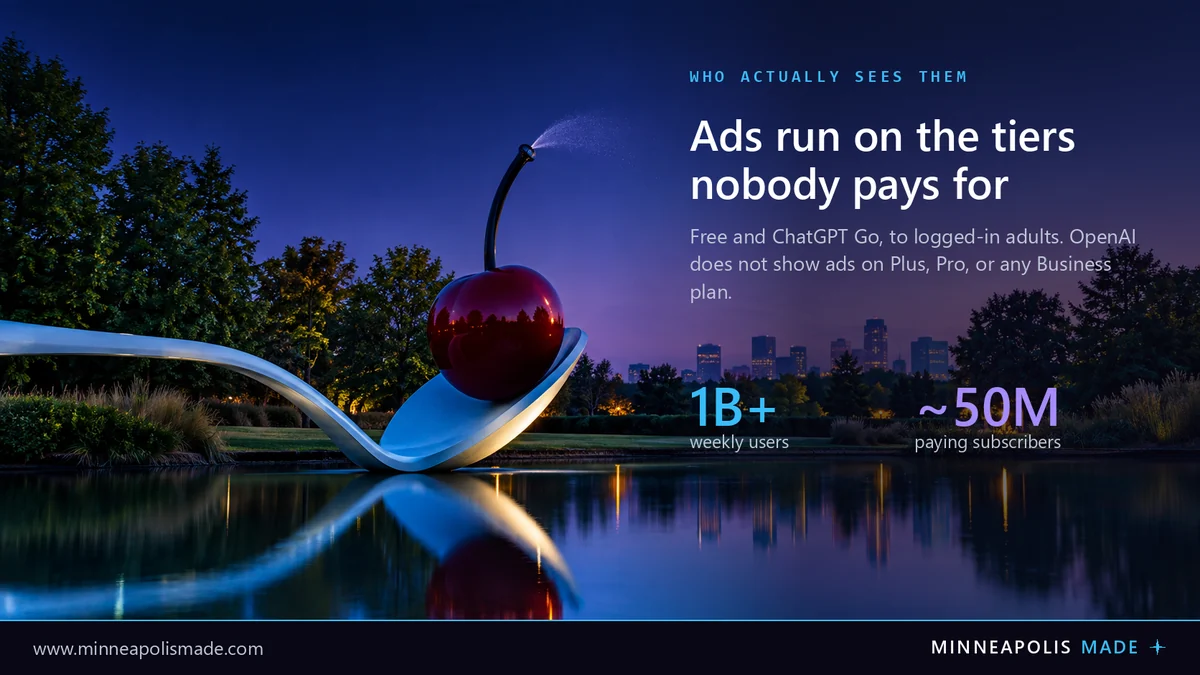
ChatGPT passed a billion weekly users in July 2026 against roughly 50 million paying subscribers. Ads serve on Free and Go, to logged-in adults. OpenAI does not show ads on Plus, Pro, or any Business plan, or to accounts identified as under 18.
Worth knowing which way that cuts: if your buyer is a developer on a Pro plan, this channel will not reach them at their desk.
Context hints are the part
nobody explains
There are no keywords. The lever that replaces them is the context hint, written at the ad group level, describing what your product offers, who it helps and when it is useful. OpenAI's systems use it to work out which conversations your ads may be relevant to.
The instinct carried over from Google Ads is to treat that field like a keyword box. It is not one. OpenAI states plainly that context hints are not exact-match controls, not audience targeting rules, and not a guarantee your ad shows for particular words or topics. They are closer to briefing a new employee than to buying a term.
Which means specificity beats breadth, and describing a situation beats naming an audience. Being specific does not restrict you to those exact words — the system generalises from the need you described.
The honest surprise of writing hints for the first time is how much fun it is. Google Ads trains you into a shopping lens: you sit there guessing the phrase a person types into a box with buying intent already attached. Hints need a conversational lens instead. You are not guessing a query, you are imagining the middle of a conversation.
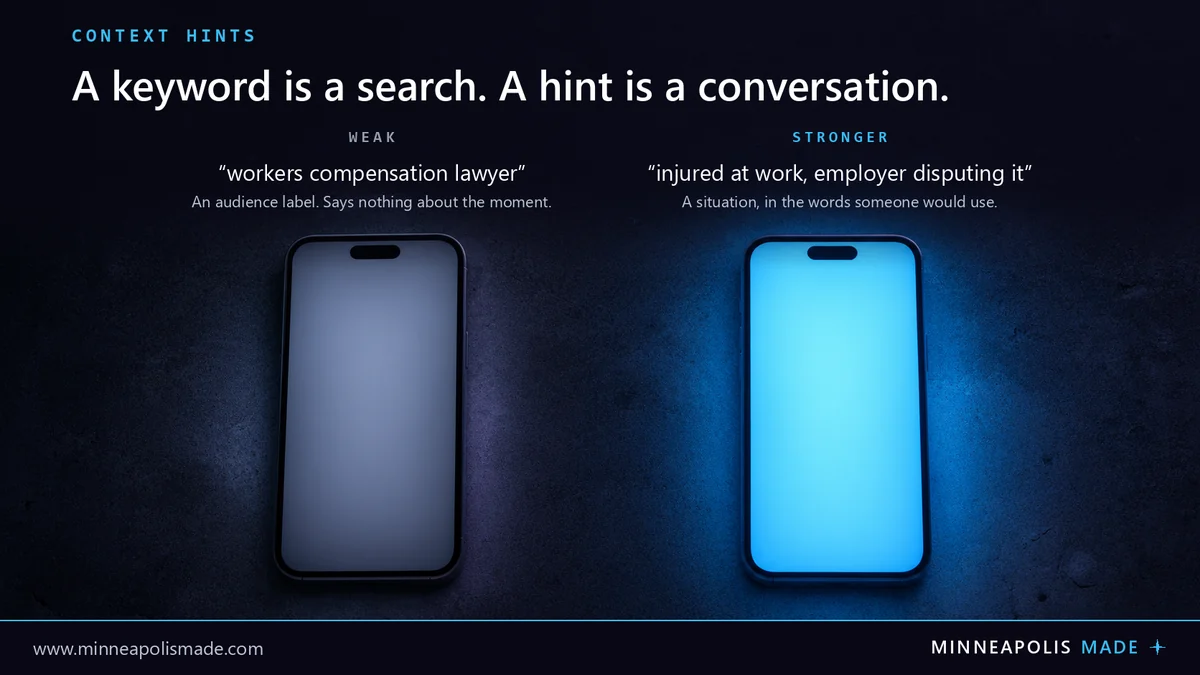
“Roof replacement cost” is a search. “Shingles came off in last night's storm and I don't know if insurance covers it” is a conversation, and it is the one the assistant is actually having. Teams that port their keyword list straight across write the first kind and wonder why delivery is thin.
workers compensation lawyer
An audience label. Says nothing about the moment the person is in.
injured at work, employer disputing the claim, unsure whether to accept the settlement offered
A situation, in the words someone would actually use describing it to an assistant.
One structural rule follows from this: keep each ad group to a single theme. If your hints describe meaningfully different problems that would need different messaging or a different landing page, they belong in separate ad groups. That is also why the landing page and the hint have to be written together, not handed off.
The controls you actually get
and the two you cannot undo
Geography
Country everywhere. In the US, also state, DMA and ZIP code. New product-feed campaigns are country-level only.
Platform
Five surfaces: iOS app, iOS web, Android app, Android web, desktop web. Reporting segments by the same five.
Budget
Daily or campaign-total. Daily is an average over seven days: no single day exceeds twice the amount. Minimum $25/day in USD.
Audiences
Custom audiences included or excluded at campaign level. Exclusion is the underused half.
Objectives, and what each one buys
| Objective | You pay per | Best for |
|---|---|---|
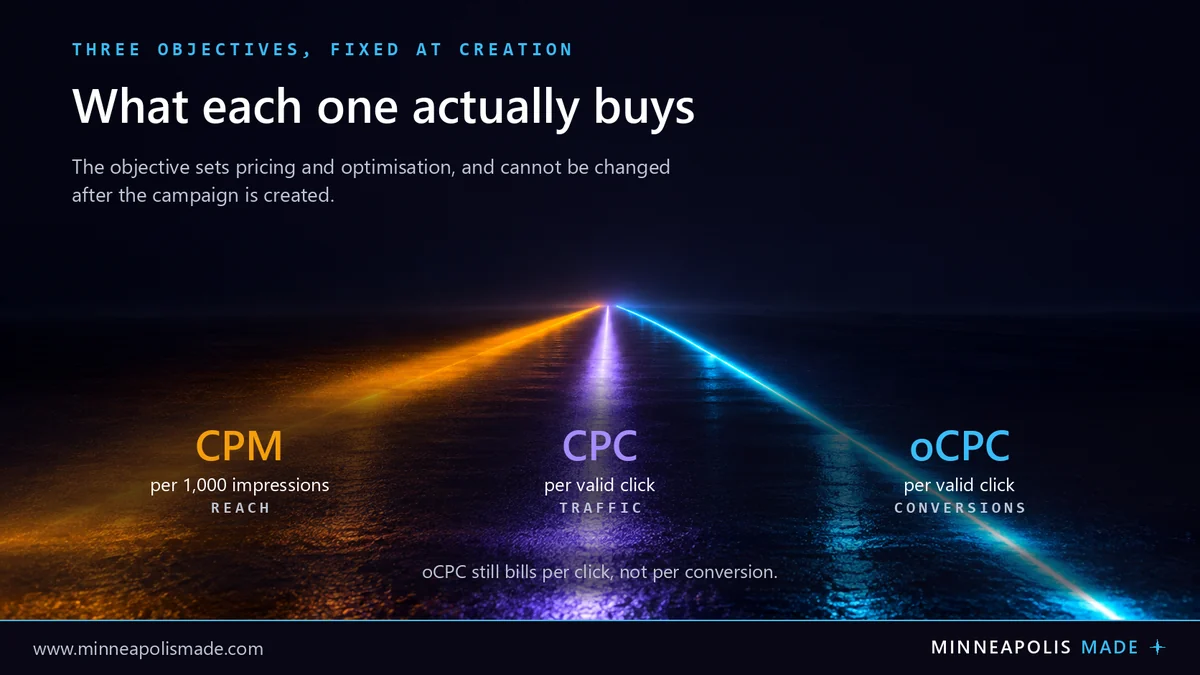
| CPM | 1,000 impressions | Reach and awareness |
| CPC | Valid click | Traffic and engagement |
| oCPC | Valid click | Clicks weighted toward a tracked conversion |
On oCPC you still pay per click, not per conversion — the optimisation changes, the billing does not. Bids are set at ad group level, and OpenAI currently recommends starting a CPC campaign at a maximum bid of $3–$5. Selection runs through a relevance-weighted second-price auction, which is the mechanism behind the advice that specific hints beat broad ones: relevance is a multiplier on your bid, not a tiebreaker after it.
The objective is fixed at creation. Wanting a different one means building a new campaign, not editing the existing one.
Some budget-type changes are one-way. Switch a campaign-total budget to a daily budget and you cannot switch it back. Both are cheap mistakes on day one and expensive ones in week six.
The creative is deliberately narrow
There is no video, no animation, no carousel and no interactive unit. An ad is a static image with a title and a description, or a static product feed if you have a catalogue. That is the whole palette, and it is a palette OpenAI has clearly chosen to keep quiet so ads sit inside a conversation rather than interrupt one.
OpenAI asks you to stay inside recommended character limits without publishing a number. In practice we write titles and descriptions under about 100 characters and they survive intact across surfaces; longer copy is where truncation starts showing up. Treat that as our working rule rather than a documented specification, because it is the former.
Narrow constraints are not a bad thing here. One image and two short lines is roughly the budget a person gives an ad inside a conversation they are already having. It does mean the landing page carries the argument the creative has no room for.
- • Advertiser name
- • Favicon, your logo
- • Title, the headline
- • Copy, the description
- • Image asset
- • Landing page
Your landing page must not block OAI-AdsBot or OAI-SearchBot. Plenty of sites blanket-blocked OpenAI's crawlers in 2024 on principle and never revisited it, and a firewall rule written two years ago will quietly disqualify the ad you are paying for today. It is the first thing we check on a new account and it is wrong more often than it should be.
The account is yours,
and OpenAI enforces that
Anyone who has tried to leave a Google Ads agency knows the fight. The account was built inside the agency's manager account, the history lives there, and getting it back is a negotiation you conduct from a weak position. Years of conversion data can end up hostage to a cancellation notice.
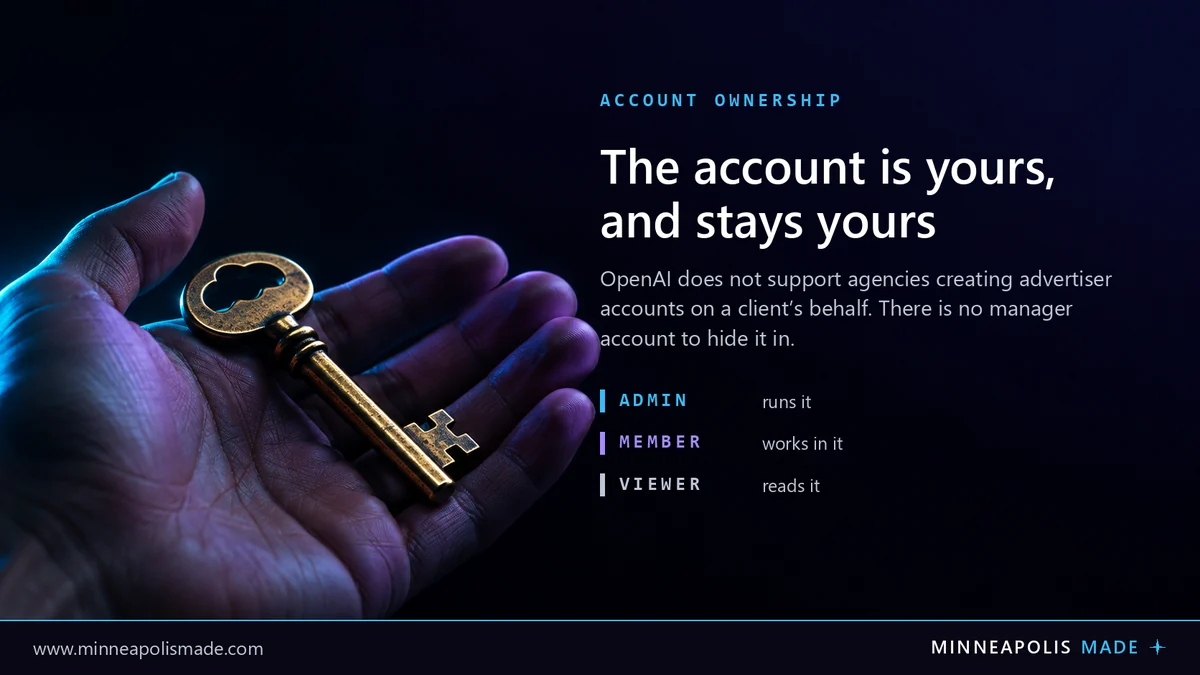
ChatGPT Ads makes that arrangement structurally impossible. OpenAI's documentation is blunt about it: individual advertiser onboarding and agencies creating advertiser accounts on a client's behalf are not supported. An agency can only be invited after its client has created the account. There is no manager account, no parent structure, no shared billing umbrella.
We are then invited in as a user on your account, at whatever role you choose. You can change or revoke that in your own settings, without asking us, on a day we do not know about.
It costs us the leverage most agencies quietly rely on, and we would rather say so on the page than have you find out you had it anyway. If this stops working for you, you keep the account, the campaign history, the conversion data and the creative. You remove our access and carry on.
One practical note: because the account must be created by you, getting started is a short call rather than a form we fill in on your behalf. It is the one step of this we genuinely cannot do for you, and that is the point.
Full management of the account and its users. At least one admin must always remain.
Builds and updates campaigns without the power to change who else has access.
Read-only. Useful for a CFO or a second agency auditing the work.
There is also a ChatGPT Ads Manager app inside ChatGPT itself. Connect your advertiser account and you can start setup, work with campaigns, ad groups and ads, and pull performance insights by asking for them in plain language. OpenAI notes the available actions and workspace access vary, so we still do the work in Ads Manager where the controls are complete and use the in-ChatGPT surface for the questions it answers faster.
Campaigns we have
live right now
We are not writing about this from the sidelines. These are running accounts, in two verticals with nothing in common except that both depend on reaching someone at a specific moment.
Goldberg & Loren
California employment law and workers' compensation. Two practice areas with different urgency, which means different ad groups and different landing pages rather than one campaign trying to cover both.
The firm is better known for personal injury, which is exactly why the hints matter. Someone describing a wage dispute to an assistant is not using injury language, and a hint written from the firm's reputation rather than the client's situation would miss the conversation entirely.
The wider paid picture for firms: law firm PPC.
Storm Guard
Roofing in Nashville, where the demand is weather-driven and the conversation starts with damage rather than with a contractor search. Geographic targeting earns its keep here.
It is also the opposite problem to the law firm. Employment cases build slowly and the person researches for weeks; roof damage is decided in days. Same platform, same controls, completely different pacing — which is a budget-type decision, and one of the two you cannot reverse later.
The wider picture for roofers: roofing marketing.
Every campaign lands on a page built for it, not on a service page that happens to exist. The creative carries one image and two short lines, so the page has to do the rest of the work. That is the same discipline behind our web design and digital marketing engagements.
What We Manage Inside Ads Manager
What this costs to run
Billed weekly. The same rate as every other Minneapolis Made service. No packages, no minimum retainer, and no percent-of-spend arrangement — which on a channel this new would mean being paid more for pushing budget into an auction nobody has learned yet.
Paid directly to OpenAI on your own billing profile, in your own account. We never touch it and never mark it up. The minimum varies by billing currency; $25 is the USD floor.
Last checked against OpenAI's documentation:
This platform is in Beta and has changed five times since January: the minimum spend, the CPM floor, the geography, the objectives, the countries. Anything written about it has a shelf life measured in weeks, including this page. It carries a date for that reason, and we re-check it against OpenAI's documentation rather than against other people's blog posts.
Frequently Asked Questions
About ChatGPT Ads
OpenAI announced advertising in ChatGPT on 16 January 2026 and the labelled Sponsored unit went live in the United States on 9 February 2026, initially on the Free and Go tiers. The self-serve Ads Manager opened to US businesses on 5 May 2026. So the product is roughly seven months old and the self-serve platform about four.
The minimum daily budget is $25 in USD. That is a change worth understanding: at the February 2026 launch the platform carried a $200,000 minimum spend and roughly $60 CPMs. OpenAI removed the minimum entirely when self-serve opened in May and CPMs fell to around $25. The barrier that kept this to enterprise budgets is gone.
Yes, in the United States. OpenAI Ads Manager supports country-level targeting everywhere, and in the US it adds state, designated market area (DMA) and ZIP code targeting. That is what makes the platform usable for a local service business rather than only national brands. One exception: new product-feed campaigns support country-level targeting only.
Context hints sit at the ad group level and describe what your product offers, who it helps and when it is useful. They help OpenAI understand which conversations your ads may be relevant to. OpenAI is explicit that they are not exact-match controls, not audience targeting rules, and not a guarantee your ad appears for particular words or topics. They are closer to a brief than a keyword list.
A ChatGPT ad is a static image with a short title and description, or a static product feed for catalogue advertisers. There is no video, animation or carousel. OpenAI asks advertisers to stay within recommended character limits without publishing a figure; in our accounts, titles and descriptions under roughly 100 characters render intact. One requirement that is easy to miss: the landing page must not block the OAI-AdsBot and OAI-SearchBot user agents, or the ad is disqualified.
CPM pays per 1,000 impressions and optimises for reach. CPC pays per valid click and optimises for users likely to engage. oCPC also charges per click but optimises delivery toward a tracked conversion event after that click. You still pay per click on oCPC, not per conversion. The objective sets pricing and optimisation and cannot be changed after the campaign is created.
The business, always. OpenAI does not support agencies creating advertiser accounts on a client's behalf, and there is no manager or parent account structure. The business creates and verifies its own advertiser account, sets up its own billing, then invites the agency as a user with an Admin, Member or Viewer role. That access can be revoked by the business at any time, and the campaign history and conversion data stay in the account. It is structurally different from Google Ads, where agency-owned accounts are common and leaving can mean losing the history.
No. OpenAI states it does not show ads to users on Plus, Pro, or any Business plan, or to accounts identified as belonging to users under 18. Ads serve on the Free and ChatGPT Go tiers, to logged-in adults, in supported countries. Since ChatGPT passed a billion weekly users in July 2026 against roughly 50 million paying subscribers, the ad-supported tiers are the overwhelming majority of the audience.
No. Ads appear in clearly labelled units below the response, and OpenAI states they do not influence the answer itself. That is a meaningful difference from search advertising, where the ad competes with the result for the same attention. In ChatGPT the answer is delivered first and the ad sits underneath it.
It is early, and that is the argument for running now rather than against it. The platform reached a $1 billion annualised revenue run rate in under 200 days with tens of thousands of advertisers, so it is not a curiosity. But it is still labelled Beta, the feature set has changed repeatedly since January, and competition in most local verticals is thin compared with Google Ads. Early access to a working auction with few bidders is the whole opportunity.
$85 per hour, billed weekly, the same rate as every Minneapolis Made service. No packages, no retainers, and no percent-of-spend arrangement that quietly rewards us for spending more of your money.
Run ChatGPT Ads before
the auction fills up.
$25 a day, one ZIP code, and a landing page written for the situation. That is a real test, not a pilot budget. We will tell you honestly if your market is not there yet.
$85/hr. Billed weekly. You own the account.
Talk About a CampaignOr call (612) 868-9079

Minneapolis Made
Minneapolis, MN 55402
Where Campaigns Run
ChatGPT Ads are managed remotely, so the campaign does not have to be local even when we are. Current accounts run in California and Tennessee alongside Twin Cities work, targeted down to state, DMA or ZIP code.
Where we work in the Twin Cities
Headquartered in downtown Minneapolis. Dedicated landing pages for the suburbs we work in most often.
Plus Wayzata, Saint Louis Park, Richfield, Hopkins, and the broader 7-county Twin Cities metro on a project basis.

Christopher Merry has been a computer geek since 1977, built his first website in 1996, and has been running SEO campaigns since 2001. He founded Minneapolis Made in 2000 with a simple premise: every project starts and ends with the strategist. The work is national. Clients run from Ohio to Oregon and Florida to North Dakota, including both Portlands. Christopher leads each engagement end to end, from the strategy to the keyword research to the code, supported by a small, family-owned team that helps execute. You talk to Christopher. He writes the plan.