Custom Web App
Development.
We build custom web applications for Minneapolis small businesses. CRMs, lead-gen tools, inventory systems, dispatch dashboards, and the internal tools that run the parts of your business spreadsheets shouldn't.
Rapid prototyping in 2 to 4 weeks. Production builds in 6 to 16 weeks. Billed at $85/hr, weekly, with full source-code ownership and no package pricing. Pairs naturally with our web development and headless CMS work.





The custom web apps small businesses actually need
These are the builds Minneapolis Made ships most. Every one started as a spreadsheet, an email thread, or a whiteboard, and turned into a tool the team actually uses every day.
Custom CRMs
Sales pipeline, contact history, follow-up automation, and reporting tuned to how your team actually sells. Not a Salesforce clone, the CRM your team won't quietly stop using after six weeks.
Lead generation tools
Quote calculators, eligibility quizzes, multi-step intake forms, and qualification flows. The thing that turns a paid click into a sales conversation, custom-built to your offer.
Inventory and asset tracking
Custom inventory systems for businesses whose product or fleet doesn't fit a generic SKU model. Trucks, equipment, materials, returns, transfers, audits.
Dispatch and routing
Crew assignments, route optimization, status updates, customer notifications. We've built dispatch dashboards for moving companies, plumbers, and field service teams.
Customer intake
Multi-step intake flows, document upload, e-signature, conditional logic, and CRM sync. Every field validated, every submission tagged with source and campaign.
Scheduling and booking
Booking systems with crew availability, capacity rules, deposits, and reminders. Custom-built for businesses whose scheduling doesn't fit Calendly or Acuity.
Internal dashboards
Reporting dashboards that pull from QuickBooks, Stripe, Google Analytics, and your own database in one place. The dashboard your operations lead has been building in spreadsheets, made real.
Workflow automation
Social posting after a job completes. Invoice sent automatically when a milestone hits. The 50 manual steps that drain your team's afternoons, scripted away with AI automation.
Integrations and middleware
The custom glue between QuickBooks, Stripe, HubSpot, Twilio, Google Workspace, and the in-house systems they don't talk to natively. REST APIs, webhooks, and scheduled jobs.
A worked example: a Minneapolis moving company
A 14-truck Minneapolis moving company runs every job through five touchpoints: the lead form on their website, the in-home estimate, the dispatch board on the morning of the move, the crew's mobile checklist during the job, and the social-media post after the job's done.
Off-the-shelf software covers maybe two of those well. The rest is spreadsheets, group texts, and a clipboard. That's where a custom web app pays for itself: one tool that owns the lead from form-fill to follow-up post, with every step tagged, timed, and reportable.
We can build that as a single app or as five small tools that share a database. The right answer depends on how the team actually uses the system on a Tuesday morning, not on what looks tidy in an architecture diagram.
How we ship a custom web app in 4 phases
Every phase ends with something you can click and use. No three-month "discovery" with no working software at the end.
-
1
Workflow audit (week 1)
We sit with the people who will actually use the software, not the people who will sign the invoice. Map the existing process, find the steps that bleed time, and write a one-page scope.
-
2
Clickable prototype (weeks 2–4)
A working prototype your team can use on real data. Not a Figma mock, an actual logged-in app with the core workflow wired up. We use the prototype to discover what the real requirements are.
-
3
Production build (weeks 4–14)
Authentication, permissions, integrations, error handling, monitoring, and the boring 60% that turns a prototype into a real production app. Iterative releases, one feature at a time, every Friday.
-
4
Rollout and ongoing care (week 14+)
Team training, documentation, monitoring set up, and an on-call commitment for the first 30 days. After that, we either hand it off to your in-house engineer or roll into our managed services at the same $85/hr rate.
The tech stack we actually use
We pick the boring stack on purpose. PHP, Laravel, Node, React, Next.js, Postgres, MySQL, Redis, and the cloud platform you're already paying for. Tools with 15-year track records, big hiring pools, and clear documentation.
We don't build production apps in whatever framework launched last Tuesday. The cost of a custom app isn't the day you ship it. It's the next five years of changes, hires, and integrations. Boring tech survives that timeline. Trendy tech doesn't.
For the AI layer (intelligent intake parsing, document classification, smart routing) we wire in Claude, OpenAI, or Gemini APIs as needed. AI features ride on top of a stable app, never become the app.
We don't just build it.
We run it.
Most shops hand you a zip file and wish you luck. We stand up the whole stack and keep it running, so your custom app is never one departed freelancer away from going dark.
Your own servers
We launch and manage the Node.js and React servers your app runs on, plus Plesk hosting, DNS, SSL, and deploys. It lives on infrastructure we stand up and maintain, not a mystery box you inherit.
Microservices & database
We wire the microservices, pick the right database, Postgres, MySQL, or Redis, and own the framework and scaffolding. Schema, migrations, backups, and scaling are handled as the app grows.
Managed for the long run
Security patches, dependency updates, uptime monitoring, and new features as your business changes. You get a running system with a human who knows it, not a code drop and a goodbye.
We build it, we ship it, it's yours, and we keep it running, billed at the same $85/hr with no lock-in. Pair it with managed services for ongoing care, or see how the same team builds AI automation on top of it.
When custom beats SaaS,
and when it doesn't
We will tell you not to hire us. If a $40 per month SaaS does the job, hire the SaaS. Custom only makes sense when one of these is true.
- Your workflow doesn't fit any off-the-shelf tool, and your team is already working around three of them
- You'd save 10+ hours per week of manual work across the team
- You're paying $500+ per month for a SaaS you only use 20% of
- Your competitive advantage is a process, and you don't want to give it to a SaaS vendor
- Your data is sensitive enough that you want to own where it lives
- An existing tool covers 80% of what you need and the workaround is a 5-minute Zapier flow
- The use case is generic (email marketing, basic CRM, basic accounting)
- You're a 1-person business and the tool replaces 30 minutes a week
- You need it shipped this Friday and a custom app takes weeks
- The vendor's product roadmap is going where you want to go anyway
Minneapolis small businesses
we build for
Moving and delivery
Lead intake, in-home estimates, dispatch boards, crew mobile, post-job follow-up.
Home services
Plumbers, HVAC, electrical, roofing. Quote calculators, scheduling, recurring service tracking, customer portals.
Law firms
Client intake automation, conflict checks, document collection, matter dashboards. Practice-specific tools that Clio doesn't quite cover.
Medical and dental
Patient intake, treatment-plan tracking, recall automation. HIPAA-aware where required.
Retail and ecommerce
Inventory, returns, vendor portals, custom pricing logic. Pairs with our e-commerce work for storefront-side builds.
B2B services
Agencies, consultancies, SaaS startups. Internal dashboards, client portals, billing automation, lightweight CRMs.
$85 per hour. Billed weekly.
No packages, no fixed-price bundles.
Most small internal tools land between $5,000 and $15,000. A more involved CRM or dispatch system typically lands between $15,000 and $40,000. Every project starts with a free workflow audit, so the budget reflects what you actually need.
Full source-code ownership. Hosted on infrastructure you control.
Get a Free Workflow AuditOr call (612) 868-9079
Custom web app development
frequently asked questions.
Custom web app development is the design and engineering of a software application built specifically for one business and one workflow. Unlike off-the-shelf SaaS, a custom web app fits the exact way your team already works rather than forcing your team to bend around a generic product. Common examples include custom CRMs, lead-gen tools, inventory systems, dispatch dashboards, and internal automation tools.
Minneapolis Made bills custom web app development at $85 per hour, weekly, with no packages or fixed-price bundles. A small internal tool typically lands between $5,000 and $15,000. A more involved CRM or dispatch system typically lands between $15,000 and $40,000. We scope every project together with the client before any work starts so the budget reflects real requirements, not a sales pitch.
A working prototype can ship in 2 to 4 weeks. A production-ready custom web app typically takes 6 to 16 weeks depending on integrations, data migration, and rollout. We use rapid prototyping so you have something to click and test long before the final build is finished.
Common builds: custom CRMs, lead generation and qualification tools, inventory and asset tracking, dispatch and routing dashboards, customer intake forms, scheduling and booking systems, internal reporting dashboards, social media automation, billing and invoicing portals, and integrations between systems your team already uses.
Most small business problems are better solved with a responsive web app than a native iOS/Android app, because a web app runs everywhere, has no app-store gatekeeping, and is roughly half the cost to maintain. When a project genuinely needs native (offline-first, deep hardware access), we build it. Most of the time the right answer is a fast mobile-first web app.
Yes. Every custom web app we build is delivered with full source-code ownership, hosted on infrastructure you control, with documentation. No vendor lock-in. If you ever decide to take development in-house or move to a different agency, the entire codebase is yours.
Yes. Most custom web apps we build talk to existing systems: QuickBooks, Stripe, HubSpot, Salesforce, Google Workspace, Microsoft 365, Twilio, Zapier, Make, and any service that exposes a REST API or webhooks. The point of a custom app is usually to glue together tools you already pay for, not replace them.
Tell us what you'd build
if a developer was on your team.
A 30-minute call. We sketch the workflow, scope a prototype, and tell you honestly whether custom is the right call for your business.
Start Your Custom BuildRelated Reading
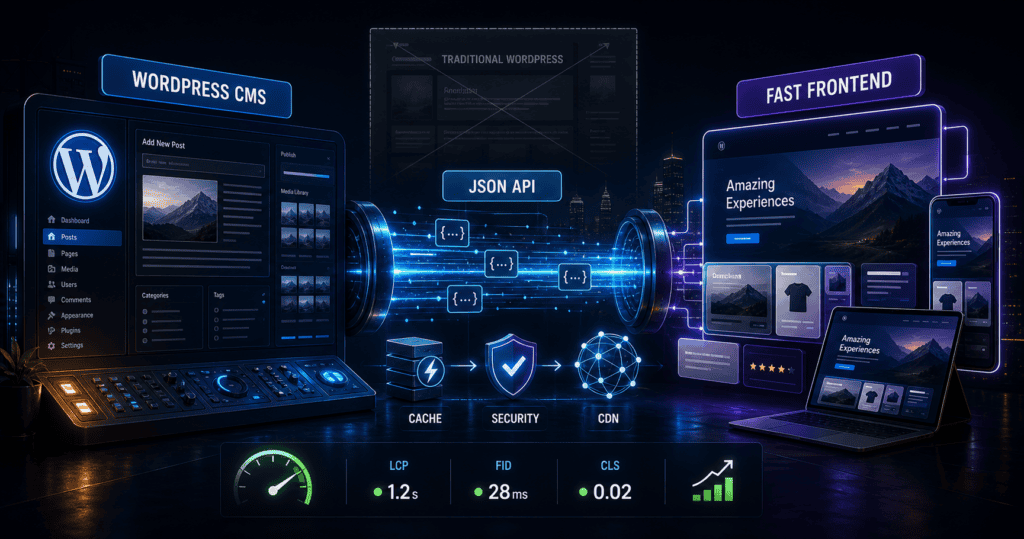
Why Headless WordPress Is the New Industry Standard
WordPress powers 42.2% of the web but was built for blogs. Why headless WordPress is the new standard for blazing fast pages and custom UX.
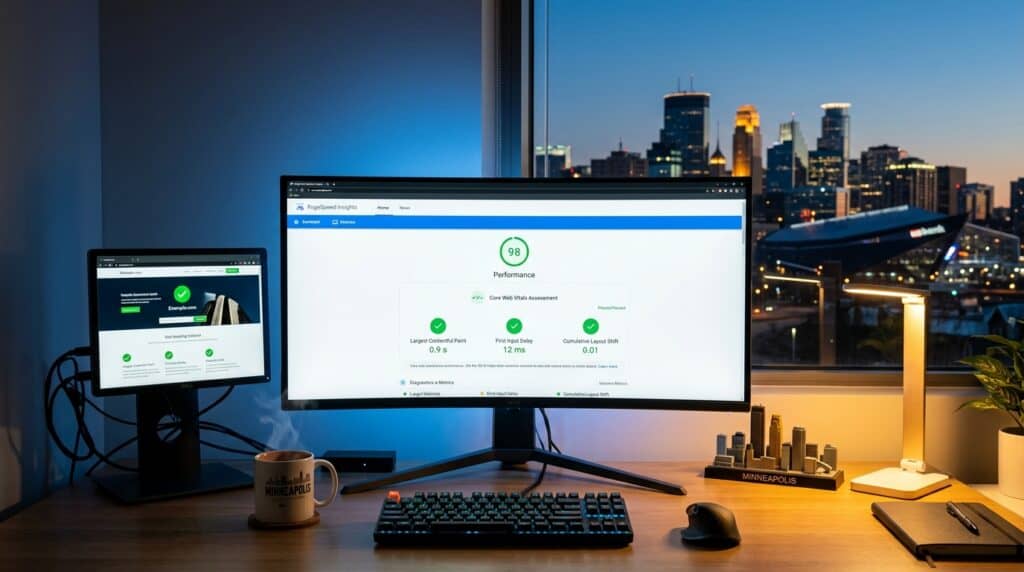
Core Web Vitals Explained: What Minneapolis Business Owners Need to Know
Google uses Core Web Vitals as a ranking factor. Here is what they measure and how to pass.

Minneapolis SEO in 2026: Reader’s Guide (Costs, Timelines, Realistic Results)
A reader’s guide for Minneapolis businesses considering SEO in 2026. Realistic costs, timelines, results to expect, and how to spot...
Minneapolis Made
Minneapolis, MN 55402
Service Area
Custom web application development for small businesses across the entire 7-county Twin Cities metro: Hennepin, Ramsey, Dakota, Anoka, Washington, Scott, and Carver counties.
Where we work in the Twin Cities
Headquartered in downtown Minneapolis. Dedicated landing pages for the suburbs we work in most often.
Plus Wayzata, Saint Louis Park, Richfield, Hopkins, and the broader 7-county Twin Cities metro on a project basis.