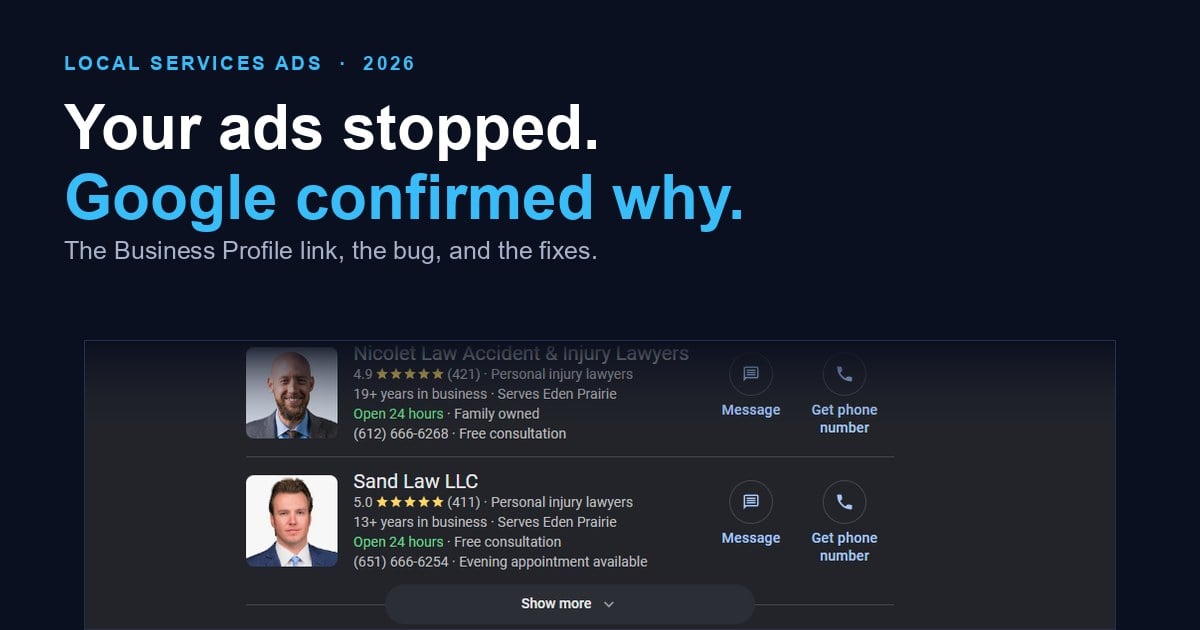
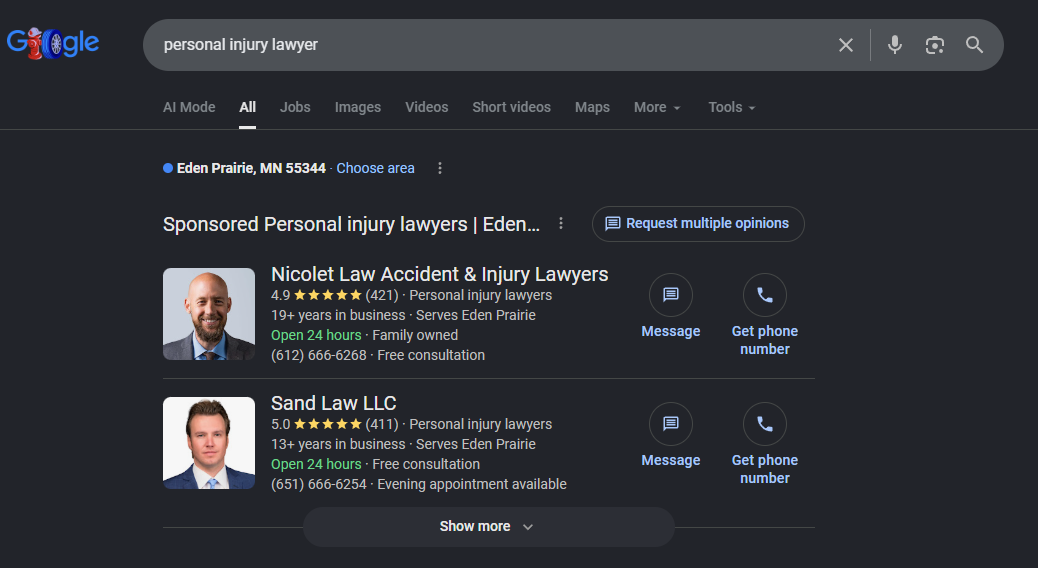
If your Local Services Ads stopped running, your leads got worse, or your agency suddenly cannot manage your account, you are not imagining it. Four things changed between July 2025 and now, and the one nobody warned you about is that LSAs depend on your Google Business Profile in a way that breaks quietly.
This is a troubleshooting guide first and an explainer second. Each section opens with the symptom you are actually seeing.
Key Takeaways
- Ads stopped with no warning? Check the Business Profile link before anything else. A licence renewal or reverification can sever it, and Google's own fix is to unlink and relink.
- Cannot add users? Known defect in the Account Access tab. Use the Google Ads path instead.
- Leads gone bad? Google removed the two credit categories that used to cover mismatches. Filtering now has to happen in settings.
- Turning off job types does not stop leads. Google says so explicitly. Only pausing does.
- The dashboard is being retired. Export your reports before your migration date or lose them permanently.
Why did my Local Services Ads stop running?
Before you check your budget or your bid, check whether your Google Business Profile link is still intact. This is the failure mode almost nobody anticipates, and it is currently hitting advertisers who changed nothing at all.
The signature looks like this. An email arrives saying your ad has stopped appearing, blaming "a data mismatch between your linked Google Business Profile and your Local Services Ads." In your account, Business Verification flips from Complete to In Progress. It still shows the correct profile. There is no button to press, no way to restart the check, and every field matches when you compare them side by side.
Advertisers reporting this on the Local Search Forum at the end of August 2026 described exactly that, including one whose ads sat paused for two and a half days while phone support confirmed they had heard of other cases but had no access to fix it. A second advertiser in the same thread traced their break to a licence renewal: they renewed, and the profile came unlinked somewhere in the process. Support escalated and told them it was a widespread issue.
Google has since confirmed it. On 1 September 2026, Google Ads Liaison Ginny Marvin responded to the complaints publicly: "We identified a bug and are actively working to resolve it." She added a detail worth holding on to, which is that "this is unrelated to the migration." If your link broke, it was not because your account was being moved to Performance Max. It was a defect, and Google knows about it.
That same week another advertiser reported the full shape of it: an account that had run for years unlinked over a weekend, no visibility of the LSAs inside any associated Google Ads account, and intermittent errors just accessing the platform. He got it relinked by contacting support, which is the useful part. Front-line support could not fix the verification-stuck cases, but a straightforward unlink can be repaired by asking.
What actually causes it
Anything that touches Business Profile verification can sever the link. A licence renewal. A reverification. An address change. A service-area business losing the address it used to display. The LSA side does not warn you first, and once the link breaks your ads stop.
That dependency is about to tighten rather than loosen. Under the Performance Max migration, Google Ads runs a daily sync from your Business Profile, and Google states that significant updates to your business name or physical address "will trigger a standard verification review… which typically takes 24 to 48 hours, during which your campaign may temporarily pause."
The fix, in Google's own words
Three practical points are buried in that. Select the correct business group, which is where agencies and multi-location operators go wrong, because the right profile under the wrong group relinks to nothing useful. Fix the address in the Business Profile before relinking, not after. And allow 24 to 72 hours to sync, so you do not conclude it failed and start over on day one.
What to do before it happens to you
- Do not schedule licence or insurance renewals, address edits or reverification during a period you need leads. The link is most fragile exactly when the profile is being re-checked.
- Screenshot your Business Verification status while it reads Complete. If it flips, you will want the before.
- Expect front-line support to be unable to help. In the August cases the escalation route was the Advanced Verification form, and the agent was not certain that was even the right team.
- If you manage this for clients, establish and test access before you need it rather than on the day something breaks.
Why can I not add users to my account?
Because the Account Access tab has been failing to load, leaving administrators unable to add or remove anyone. Len Raleigh reported it publicly in May 2026, writing that the tab "has been down since at least May 1. Admins are unable to add users to LSA," and Anthony Higman confirmed it was affecting every account he manages.
The workaround Raleigh published is to bypass the Local Services path entirely: use ads.google.com/aw/accountaccess/users rather than ads.google.com/localservices/accountaccess. It has not worked for everyone, and Barry Schwartz reported the alternate URL erroring for him too.
Treat access as something to secure early. It is the same surface being rebuilt by the migration into Google Ads, and it has been unreliable for months.
Why did my leads get worse?
Partly because Google removed the two refund categories that used to absorb bad leads. The lead credit policy now states plainly that Google "no longer supports credits for 'job type not serviced' and 'geo not serviced' leads."
Those were the two that mattered. A roofer charged for a gutter enquiry filed job type not serviced. A firm charged for a caller three counties out filed geo not serviced. Both routes are closed, which moves the work from disputing after the fact to configuring before the charge.
The gotcha that catches everyone
The obvious response is to switch off job types you do not want. Do that, but know its limit, because Google states it directly:
The reason is a separate setting most advertisers have never opened. Google automatically opts every advertiser into their industry's general category, so your ad can serve on "plumber near me" or "lawyer near me" with no specific service in the query at all. Job types do not govern those. Broad search does.
How to turn off broad search
It is two clicks and almost nobody knows it exists. In the Local Services lead inbox, open the menu, choose Profile & budget, and on the Settings card uncheck broad search. Google warns plainly that this will reduce lead volume, because you stop appearing for category queries. That is the trade: fewer leads, better matched.
Three things to know before you flip it.
- Check what broad search is already costing you first. In your lead inbox, open Leads, set the "All search intents" filter to Category, and look at the Job Type column. A dash rather than a job type marks a broad category lead. You can also filter Total lead spend and Charged leads by Category versus Direct Business in Reports. Do that before deciding, because the answer differs enormously between accounts.
- Law firms have a second toggle. Opting out of broad search stops you serving on general queries for the practice areas you chose. To also stop appearing for "lawyer near me" style queries with no practice area at all, go to Profile & Budget, click Job Type, and switch off "Appear in general law searches." More on the channel mix for firms in law firm PPC.
- It is account-wide, not per vertical. If you run plumbing and HVAC in one account, disabling broad search kills general category queries for both. If you want it off for one and on for the other, you need separate accounts.
So the honest sequence is: narrow job types to change which specific searches trigger you, then decide separately whether broad search is earning its keep. And if you need leads to stop entirely, pause, because neither setting takes you to zero.
The rest of the checklist
- Set the service area to where you are profitable, not where you are willing to drive. A geographic mismatch is now an unrecoverable cost rather than a dispute.
- Align ad hours with the hours you genuinely answer. Running ads into unstaffed hours means paying for the lead and taking a responsiveness penalty for missing it.
- Do not use a call tracking number. Google requires that "your business phone number must not be a tracking number," and changing that number requires a support agent regardless.
- Reconcile monthly, not weekly. Invalid and low-quality leads are still credited automatically, usually within 30 days, and the original charge stays on the invoice. You are looking for a credit against a future balance, not a refund line.
- Check your exclusions. There are no lead credits at all for health care verticals, tax specialists, or advertisers in EMEA.
Why does my position keep moving?
Some of it is deliberate. Google states that ad ranking "optimizes for the overall health and diversity of the Local Services Ads ecosystem, and provides sufficient opportunity for all providers." Placement is not a pure merit order, and checking your position four times a day will show you movement that is not a fault in your account.
Note what Google does not say, because it matters when someone tells you they know the cadence. There is no stated frequency, no trigger, no schedule. Diversity is an objective inside the auction rather than a shuffle applied afterwards, so "when does Google rotate" has no documented answer.
The best public measurement is older than most people realise. In October 2023 Joy Hawkins of Sterling Sky ran hourly rank scans for four days and found that across 124 scans Google rotated ten different advertisers through the top spots, while desktop dropped from three ad slots to two and mobile showed the same top two in the same order only 11% of the time. That is a named method with a real sample, and it points to rotation operating within hours. It is also three years old, so treat it as evidence that rotation is real and fast rather than as a current benchmark.
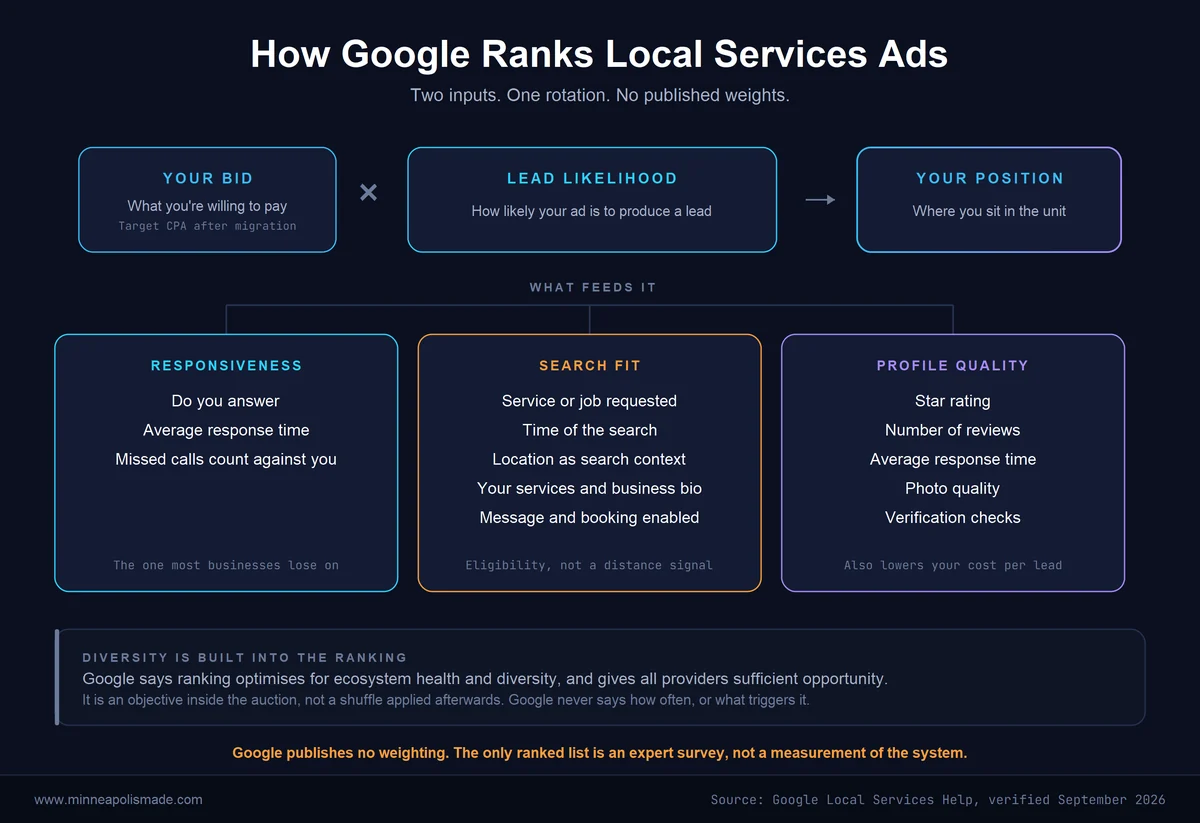
One line in that list is stated plainly by Google and almost never acted on: profile quality is not only a ranking lever, because higher quality profiles "may rank higher and may also pay lower costs per lead." Reviews and photos move your price, not just your position. Most advertisers treat review-building as a visibility project and never notice it is also a discount.
The closest thing to a weighting anyone publishes
Google gives no weightings, but it is not the only source. Whitespark's 2026 Local Search Ranking Factors, published 6 November 2025, surveys local search practitioners and scores LSA factors into a ranked order. It is an expert survey rather than a measurement of Google's system, and it should be read that way, but it is the best public attempt that exists.
| Rank | Factor | Score | In Google's own documentation? |
|---|---|---|---|
| 1 | Budget & bidding | 32 | Yes |
| 2 | Reviews | 31 | Yes |
| 3 | Service selection | 23 | Yes, as business relevance |
| 4 | Response times | 22 | Yes |
| 5 | Being verified | 20 | Yes, as verification checks |
| 6 | Proximity to searcher | 15 | No |
| 7 | Job acceptance rate | 15 | No |
| 8 | Ad hours | 11 | No |
| 9 | Primary category | 9 | No |
The last four are the interesting ones, because practitioners rate them and Google never names them.
- Job acceptance rate. Whether you take the jobs you are offered, not just whether you answer. Declining work you were shown for appears to cost you visibility.
- Primary category. Your Google Business Profile primary category, which is now doubly relevant given the profile is the system of record and the link that breaks.
- Ad hours as a ranking input rather than only a budgeting choice.
- Proximity to searcher, which sits awkwardly against Google's own wording and is worth being honest about.
The proximity row needs unpacking, because both sides are describing something real. Google documents location as eligibility, not as ordering. Its geography help page says ads show to people "estimated to be located within a particular geographic area (cities or postal codes) at the time of their search," and separately to people who name your area in the query from anywhere, so someone in Los Angeles searching "repair toilet San Francisco" sees San Francisco ads. That is binary and it works at city or postal-code granularity. It is not a radius and not a distance measurement. In the ranking documentation, location appears once, inside the context of the search, beside the service requested and the time of day.
So Google never describes distance from the searcher as something that orders the ads, and it never says it is not. What it does describe explains the observation on its own: if you only appear when the searcher's city or postal code sits inside your service area, every business that searcher sees is already local to them. The set is filtered by geography before ranking starts, which from the outside looks exactly like proximity sorting without any distance signal existing in the order. That is not proof there is no distance factor. It is a sufficient explanation that does not need one.
The practical upshot is the same either way, and it is more actionable than the debate. Your service area selection is the proximity lever. It is binary, you control it, and it decides which searches you are even in the running for.
Darren Shaw adds one nuance from his own accounts that Google does not document anywhere: review recency appears to matter for LSA visibility, not only rating and volume. If that holds, a business coasting on two hundred reviews from three years ago is weaker than the count suggests, and a steady trickle beats a burst.
Worth noting on the value question too: Whitespark reports personal injury clients who rank well in both local and organic results and still drive 70% of their cases through Local Services Ads. Ranking organically does not make the ad unit redundant.
What actually demotes a Local Services Ad?
There is no definitive list, and anyone who hands you one has written it themselves. Google publishes ranking factors but has never published a demotion or penalty list for Local Services Ads the way it does for some other products. What follows is everything that is documented, grouped by how well evidenced each item is, so you can see which parts are Google's word and which are not.
Documented by Google as lowering your placement
- Missed calls. Google states directly that missed calls may negatively affect your responsiveness, which feeds lead likelihood.
- Slow average response time, named separately from responsiveness as a profile quality input.
- Low rating or few reviews. Both named. This is also the channel through which a review removal becomes a ranking loss.
- Missing or poor images. Google says higher quality profiles, "including those with images, may rank higher."
- Incomplete verification checks, listed under profile quality.
- Message and booking leads switched off, which reduces the ways a customer can reach you and therefore how likely your ad is to produce a lead.
- Not being fully onboarded. Pre-badge advertisers can run while completing verification, but Google states those listings appear below providers who have finished the process. That is an explicit, documented demotion.
- A second location in the same area. Where multiple locations serve one geography, Google shows "only the highest ranking ad," so your other profiles are suppressed rather than ranked.
- A lower bid, which remains one of the two named auction inputs until manual bidding is removed at migration.
Documented by Google as stopping your ads outright
- The Google Business Profile link breaking, whether through a licence renewal, reverification, address change or the confirmed bug.
- A significant business name or address change, which triggers a verification review of 24 to 48 hours during which the campaign may pause.
- Failing screening, which carries a 30-day wait to reapply and 180 days after a second denial.
Reported by practitioners, not documented by Google
The four factors Google never names, from the survey table above, are the inverse demotions: a poor job acceptance rate, stale reviews, ad hours that do not match demand, and the wrong primary category. Treat them as informed observation rather than policy.
The list nobody connects: Business Profile problems that now reach your ads
This is the one worth your attention, because it did not used to matter and now does. Your Local Services Ads depend on the linked Business Profile. If that profile is suspended, your ads lose the thing they are attached to. So the suspension risks below are not local SEO trivia any more, they are ad availability risks.
Ranked by the same Whitespark survey, from highest risk down: an address that is a PO box, mailbox store, virtual office or otherwise false; association with a suspended Google account; reports of violations on the profile; association with other suspended listings; a hacked site or malware; reports of review gating; reports of fake reviews; keyword stuffing in the business name; and multiple profiles sharing one phone number.
If your profile is already suspended, start with what to do about a suspended Google Business Profile, because the ads cannot come back before the profile does.
Two of those deserve singling out for anyone running Local Services Ads. Review gating and fake review reports sit in the same policy family as the misplaced-review problem above, so a sloppy review process is now a route to losing the profile your ads hang off. And multiple profiles sharing a phone number is the exact configuration multi-location operators drift into, which pairs badly with the rule that only your highest ranking ad shows in a shared area.
Unique InsightThe reason no definitive list exists is worth stating rather than glossing. Google documents what helps and stays quiet on what hurts, which leaves a vacuum that gets filled with confident invention. What can be said honestly is that the demotion surface got larger in 2025 without Google framing it that way. Before the review migration and the Business Profile dependency, an LSA account was a fairly self-contained thing you could fix from inside the LSA dashboard. Now the failure modes with the biggest consequences, suspension and unlinking, both live somewhere else entirely.
Why did my review count change?
Because on 11 July 2025 Google moved LSA review management into Google Business Profile and re-verified every existing review on the way across. Its notice to advertisers said reviews would be fully managed from Business Profile rather than the LSA account, that existing reviews would be checked against Maps policies, that non-compliant ones "may no longer appear," and that rating and review counts may change.
They changed in both directions. Some businesses saw counts jump as LSA reviews merged in; others lost reviews that had sat on their profile for years. Google has never published an aggregate figure and we are not going to invent one.
The reason it stings is the ranking link. Google states that star ratings and number of reviews affect how a business ranks in Local Services Ads, so a migration that removes reviews is a ranking event, not a cosmetic one.
Going forward, Business Profile is the system of record. Request reviews using the Business Profile review link rather than the LSA dashboard, work from the count you have, and clean up any incentivised or bulk solicitation on your side, since that is exactly what a policy re-check removes.
Multi-location: why funnelling reviews to one profile now costs you
This is the trap that got quietly more expensive in July 2025, and it catches franchises, multi-branch trades and law firms with satellite offices.
The practice is common enough to feel harmless. A customer served out of your Brooklyn Park branch gets a review request pointing at the Minneapolis profile, because Minneapolis is the one you are trying to lift. Google's Maps policy is not ambiguous about it. Prohibited content includes "content that is not based on a real experience or does not accurately represent the location or product in question," and the merchant-side rule is stated separately: you may not "solicit or encourage the posting of content that does not represent a genuine experience."
Note where the violation sits. It is not only the reviewer who is offside. Asking is the breach. And funnelling reviews to a single profile also produces exactly what the Rating Manipulation policy describes as "content exhibiting unusual volumes or patterns of review contributions that are indicative of efforts to manipulate a place's rating."
Unique InsightHere is the part that changed, and why this belongs in an LSA article rather than a Business Profile one. Before 11 July 2025, LSA reviews lived in the Local Services account and Business Profile reviews lived separately. A misplaced review was a Business Profile problem. Since the migration, Business Profile is the system of record for LSA reviews, and Google states that star ratings and number of reviews affect your Local Services Ads ranking. So a review-request habit that violates Maps policy is no longer a reputation risk sitting off to one side. It is now pointed directly at the pool that feeds your ad placement. The same migration re-verified every existing review against these exact policies, which means misplaced historical reviews were precisely the kind most likely to have been stripped out on the way across.
There is a second reason the funnelling does not even work. Google's ranking documentation states that "if your business has multiple locations that serve the same geographic area, Local Services will show only the highest ranking ad in response to a user's query." Concentrating reviews on one profile to dominate a shared market does not get you more slots. It gets you one slot, the same as before, with a policy exposure attached.
What to do instead
- Match the review request to the location that did the work. Use each profile's own review link, generated from that profile, not a single shared link for the whole company.
- Audit your CRM or intake automation. This usually breaks at the template level, where one review URL was hard-coded years ago and every branch has been sending customers to it since.
- Do not ask staff for review counts or specific content. Google separately prohibits merchants "requesting that staff solicit a certain number of reviews" or reviews that "include specific content, including content that identifies a staff member." Naming your technician in the ask is a violation, not a nice touch.
- Spread the effort rather than concentrating it. If two locations serve one area, only the stronger ad shows anyway, so the marginal review is worth more on the weaker profile in a market you are not yet winning.
- Keep it steady. Whitespark's Darren Shaw reports review recency as a factor in LSA visibility from his own accounts, which Google does not document. A consistent trickle is safer on policy and, if he is right, more effective than a burst.
Related: Google Business Profile optimisation and how to handle a bad review.
Ads down and support going in circles?
We will work the Business Profile link, the verification status and the escalation path with you. We do this for businesses anywhere in the country.
What happened to my Google Guarantee badge?
Google retired it. On 20 October 2025 the Google Guaranteed, Google Screened and License Verified by Google badges were replaced by a single blue Google Verified badge, and Google confirmed the new badge would replace those programmes along with the Money Back Guarantee.
The badge swap was automatic, so your ad updated itself, and Google states plainly that "Local Services Ads ranking won't be affected by this change." If your placement moved around the changeover, the badge was not the cause.
Where it shows is worth reading carefully, because it is often misreported. Google says the badge "will display on the Local Services Ads profile, and it may dynamically appear on other surfaces where it adds consumer value." So it is not absent from your profile. What is conditional is whether it follows you elsewhere. Do not plan around it appearing everywhere a customer might meet you.
Two consequences were not automatic.
The first is that the money-back guarantee is gone. Google set a hard boundary on the wind-down: reimbursement could only be requested for services booked through Local Services Ads before 7 December 2025, and requests had to be filed within 30 days of the service being completed. If you have a customer still expecting that remedy, it has closed. For years the pitch was that Google would reimburse a dissatisfied customer up to a lifetime cap, and that was a genuine closing argument against a bigger competitor. It no longer exists, so a sales script leaning on it needs rewriting rather than rebadging.
The second is that every place you put the old badge yourself still says Google Guaranteed. Homepage, footer trust bar, estimate template, van livery, email signature. Nothing breaks and no warning fires, so it sits there advertising a discontinued programme and implying a refund nobody will honour. Search your own site for the phrase, including image filenames and alt text.
If you are applying for the first time, note that screening denials escalate: 30 days before you can reapply after a first denial, and 180 days for every attempt after a second. An application that fails twice over a lapsed insurance certificate costs half a year of eligibility.
The eligibility list got much longer in August 2026
If you looked at Local Services Ads a year ago and decided your industry was not covered, look again. In August 2026 Google broke its category list into far more granular entries and pushed into industries LSAs were not previously associated with. Restaurants now run from American, Chinese and Italian through pizza, sushi, steak houses and vegan. Automotive gained Auto Glass Repair, Brake Shop, Car Battery Store, Car Inspection, Oil Change, Tire Shop and Transmission Shop as separate categories rather than one lump for auto repair. Beauty expanded too.
Google told Search Engine Land the specificity is deliberate, so a transmission shop can identify itself as a transmission shop rather than compete as general auto maintenance. If your service was previously buried inside a broad category, this is the moment to check whether a precise one now exists for you.
One catch worth knowing before you get excited: the Google Verified badge is not available in the auto, beauty and dining categories. Google widened that exclusion at the same time it widened the category list, so these industries can run Local Services Ads but cannot earn the trust mark that goes with them.
Pre-badge ads: running before you are fully verified
Also new in the same documentation update, and genuinely useful if you are starting out. Businesses that have passed preliminary checks can begin receiving leads while they finish the remaining verification requirements. Those listings appear below providers who have completed full onboarding, so you are trading placement for a head start rather than jumping the queue. If you are waiting on an insurance certificate or a licence check, you may not have to sit idle.
What does "contacted multiple businesses" mean on my leads?
It means the enquiry arrived through Request multiple opinions, where one consumer messages several providers at once. Google formally announced it on 12 November 2025, though Anthony Higman has noted it ran for roughly two years before that acknowledgement.
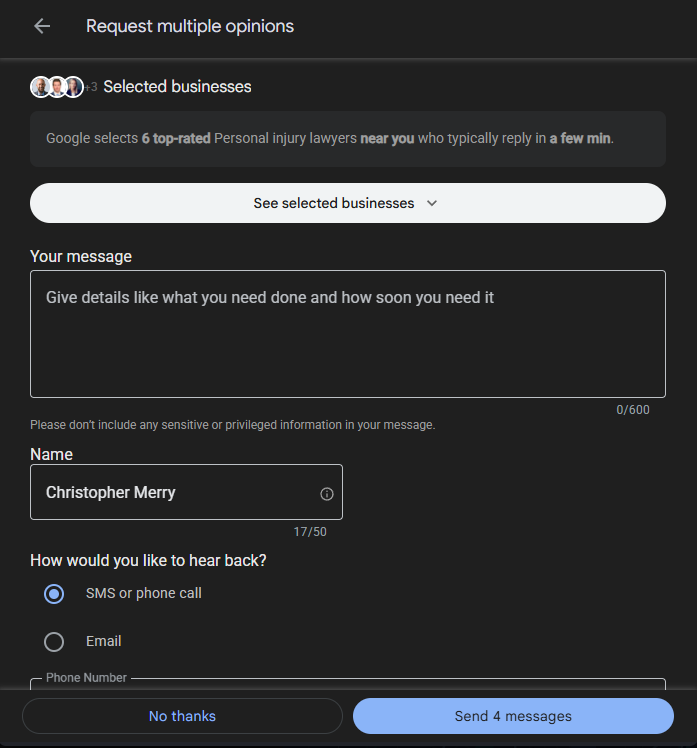
Read that grey panel again, because it is the operationally important part. Google is telling the customer to expect a reply in minutes, and it sets that expectation before you know the lead exists. From the moment they send, you are racing competitors who received identical text.
Speed therefore stops being a service nicety and becomes the whole contest, and it compounds because Google names both responsiveness and average response time as ranking inputs. Slow replies lose you the job and reduce how often you are shown next time.
On cost, every recipient is charged. Google has not said so outright, and this is a deduction rather than a quote, but you do not offer "higher discounts for leads where the consumer contacts multiple businesses" unless those leads are billed, and practitioners tracking the feature report the same. Google replaced the old flat 50% message-lead discount with value-based pricing that weighs booking likelihood, service type and whether the consumer contacted multiple businesses.
Unique InsightThere is a bind here with no clean answer. Only businesses opted into message leads take part in fan-out, so you can avoid competing against four firms for one enquiry by switching message leads off. But Google names communication options as a ranking input, noting that enabling message and booking leads gives customers more ways to reach you. Turning them off to dodge the fan-out costs you placement. No configuration gets you both, and Google never connects those two statements. Which way to lean depends on your close rate in head-to-head comparisons, so track the leads labelled "contacted multiple businesses" as their own cohort and work out cost per booked job on them alone. A blended figure hides this completely.
What do Local Services Ads cost?
Home services averaged $53 per lead in February 2026 across 888 contractors and $6.72 million in tracked spend (SearchLight Home Services LSA Benchmark). The blended figure hides a real spread, and it does not travel outside home services.
| Trade | Cost per lead | Accounts in sample | Consumer search CPC |
|---|---|---|---|
| Electrical | $39 | 112 | $22.88 |
| HVAC | $51 | 409 | $40.16 |
| General / all trades | $54 | 464 | — |
| Plumbing | $57 | 230 | $38.80 |
| Drain & sewer | $59 | 23 | $39.37 |
| Water heater | $71 | 2 | $32.72 |
| Blended average | $53 | 888 | — |
Read the sample column before you trust a row. The water heater figure rests on two accounts and $15,000 of spend; drain and sewer on twenty-three. Those are anecdotes with a decimal point. HVAC, plumbing, electrical and the general line carry the overwhelming majority of the spend and are the rows worth planning against. Most articles republish all six with equal confidence and no sample sizes at all.
Related: how to set a Google Ads budget, which is the comparison most advertisers are actually making.
The downstream numbers matter more than the lead price anyway. The same benchmark reports a 43.9% book rate, a $233 cost per paying customer, an average ticket of $1,826 and a 7.84x closed return. A $59 lead that books beats a $39 lead that does not.
Why there is no figure for legal, real estate, financial services or wellness
Because no benchmark of comparable rigour exists publicly. The most circulated legal figure sits on a page that no longer resolves. The next most quoted set carries a median legal cost per lead of $126, but its observation window is Q1 2023 to Q4 2024, it states that it combines "observed, modeled, and cited data," and the sources it names are general marketing reports rather than anything measuring LSA leads. A pre-2025 modelled number cannot describe a product Google rebuilt in 2025.
What is measurable is competitive intensity in consumer search, which is the pressure setting lead prices.
| Vertical | Median consumer CPC | Range across queries | Most expensive query |
|---|---|---|---|
| Home services | $38.80 | $11.54 – $40.16 | hvac repair near me |
| Legal | $27.67 | $6.81 – $176.26 | personal injury lawyer |
| Financial services | $22.52 | $10.20 – $22.52 | financial advisor near me |
| Real estate | $11.50 | $11.21 – $11.50 | realtor near me |
| Wellness | $9.55 | $1.20 – $9.55 | chiropractor near me |
Google Ads cost per click for representative consumer queries, United States, pulled September 2026. A click is not a lead, so treat this as relative pressure rather than a price list.
Look at the legal range rather than the legal median. It runs from $6.81 for estate planning to $176.26 for personal injury, a twenty-six-fold spread inside one vertical, against roughly four-fold for the trades. That is why a single legal cost per lead is meaningless in a way a home services one is not. If someone quotes you a number without naming your vertical, your practice area and their sample size, it is decoration.
What happens when the dashboard is retired?
From 1 August 2026 Google began migrating Local Services Ads into Google Ads as a specialised Performance Max campaign type with pay-per-lead goals. Pay-per-lead billing, Search and Maps placement, keywordless targeting, your leads, your verification status and your badge all carry across. Despite the name, these campaigns do not expand into Display, YouTube or Gmail.
Four things change, and one has a deadline.
- Export your reports first. Historical performance does not transfer. Google offers a download at ads.google.com/localservices/gaferedirection and advises screenshotting them if you need them immediately. You get a 14-day email warning and a 7-day reminder. Miss it and the record of what this channel cost and returned is gone.
- Manual bidding ends. Setting a maximum cost per lead is no longer supported, and vertical-level Target CPA becomes a single campaign-level target. If you ran different targets per vertical, you now need separate campaigns.
- Weekly budgets become daily averages, calculated by dividing your weekly figure by seven, with monthly spend capped at the daily average times 30.4.
- BBB callouts are deprecated. Pick at least six other structured callouts to replace that trust signal.
For trades specifically, the channel mix around this sits in home services marketing.
One more for agencies: you cannot yet create new pay-per-lead campaigns inside Google Ads. New setups still go through g.co/localservices until campaign creation arrives.
Are Local Services Ads still worth running?
For most eligible service businesses, yes, provided you answer the phone. The placement outranks everything on the page and you pay per conversation rather than per click, which is a favourable trade when your close rate on inbound calls is decent.
They are a poor fit in three situations. If your intake is unreliable, the model charges you for the call and then lowers your placement for missing it. If your margins cannot absorb a mismatched lead you can no longer dispute, the removal of those two credit categories moved real risk onto you. And if your vertical has no lead credits at all, you are running without the safety net the product is usually sold with.
If you want out, pause rather than delete. Pausing preserves your profile, reviews and verification status, and verification is the slow part of coming back. A paused listing also drops below the paid listings rather than disappearing, so depending on your market you may still pick up some leads while paused, without being charged.
One underused feature while you are still running: calls generated through Local Services Ads are recorded and playable in the dashboard. If you have never listened to how your team handles an inbound call, that recording is the fastest audit of the responsiveness factor you are being judged on.
Get a straight read before you spend more
Job types, service area, ad hours, the Business Profile link. We work at $85 an hour with no packages, anywhere in the US, and we will tell you if the right answer is to leave it alone.
Frequently Asked Questions
What are Local Services Ads?
Local Services Ads are pay-per-lead ads that appear at the very top of Google Search and Maps for service businesses. Google charges for the contact rather than the click, so you pay when someone calls, messages or requests a booking. They require background and licence screening, and are limited to eligible verticals.
Why did my Local Services Ads stop running?
Check the Google Business Profile link first. A licence renewal, reverification or address change can sever it, which stops your ads and flips Business Verification to In Progress with no action available. Google's documented fix is to unlink and relink the profile, selecting the correct business group, then allow 24 to 72 hours to sync.
Does turning off job types stop my leads?
No. Google states that deselecting all job types will not stop leads on the overall category, and that you must pause your ad to stop receiving all leads. Narrowing job types does change which searches trigger your ads, so it remains worth doing, but it cannot take you to zero.
Can I still dispute a bad Local Services Ads lead?
Partly. The automated system still credits invalid or low-quality leads, usually within 30 days, with the original charge remaining on your invoice. But Google no longer supports credits for job-type-not-serviced or geo-not-serviced leads, and credits are unavailable entirely in health care verticals, for tax specialists, and in EMEA.
What causes a Local Services Ad to be demoted?
Google names missed calls, slow response times, low ratings or review counts, missing images, incomplete verification, and disabled message or booking leads. Not being fully onboarded also places you below verified providers. Google has never published a definitive demotion list, so anything more specific is practitioner observation rather than policy.
Can a Google Business Profile suspension stop my Local Services Ads?
Yes, and this is newly consequential. Your ads depend on the linked Business Profile, so suspension risks such as a false or virtual address, review gating, fake review reports or keyword stuffing in the business name now threaten ad availability, not just local pack visibility.
Can I ask a customer to review a different location?
No. Google's Maps policy prohibits content that "does not accurately represent the location," and separately bars merchants from soliciting content that does not represent a genuine experience, so the request itself is the violation. Since July 2025 those reviews also feed your Local Services Ads ranking, so removal now costs you placement as well as reputation.
Why can I not add users to my Local Services Ads account?
A known defect has left the Account Access tab failing to load, with administrators unable to add users. The workaround reported by practitioners is to use ads.google.com/aw/accountaccess/users rather than the Local Services account access URL, though it has not worked reliably for everyone.
Is Google Guaranteed still available?
No. Google retired the Google Guaranteed badge on 20 October 2025, along with Google Screened and License Verified by Google, replacing all three with a single Google Verified badge. The money-back guarantee that accompanied it was discontinued at the same time.
How do I get Google Guaranteed?
You cannot. The programme ended on 20 October 2025 and was replaced by the Google Verified badge, granted automatically once you pass Local Services Ads screening. There is nothing separate to apply or pay for, and the money-back guarantee that made the old badge valuable no longer exists.
What does "This consumer has contacted multiple businesses" mean?
The enquiry came through Request multiple opinions, where one consumer messages several providers at once. You are still charged, though Google applies a value-based discount and says fan-out leads may carry a higher one. Only businesses opted into message leads receive them.
How fast do I have to reply to those leads?
Faster than the competitors who received the same message. Google tells the consumer in the request panel that the selected businesses "typically reply in a few min," setting that expectation before you know the lead exists. Response time and responsiveness are also named ranking inputs, so a slow reply costs the job and future placement.
How much do Local Services Ads cost?
Home services averaged $53 per lead in February 2026 across 888 contractors, ranging from $39 for electrical to $59 for drain and sewer. No comparable public benchmark exists outside home services. You pay per lead rather than per click, and price varies widely by vertical and market.
Why do my rankings keep moving?
Some movement is deliberate. Google states that ad ranking optimises for the overall health and diversity of the ecosystem and gives all providers sufficient opportunity. It never states a cadence or trigger. Beyond that, responsiveness, review rating and count, average response time and profile completeness all feed your position.
Are Local Services Ads being discontinued?
No, but the standalone dashboard is. From 1 August 2026 Google began migrating Local Services Ads into Google Ads as a Performance Max campaign type with pay-per-lead goals. Billing and placement are unchanged, but manual bidding ends and historical reports do not transfer, so export them before your migration date.
What happens if I fail Local Services Ads screening?
You must wait 30 days to reapply after a first denial. If a second application is also denied, the wait becomes 180 days for every subsequent attempt. That escalation is why a speculative first application, submitted with a lapsed insurance certificate or a mismatched business name, is an expensive mistake.
How do I cancel or pause Local Services Ads?
Pause rather than delete, because pausing preserves your profile, reviews and verification status, and verification is the slow part of returning. Check your job types and service area before quitting, since most lead-quality problems are settings problems rather than a fault with the product itself.
Sources
- Google Local Services Help, Edit your ad or business information, retrieved 2026-09-07.
- Google Local Services Help, About ad rankings, retrieved 2026-09-07.
- Google Local Services Help, About Automated Local Services Ads lead credits, retrieved 2026-09-07.
- Google Local Services Help, Reviews and Ratings on Local Services Ads, retrieved 2026-09-07.
- Google Local Services Help, Business screening and verification requirements, retrieved 2026-09-07.
- Google Ads Help, Local Services Ads transition to Performance Max campaigns with pay-per-lead goals, announced 3 August 2026, retrieved 2026-09-07.
- Google, Google Verified makes it easier to find trusted local businesses advertising on Google, 20 August 2025, retrieved 2026-09-07.
- Local Search Forum, Google Business Profile link broke from Local Services Ads, 31 August 2026, retrieved 2026-09-07.
- Search Engine Roundtable, Google Working On Fixing Local Service Ads Bug, 1 September 2026, reporting Google Ads Liaison Ginny Marvin, retrieved 2026-09-07.
- Search Engine Roundtable, Google Local Services Ads Broad Search Details Added To Help Doc, 24 June 2026, retrieved 2026-09-07.
- Google Local Services Help, About reaching customers with your Local Services Ads, retrieved 2026-09-07.
- Google Local Services Help, Edit your industries, service areas, and job types, retrieved 2026-09-07.
- Search Engine Roundtable, Google Local Service Ads Account Access Not Loading For Advertisers, 6 May 2026, reporting Len Raleigh and Anthony Higman, retrieved 2026-09-07.
- Search Engine Roundtable, Google Local Service Ads Reviews Managed By Business Profiles, July 2025, retrieved 2026-09-07.
- Search Engine Roundtable, Google Local Service Ads Message Leads New Value-Based Pricing, 12 November 2025, retrieved 2026-09-07.
- SearchLight Digital, Google Local Service Ads Cost Per Lead by Trade, 1–28 February 2026, 888 contractors / $6.72M spend / 126,650 leads, retrieved 2026-09-07.
- Google Maps User Generated Content Policy, Prohibited & restricted content, retrieved 2026-09-07.
- Google Local Services Help, About Google Verified badge, retrieved 2026-09-07.
- Search Engine Land, Google expands Local Services Ads categories ahead of migration, Anu Adegbola, 24 August 2026, retrieved 2026-09-07.
- Whitespark, 2026 Local Search Ranking Factors, Darren Shaw, published 6 November 2025, practitioner survey, retrieved 2026-09-07.
- Sterling Sky, Google Just Made a Massive Change to Local Services Ads, Joy Hawkins, October 2023, retrieved 2026-09-07.
- Consumer search CPC figures: Google Ads keyword data via DataForSEO, United States, pulled 2026-09-07.