
Global search advertising will hit $218.3 billion in 2026, according to PPC Chief’s compilation of Statista data. That’s a staggering number. But here’s the question that actually matters: how much of that should come out of your budget? The answer isn’t a dollar figure you’ll find in a generic article. It’s a calculation based on your industry, your margins, and your growth goals. Most PPC guides hand you a range and wish you luck. This one gives you the formula.
Key Takeaways
- Average Google Ads CPC is $5.26 across all industries, up 12.88% year-over-year (WordStream, 2025)
- SMBs typically spend $1,000-$10,000/month and allocate 20-40% of their marketing budget to PPC (WebFX, 2026)
- Use the 4-variable formula: (Revenue Goal / AOV) x Target CPA = monthly budget floor
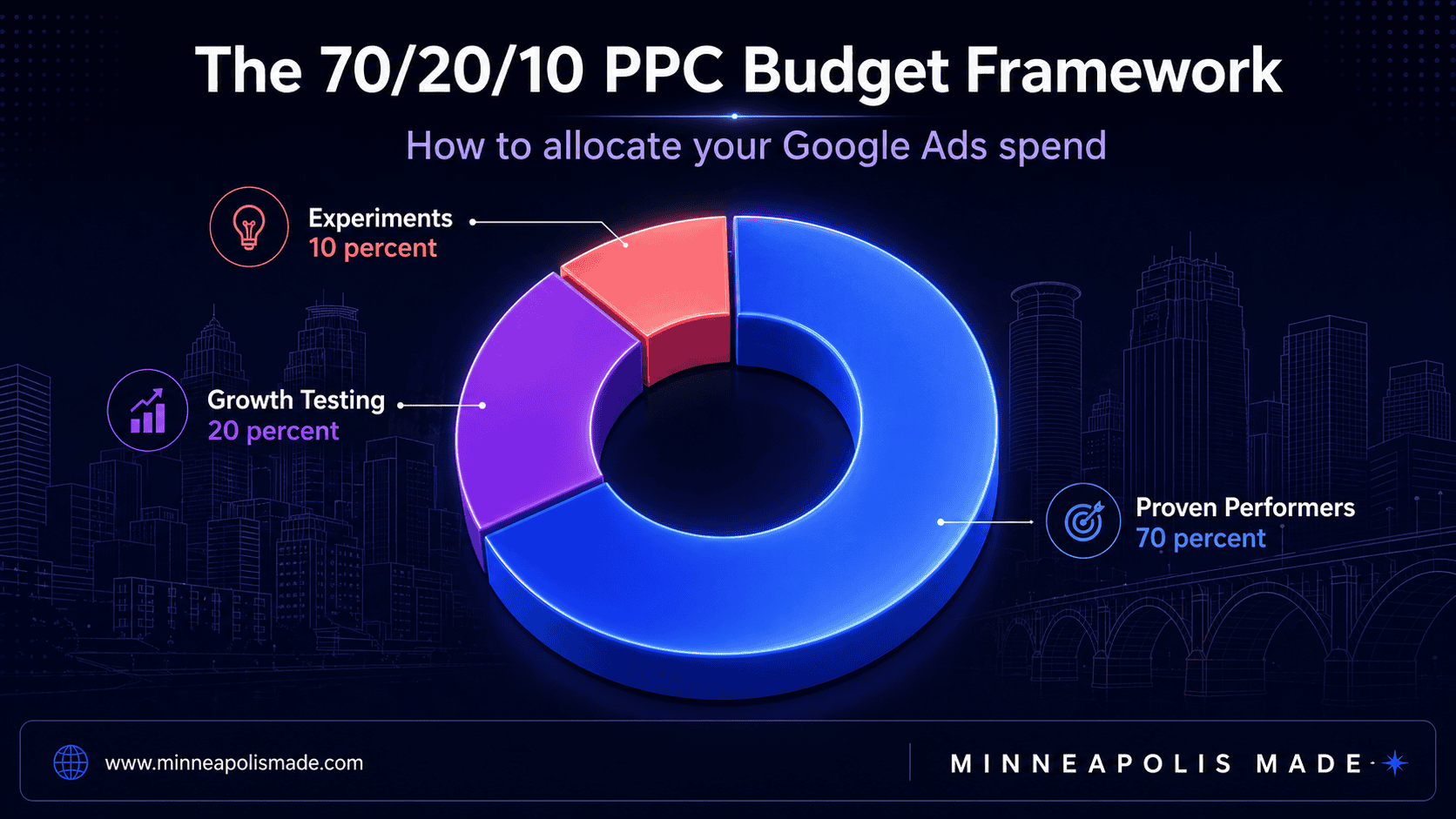
- Allocate 70% to proven campaigns, 20% to growth tests, 10% to experiments
- Budget an extra 20-30% for month one to cover Google’s AI bidding learning period
How Much Do Google Ads Actually Cost in 2026?
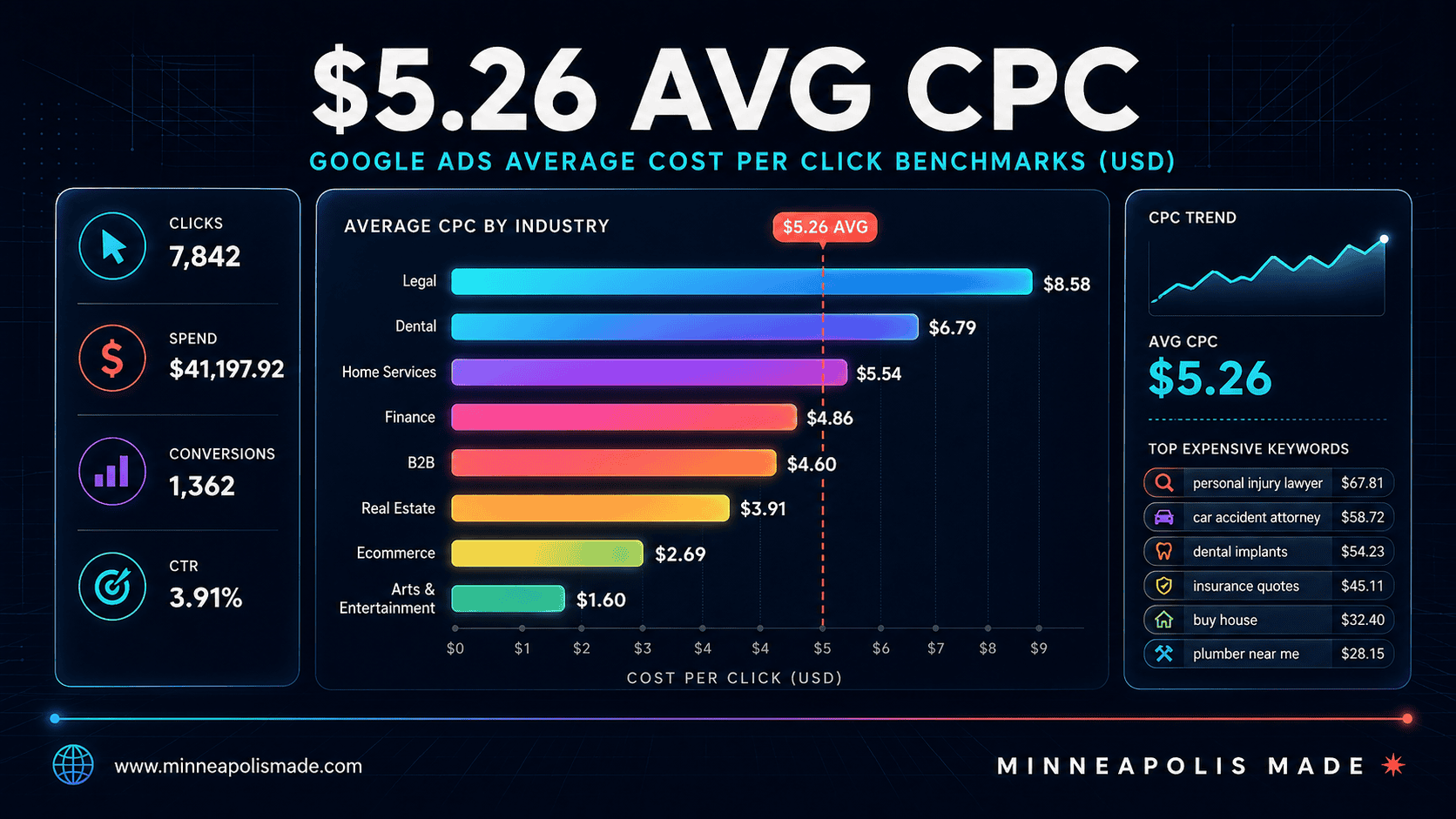
The average cost per click across all Google Ads industries is $5.26, up 12.88% from the prior year, based on WordStream’s analysis of 16,000 campaigns (2025). That single number hides enormous variation. A click in arts and entertainment costs $1.60. A click for a personal injury attorney costs $8.58. Your actual spend depends entirely on where you compete.
Google Ads operates on an auction system. You’re not buying clicks at a fixed price. You’re bidding against other advertisers for the same search queries. Your Quality Score, ad relevance, and landing page experience all affect what you actually pay. Two businesses targeting the same keyword can pay wildly different CPCs.
Here’s what changed in 2026: Google updated its budget pacing algorithm in March, making daily spend more aggressive for campaigns using ad scheduling. If you’re running ads only during business hours, your daily budget now depletes faster during those windows. That means your effective monthly spend could hit your cap sooner than it did last year.
Google commands 69.04% of the global PPC market, according to PPC Chief’s compilation of eMarketer data (2026). It’s still the platform that matters most for search-intent advertising. Meta, LinkedIn, and Microsoft Ads have their place, but for capturing people actively searching for what you sell, Google remains the default.
Related: Full-service digital marketing from Minneapolis Made
What Should a Small Business Spend on PPC?
Most small-to-mid-size businesses spend between $1,000 and $10,000 per month on PPC, with the majority allocating 20-40% of their total marketing budget to paid search, according to WebFX’s 2026 pricing guide. That’s a wide range, and it should be. A local bakery and a regional law firm have completely different economics.
Think about it in tiers. At $500-$1,500 per month, you’re in starter territory. You can test a handful of keywords, run one or two campaigns, and get a feel for what converts. Don’t expect dominance. You’re learning.
At $1,500-$5,000 per month, things get interesting. You’ve got enough budget to run Search campaigns across your core keywords, test Performance Max, and build a remarketing audience. This is where most local businesses in Minneapolis operate, and it’s where we see the best ROI for companies that haven’t run ads before.
Above $5,000, you’re scaling. Multiple campaign types, aggressive bidding on high-value keywords, dedicated landing pages, A/B testing ad copy. This tier makes sense when you’ve already validated your funnel and know your numbers.
Original Data
Sixty-five percent of small-to-mid-size businesses now run active PPC campaigns, according to a PPC Chief’s compilation of Clutch survey data (2026). Across our own client base here in Minneapolis, we’ve noticed that businesses spending below $1,500/month rarely generate enough data for Google’s Smart Bidding to optimize effectively. The algorithm needs conversion volume to learn. Starve it, and you’re paying for clicks that never improve.
Related: How organic SEO complements your paid search strategy
Are Google Ads Worth It for Small Businesses in 2026?
Yes, when your business has a defined service area, an average customer worth at least $200, and you can sustain a 90-day testing period. Google Ads still pays back faster than SEO for high-intent transactional queries. WordStream’s 2025 benchmark study found small businesses average a 200% return on ad spend on properly-tuned campaigns, meaning $2 returned for every $1 spent.
Where Google Ads doesn’t work: discount-driven categories where bidders race CPC up faster than margin allows, brand-new businesses with no historical conversion data for the AI bidding to learn from, and any campaign budgeted under $30/day in a competitive metro market. The platform’s machine learning needs roughly 30 to 50 conversions per month to optimize, which means a $300/month budget in the $40-CPC legal vertical can’t gather enough data to ever beat manual bidding.
The honest test: run for 90 days at a real budget, track lead-to-customer conversion, and measure cost per acquired customer against your customer lifetime value. If lifetime value exceeds CPA by 3x or more, the channel is profitable for you. If not, that budget belongs in SEO and content, where the same dollars compound over years instead of disappearing the moment you pause.
Google Ads Budget Calculator: The 4-Variable Formula
The average Google Ads conversion rate is 7.52%, and the average cost per lead is $70.11, based on WordStream’s 2025 benchmark data. Those numbers give you a starting point, but your budget should flow from your revenue goals, not from industry averages. Here’s the formula we use with every new PPC client.
Step 1: Define your monthly revenue goal from ads. Say you want $20,000 in new revenue from Google Ads each month.
Step 2: Divide by your average order value (AOV). If your average sale is $500, you need 40 conversions per month. ($20,000 / $500 = 40)
Step 3: Estimate your cost per acquisition (CPA). If your industry’s average CPC is $5.26 and the average conversion rate is 7.52%, your estimated CPA is about $70. ($5.26 / 0.0752 = ~$70)
Step 4: Multiply conversions by CPA. 40 conversions x $70 CPA = $2,800 per month. That’s your budget floor.
Want your daily budget? Divide your monthly number by 30.4, the average days in a month. A $2,800 monthly budget becomes roughly $92 per day.
PPC Budget Calculator
70/20/10 allocation of your $2,800 floor
Want a Minneapolis Made marketer to validate these numbers against your actual industry, margins, and historical conversion data?
Book a Free PPC AuditFormula: (Revenue Goal ÷ AOV) × Target CPA = monthly budget floor. Numbers update as you type. Stored locally in your browser only.
Unique Insight
Here’s something most budget guides skip entirely: the ramp-up tax. During the first 30-60 days of a new campaign, Google’s AI bidding algorithms are still learning. They’re testing audiences, adjusting bids, and figuring out who converts. During this period, your CPA will be higher than normal. We’ve seen it run 20-30% above steady-state CPA across dozens of accounts. Smart budgeters add that premium to their month-one estimate and plan to taper spending as performance stabilizes.
Not sure if your PPC budget is actually working?
We’ll review your Google Ads account, identify wasted spend, and show you exactly where your budget should go. No commitment, no sales pitch.
What’s the Average CPC by Industry in 2026?
Legal services top the charts at $8.58 per click, followed by dentists and home improvement services at $7.85 each, according to WordStream’s 2025 benchmarks. On the low end, arts and entertainment advertisers pay just $1.60 per click. Knowing where your industry falls on this spectrum is the single most important input for your budget calculation.
But averages lie. Within “legal services,” a family law attorney in Minneapolis might pay $15 per click while a personal injury firm in Los Angeles pays $150. Geography, practice area, and competition density all shift the number. Use Google’s Keyword Planner to get CPC estimates for your specific keywords in your specific market.
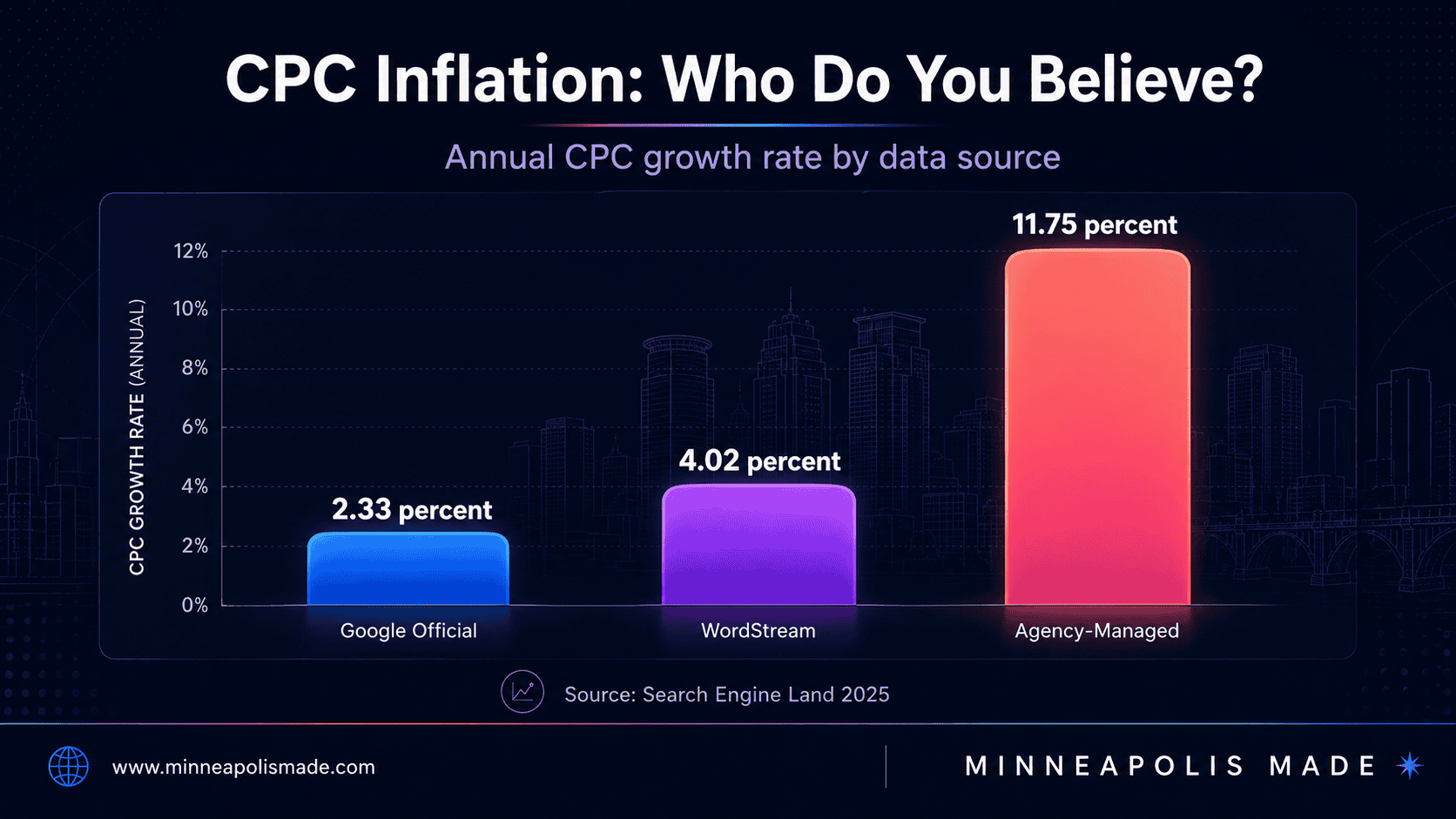
CPC isn’t just rising. It’s accelerating. A Search Engine Land analysis (2025) found three competing inflation estimates: Google’s own data suggests 2.33% annual CPC growth, WordStream’s benchmarks show 4.02%, and agency-managed accounts experience 11.75% CAGR. Who do you believe? It depends on your account type and management intensity. But the direction is clear: plan for higher CPCs next year than this year.
Why does this matter for budgeting? If you’re projecting a 2026 budget based on 2024 CPCs, you’re already underfunded. CPC increased for 87% of industries in the past year. Budget a 5-12% annual CPC inflation cushion, or you’ll lose impression share as competitors outbid you.
Is $100 a Day Enough for Google Ads?
At $100 per day ($3,000/month), you can run competitive campaigns in most industries, but only if your average CPC stays below $10. The general rule of thumb: budget enough for at least 10 clicks per day. If your CPC is $5, $100/day gives you 20 clicks. That’s workable. If your CPC is $15, you’re getting 6-7 clicks, and Google’s bidding algorithm doesn’t have enough signal to optimize.
For industries like restaurants ($2.05 CPC), real estate (~$3.00), or e-commerce (~$3.50), $100/day is generous. You’ll get 30-50 clicks daily, plenty of data for Smart Bidding, and enough budget to test multiple ad groups.
For legal ($8.58), dentists ($7.85), or home improvement ($7.85), $100/day is tight. You might get 12-13 clicks. It works if your conversion rate is strong, but there’s no room for waste. Every click needs to count, which means tight keyword targeting, aggressive negative keyword lists, and landing pages built for conversion.
What about $500/month? That’s $16/day. In most industries, you’re getting 3-4 clicks daily. That’s not enough data for the algorithm, not enough volume for statistically significant testing, and not enough conversions to justify the management time. We’ve talked to too many business owners who tried $500/month, got poor results, and concluded “Google Ads doesn’t work.” It works. They just didn’t feed it enough fuel.
Related: How to choose the right digital agency for your business
The 70/20/10 Budget Allocation Framework
US digital ad spending grew 11% in 2025, and eMarketer projects another 6.6% rise in 2026 (8.9% with political ad spend included), driven by AI-led platform growth. Businesses are pouring money into ads. But how you distribute your budget across campaign types matters as much as the total number. Here’s the framework we use.
70% to proven performers. These are your Search campaigns targeting high-intent keywords that already convert. They’re your money makers. Don’t get clever with this portion. Keep it running on what works.
20% to growth tests. Try Performance Max campaigns, expand into new keyword territories, test new audience segments. This is where you discover your next winners. Some experiments will fail. That’s the point. You’re buying information.
10% to pure experiments. YouTube ads, Display campaigns for brand awareness, competitor conquesting. These aren’t expected to deliver immediate ROI. They build familiarity and fill the top of your funnel. Think of this as planting seeds.
Personal Experience
When we took over a $2,000/month Google Ads account for a Minneapolis home services company, 100% of the budget was in one broad-match Search campaign. Conversions were expensive and inconsistent. We restructured into the 70/20/10 framework, moved 70% to exact-match proven keywords, 20% to Performance Max, and 10% to remarketing. Within 90 days, CPA dropped 40% and total conversions increased by a third. The total spend didn’t change. The allocation did.
Google’s March 2026 budget pacing update makes allocation even more critical. Campaigns with ad scheduling now pace more aggressively toward their monthly caps, which means poorly allocated budgets exhaust faster on your least profitable campaigns. Review your allocation monthly.
Related: How a strong website multiplies your ad spend ROI
Google Ads Trends in 2026: What Changed and What It Means for Your Budget
Three shifts in 2026 are reshaping how small businesses should plan PPC spend. More than 50% of Google Ads accounts now run Performance Max (PMax) campaigns, per PPC Chief’s 2026 PPC statistics. PMax automates ad placement across Search, YouTube, Display, Discover, and Gmail in a single campaign, but it also means you have less control over where your budget gets spent. Google’s AI decides.
The second shift: Google updated its budget pacing rules in March 2026 for campaigns using ad scheduling. If your campaign only runs business hours, the daily budget now depletes more aggressively within those windows, which can mean monthly spend hits its cap 3 to 5 days earlier than it would have in 2025. Plan for this by either widening your scheduled hours or budgeting 10% lower than the calculator’s output to absorb the new pacing behavior.
Third: AI-driven bidding strategies (Maximize Conversions, Target ROAS, Target CPA) now require more conversion volume than they did last year to perform reliably. Google recommends 30 to 50 conversions per month per campaign for stable optimization. Below that threshold, you’re better off with manual CPC bidding even though Google’s interface keeps pushing you toward automated options.
What this means for your 2026 budget: if you’re under 30 conversions per month, manually bid. If you’re over 50, let the AI run. The 70/20/10 allocation in the previous section assumes you’re somewhere on this spectrum, adjust the proven-campaigns slice accordingly.
Related: SEO vs AEO vs GEO, how AI is reshaping organic marketing alongside the paid changes covered here.
Five Budget-Killing Mistakes (and How to Fix Them)
Businesses earn an average of $2 for every $1 spent on PPC, according to PPC Chief’s compilation of Google Economic Impact Report data (2026). But that’s the average. Plenty of businesses earn $0.50 or less. The difference usually isn’t strategy. It’s execution errors that silently drain budget.
Running broad match without negative keywords. This is the number-one budget killer we see in audits. Broad match captures search queries you’d never target intentionally. Without negative keyword lists, you’re paying for clicks from people who will never convert. We’ve audited accounts where 30-40% of ad spend went to irrelevant searches.
Ignoring the search terms report. Google shows you exactly what people typed before clicking your ad. If you’re not reviewing this weekly, you’re flying blind. One Minneapolis client was spending $400/month on clicks from people searching “free” versions of their paid service. Five minutes of negative keywords fixed it.
Using the wrong bidding strategy. Maximize Clicks sounds great until you realize it’s optimizing for volume, not value. If you have conversion tracking set up, use Target CPA or Maximize Conversions. If you don’t have conversion tracking, stop everything and set it up first. Running Google Ads without conversion tracking is like driving with your eyes closed.
Spreading budget across too many campaigns. Five campaigns at $10/day each gives every campaign about 2 clicks daily. None of them have enough data to optimize. Consolidate. It’s better to run two strong campaigns than five starved ones.
Skipping the landing page. Sending ad traffic to your homepage is lazy and expensive. Dedicated landing pages with a single CTA convert 2-5x better than generic pages. The ad promises something specific. The landing page should deliver exactly that, nothing more.
Related: Google Business Profile optimization for law firms
Frequently Asked Questions
How much do Google Ads cost in 2026?
Most businesses spend between $1,000 and $10,000 per month on Google Ads. The average CPC across all industries is $5.26, according to WordStream’s 2025 benchmark study of 16,000 campaigns. Your actual cost depends on industry, location, competition, and Quality Score. Legal and dental practices pay the highest CPCs, while arts and entertainment pay the lowest.
What’s the minimum budget for Google Ads?
Google has no official minimum, but from experience, $1,500/month is the practical floor for meaningful results. Below that, you’re not generating enough clicks for Google’s Smart Bidding algorithms to optimize effectively. At $500/month, you’ll get 3-4 clicks per day in most industries, which isn’t enough data to learn what converts.
Is Google Ads worth it for small businesses in 2026?
Yes. Businesses earn an average of $2 for every $1 spent on PPC, per PPC Chief’s compilation of Google Economic Impact Report data. But ROI varies wildly by execution quality. A well-managed campaign can return $5-$8 per dollar. A poorly managed one returns nothing. The platform isn’t the variable. Your strategy and landing pages are.
How much should I spend on PPC vs SEO?
If you’re a new business without organic rankings, start at 70% PPC and 30% SEO. PPC delivers traffic immediately while SEO builds over months. As your organic presence grows, shift toward 40% PPC and 60% SEO. Established businesses with strong rankings can treat PPC as supplemental, focusing spend on competitive keywords where organic ranking alone isn’t enough.
How often should I adjust my Google Ads budget?
Review performance monthly and make budget adjustments quarterly. Avoid changing budgets weekly, as it disrupts Google’s learning algorithms. The exceptions: seasonal businesses should increase budget 30-60 days before peak season, and any business should cut spending immediately on campaigns with zero conversions after 30 days of data.
Is $10 a day enough for Google Ads?
Almost never. A $10/day budget gives you ~$300/month, which is below the threshold where Google’s AI bidding can gather enough data to optimize. In most US metro markets, $10/day buys 1 to 3 clicks for competitive commercial keywords (legal, home services, B2B SaaS), or 5 to 15 clicks for cheaper categories. That’s not enough conversion volume to learn anything meaningful in a 30-day window. If $10/day is your ceiling, run a single, hyper-narrow geo-targeted Search campaign with manual CPC bids on 5 to 10 highly specific long-tail keywords: and expect lead generation, not optimization, as the goal.
Is $20 a day good for Google Ads?
It works for tightly focused local Search campaigns, not for broad reach. $20/day equals $600/month, which clears the floor for a small Search-only campaign in a single metro area with a narrow keyword list. At $5 average CPC, that’s about 120 clicks per month, enough to generate 3 to 8 leads if your landing page converts at industry average (3 to 5 percent). It is not enough to run Display, YouTube, or Performance Max alongside Search. If $20/day is your ceiling, kill every campaign except one Search campaign and skip the brand-defense, retargeting, and growth experiments until budget allows.
Your Google Ads budget isn’t a number you pick from a blog post. It’s a calculation that flows from your revenue goals, your industry’s CPC, and your conversion rate. Use the 4-variable formula, structure your spend with the 70/20/10 framework, and budget 20-30% extra for the first month’s learning period. Then let the data guide you.
Related: Learn how SEO and PPC work together for maximum ROI
Ready to stop guessing and start calculating?
We’ll run your numbers through the 4-variable formula, benchmark your CPCs against industry data, and build a custom budget recommendation for your business.