
We speed-tested every law firm ranking on page one for four practice areas across the 20 largest cities in America. 622 firms returned a result. 556 of them, 83 percent, fail Google’s threshold for how quickly a page should show a visitor something.
That threshold is 2.5 seconds. The median firm here took 4.7 seconds. The slowest took 167.9 seconds, and we ran that one three times to be certain.
These are not firms nobody can find. Every one earned a page-one position for a query worth real money. They won the hard part, and then they hand the person a page that is still blank.
Key Takeaways
- 622 law firm websites tested across 20 cities and four practice areas. Only 17 percent meet Google’s 2.5 second LCP threshold.
- Page speed does not explain search position. Across 718 page-one results it accounts for under 1 percent of the variation in ranking.
- Two-thirds run WordPress. Within those, WPBakery sites load roughly twice as slowly as Gutenberg sites.
- The largest national firms are slower still at a 9.7 second median, but their clients do not arrive through search.
- Every number is reproducible. Each row links to a live PageSpeed Insights test.
Does a slow website hurt a law firm’s Google ranking?
Barely, and we tried hard to prove otherwise. Across 718 page-one results, the correlation between mobile performance and search position is statistically indistinguishable from zero. Firms in the top three positions load about 0.7 seconds faster than firms at position ten and below. Speed accounts for under one percent of the difference in where a firm ranks.
Google describes the same thing in its own page experience documentation.
That tiebreaker condition, lots of comparable content, describes any legal search result. Twenty firms in one metro publishing near-identical practice area pages is exactly the situation Google names. So speed is worth something. It is not worth what the cold emails claim, and anyone selling a rebuild on the promise of climbing to position one is selling something this data does not support.
Original DataWe report this because we set out to find the opposite. The easy version of this study is “your slow site is why you are not ranking.” We ran the correlation expecting to confirm it, found nothing, ran it again on five times the sample, and found nothing again. Publishing the null result costs us the simpler pitch, and it is the reason the rest of these numbers are worth trusting.
What does a slow law firm website actually cost?
The visitor. Not the ranking, the visitor.
Somebody has just been rear-ended, served, arrested, or handed a foreclosure notice. They are on a phone, in a bad hour, and they open three or four firms from the same results page. Every one of those firms paid to be there. The one that renders first gets read first. The others are still spinning when the thumb moves on.
Google’s own research puts a shape on this: as page load time goes from one second to ten seconds, the probability of a mobile visitor bouncing increases 123 percent (Google/SOASTA Research, 2017). The BBC, cited in Google’s performance documentation, found it lost an additional 10 percent of users for every extra second of load time.
We cannot tell you what any specific firm below is losing. We did not measure their conversions and we are not going to invent a figure. What we can tell you is that 556 firms on page one take longer than Google’s threshold to show a person anything, and the person choosing between them is not waiting.
Which law firm websites are the slowest?
Every site slower than 30 seconds was tested three times and the median reported, marked below. None of these is one unlucky request.
| # | Firm | LCP | Mobile | City | Platform | |
|---|---|---|---|---|---|---|
| 1 | Hangley Aronchick Segal Pudlin & Schiller | 167.9s ×3 | 46 | Philadelphia | WordPress / Gutenberg | Verify |
| 2 | Vasquez Law Group | 56.0s ×3 | 51 | Houston | – | Verify |
| 3 | Barr, Jones & Associates LLP | 45.1s ×3 | 43 | Columbus | WordPress / Gutenberg | Verify |
| 4 | Modern Family Law | 39.3s ×3 | 30 | Austin | HubSpot CMS / Gutenberg | Verify |
| 5 | Modern Family Law | 39.3s ×3 | 30 | San Jose | HubSpot CMS / Gutenberg | Verify |
| 6 | Attorneyadamburke | 39.3s ×3 | 25 | Columbus | WordPress / Elementor | Verify |
| 7 | Modern Family Law | 39.3s ×3 | 30 | Denver | HubSpot CMS / Gutenberg | Verify |
| 8 | Tran Singh LLP | 38.7s ×3 | 31 | Houston | – | Verify |
| 9 | Walters Gilbreath, PLLC | 31.5s ×3 | 27 | Houston | HubSpot CMS / Gutenberg | Verify |
| 10 | Walters Gilbreath, PLLC | 31.5s ×3 | 27 | Dallas | HubSpot CMS / Gutenberg | Verify |
| 11 | Campione Law Pa | 30.4s | 40 | Jacksonville | WordPress | Verify |
| 12 | DeBrun & Armstrong Law | 28.6s | 47 | Charlotte | WordPress / Divi | Verify |
Hangley Aronchick Segal Pudlin & Schiller returned 167.9, 165.6, 169.8 seconds across three separate runs. It ranks ninth in Philadelphia for bankruptcy. Somebody searching for that will find the firm, click, and wait the better part of three minutes for the page to appear.
Which law firm websites are the fastest?
These firms sit on the same results pages as the ones above, competing for the same people, and they render before a visitor has time to reconsider.
| # | Firm | LCP | Mobile | City | Platform | |
|---|---|---|---|---|---|---|
| 1 | Coby Wooten | 1.0s | 87 | Fort Worth | WordPress / Gutenberg | Verify |
| 2 | Gallettalawfirm | 1.0s | 100 | Charlotte | WordPress | Verify |
| 3 | Dougherty, Hanneman & Snedaker, LLC | 1.0s | 100 | Columbus | WordPress | Verify |
| 4 | Jayne Law Group, P.C. | 1.0s | 97 | San Francisco | WordPress / Divi | Verify |
| 5 | Ch13Nsh | 1.0s | 100 | Nashville | – | Verify |
| 6 | The Law Office Of Tara Carter | 1.0s | 100 | Nashville | WordPress | Verify |
| 7 | Robert L. Caplan Attorney at Law | 1.1s | 76 | Columbus | – | Verify |
| 8 | V. Freitas Law, PLLC | 1.1s | 92 | Seattle | WordPress / Divi | Verify |
| 9 | Fulgham Hampton Criminal Defense Attorneys | 1.2s | 100 | Fort Worth | Drupal / Gutenberg | Verify |
| 10 | Janet E. Johnson, P.A. | 1.2s | 85 | Jacksonville | – | Verify |
Which practice area has the slowest websites?
Bankruptcy, by a clear margin. Family law is the fastest of the four. Personal injury has the worst median score of any practice area despite being the most commercially contested.
| Practice area | Firms | Median mobile | Median LCP | Pass 2.5s |
|---|---|---|---|---|
| Personal Injury | 188 | 66 | 4.8s | 32 of 188 |
| Bankruptcy | 164 | 70 | 5.8s | 26 of 164 |
| Criminal Defense | 157 | 70 | 4.5s | 32 of 157 |
| Family Law | 163 | 72 | 4.1s | 26 of 163 |
Why are law firm websites slow?
Because two-thirds are built on the same platform, and a meaningful share add a page builder on top of it.
| Platform | Firms | Share | Median mobile | Median LCP |
|---|---|---|---|---|
| WordPress | 396 | 65% | 66 | 5.2s |
| No fingerprint detected | 172 | 28% | 76 | 3.5s |
| HubSpot CMS | 11 | 2% | 51 | 5.9s |
| Squarespace | 7 | 1% | 52 | 11.6s |
| Joomla | 7 | 1% | 64 | 7.0s |
| Webflow | 6 | 1% | 78 | 3.4s |
| Drupal | 5 | 1% | 75 | 5.4s |
Two platforms stand out, with the caveat that both samples are small. All 7 Squarespace sites failed the threshold, at an 11.6 second median. That is the worst of any platform here and the only one where nothing came close, the fastest of them landing at 6.2 seconds. HubSpot CMS had the lowest median score of any platform at 51, across 11 sites.
HubSpot is the more interesting case, because its range runs from 2.3 seconds to 39.3. One agency shipped a HubSpot site that renders in 2.3 seconds and another shipped one that takes 39.3, on the same platform, in the same industry. That spread is the whole argument in miniature: the platform is not deciding the outcome, the person building on it is.
WordPress is not the problem by itself. It runs 396 of the sites measured here and the median one is not catastrophic. What separates a fast WordPress site from a slow one is mostly what got layered onto it.
| WordPress page builder | Firms | Median mobile | Median LCP |
|---|---|---|---|
| Gutenberg | 210 | 69 | 4.8s |
| Elementor | 95 | 63 | 5.0s |
| Divi | 37 | 65 | 6.1s |
| Oxygen | 5 | 54 | 6.6s |
| Beaver | 12 | 71 | 6.8s |
| None / classic | 17 | 69 | 7.2s |
| WPBakery | 18 | 56 | 9.4s |
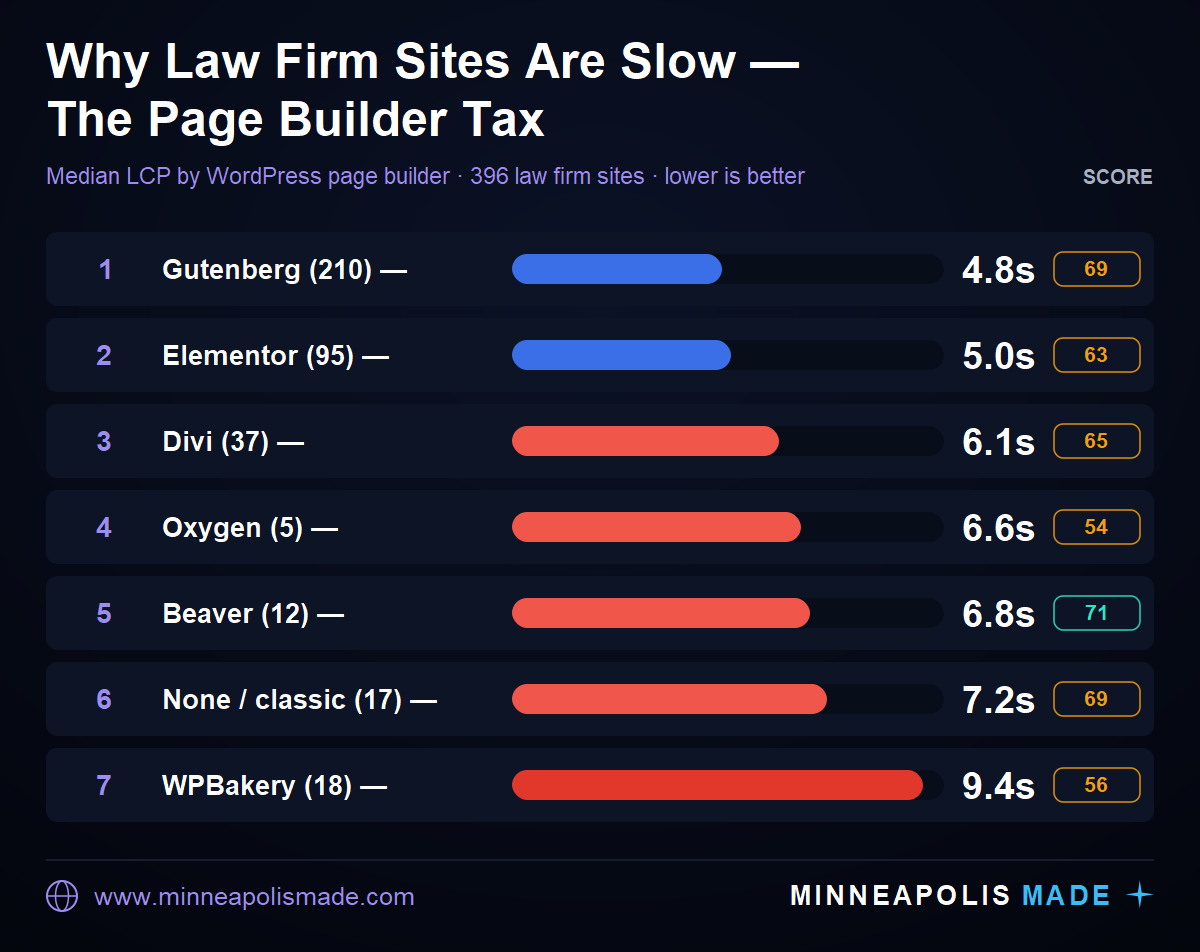
WPBakery sites load roughly twice as slowly as Gutenberg sites in this sample. That is the single clearest signal in the dataset. These builders ship a rendering layer to the browser so a page can be assembled in a visual editor, and the visitor pays for that convenience on every load. The firm bought a site that was easy for somebody to edit. The person in the hospital car park pays the interest.
Two honest caveats. The 28 percent with no detectable platform fingerprint are the fastest group here, but simpler sites are both harder to fingerprint and faster, which may be one fact rather than two. And a firm choosing WPBakery in 2026 may be a firm not investing in its website generally, which would make the builder a symptom rather than the whole cause.
Who actually built these websites?
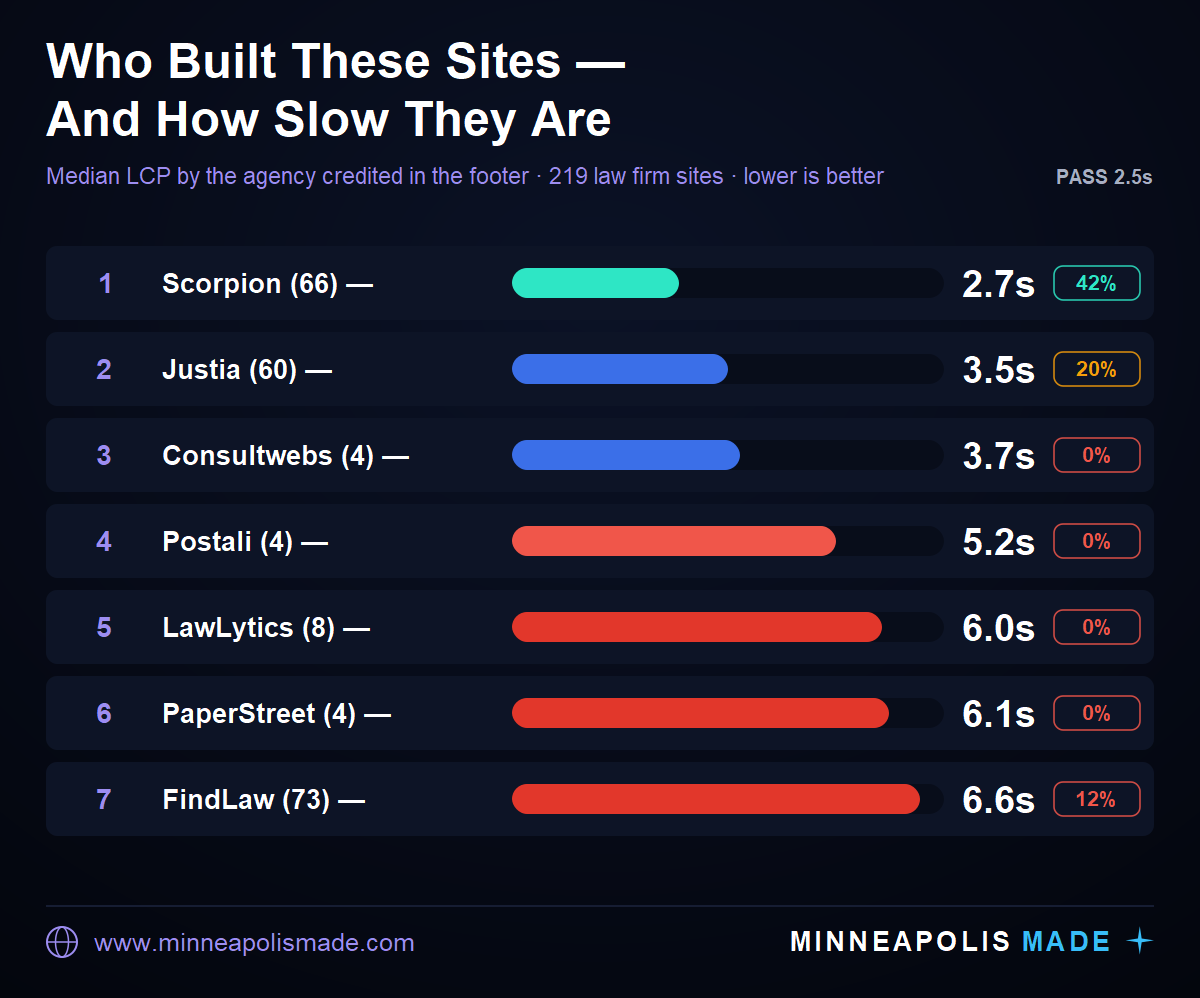
Almost none of these firms built their own site. Legal is a vertical served by specialist agencies, and their names are in the footer. We read the credit off every homepage we could and attributed 272 of the 622 measured sites. Seven agencies account for 219 of them.
| # | Agency credited | Sites | Median score | Median LCP | Pass 2.5s | Slowest |
|---|---|---|---|---|---|---|
| 1 | Scorpion | 66 | 74 | 2.7s | 42% | 56.0s |
| 2 | Justia | 60 | 85 | 3.5s | 20% | 17.0s |
| 3 | Consultwebs | 4 | 78 | 3.7s | 0% | 7.9s |
| 4 | Postali | 4 | 75 | 5.2s | 0% | 8.7s |
| 5 | LawLytics | 8 | 74 | 6.0s | 0% | 14.6s |
| 6 | PaperStreet | 4 | 67 | 6.1s | 0% | 13.8s |
| 7 | FindLaw | 73 | 64 | 6.6s | 12% | 45.1s |
Scorpion built 66 of the sites in this study and the median one renders in 2.7 seconds, with 42 percent clearing Google’s threshold. FindLaw built 73 and the median one takes 6.6 seconds, with 12 percent clearing it. Same vertical. Same kind of client. Same kind of content. A 2.4 times difference in what the visitor waits for.
Is a slow website the developer’s fault?
Yes, and the data above is why that is not an insult but an observation.
Every excuse for a slow law firm site is available equally to every agency in that table. Legal content is text and headshots. The compliance requirements are identical. The clients have comparable budgets and comparable demands. If a six second median were a property of the industry, Scorpion could not be running at 2.7.
The same pattern holds at the top of the market. Davis Polk, a firm with thousands of lawyers and a global site, renders in 1.6 seconds. Reed Smith does it in 2.4. Meanwhile Hogan Lovells takes 20.2 seconds and McDermott 17.5, at the same scale, with the same budgets, in the same year. That is a twelve times spread inside one tier of the same industry.
Unique InsightNobody who does this professionally ships a homepage that takes six seconds to render in 2026. The tooling to avoid it has been free and well documented for years. When a site loads slowly, somebody either did not measure it, did not know how, or knew and shipped anyway because the person paying could not tell the difference. All three are the developer’s responsibility, and the third one is the worst of them.
What makes this checkable rather than an opinion is that the agency’s name is sitting in the footer of the site it built. A firm can look at its own homepage, find the credit, find that agency in the table above, and see what the rest of that agency’s work looks like.
How Minneapolis Made builds a site in 2026
We build to a number, and the number goes in the contract. Largest Contentful Paint under 2.5 seconds on a mid-range phone on throttled mobile data, measured before launch and measured again on a schedule afterwards, because sites decay as widgets get added.
Our own site renders in 2.3 seconds with a Lighthouse mobile score of 98. We tested it three times to write that sentence and got 98 every run. In our benchmark of 21 Minneapolis-area agency websites it is the highest scoring one we found, though Media Junction is close enough on LCP that we would not claim daylight.
The method is not clever. No page builder shipping a rendering engine to the browser. Images sized for the device asking for them. Fonts that do not block text from painting. Third party scripts loaded after the content rather than in front of it, and a hard argument with anyone who wants a fourth tracking tag. None of that is a trade secret. It is just what it costs to care about the number.
Related: We tested 21 Minneapolis web design agencies the same way
Why are the biggest firms in America even slower?
We measured 29 of the largest US law firms as a control group. Their median LCP is 9.7 seconds against 4.7 seconds for the firms above. The biggest firms in the country have the slowest websites in this study.
Personal ExperienceThat looks like a contradiction until you ask how each group finds clients. A Fortune 500 general counsel does not pick outside counsel by searching on a phone. They use panels, relationships and RFPs. For those firms the website is a brochure, and a brochure can be slow without costing anything measurable. Kirkland & Ellis booked over ten billion dollars last year with a homepage that takes 8.4 seconds to render.
The firms in the tables above have no such luxury. Their website is the front door. To their credit they are roughly twice as fast as the national firms, which is what you would expect from people whose income depends on it. They still miss the threshold 83 percent of the time.
Want your firm’s numbers?
We will run the same mobile Lighthouse test on your site and send you the LCP, layout shift and blocking time, with the specific causes and what it would take to fix them. Same method as every row above.
How do you check your own firm’s website?
Run it through PageSpeed Insights, then ignore the score at the top. Scroll to Largest Contentful Paint and read that instead. If it is above 2.5 seconds on mobile you have the same problem as 83 percent of the firms here, whatever the score says.
The composite score hides this constantly. In our national cohort one firm scored 70 out of 100 while taking 16.8 seconds to render, because good layout stability and low blocking time pulled the average up over a catastrophic load. The score averages five things. LCP is the one a human actually experiences.
Related: Core Web Vitals explained, without the jargon
Frequently Asked Questions
What is a good page speed for a law firm website?
Largest Contentful Paint of 2.5 seconds or less on mobile, which is Google’s own threshold. Layout shift under 0.1 and interaction delay under 200 milliseconds complete the set. In this study 17 percent of firms met the LCP bar.
Will a faster website make my firm rank higher?
Probably not by itself. Across 718 page-one results, speed accounted for under one percent of the variation in position. Google treats page experience as a tiebreaker between comparable pages rather than a ranking lever. Speed is worth fixing for what happens after the click.
Is WordPress bad for law firm websites?
No. Two-thirds of the firms here run WordPress and plenty of them are fast. What correlates with slowness is the page builder layered on top. WPBakery sites in this sample load about twice as slowly as Gutenberg ones.
How were these numbers measured?
Google Lighthouse via DataForSEO, mobile emulation with throttling, plus a separate desktop pass. Firms are page-one organic results for each city and practice area, with directories, bar associations and referral services excluded. Sites slower than 30 seconds were tested three times and the median reported.
Why is my firm not in this report?
We tested page-one organic results in the 20 largest US cities for four practice areas on a single day. Rankings move, and 39 sites returned an error to the testing tool and are listed as not scored rather than removed. You can run the same test on any site yourself using the Verify links.
The short version
622 law firms are already ranking on page one. 556 of them take longer than Google’s threshold to show a visitor anything, and it is not costing them their ranking. It is costing them the person who already found them.
If your firm is choosing a web design partner, the question is not what the site will look like. It is what it will weigh, and who is accountable for that number a year after launch.
Related: How we build law firm websites
Building or rebuilding a firm website?
We build law firm sites where the render path is a requirement rather than a cleanup task, and we hand over the measurements to prove it.