What Actually Ranks
in Twin Cities
Local Packs.
We measured every ranked business in 240 Twin Cities local packs. Proximity decided position in 97% of them. Backlinks landed within a few points of a coin flip. Here is the whole dataset, including the thing we expected to find and did not.
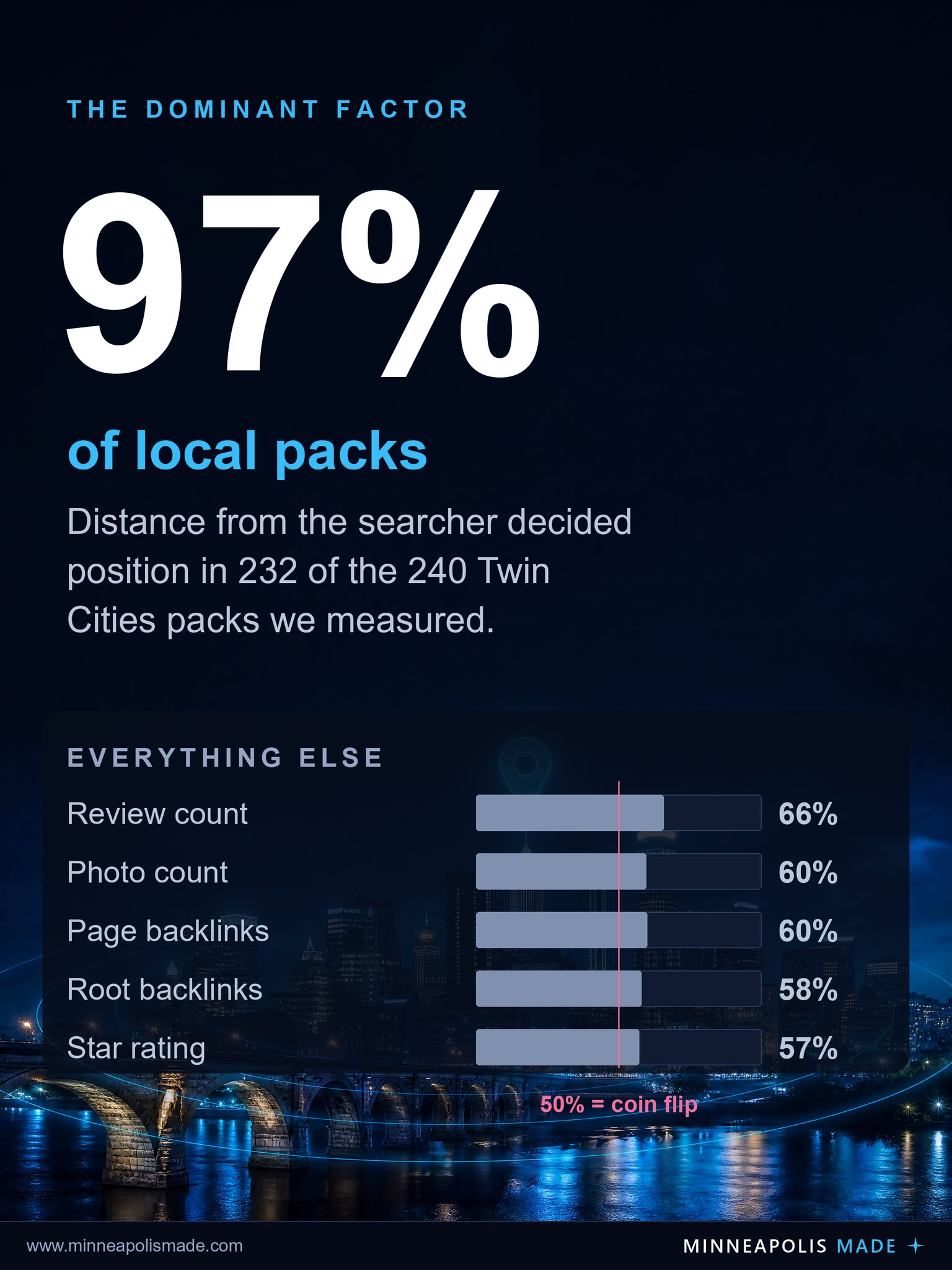
One factor decided almost every pack. It was not the one the industry optimises for.
232 of 240 packs
One Google Maps local pack collected for each of 12 industries across 20 Twin Cities municipalities on September 7, 2026. That is 240 packs and 4,800 ranked positions, with no failed cells. Every search was pinned to fixed coordinates so distance from the searcher could be measured directly rather than assumed. Correlations were computed inside each pack and then aggregated, because pooling all 4,800 rows would partly measure differences between markets rather than what moves a business against the competitors it actually faces.
The question we started with
Google's Business Profile guidelines say to "provide a website that represents your individual business location." Practitioners have followed that for years, pointing each location's profile at that location's page rather than the homepage. It is documented advice and it is sensible advice. Nobody had measured whether it moves rankings.
So we measured it. And while the data was there, we measured everything else the local pack exposes: distance, reviews, ratings, photos, and backlinks at both page and root-domain level.
The answer to the original question is no detectable effect. The answer to the broader question turned out to be far more interesting.
Proximity is not a factor. It is the factor
In 232 of 240 packs, businesses closer to the searcher ranked higher. That is 97% consistency across twelve unrelated industries and twenty municipalities. Nothing else came close, and the gap is not subtle: the second-place factor sits 31 points behind.
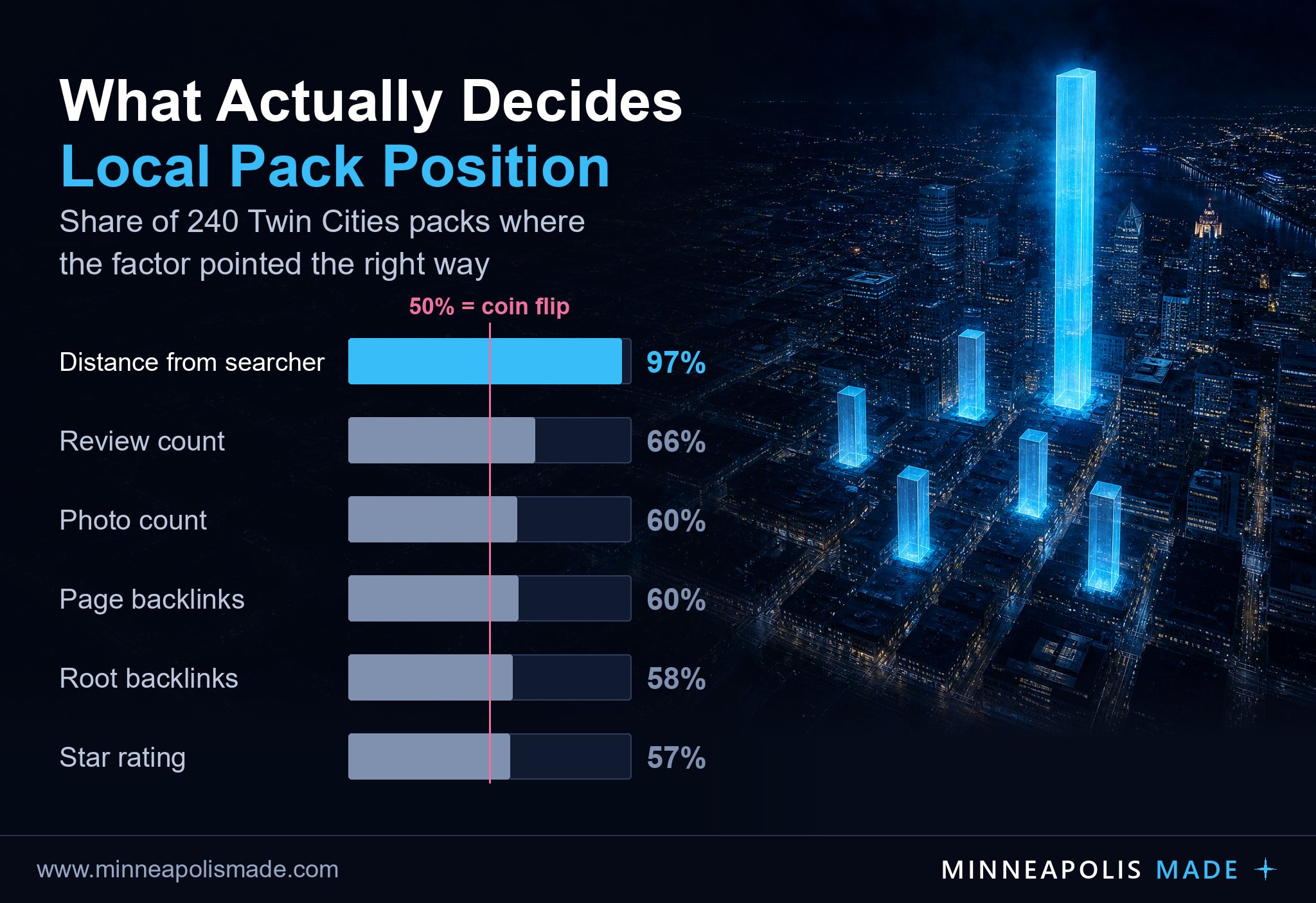
| Factor | Median rho | Packs in expected direction |
|---|---|---|
| Distance from searcher | +0.404 | 97% |
| Review count | −0.120 | 66% |
| Photo count | −0.050 | 60% |
| Referring domains (page) | −0.055 | 60% |
| Referring domains (root) | −0.047 | 58% |
| Star rating | −0.045 | 57% |
Spearman rank correlation computed within each pack, then aggregated across 240 packs. A coin flip would produce 50%.
Backlinks did almost nothing
This is the result worth arguing about. Referring domains pointed the right way in 60% of packs measured at the page Google linked to, and 58% measured at the root domain. Both sit within a few points of chance.
Link authority is the metric the industry works hardest at, and inside a local pack it is close to inert. That does not make links worthless, because the same business also competes in organic results where authority behaves very differently. It does mean that budget aimed at local pack position specifically is going to the wrong place.
An early cut of this data measured only root domains and produced a headline that looked dramatic: a top-ranked independent with 20 referring domains sitting beside a franchise with 6,476. It was an artefact. The franchise page Google actually ranked carried 55. Measuring the exact ranked URL alongside its root killed a finding we had already written down, which is why both are reported here.
The location page question, answered
Comparing profiles that point at a location-specific page against profiles that point at the homepage, matched on review count so that company size cannot masquerade as URL strategy, the difference is not distinguishable from zero at any sample size we could construct.
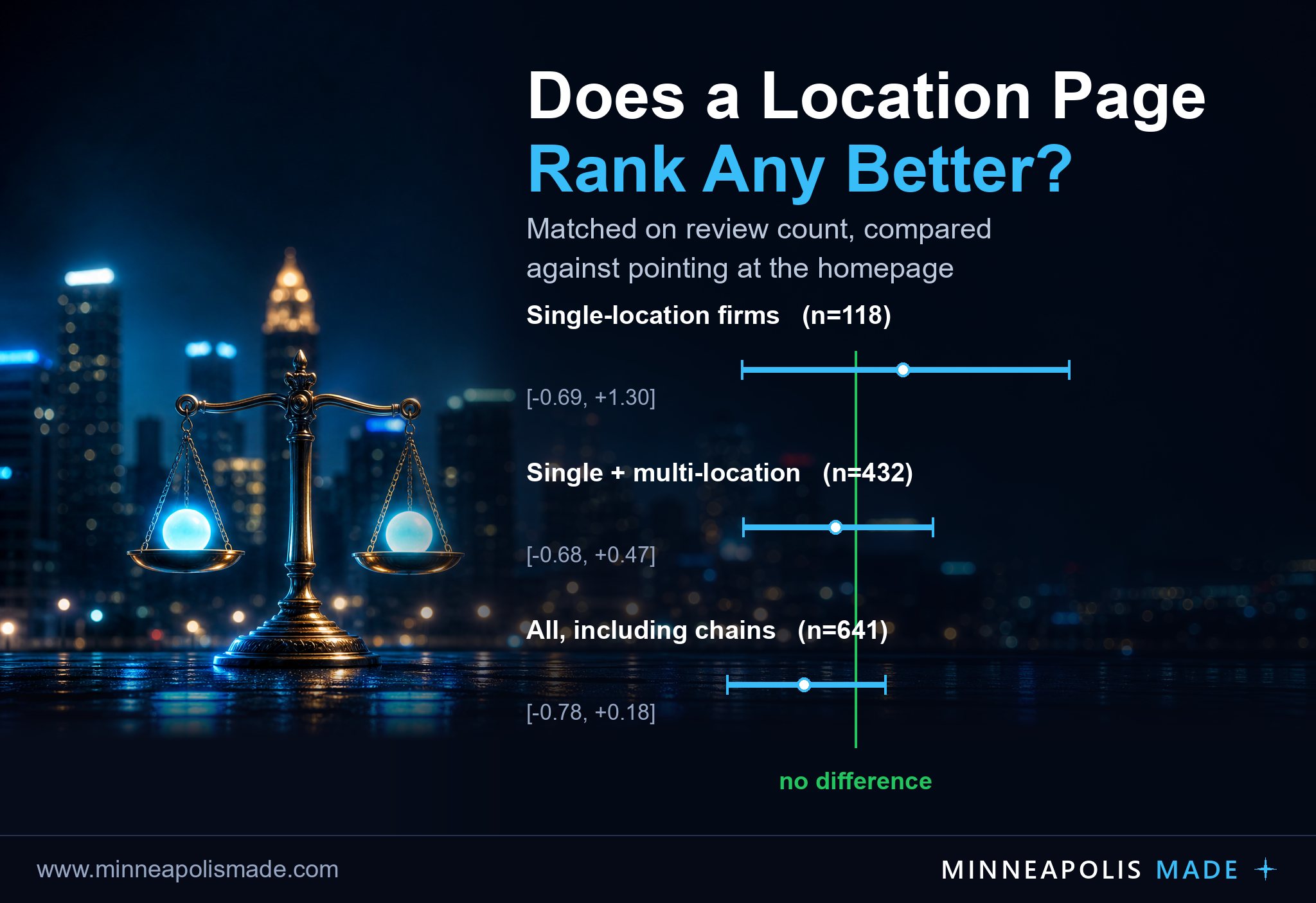
Two things this does not mean. It does not mean the practice is wrong: Google documents it, and sending a searcher to the page about the location they searched for is a conversion decision that a ranking null says nothing about. And it does not mean no effect exists. It means any effect is smaller than roughly one position, which is what this sample can resolve.
The naive version of this comparison, before matching on review count, looked far more flattering. Businesses using location pages carry a median 236 reviews against 101 for homepage-linked profiles, because having location pages to point at is something larger operations do. Left uncontrolled, that gap reads as a ranking benefit. It is company size wearing a costume.
One listing in ten had no website at all
492 ranked listings, 10.2% of the dataset, had no website linked to the profile. Fifty-seven of those took a top-three position. A Business Profile with nothing behind it still competes, which is difficult to reconcile with a model where website signals drive local pack placement.
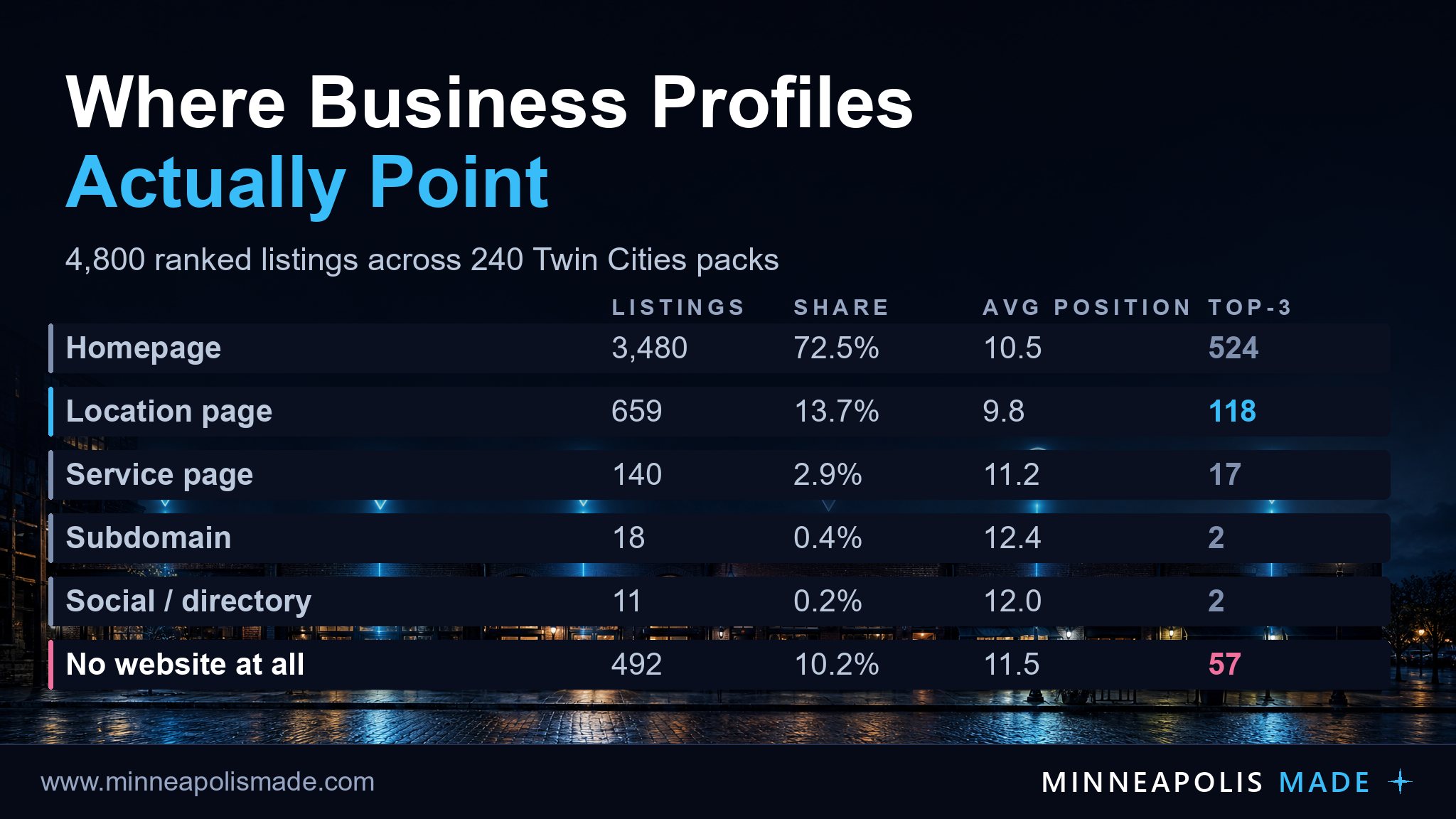
Only 13.7% of ranked profiles point at a location page. Eleven profiles point at a Facebook or Google page rather than a site of their own.
What this changes about local strategy
If proximity dominates and you cannot move your building, the useful question is not "how do I rank everywhere" but "where am I already close enough to win, and am I competitive there." A business three miles from a suburb's centre is playing a different game in that pack than one thirty miles away, and no amount of link building closes that gap.
Review count beat star rating, 66% against 57%. Volume tracked position better than sentiment, so a steady flow of reviews is worth more than protecting an average.
And the location page is still worth building. Just build it because it converts the person who clicks, not because it moves a ranking. On this evidence, it does not.
Limitations
- One metro, one moment. A single collection on September 7, 2026. Local packs are volatile and Google states that ranking optimises for ecosystem diversity. Nothing here tracks change over time.
- Correlation, not causation. Distance dominating is partly definitional, since the local pack is a geographically constrained product. This measures how strongly, not why.
- The location-page sample is 118 single-location firms. Enough to exclude an effect of about one position or larger. Not enough to exclude a small one.
- Link target is inferred from the URL. A location page is detected by place names in the path or subdomain. A page that targets a location without naming it in the URL is misclassified.
- One data source throughout. All link figures come from a single provider. A spot-check found two major tools differing roughly threefold on the same domain, so mixing them mid-study would manufacture variance that looks like signal.
Want to know where you are actually competitive?
The useful version of this analysis is the one run on your own packs: which municipalities you are close enough to win, where your review volume puts you against the businesses already there, and which of those gaps is worth closing. We do that work for Twin Cities businesses and for clients across the country.
Talk About Your Local RankingsFrequently asked questions
What is the biggest local pack ranking factor?
Distance from the searcher, by a wide margin. Across 240 Twin Cities packs, closer businesses ranked higher in 232 of them, or 97%. No other factor measured exceeded 66% against a 50% coin-flip baseline.
Do backlinks help you rank in the local pack?
Barely, on this evidence. Referring domains pointed the right way in 60% of packs at page level and 58% at root-domain level, both close to chance. Link authority does far less work inside a local pack than in organic results.
Should a Google Business Profile link to a location page or the homepage?
Google guidelines say to provide a website representing the individual location, so the location page is correct practice. It did not measurably change ranking: 0.29 positions with a 95% interval from −0.69 to +1.30, which includes zero.
Do reviews or star ratings matter more for local ranking?
Review count outperformed star rating, 66% against 57%. How many people reviewed a business tracked position better than the average score those reviews gave.
Can you rank in the local pack without a website?
Yes. 492 listings, 10.2% of ranked positions, had no website linked, and 57 took a top-three spot. They averaged position 11.5 against 10.5 for homepage-linked profiles.
How was this local search study conducted?
One Google Maps local pack per industry and municipality, 12 by 20, on September 7, 2026. Searches were pinned to fixed coordinates so distance could be measured. Correlations were computed within each pack, and the location-page comparison was stratified by review count with bootstrap confidence intervals.

Christopher Merry has been a computer geek since 1977, built his first website in 1996, and has been running SEO campaigns since 2001. He founded Minneapolis Made in 2000 with a simple premise: every project starts and ends with the strategist. The work is national. Clients run from Ohio to Oregon and Florida to North Dakota, including both Portlands. Christopher leads each engagement end to end, from the strategy to the keyword research to the code, supported by a small, family-owned team that helps execute. You talk to Christopher. He writes the plan.
Related reading: how we approach SEO, what breaks in Local Services Ads, and our Minneapolis agency speed benchmark.