Skip to content

Law Firm SEO Microsites: How "Off-Site SEO" Vendors Hijack Your Brand

2026.06.12 // Christopher Merry // 63 min read

Law Firm SEO Microsites: How "Off-Site SEO" Vendors Hijack Your Brand

I know what you are thinking. A sixty-three-minute read? Are you kidding me? The reason this article is this long is that the damage this scheme does to a law firm's online ecosystem and internet marketing presence is so extensive it warrants the length. Eight separate systems take hits at the same time: the website, the Google rankings, the Local Pack visibility, the directory listings, the AI search citations, the Knowledge Graph profile, the bar advertising compliance, and the trademark posture, all in parallel, all inside a single eighteen-month window. Sixty-three minutes to understand it. Years to undo it.
Imagine you signed up with a marketing vendor who promised SEO leads on a per-case basis. No upfront cost. No risk. They build the marketing, you get the leads, you only pay when you close a case. The math sounded clean.

A year later, you search for your own firm by name. And instead of finding your own website in position one, you find someone else. A generic templated site you have never seen, with a stock layout, stock photos, and no relationship to your firm's actual branding. The only things it shares with your real website are the parts that matter to a search engine: your name on every page, your address in the local graph, and a phone number that routes every caller to an intake center you have never spoken to. You authorized that site, in a sense. It was built under the contract you signed. You just did not understand what the contract actually committed you to.

What it committed you to is this: the vendor's only way to deliver signed cases on a per-case fee is to rank for searches that produce intake calls. Competitive keywords like "car accident lawyer Portland" are nearly impossible to rank for from scratch and are dominated by entrenched firms with decades of authority. So the vendor picks the easiest possible target, the one with structurally zero competition: your own firm's name.

That is what this article is about. It is called brand hijacking, and it is the single most extractive thing a marketing vendor can do to a law firm.

The reason it works is uncomfortably simple. Your brand name is structurally easy to rank for, because there is exactly one of your firm in any given market, by definition. Search the name of any local business you know. The owner's site comes up in position one almost every time. Search Minneapolis Made and this website comes up in position one for the same reason: this site has owned the name for decades and there is no second Minneapolis Made for Google to weigh us against. Brand-name search has effectively zero competition, because no two firms share a name.

The vendor is monetizing exactly that. They register a network of microsites carrying your name and wait for those microsites to age into the brand-search results that should have been yours. Every time a consumer types your name into Google, clicks on the vendor's site that has quietly aged into the result alongside yours, fills out the form, and signs a case, the vendor sends you an invoice. You are paying per case for leads from people who were already searching for you. The vendor did not generate the demand. Your reputation did. The vendor just inserted a tollbooth on the road between the consumer and your front door.

It gets worse. The same vendor running this scheme for your firm is running it for forty-nine other firms in the same template network, with overlapping NAP data spread across all of them. Other businesses start showing up calling themselves something close to your name. The directory ecosystem and the AI search engines (ChatGPT, Perplexity, Google AI Overviews, Bing Copilot) cannot tell which version of your name is the real one and start hedging. Your Google Business Profile gets flagged for NAP inconsistency. Your website starts losing rankings on its own brand searches because the vendor's network is outvoting yours fifty to one in Google's entity graph.

And if you ever disagree with what the vendor is doing and try to leave, the vendor still owns the domain. Your name is on it. They keep ranking on it. The leads from your name keep going through them, billed to whichever firm pays the per-case fee next. If Google eventually catches the network and takes it down for spam, the action does not just hit the vendor. It cascades to every firm in the network, including your real domain, which inherits a portion of the demotion. Your GMB suspends. Your website falls off page one for searches you used to dominate. The vendor walks away from a portfolio of aged domains and starts the cycle over with the next firm in the next state.

This is brand hijacking. The mechanics are uglier than they look, the damage compounds for as long as the program runs, and there is a point past which it cannot be unwound at all. The single most important rule for any law firm reading this article is one sentence long.

Never let anyone run an SEO campaign on a domain other than your own. Not under contract. Not with a written license. Not for a discount. Not as a pilot. Not as a satellite. Not as a microsite. Never.

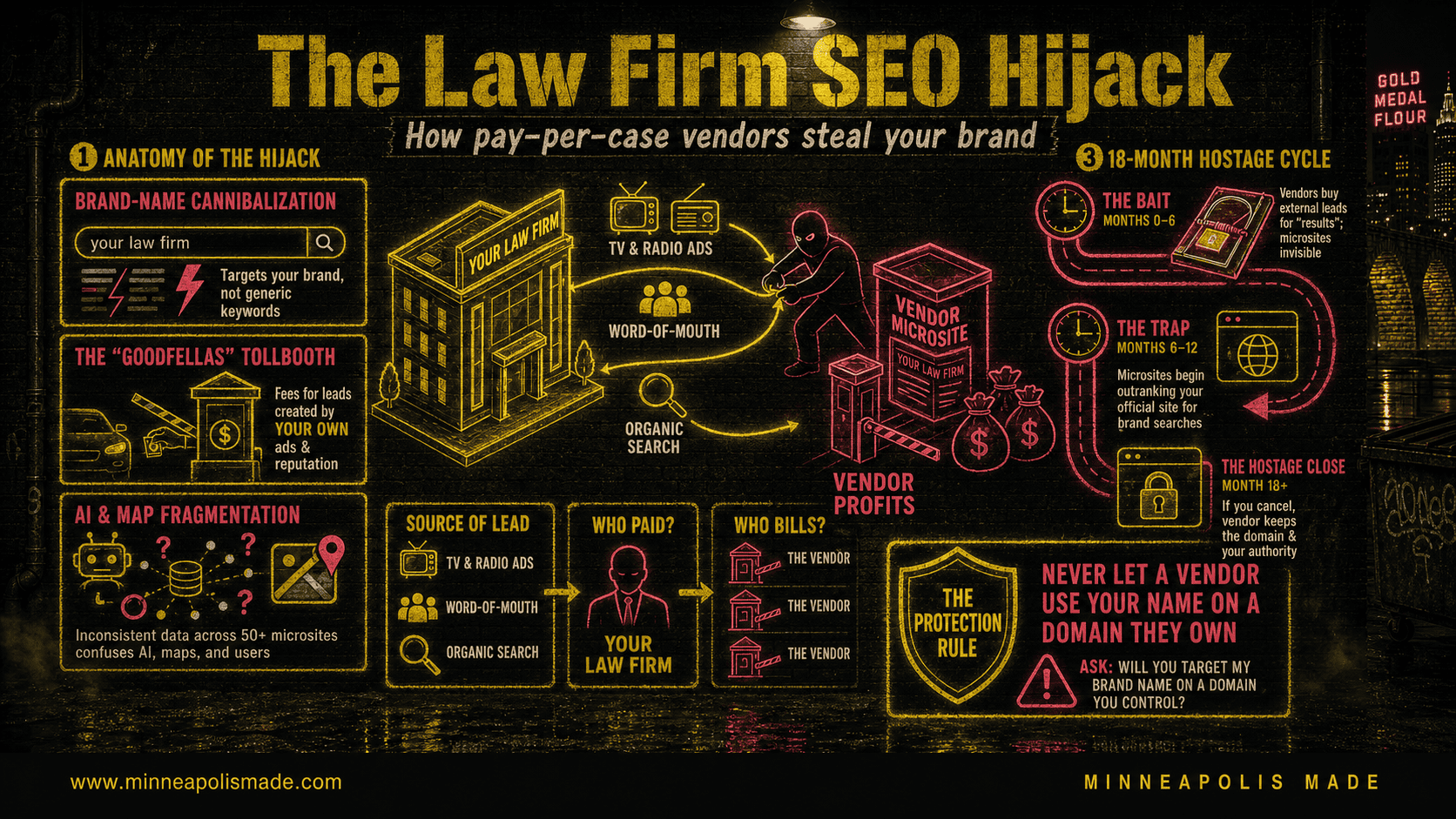
Cinematic amber-noir editorial infographic titled 'The Microsite Trap: How SEO vendors hijack law firm brand equity.' Four numbered sections. (1) Brand Search Tollbooth: a searcher types the law firm name into Google, hits a vendor-controlled tollbooth, and is billed for traffic created by the firm's own reputation. (2) Doorway Penalty Risk: a law firm main website plus templated city microsites (Chicago Lawyers, Dallas Lawyers, Phoenix Lawyers) all marked with Google Penalty stamps. (3) The Real Difference, a comparison table contrasting Legitimate SEO versus Vendor Microsite across Domain Ownership (owned by the firm vs owned by the vendor), Brand Searches (build the firm's brand vs capture brand demand for the vendor), and Termination (firm keeps assets vs vendor keeps domains, rankings, and footprints). (4) Protection Playbook: a 60-second WHOIS ownership test feeds into a Four Essentials contract clause checklist that leads to one authoritative firm-owned domain. Whole graphic sits in a wet brick alley with amber and yellow neon, Stone Arch Bridge silhouette behind, Minneapolis Made brand footer along the bottom edge. Functions as a visual TL;DR of the entire article.

Doorway pages are an explicit violation of Google's Search Essentials spam policies. The penalty for using them is total: removal from Search, suspension from Google Business Profile, and a long-tail dent in a firm's authority that the December 2025 Core Update made even harder to recover from.

But for law firms specifically, the most damaging version of the doorway playbook is no longer something an agency builds for itself. It is something an outside vendor pitches to the firm as a "microsite program" or "off-site SEO," then bills per case. The domains are registered to the vendor, the rankings accumulate to the vendor, and within twelve to eighteen months the firm is paying per signed case to capture demand its own brand created.

For Your Money or Your Life (YMYL) categories like legal services, this is not just a tactical mistake. It is a structural transfer of brand equity from the firm to a third party, and the longer it runs the more expensive it becomes to unwind.

Key Takeaways

  • Doorway pages are an explicit Google Search spam policy violation. Sites caught using them can be removed from Search entirely, per Google's Spam Policies documentation.
  • The modern variant is vendor-owned: a "microsite program" or "off-site SEO" service where the agency builds city-and-practice-area sites on domains they register, then bills the firm per signed case. The domains, the rankings, and the analytics never belong to the firm.
  • Aged microsites carrying the firm's name and address eventually rank for the firm's own brand searches. Every intercepted brand search becomes a case the firm pays the vendor to capture, even though the firm's marketing created the demand.
  • Legal services are YMYL. Google's Search Quality Rater Guidelines instruct human raters to apply the strictest E-E-A-T scrutiny here, which is why doorway tactics fail faster and harder for law firms than for other verticals.
  • The exact-match domain (EMD) framing is the distraction. This scheme works because your brand name is a unique entity. There is only one of your firm in your market, and Google's entity systems already know it. The vendor's microsites do not need to outrank "car accident lawyer." They only need to age into a ranking result for your firm's name, which is a race with one legitimate competitor. The URL format is decoration.
  • The lock-in compounds. At one month, exit cost is near zero. At eighteen months, the vendor controls aged ranking domains carrying the firm's NAP data and can re-brand them for a competitor the day the contract ends.
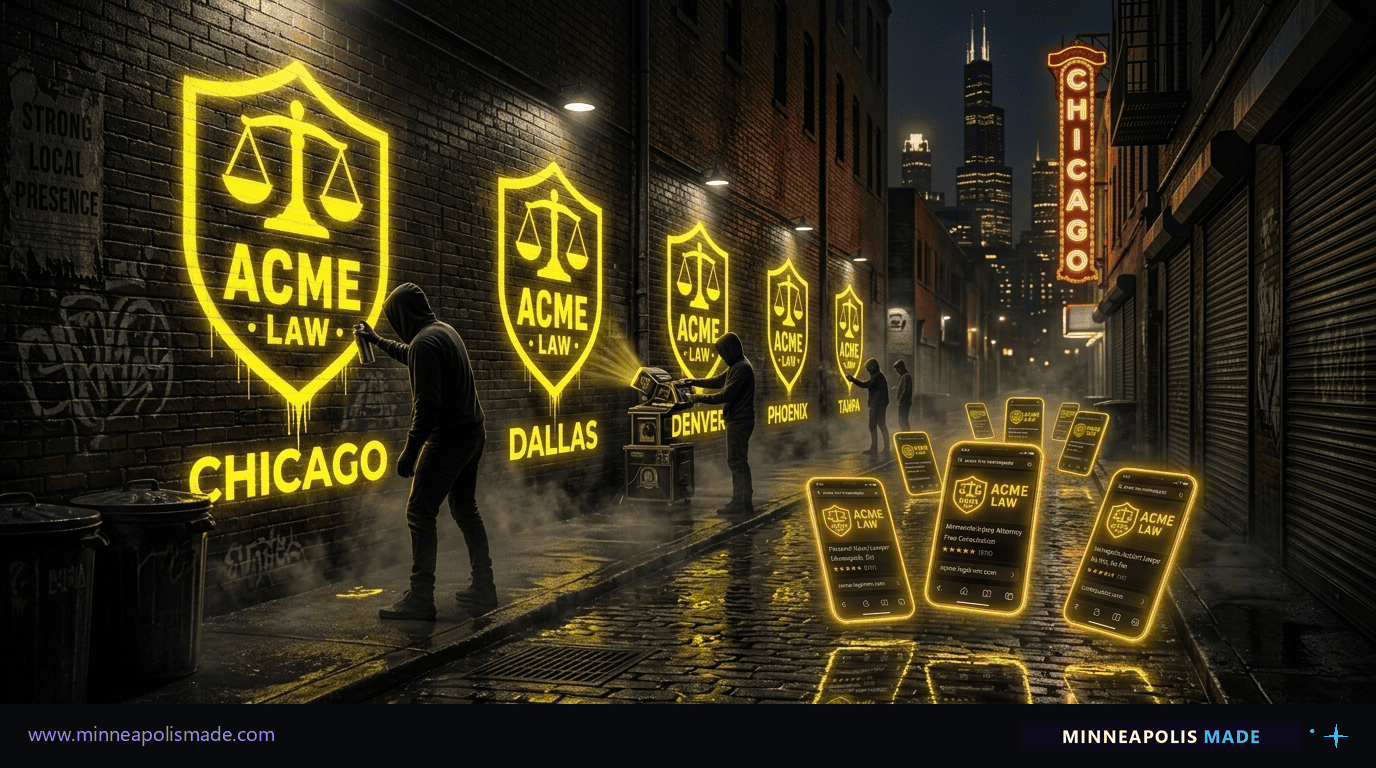
Cinematic concept illustration of brand-shield theft: a gritty wet brick alley at night, hooded figures stenciling and projecting identical amber-yellow ACME LAW shield logos onto the alley wall with different city names dripping in paint underneath (CHICAGO, DALLAS, DENVER, PHOENIX, TAMPA), glowing amber phone mockups of templated law firm websites on the wet cobblestones, illustrating how vendor microsite networks copy a law firm's brand identity across dozens of cities

What Are Doorway Pages, and Why Does Google Penalize Them?

Google defines doorway pages as "sites or pages created to rank for similar search queries" that funnel users to a single destination, and the company treats them as a top-tier spam violation alongside cloaking and link manipulation, per Google's official Spam Policies for Web Search. The penalty is not a soft demotion. Sites that violate the policy can disappear from Search results entirely, with no automated path back.

The classic doorway pattern looks like this: an agency builds dozens of nearly-identical landing pages, each targeting a city plus service combination like denver-car-accident-lawyer.com, boulder-car-accident-lawyer.com, aurora-car-accident-lawyer.com, and so on. None of them serve the user. They exist only to capture a search query and funnel the visitor to a single intake form. Google's policy explicitly calls out "having multiple domain names or pages targeted at specific regions or cities that funnel users to one page" as the textbook example.

The reason Google penalizes doorways so aggressively is structural. Doorway pages waste crawl budget, dilute the link graph, and degrade the search experience by stuffing the index with near-duplicate content that does not answer the user's actual question. For a search engine trying to surface authoritative answers, doorway sites are pollution.

Google's Spam Policies documentation defines doorways as "sites or pages created to rank for specific, similar search queries" and lists "multiple domain names targeted at specific regions or cities that funnel users to one page" as a textbook example. Sites violating the policy can be removed from Search results.

The Real Danger: When a Network Gets a Penalty, Everyone Gets a Penalty

The penalty being severe in theory is not the most dangerous part of this. The most dangerous part is that doorway networks are extremely easy to identify from the outside, and when one of them gets actioned, it gets actioned as a network, not as individual sites.

The signals are unmistakable. Identical HTML scaffolds. Identical schema markup. Sequential domain registration dates inside the same registrar account. Identical DNS records. Identical hosting fingerprints. Identical CMS templates. Reverse-WHOIS lookups, pattern-match crawls, and shared-IP cluster reports surface the entire 50-site footprint inside an hour of casual investigation. Google's search quality team has automated tools for exactly this kind of pattern detection, and competitors, watchdogs, and aggrieved former clients have manual spam-report tools that route directly to that team.

When the action comes, it does not arrive at one EMD. It arrives at the cluster. Google identifies the shared infrastructure, traces it back through every domain in the network, and applies the manual action across the entire set at once.

Unique Insight

This is the part most firms never think about until it is too late: your microsite's survival is now governed by the conduct of every other firm on the vendor's stack. A law firm in Dallas that figured out what was happening, hated their vendor enough to file a Google spam report, and triggered an investigation just took your microsites down along with theirs. Your competitor's microsites. The microsites of thirty unrelated firms across the country sitting on the same templated platform. All of them, the same week, in the same action. You did not file the report. You did not even know the Dallas firm existed. You still ate the penalty.

And because the vendor stamped your name, your phone number, and your physical address into every one of those penalized domains, the residual NAP entanglement bleeds back into your real, owned domain. Your primary website inherits a share of the demotion. You did not run a doorway program. You hired a vendor that ran one for a hundred other firms, and the algorithmic correction does not discriminate between participants and bystanders.

If your brand is on the network, the network is on you.

What Bar Advertising Rules and Trademark Law Say About Vendor-Owned Microsites

The Google policy problem is the most visible part of this scheme, but it is not the only one. For law firms specifically, vendor-owned microsites that carry the firm's name, address, and phone number on domains the firm does not control implicate state bar advertising rules and federal trademark law in ways most firms do not realize until a competing firm, a former client, or a state bar disciplinary committee figures it out first.

The bar advertising problem. ABA Model Rule 7.2 ("Communications Concerning a Lawyer's Services") governs how a lawyer may pay for client referrals and what disclosures are required. Rule 7.2(b)(2) permits payment to a "qualified lawyer referral service" but generally prohibits paying nonlawyers a per-client or per-case fee for recommending the lawyer's services. Per-signed-case billing tied to leads that originate on a vendor's domain (carrying the firm's name without disclosure of the vendor relationship) sits squarely in the disputed zone of this rule in most jurisdictions.

Several states, including Florida (Rule 4-7.17) and New York (Rule 7.2), have explicit lead-generation rules with stricter disclosure requirements than the ABA Model Rule. ABA Model Rule 7.1 (false or misleading communications) and Model Rule 5.3 (responsibilities regarding nonlawyer assistants) add further exposure: a firm is responsible for the conduct of nonlawyer agents acting on its behalf, and a microsite that misrepresents the firm's identity or fails to disclose the vendor's role can be the firm's disciplinary problem even if the vendor authored every word.

The practical effect is that an attorney who signs a microsite contract without first reviewing it against the relevant state bar rules can be exposed to disciplinary action that has nothing to do with Google's algorithm. The bar does not need a quality update to act. It needs a single complaint.

The trademark problem. A firm's name is a trademark whether or not it is federally registered. Most vendor contracts grant the vendor a written license to use the firm's name, photographs, and logo for the duration of the engagement, so the simple "unauthorized use" framing many articles on this topic rely on does not actually apply in the typical case. The vendor is licensed. That is precisely how they got the name on every page in the first place.

The exposure is narrower and more specific, and the vendor's contract drafters rarely eliminate it. Three failure modes survive even a broad written license.

Scope. A license to use the firm's mark to promote the firm is not a license to use it to generate inquiries that get routed to competing firms or brokered to whichever payer bids highest, which is exactly what happens when the vendor monetizes the lead pipeline independently of the firm. Using a licensed mark for a commercial purpose outside the scope the licensor authorized is a textbook overrun of the license, and the firm has a contract-and-Lanham-Act argument the moment it surfaces.

Post-termination use. The license to use the mark ends when the contract ends. Any continuation, even briefly, becomes infringement under 15 U.S.C. § 1114 for federally registered marks, and false designation of origin under 15 U.S.C. § 1125 in either case. A vendor that keeps the firm's name, address, and attorney bios on aged domains thirty, sixty, or ninety days after termination is, at that point, infringing on a former licensor's mark. The fact that the domain was originally licensed does not survive the termination.

False designation of origin, even during the license. Publishing the firm's name and address on a domain the firm does not own can deceive a consumer who reasonably believes they are on the firm's official website. A license to use the mark is not the same as a license to misrepresent the source of the website. The misnaming pattern we have documented in vendor networks (a microsite that publishes the wrong firm name at the correct firm address) makes the deception undeniable, but even a flawless microsite carrying the right firm's correct name can support a § 1125(a) claim if the public-facing context creates a false association.

Unique Insight

This reframes the problem from "my marketing vendor made a bad choice" to "my marketing vendor created legal exposure for me and is also infringing my mark." Most firms reading this article are sitting on potential recourse they do not know they have. The remedies under the Lanham Act include injunctive relief (the vendor must take the firm's name off the domains), damages, and in egregious cases, statutory damages and attorney fees. The vendor's domain portfolio, the very asset the vendor has been quietly building on the firm's brand, is the asset most exposed to that injunctive relief.

None of this is legal advice. It is the framing every law firm should bring to its own ethics counsel and its own intellectual property counsel before signing the contract, and immediately if the contract has already been signed.

How Do Doorway Pages Damage E-E-A-T and YMYL Trust?

For YMYL (Your Money or Your Life) topics like legal services, Google's Search Quality Rater Guidelines instruct human raters to apply "very high Page Quality standards" because, in Google's own words, low-quality content in these categories "could potentially impact a person's health, financial stability, or safety, or the welfare or well-being of society." Legal services are explicitly named as a YMYL topic in the guidelines. Doorway pages fail every single E-E-A-T pillar at once: there is no real Experience (the page was generated, not lived), no Expertise (the content is templated), no Authoritativeness (the domain has no link equity), and no Trust (the contact info is often a redirect, an intermediary, or a different firm entirely).

The December 2025 Core Update sharpened this further. Google now uses site-wide quality signals to demote thin doorway content even when an individual page looks acceptable in isolation. A law firm whose vendor built a doorway network can find its main domain demoted because Google associates the doorway sites with the firm through shared phone numbers, NAP data, or backlink patterns.

Unique Insight

The trap most firms walk into is that doorway tactics work for about 90 days. Rankings improve, the vendor's monthly report shows growth, and everyone takes a victory lap. Then the algorithmic correction hits, and the firm loses not just the doorway rankings but a chunk of its primary domain's authority too. By that point the vendor has been paid, the contract is signed, and disentangling the doorway footprint requires a forensic audit that costs more than the original engagement.

Forget the EMDs. The Real Engine Is Your Own Brand Entity.

Most articles on this topic spend half their word count debating exact-match domains. We have done a little of that ourselves above, and it is worth correcting now, because the EMD framing is the distraction the vendors actively want every firm to focus on. The EMD is wrapping paper. It is not the engine.

Yes, exact-match domains have quietly come back since 2024. Local-pack updates, entity-driven ranking, and Google's renewed reliance on URL-level keyword signals in low-competition queries have given keyword-rich domains a real ranking lift again in small and mid-size markets. That is true. It is also irrelevant to why this scheme works.

Unique Insight

The vendor could run the exact same scheme on a network of dictionary-word domains, on a network of invented brand names, on a network of city-only URLs with no keyword in them at all, and the outcome would be identical. The engine driving this scheme is not the URL. The engine is your firm's own brand entity, and the fact that your name is structurally unique inside your market.

Here is the mechanic in plain terms. There is exactly one Acme Personal Injury in Portland, Oregon. There is exactly one of any specific law firm in any specific market, by definition. A brand name is a unique entity. The query "Acme Personal Injury Portland" has, structurally, one and only one correct answer, because no competing firms are entered in that race. Their name is not Acme. The race is empty.

The vendor knows this. The vendor is not trying to rank a network of microsites for "car accident lawyer Portland." That is a competitive head term with hundreds of established firms fighting over it. The vendor would lose. The vendor is trying to rank the same network for "Acme Personal Injury Portland," a query with exactly one legitimate competitor, which is the firm itself, and that competitor has been generously building Google's entity recognition for the name for decades through advertising, reviews, referrals, and press.

Stamping the firm's name, address, and phone on every page of every microsite is therefore the entire strategy. Everything else, the EMD, the city in the URL, the templated content, is decoration. Sixty or ninety days in, the microsite is not ranking for the head keyword. It cannot. It is ranking for the firm's own brand name, which it can, because the firm's reputation has done all the heavy lifting of training Google that this brand entity matters. The vendor just needs to enroll a domain they control in that pre-built race.

This is also why your historical instinct that "EMDs do not work anymore" is not actually a defense against the scheme. The vendor is not betting on the EMD. The vendor is betting on you. Specifically, on the unique authority your brand name carries inside the markets you serve. The more locally famous your firm is, the more reliably the vendor's microsite ages into the brand-search results that should have been yours, and the more revenue the vendor extracts from search demand your marketing produced.

None of this changes the underlying Google policy classification. Microsite networks built to funnel users to a single intake are still doorway pages under Google's spam policies, and they are still scaled content abuse under the 2024 policy expansion. Whether the URL is an EMD or a random string of letters does not change the outcome. The brand-entity hijack is the mechanic. The Google policy violation is downstream of it.

What Is the "Off-Site SEO" Microsite Scheme, and Why Is It Brand Hijacking?

The most predatory version of the doorway playbook is now being sold as a service. A vendor cold-calls the firm and offers to run "off-site SEO," a "satellite content network," or a "microsite program" on the firm's behalf, then quietly builds the entire footprint on domains the vendor owns rather than domains the firm owns. The pitch sounds modern and risk-averse: keep the main site lean, capture local long-tail keywords on dedicated city domains, route the leads to the firm's intake, and pay only per signed case. What is actually happening is that every backlink, every ranking, every piece of accumulated topical authority is being deposited into a portfolio the vendor controls and the firm rents.

Three structural problems break the moment the firm understands who owns the assets:

  1. The firm starts competing against its own vendor in the firm's own SERPs. The vendor's microsites publish content on the same topics the firm is trying to rank for. In small and mid-size markets where the firm's main domain is thin, the microsite is often the only ranking presence, which means the firm is no longer competing against other firms in that city. It is competing against a domain it pays for monthly.

  2. The firm's name is written into every page of the vendor's microsites. And the timeline here is not decades. The domains in the vendor network we analyzed are less than a year old. The vendor registered fifty of them inside a single calendar month, all on the same hosting infrastructure, all running the same template. The EMD format itself, something like carcrashlawyer-[state].com, does not even make semantic sense as a search query. Nobody types "car crash lawyer Minnesota" hoping to land on a brand literally called "Car Crash Lawyer Minnesota." There is no organic search demand for a state-shaped law firm.

    What gives these microsites ranking power is not their domain age and not the keyword stuffed into the URL. It is the firm's actual brand name, repeated on every page, in every header, footer, schema block, and contact form. The single ranking these microsites are structurally guaranteed to earn is the firm's own brand name. Once the microsite ranks for "[firm name] [practice area]" searches, every person who searches the firm by name, demand created by years of advertising, reviews, and referrals, becomes a case the firm pays the vendor a per-signed-case fee to capture. The firm does not stop generating that demand. It simply starts being charged to receive it.

  3. When those thin sites get hit by a quality update, Google ties the wreckage back to the firm. Shared phone numbers, shared physical addresses, shared schema markup, and shared backlink patterns let Google's local algorithms recognize that the doorway network and the firm's real domain are connected. The firm's primary domain inherits the demotion. The vendor still gets paid for the cases that came in before the hammer dropped.

    And the asymmetry of the damage is the cruelest part. The firm's primary domain, the one the firm actually owns, the one registered to the firm's name, the one that would still answer to the brand tomorrow if every vendor and web developer walked out the door, is the one Google suppresses. The vendor's microsites, by that point aged into the brand-search results for the firm's own name, keep ranking. Every search produced by the firm's existing advertising, referrals, and reputation continues to land on a domain the vendor owns. The vendor keeps invoicing per case. The firm keeps paying. The asset that should have been the firm's safety net, its real, owned, transferable domain, is the one taking the hit.

Unique Insight

This is the part that catches most firms off guard: the scheme is not designed to fail, it is designed to make the firm dependent. The vendor does not need the microsite network to outrank the firm's main domain across the board. They only need it to capture enough mid-funnel and branded leads that turning the program off becomes economically painful. Eighteen months in, the firm has paid the vendor month after month, has no domain equity, has no backlink portfolio, has no analytics history of its own on the off-site footprint, and has no way to disentangle without losing every lead source the vendor built. The vendor is now selling the firm access to its own reputation.

The defensive question is simple, and it has to be in the contract: every domain, every page, every backlink, every Google Search Console property, every Google Business Profile, and every analytics property created during the engagement is registered to, owned by, and transferable to the firm on demand. A vendor willing to sign that clause is not running the scheme. A vendor that hedges on it is.

Why Brand Search Is the Cheapest Keyword for a Vendor to Steal

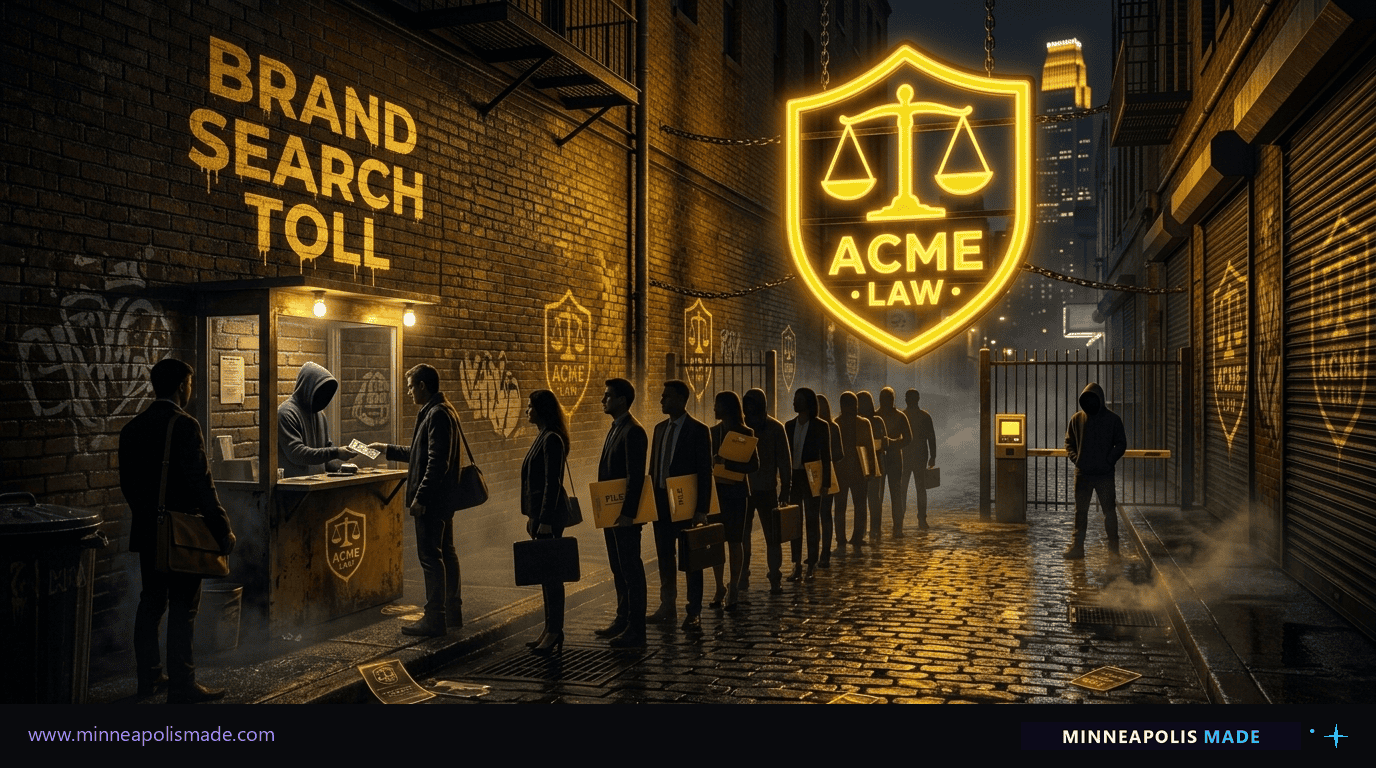
Cinematic concept illustration of brand-search interception as a protection racket: a massive amber-yellow ACME LAW shield logo suspended on chains over a clandestine alley payment booth, a hooded figure inside the booth collecting cash, a line of anonymous consumer silhouettes carrying briefcases and folders queued up to pay before passing under the shield, 'BRAND SEARCH TOLL' stenciled in dripping amber paint on the brick wall, illustrating how vendor-owned microsites build a tollbooth on a law firm's own brand searches

This is a protection racket wearing SEO language as a costume. The Goodfellas line captures the dynamic with uncomfortable precision: "Want to put up a billboard? Somebody types in Acme Corp, pay me."

And it is not just billboards. Every legitimate marketing channel a law firm spends on becomes a feeder for the vendor's tollbooth, because the predictable next move from a consumer who encounters the firm's name in any context is to open a phone and search for the firm by name. Once the vendor's microsite is one of the top results for that brand search, every one of these channels quietly turns into the vendor's revenue:

  • Ran a TV commercial. Viewer remembers "Acme Corp," pulls out their phone, searches "Acme Corp," lands on the vendor's microsite, fills out the contact form. The case converts. "F*** you... pay me!"
  • Cut a radio spot. Driver hears the firm's name on the morning commute, searches "Acme Corp" at the next red light, lands on the vendor's site, calls the listed number. The intake books the consult. "F*** you... pay me!"
  • Bought a highway billboard. Passenger types "Acme Corp" into Google before the next exit, lands on the microsite, taps the click-to-call button. The lead turns into a case. "F*** you... pay me!"
  • Printed a brochure for a community event. Attendee reads it that evening, searches "Acme Corp," lands on the vendor's site, fills out the form. The client signs the retainer. "F*** you... pay me!"
  • Sent direct mail to households in the firm's target ZIP codes. Recipient searches the firm's name to verify legitimacy before calling, lands on the microsite, dials the number on the page. The case converts. "F*** you... pay me!"
  • Sponsored a charity 5K, a Little League team, or a local theater. Anyone who recognized the name later searches it, lands on the vendor's domain, books a consult. The lead turns into a case. "F*** you... pay me!"
  • Sponsored a pro sports team, a stadium signage deal, or a jersey patch. Fan sees the firm's name on a baseline ad, an outfield wall, or a team jersey, pulls out their phone between innings, searches "Acme Corp," lands on the vendor's microsite, fills out the contact form. The retainer gets signed. "F*** you... pay me!"
  • Sponsored a podcast or local news segment. Listener searches "Acme Corp" the next time they think about hiring a lawyer, lands on the vendor's site, fills out the intake form. The per-case fee gets invoiced. "F*** you... pay me!"
  • Booked an attorney on a TV news interview about a high-profile verdict. Viewer searches the firm, lands on the microsite, taps the contact button. The client signs the retainer. "F*** you... pay me!"
  • Wrapped the firm's vehicles with logos and a phone number. Driver behind them at a stoplight searches the name, lands on the vendor's site, calls the listed number. The case converts. "F*** you... pay me!"
  • Earned a write-up in the local paper for a major case result. Reader searches the firm, lands on the microsite, books a free consult. The lead turns into a case. "F*** you... pay me!"
  • Ran Facebook, Instagram, or YouTube ads. User who didn't click the ad still remembers the name, searches for it later, lands on the vendor's domain, fills out the form. The client signs the retainer. "F*** you... pay me!"
  • Hosted a CLE, gave a keynote, or wrote a book chapter. Reader or attendee searches the firm afterward, lands on the vendor's microsite, contacts the listed intake. The case converts. "F*** you... pay me!"
  • Got a referral from a past client. Friend hears "call Acme Corp, they handled my case," types "Acme Corp" into Google, lands on the vendor's site, fills out the form. The retainer gets signed. "F*** you... pay me!"
  • Got a referral from another attorney. Referred party searches the firm's name, lands on the microsite, calls the number on the page. The lead turns into a case. "F*** you... pay me!"
  • Earned organic Google reviews visible across the firm's profile, citation directories, and Avvo, Justia, FindLaw. Searcher reads the reviews, lands on the vendor's site, books the consult. The client signs the retainer. "F*** you... pay me!"
  • Built a thirty-year reputation as the firm people in town call after a serious accident. Adult child of that household searches "Acme Corp" on behalf of their parent, lands on the vendor's microsite, fills the intake form. The case converts. "F*** you... pay me!"

Every single one of those is a channel the firm paid for, built, or earned. None of them are channels the vendor created.

But once the vendor's microsite ranks for the firm's brand name, every one of those channels becomes a lead-attribution argument the vendor can make: "That case came through our site. Per the contract, that is a per-case fee."

The firm cannot easily disprove it, because the click happened on a domain whose analytics the vendor owns. The firm's TV budget, radio budget, billboard budget, sponsorship budget, PR budget, and reputational equity have all quietly been refunneled into a per-case invoice from a third party.

This is also why per-case billing is the perfect business model for the vendor and the worst possible model for the firm. Per-case fees sound aligned because the vendor only gets paid when a lead closes. In the brand-search context, the vendor is being paid for cases that would have come in for free.

The firm cannot easily tell which cases were genuinely net-new and which were intercepted brand demand the firm's own marketing produced, because the vendor controls the analytics, the tracking numbers, and the click data. The firm pays either way.

The bigger the firm's brand grows, the more valuable the vendor's tollbooth becomes, and the more the vendor extracts.

Unique Insight

Or to put it in a frame every law firm marketing director already understands: the vendor has just signed your firm up for a Google Ads campaign you cannot turn off.

You cannot set a daily budget. You cannot pause it. You cannot exclude branded queries. You cannot review the keyword report. You cannot see which clicks closed. The campaign runs on the search demand your firm's own marketing creates. The campaign bills you per signed case the campaign claims to have produced. And the campaign never shuts off, because you do not own the campaign. The vendor does. The only way out is to stop using the vendor at all, and even then the campaign keeps running on a domain the vendor still controls, billed to whichever competing firm the vendor signs next.

What should have been free traffic, your own brand-search demand, is now a recurring per-case invoice from a third party who built nothing. They simply enrolled themselves as the tollbooth on a road your reputation built. For a national personal injury firm with healthy brand recall, the math becomes obscene quickly: an intercepted multimillion-dollar settlement at a per-case fee, repeated across the network for eighteen months, runs into seven figures of leakage on demand the firm itself created.

How Vendor Microsites Harvest Domain Authority From Your Brand

Cinematic concept illustration of domain authority harvesting as direct brand-shield copying: a weathered art-deco stone tower on the left with a massive glowing amber-yellow ACME LAW shield mounted on its façade (the firm's earned authority), a flimsy scaffolded tower on the right where a hooded figure operates a beam projector that copies the same ACME LAW shield onto a blank canvas panel, dozens of amber light streams flowing across the gap between the two shields, floating HUD labels reading 'DR 87 30 YEARS EARNED' over the stone tower and 'DR 0 to DR 34 18 MONTHS HARVESTED' over the scaffold, REGISTERED 2026 construction sign, illustrating how vendor microsites harvest decades of accumulated brand equity by copying a law firm's brand identity onto domains the vendor controls

A vendor's freshly registered carcrashlawyer-[city].com domain starts life at Ahrefs Domain Rating zero and Moz Domain Authority zero. By every conventional measure, it is invisible. The firm's domain, by contrast, has spent decades accumulating bar association listings, legal directory citations, press write-ups, and a deep review profile, the kind of authority that takes years to build and cannot be bought. Stamping the firm's name and address on every page of the vendor's microsite begins quietly transferring that authority to a domain the vendor controls, through Google's entity graph. Search engines associate the vendor's microsite with the firm's brand entity, and the branded backlinks the firm earned over decades begin to count as validation signals for the vendor's domain, because the entity sitting on the microsite is the same entity sitting at the other end of those links.

Original Data

The numbers are not subtle. In the vendor networks we have analyzed, microsites consistently climb from Ahrefs Domain Rating 0 at launch to DR 26 within twelve months, and DR 34 within eighteen months. We have seen older properties in the same templated networks measure higher.

Those numbers are not earned by the microsite's own content, its own backlink portfolio, its own original research, or its own audience. They are not earned at all. They are harvested, through co-occurrence and entity association, from the client firm's brand equity.

Microsites in vendor-owned law firm networks consistently climb from Ahrefs Domain Rating 0 at launch to DR 26 within twelve months and DR 34 within eighteen months. The authority is not earned through the microsite's own content or backlinks. It is harvested from the client firm's brand entity through name, address, and phone co-occurrence on every page, which causes search engines to associate the firm's accumulated branded backlinks with a domain the firm does not own.

This is what makes the program so structurally extractive. The vendor's domain is not just renting tollbooth access to the firm's brand searches. It is also collecting an equity transfer in the form of domain authority that the firm spent decades building, now showing up on a property the firm does not own. Every month the program runs, the vendor's portfolio asset grows in market value while the firm's marketing budget feeds it.

And on contract end, the vendor walks away with a domain that carries DR 26 or DR 34, ranks for the firm's brand terms, sits at the firm's real address in Google's local graph, and is ready to be repointed at a competing firm the next morning. The competing firm gets all of that accumulated authority for the price of a per-case fee. The firm whose decades of work built it gets nothing.

How a Microsite With Zero Traffic Still Generates Leads: The Bait-and-Switch Behind the First Twelve Months

Here is the fact that does not survive a hard look. At month two of a microsite engagement, the vendor's domains are thirty to sixty days old, carry zero domain authority, and rank nowhere meaningful for any keyword that any human searches. They could not be generating organic traffic at any volume. They are, by every measurable signal, dead.

And yet the vendor's invoice shows signed leads. The firm closes cases. The monthly report looks healthy. Everyone concludes the program is working. So how is this possible?

Unique Insight

The leads are real. They just are not coming from where the vendor says they are.

The bait-and-switch works like this. A microsite vendor running a network of fifty or two hundred firms across a national portfolio has a steady appetite for cheap leads they can route through to early-engagement clients to keep those clients subscribed. They source the leads externally, from lead marketplaces, broker networks, paid ads run against generic queries, rotating call-tracking numbers on totally unrelated domains, and resale partnerships with other marketing companies. The cost per lead in those channels is predictable and small relative to the per-case fee. The vendor pays it, attaches a tracking number that routes through the vendor's intake center, and bills the client firm per signed case as though the lead came from the new microsite the firm just paid them to build.

This is the reason the vendor insists on owning the intake. It is the only way the bait-and-switch survives audit. If the firm could see the source of every call directly, the externally-sourced leads would be visible immediately, the actual origin of each conversion would be obvious, and the attribution fiction would collapse inside thirty days. By routing every lead through the vendor's tracking layer, the vendor controls the attribution narrative. Every signed case becomes a microsite-attributed case, regardless of where the lead actually originated.

The pattern typically runs for the first six to twelve months. The vendor sources leads externally. The firm sees results. The contract renews. The internal champion at the firm who signed off on the program points to the case volume as proof of ROI, and that proof is real, in the sense that real cases really did sign. The cases just did not come from the asset the firm thought it was paying for.

Meanwhile, the actual asset being built is the one we described in the authority-harvest section above. The vendor's brand-name footprint deepens on domains the vendor owns. The brand-search aging accumulates. The directory ecosystem ingests the wrong NAP. AI engines begin associating the firm's name with the vendor's domains. None of that is visible in the monthly performance report, because the monthly performance report measures leads and cases, both of which the vendor is supplying from a different source.

Then somewhere between month twelve and month eighteen, the dynamic flips. The aged microsites finally rank for the firm's brand searches. The vendor no longer needs to source leads externally because the program is, finally, actually working. It just is not working on the keywords the original proposal said it would, and it is not working on any keyword the firm was hoping to win. It is working on the firm's own name, intercepting brand demand the firm spent decades generating.

By that point the firm has been paying for a year, has built no transferable assets of its own, and has migrated from paying the vendor for externally-sourced leads to paying the vendor to capture brand demand the firm itself produced. The early-engagement bait got the firm to month twelve. The switch is what runs from month twelve to month eighteen and beyond.

A microsite generating leads at month two of a vendor engagement is mathematically impossible from organic search alone, because a 30 to 60 day old domain carries zero domain authority and ranks nowhere meaningful. The leads are real but externally sourced: the vendor purchases leads from lead marketplaces, broker networks, and paid ads, routes them through a vendor-controlled tracking number and intake center, and bills the client firm per signed case as if the leads originated from the microsite. The pattern runs for six to twelve months until the vendor's domains have aged enough to actually intercept the firm's brand searches, at which point the vendor stops sourcing externally and begins billing the firm to capture brand demand the firm's own marketing produced.

Unique Insight

The firm was never paying for leads. The firm was paying for time. The vendor needed twelve months to age into the firm's brand entity, and the externally-sourced leads were the rent the vendor paid to keep the firm subscribed during the construction phase. Once construction was complete, the rent was no longer necessary, because the building was paid off — by the firm, with cases. Everything from month twelve forward is pure margin on an asset that the firm built with the firm's marketing budget, reputation, and name, all of which the vendor still owns on the day the firm signs its termination letter.

A Worked Example: How the Microsite Program Damages "Acme Personal Injury" Over 18 Months

Personal Experience

To make the harm concrete, here is a worked example drawn from a real impact assessment our team prepared for a national personal injury firm one month into a microsite vendor engagement. We will call the firm Acme Personal Injury.

The vendor has built two new "car accident lawyer" microsites on EMDs the vendor registered, both carrying Acme's name and address on every page. Acme is billed a flat per-signed-case fee for any lead the microsites produce.

The same vendor runs an identical eight-site, seven-firm template network on shared hosting for other personal injury firms across the country, several of which are twelve months further into the program than Acme is.

At one month old, Acme's microsites produce essentially zero search traffic. The vendor frames this as normal SEO ramp time and projects break-even by month six. The actual trajectory, visible in the older client sites already operating in the same network, is the trajectory Acme is on unless something changes.

Original Data

Across the seven-firm vendor network we analyzed, the older microsites (10 to 14 months old) show four consistent damage patterns.

Brand-search interception appeared in five of seven older client portfolios: a search for "[client firm name] [city] car accident attorney" returned the vendor's microsite on page one alongside or above the firm's own domain.

City cannibalization appeared in four of seven: the vendor's microsite ranked in small and mid-size markets where the firm's main domain had no city page at all, becoming the firm's only search presence in that market.

Entity dilution appeared in three of seven: duplicate NAP data across the network created Google Business Profile trust signals that conflicted with the firm's real listing, and in one case a Google-facing description on a microsite misnamed the client firm entirely, publishing the wrong firm name at the correct firm address.

Doorway-network footprint appeared across all seven: shared hosting, near-duplicate templates, and shared schema markup that fits Google's scaled content abuse and doorway policies precisely.

Across a vendor microsite network serving seven personal injury firms, brand-search interception appeared in five of seven older client portfolios, city cannibalization in four of seven, and entity dilution in three of seven, including one case where the vendor's Google-facing description misnamed the client firm at the client's real address. All seven sites sit on the same shared-hosting footprint, which fits Google's doorway and scaled-content abuse policies.

Original Data

We did not stop at the seven firms in the vendor's known portfolio. When we ran reverse-WHOIS and pattern-matching searches against the vendor's registered domains, we found something that made the scale of the operation undeniable.

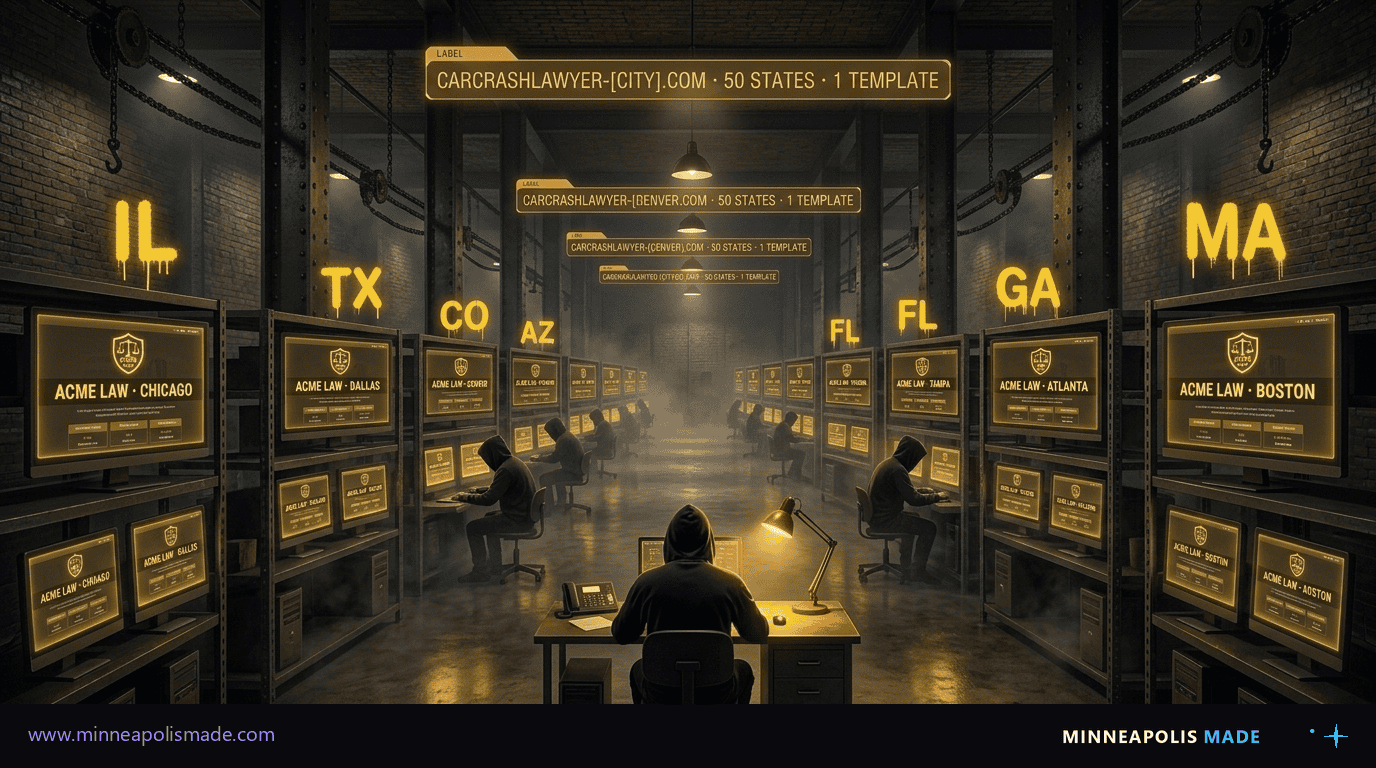
The vendor had registered variations of carcrashlawyer-[city]-pattern domains across fifty different states. Not five, not a dozen. The full national footprint, with much of it already pointed at templated WordPress installs sitting on the same shared-hosting infrastructure as Acme's two microsites. This was not a boutique scheme run for a handful of firms. It was a factory.

Cinematic concept illustration of the 50-state brand-theft factory floor: a vast clandestine industrial brick warehouse stretching into deep perspective, rows of amber-glowing monitors on both sides each displaying an identical templated ACME LAW webpage with the same shield logo and a different city name swapped in (ACME LAW CHICAGO, DALLAS, DENVER, PHOENIX, TAMPA, ATLANTA, BOSTON), state codes (IL, TX, CO, AZ, FL, GA, MA) stenciled in dripping amber paint above each row, hooded figures at scattered terminals, a hooded operator at a primary desk in the foreground with a warm amber lamp, floating HUD label reading 'CARCRASHLAWYER-[CITY].COM 50 STATES 1 TEMPLATE,' illustrating the templated 50-state infrastructure behind the vendor brand-theft scheme

Pulling the page source from a dozen of those templated sites confirmed what the structural evidence implied. Every page across every state was an identical HTML scaffold with three swap-in slots: the client firm's name, the client firm's street address, and the client firm's primary phone number. Switch those three fields and an Acme microsite became a Boise microsite became a Tampa microsite. No editorial variation, no jurisdiction-specific legal content, no real photography. Same site, same scaffolding, three find-and-replace operations.

The most damaging discovery was on the content layer. The vendor had scraped one of Acme's actual attorney bio pages directly from the firm's own website and republished it verbatim on a microsite. No rewriting. No canonical tag pointing back to Acme's domain. No attribution. The bio, the credentials, the photo description, the bar admissions, the case results, all of it, sat on a domain Acme did not own, indexed by Google, competing with Acme's real bio page for the attorney's own personal name.

Reverse-WHOIS analysis revealed the same vendor had registered carcrashlawyer-[city]-pattern domains across fifty different states. Source inspection of a dozen templated sites confirmed a single HTML scaffold with three swap-in fields (firm name, street address, phone number) applied to every property. In one case, the vendor scraped a client firm's actual attorney bio page verbatim and republished it on a domain the firm did not own, with no canonical tag back to the original, indexed by Google in direct competition with the firm's real bio for the attorney's own name.
Dual-line chart titled 'The 18-Month Brand-Equity Transfer.' Amber line shows the vendor microsite's Domain Rating climbing from DR 0 at month 0 through DR 26 at month 12 to DR 34 at month 18, harvested from the firm's brand entity. Coral line shows the firm's cumulative per-case fees rising in parallel from $0 to $33,000 by month 12 to roughly $100,000 by month 18, crossing the vendor DR curve in the cannibalization phase. Four phase bands run along the bottom: Build (months 0 to 3), Early Ranking (3 to 6), Brand-Search Migration (6 to 12), Cannibalization and Lock-In (12 to 18). Illustrates the article's central thesis that the vendor's portfolio asset grows in value while the firm's marketing budget feeds it.

The 18-Month Damage Curve: From Free Pilot to Brand Hostage

The economic shape of the microsite program is the part vendor pitches consistently leave out. The harm is small at month one, modest at month six, and structural by month eighteen. Each phase makes the next harder to escape.

Months 0 to 3 (build phase). The vendor registers the EMDs, stands up templated city pages, and writes the firm's name and address into every page. Search traffic is near zero. The firm pays a setup fee and possibly a monthly retainer. No cases come through the microsites yet. Exit cost: near zero.

Months 3 to 6 (early ranking phase). Long-tail city pages start ranking for low-competition phrases the firm's main domain does not target. The vendor's monthly report shows ranking growth and the first per-case fees. The firm sees inbound leads it did not have before and concludes the program is working.

Months 6 to 12 (brand-search migration phase). Because the firm's name appears on every microsite page, search engines start associating the vendor's domains with the firm's brand entity. Brand searches like "[firm name] [city]" begin returning the microsite alongside the firm's main domain.

Per-case billing accelerates, but a growing share of those cases would have come through the firm's own marketing for free. The firm's main domain shows no growth in branded organic traffic, because the microsites are intercepting some of it.

Months 12 to 18 (cannibalization and lock-in phase). In thin local markets, the vendor's microsite outranks the firm's main domain on city plus practice area searches. In small markets, the microsite becomes the firm's only search presence.

Per-case fees now consume budget that would otherwise have built location pages, reviews, and links on the firm's own domain. Internal advocates for the program point to its case volume as proof of ROI. Internal critics cannot prove how many of those cases the firm would have signed anyway, because the vendor controls the data.
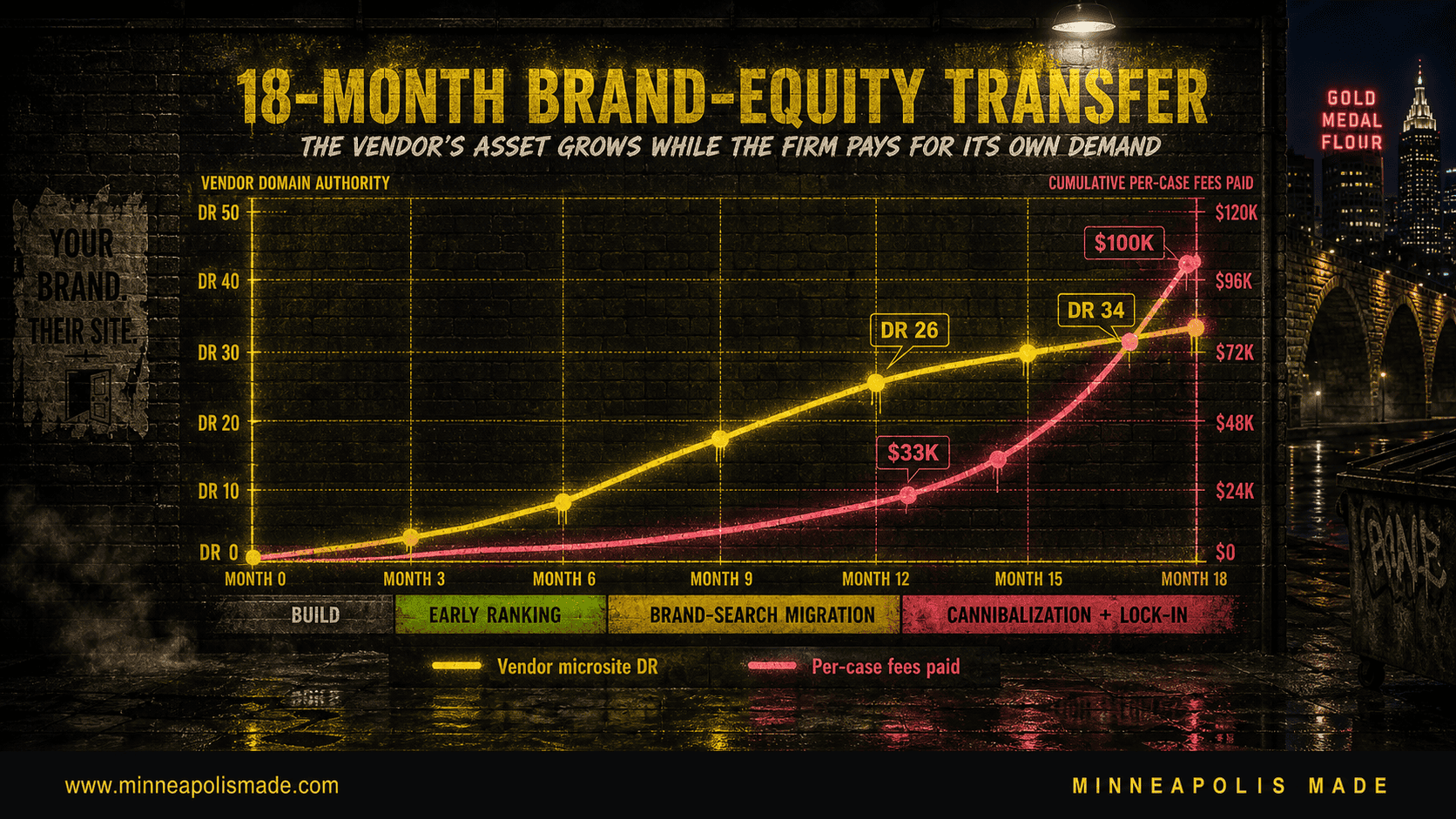
Month 18 and beyond (re-brand risk). If the firm tries to leave, the vendor keeps the domains. Those domains carry the firm's name on every page, rank for the firm's brand searches, and sit at the firm's real address in Google's local graph.

The vendor can re-brand them for a competing firm in the same market the following month and continue billing that competitor per case for the demand the original firm spent years building.

How Do Doorway and Microsite Networks Hurt Google Business Profile Rankings?

Google Business Profile (GBP) treats NAP (Name, Address, Phone) consistency as a top-five Local Pack ranking factor, per Whitespark's annual Local Search Ranking Factors survey. Doorway and microsite networks almost always poison the firm's NAP graph. The secondary sites list a slightly different business name, a virtual address, or a tracking phone number, and Google's local algorithms detect the conflict.

Worse, vendor microsites often share the same address or phone as the firm's real profile, which triggers Google's duplicate-listing filters. In one case we audited, a firm had three GBP suspensions in eighteen months, all traceable to a microsite network the previous vendor had built without disclosing the EMD list. Each suspension cost the firm a minimum of three weeks of Local Pack visibility plus the manual reinstatement work, in a category where the Local Pack drives the majority of new client intake.

If a vendor is talking about "city-specific microsites," "location landing pages on separate domains," or "satellite sites we host for you," the architecture they are describing is a doorway architecture. The right pattern is a single authoritative domain with internally-linked city pages that contain real, distinct content. Same site. Same NAP. Same author. Different cities served by genuinely different on-the-ground content.

The AI and Directory Cascade: How One Wrong Phone Number Poisons Your Entire Knowledge Graph

The Google Business Profile damage described above is contained inside Google's local graph. The harder problem, and the one that does the most durable damage in 2026, is what happens to a firm's AI search visibility when fifty vendor microsites carrying a slightly different phone number, address, or firm name get crawled by the systems that feed AI Overviews, ChatGPT search, Perplexity, Bing Copilot, and Claude.

Generative AI search engines do not look up an answer at query time the way Google's blue links do. They build an internal entity profile for every business by aggregating signals across the open web, weighted by source authority and statistical consistency. The same is true of the local directories (Yelp, Avvo, Justia, FindLaw, Yellowpages, Foursquare, Bing Places, Apple Maps Connect) that increasingly feed those AI systems. Both the AI engines and the directories reward consistency. They penalize fragmentation.

Unique Insight

This is where the 50-state vendor footprint becomes load-bearing in a way most firms never consider. The vendor's microsites publish the firm's name with a vendor-controlled tracking phone number, a vendor-controlled intake address, or even a slightly mangled firm name on fifty domains. The firm's own website publishes the correct NAP on one domain. The AI engines and the directories see fifty sources of "wrong" data and one source of "right" data. They do not break that tie in the firm's favor. They break it in favor of the statistically louder signal.

Within ninety days of the vendor network aging in, the firm's brand entity in Google's Knowledge Graph, in Bing's entity store, in Perplexity's source index, and in ChatGPT's web-search retrieval starts returning the vendor's phone number when a consumer asks "what's Acme Personal Injury's phone number?" The directory ecosystem follows in parallel. Avvo's auto-claim system updates the listing to match the vendor's tracking number. Yelp inherits the vendor's intake address. FindLaw flags the firm's listing as having inconsistent NAP and downranks it in their internal trust score. None of this requires the vendor to attack the directories. It happens by gravity, because the vendor's footprint outweighs the firm's.

Original Data

In the seven-firm vendor portfolio we analyzed, three of the older client firms had AI-engine query results that returned the vendor's tracking number as the firm's primary phone within twelve months. In two of those cases, the consumer who dialed the vendor number was answered by the vendor's intake center, screened, and brokered to a different firm entirely. The original firm never saw the call, never knew the lead existed, and continued paying its monthly SEO and per-case-fee invoice while the asset it spent years building was being routed elsewhere by the very AI systems consumers now use to find them.

Generative AI search engines (ChatGPT, Perplexity, Google AI Overviews, Bing Copilot) and local directory ecosystems (Yelp, Avvo, Justia, FindLaw, Yellowpages) build entity profiles by weighting consistency across many sources. A vendor microsite network publishing a law firm's name with a tracking phone number on fifty domains outweighs the firm's correct NAP on one domain by 50 to 1. Within roughly ninety days, AI-engine answers to "what is [firm name]'s phone number" begin returning the vendor's tracking number, routing consumers to the vendor's intake center where leads can be brokered to competing firms.

The recovery problem is what makes this the most expensive part of the damage. Even after the firm forces the vendor to remove its NAP data from every microsite, three layers of residue remain. Directory listings may have permanently auto-updated to the wrong phone and require manual outreach to each directory operator. AI training data for any model whose snapshot was taken during the contaminated window will continue returning the wrong number until the model retrains, which can take six to eighteen months. The Knowledge Graph at Google, Bing, and the AI search vendors will downrank the firm's brand entity for trust-score reasons until enough fresh signals overwrite the old fragmentation, which is on its own timeline.

This is the closing argument on the asymmetry of the damage. The vendor walks away from the contract clean. The firm walks away with a six- to eighteen-month cleanup project across multiple ecosystems it does not control, while the AI systems consumers actually use to find law firms in 2026 continue returning the wrong answer.

How to Tell If Your Current Vendor Is Already Running This Scheme: A 60-Second Test

Most firms reading this article already have an SEO or marketing vendor. The question is not whether to evaluate the next proposal. It is whether the program already running has been quietly extracting brand equity for the last six, twelve, or eighteen months. The diagnostic for that takes about a minute and costs nothing.

Step 1: open a reverse-WHOIS tool. Free options include viewdns.info/reversewhois, whoxy.com/reverse-whois, and dnslytics.com/reverse-whois. Type in the registrant name, registrant email, or company name your vendor uses on their main agency website. Reverse-WHOIS will return every domain currently registered to that name, email, or organization in the WHOIS database.

Step 2: read the list. A legitimate agency might own its primary brand domain, a few alternate spellings, and maybe a handful of campaign-specific microsites for actual paying clients (with the client's permission). A microsite vendor will return a list that looks structurally different: fifty to two hundred domains in a single registrant cluster, all sharing the same EMD pattern, all registered within the same one to three month window, often with consecutive registration dates and identical name servers. Carcrashlawyer-Chicago.com registered the same day as carcrashlawyer-Dallas.com, carcrashlawyer-Denver.com, and forty-seven others is the fingerprint.

Step 3: cross-reference with your own brand. Run a Google search for "[your firm name]" site:[suspicious-domain.com] for any domain in that registrant cluster you do not recognize. If your firm's name, address, or attorney bios appear on a domain you do not own, the vendor is publishing your brand on their infrastructure without you ever having seen the site they built.

Step 4: check Google Search Console properties. Log into your firm's GSC. Look at the list of verified properties associated with your domain or your verified user account. If there are properties you do not recognize, especially properties whose URLs match the suspicious cluster, the vendor has been tracking the performance of those microsites under your account, which means their bills attributing leads to those sites have data you can audit. If there are no such properties and the vendor still bills you per case on traffic you cannot measure, that is its own answer.

Reverse-WHOIS lookups on free public tools (viewdns.info, whoxy.com, dnslytics.com) surface the entire domain footprint of a microsite vendor in under sixty seconds. A clustered registrant with fifty to two hundred EMD domains sharing identical registration dates, name servers, and templated patterns is the unambiguous signature of a vendor-owned microsite network. If a law firm's brand name, address, or attorney bios appear on any domain in that cluster, the firm's brand equity is being published on infrastructure the firm does not own.

How Do You Spot a Microsite or Off-Site SEO Scheme in a Vendor Proposal?

The pitch language is remarkably consistent across vendors running this playbook. Watch for these phrases in any proposal:

  • "Microsite program" or "satellite microsites"
  • "Off-site SEO" framed as a parallel program to the firm's main website
  • "City-targeted domains" or "geo-domains"
  • "Local funnel network" or "local domination network"
  • "Lead capture sites" separate from the firm's main site
  • "Per signed case" or "per qualified lead" billing tied to those sites
  • "PBN" or "private blog network" (this is link manipulation, a separate but related Google policy violation per link spam policies)
  • Any setup where the domains, hosting, or Google Search Console properties are held in the vendor's name rather than the firm's

Ask four specific questions before signing:

  1. Will every domain, hosting account, GSC property, and GBP listing created during the engagement be registered to the firm and transferable on termination?
  2. Will every page you build live on the firm's primary domain, or will it live on domains the vendor controls?
  3. Will every contact form route directly to the firm's intake with no vendor-side tracking layer that the firm cannot turn off?
  4. Will the contract carve out branded searches (any query containing the firm's name) from per-case billing?

A legitimate vendor will answer yes to all four without hedging. A microsite vendor will start qualifying the answers on questions one and two.

If a table is easier to scan against the vendor's actual proposal, here is the side-by-side. A real engagement looks like the left column. A microsite scheme looks like the right.

DimensionLegitimate SEO AgencyMicrosite / Off-Site SEO Vendor
Domain ownershipAll domains registered to the firmDomains registered to the vendor
Hosting accountFirm's hosting, firm's billingShared vendor infrastructure, often with other firms
Where the content livesFirm's primary domainA network of EMDs the vendor controls
Billing modelHourly, retainer, or scoped projectPer signed case, per qualified lead, per applicant
GSC accessFirm verified as owner; agency added as userVendor verified as owner; firm has no access
AnalyticsGA4 in the firm's account, raw data accessibleVendor's internal dashboard, no raw data exposed
Contact form destinationDirect to firm intake, firm-controlledThrough a vendor tracking layer that the firm cannot turn off
Branded-search treatmentCarved out of any performance billingCharged the firm at the same rate as cold-search leads
On contract terminationAll assets transfer cleanly to the firmVendor keeps domains, can re-point them to a competitor
Bar advertising disclosureEngagement is disclosed and compliant with state rulesVendor relationship undisclosed on the public-facing site

If any row in the right column matches the proposal in front of you, the engagement is functionally the microsite scheme described in this article, no matter what the cover page calls it.

Unique Insight

The hidden cost of the microsite engagement is not the per-case fees. It is the reputational entanglement. If the firm's NAP and brand entity appear on a network of thin EMD sites that Google eventually classifies as doorway abuse, every algorithmic update that targets that pattern has a chance of pulling the firm's primary domain down with it. Disentangling the footprint after the fact requires registrar outreach (often without the vendor's cooperation), canonical and 301 surgery, NAP cleanup across the local graph, and sometimes Google reconsideration requests. The cleanup easily costs more than the original engagement, in a phase of the firm's growth when that budget would have been better spent on owned assets.

This Scheme Is Not Unique to Law Firms. It Runs in Every YMYL Vertical.

The mechanic that makes this scheme work for law firms is not legal-specific. The templated scaffold the vendor uses does not care whether the swap-in slot says Acme Personal Injury or Acme Financial Advisors or Acme Roofing. The brand-entity math is identical. The authority-harvest mechanic is identical. The per-case (or per-lead, or per-applicant) billing model is identical. The eighteen-month damage curve is identical.

The categories where this plays out are the same categories Google's Search Quality Rater Guidelines treat as Your Money or Your Life (YMYL), the topics Google instructs human raters to scrutinize most strictly. That is not a coincidence. YMYL categories are exactly the verticals where consumers search for trust before they call, which is exactly the search behavior that makes brand-name hijacking financially worth running.

Here is the same vendor playbook, vertical by vertical:

  • Legal services. EMDs like carcrashlawyer-[city], divorce-attorney-[city], dui-lawyer-[city]. Billed per signed case. Most exposed because of YMYL scrutiny, bar-advertising rules, and the high per-case value of an intercepted brand search.
  • Insurance. EMDs like auto-insurance-quotes-[city], home-insurance-[state], life-insurance-[city]. Billed per qualified lead or per policy bound. The firm's brand recall from radio, TV, and direct mail drives the searches; the vendor's microsite intercepts them.
  • Financial services and advisory. EMDs like financial-advisor-[city], wealth-management-[city], debt-relief-[state]. Billed per consultation booked. Authority harvest is especially valuable here because financial advisor entity signals are slow to build organically.
  • Real estate. EMDs like homes-for-sale-[city], [city]-realtor, buy-house-[city]. Billed per closed transaction or per qualified buyer. The vendor's site looks indistinguishable from a legitimate brokerage page because real estate templates are already homogeneous.
  • Home services (high-cost / safety-critical). EMDs like roofing-[city], foundation-repair-[city], emergency-plumber-[city]. Billed per booked job. Google has been treating high-ticket home services with YMYL-level scrutiny since the 2023 to 2025 helpful content updates because the financial and safety stakes are real.
  • Education. EMDs like [city]-trade-school, online-mba-programs-[state], nursing-school-[city]. Billed per applicant or per enrolled student. The lifetime value per intercepted enrollment is high enough that vendors aggressively scale this category nationally.

If your business operates in any of those six categories, the analysis in this article is not a law firm problem. It is your problem with different EMDs.

The defensive contract clauses listed later in this article apply identically across all six verticals. So does the diagnostic test: who owns the domains, the GSC properties, the GBP listings, the hosting, and the analytics? If the answer is anyone other than the firm signing the check, the scheme described above is the scheme being run, regardless of whether the swap-in field on the templated scaffold says attorney, roofer, insurance agent, financial advisor, realtor, or admissions counselor.

No Contract Can Fix Off-Site SEO. The Damage Happens Where Contracts Cannot Reach.

Most of this article up to this point has described what the right contract would look like if a firm absolutely had to go through with an off-site SEO arrangement: ownership transfer, no off-domain content carrying the firm's name, branded-search carve-outs, post-termination non-re-pointing. Those clauses are real protections, and any firm currently in a vendor arrangement should insist on them. They are the minimum acceptable bar.

But here is the sharper truth that the four clauses do not address.

Unique Insight

There is no version of off-site SEO that is actually worth doing. Even with a perfect contract, even with airtight ownership clauses, even with the cleanest possible termination protections, a microsite carrying the firm's name on a domain the firm does not own has no legitimate upside the firm could not achieve more cheaply, more safely, and with full asset ownership on its own primary domain.

Every reason an off-site microsite was supposed to exist is solvable on the firm's own domain. Want more city-targeted landing pages? Build them on the firm's own domain. Want practice-area depth? Build it on the firm's own domain. Want long-tail SEO? Build it on the firm's own domain. There is literally no SEO outcome an off-site domain can deliver that an on-site domain cannot deliver better, cheaper, and with the firm keeping every dollar of equity it builds.

The contract is therefore a defense against a downside, not an argument for an upside. It is minimum-acceptable protection against a strategy that has no legitimate marketing value in any form. And the downside cannot be contracted away, because three structural damage vectors run through systems no contract reaches.

  1. The AI ecosystem. ChatGPT, Perplexity, Google AI Overviews, Bing Copilot, and Claude with search ingest whatever they find on the open web and bake it into their entity profiles. They do not ask permission. They do not check for contractual licenses. They do not unscrape bad data when the vendor contract terminates. Once a firm's name has been published on a vendor's domain alongside a slightly wrong phone number, that wrong number is in the AI training corpus and the AI search index. The firm has no contractual relationship with OpenAI, Anthropic, Perplexity, Microsoft, or Google's AI division through which to demand removal. Even after the bad data is scrubbed from the source, the models that already trained on it will keep returning the bad answer for the next six to eighteen months until they retrain.

  2. The directory and NAP ecosystem. Avvo, Justia, FindLaw, Yelp, Yellowpages, Foursquare, Bing Places, and Apple Maps Connect crawl whatever they find on the open web and either auto-update existing listings or auto-create new ones. They do not check for contracts. They will pull bad NAP data, normalize it as canonical inside their internal trust graphs, and propagate it across the entire local-search ecosystem. Cleaning up that propagation after the fact requires individual outreach to each directory operator, often with waiting periods, often with proof-of-ownership requirements, and sometimes with no available remedy at all.

  3. Google's Knowledge Graph. Google builds entity profiles by consensus across thousands of sources. Once Google has been told fifty times that a firm's phone number is the vendor's tracking number, Google's confidence score for the correct number drops, and the firm's brand entity becomes a fragmented record in the graph. No clause in any vendor contract changes Google's internal entity-confidence math. Google does not negotiate with the parties whose data fed the confusion.

A contract is a defensive instrument against the vendor. It does not protect the firm against ChatGPT, Perplexity, Avvo, the open-web crawler ecosystem, or Google's Knowledge Graph. Those systems do not read contracts. They read the web. And once they have read something incorrect about a firm, no contractual remedy reaches into their internal data stores to fix what they learned.

The only protection against having a firm's brand entity scraped, frozen, and propagated incorrectly across systems the firm does not control is to never publish the firm's brand entity on a domain the firm does not own in the first place. The contract is a bandage. Not publishing is the only actual fix.

What Should Law Firms Build Instead?

The pattern that actually wins in 2026 for YMYL businesses looks nothing like a vendor-owned microsite network. It looks like this:

  1. One authoritative primary domain owned by the firm, with real attorney bios that include credentials, bar admissions, photos, and case results (within ethics rules).
  2. City-specific pages on the primary domain, each with genuinely distinct content: local landmarks, court information for that jurisdiction, regional case examples (anonymized), and on-the-ground details that prove the firm actually serves that city.
  3. A clean, consistent NAP across the GBP profile, the website, bar association listings, and legal directories like Avvo, Justia, and FindLaw.
  4. Original content with information gain: in-depth practice area pages, attorney-written blog posts, original case studies (with permission), and FAQ content that answers the specific questions clients actually ask during intake.
  5. Schema markup for Attorney, LegalService, LocalBusiness, and FAQPage, applied per page rather than templated site-wide.
  6. A locked brand SERP: the firm's own domain plus owned profiles (GBP, LinkedIn, Avvo, Justia, bar association, Wikipedia where appropriate) filling the entire first page for the firm's name. No room for a vendor microsite to wedge into the brand results later.

This approach takes longer to ship. It produces fewer pages. It does not look impressive in a monthly report deck. It just works, and it survives Core Updates instead of collapsing on contact with them. More importantly, every asset built belongs to the firm permanently, which means every month of investment compounds rather than rents.

If You Are Already in a Microsite Program: The Five-Step Exit Playbook

Prevention is cheaper than rescue, but rescue is still possible if the program is caught early. The damage curve described earlier compounds, which means the cost of exiting at month two is dramatically lower than the cost of exiting at month eighteen, and the cost of exiting at month eighteen is dramatically lower than the cost of doing nothing. If the diagnostic test surfaced a vendor-owned microsite footprint carrying your firm's name, here is the order of operations.

  1. Audit and map the entire footprint before doing anything else. Use the reverse-WHOIS and Google site-search techniques from the 60-second test to surface every domain in the vendor's portfolio carrying your firm's name, address, or attorney content. Capture screenshots of every page, archive the WHOIS records, and document the registration dates, name servers, and hosting infrastructure. You are building an evidentiary record for the contract enforcement and (if it comes to it) the trademark conversation.

  2. Demand asset transfer in writing. Send the vendor a written request, under the existing contract or under the implied license created by your contractual relationship, to transfer registration of every domain carrying your firm's name to the firm. Include hosting, Google Search Console properties, Google Business Profile listings, analytics accounts, and any other vendor-held assets associated with your brand. Set a deadline. A vendor running this scheme will refuse, qualify, or stall. That refusal is the trigger event for the next steps.

  3. Cease publication of your NAP data on the vendor's domains. Whether or not the vendor cooperates with transfer, demand removal of your firm's name, address, attorney photos, attorney bios, and phone number from every domain in the vendor's network. This is both a contractual claim and, if the firm's mark is being used commercially without authorization, a trademark claim. Removing the NAP data severs the entity-graph link Google uses to associate the vendor's domains with your firm and starts unwinding the brand-search interception.

  4. Implement the four defensive clauses in any continuation or replacement engagement. If the firm is staying with the same vendor in a restructured arrangement, or transitioning to a new vendor, the four clauses (ownership transfer, no off-domain content carrying the firm's name, branded-search carve-out, post-termination non-re-pointing) become preconditions. No clauses, no engagement.

  5. Rebuild equity on the owned domain immediately. The brand-search demand the firm has been generating for years does not stop while the cleanup runs. Redirect that demand back to the firm's primary domain by publishing the city-specific content, the practice-area depth, and the schema markup the vendor's microsites had been hosting (using your own content, not scraped from theirs). The faster the firm's domain becomes the most authoritative result for its own brand searches, the faster the vendor's network loses ranking on those queries, even before any domain transfer is litigated.

None of these steps require Google's cooperation. They do not require waiting for an algorithmic correction. They do not require the vendor's good faith. They are unilateral steps the firm can take using the firm's own contractual rights, its own marketing budget, and (if necessary) its own legal counsel.

Worried a vendor is building microsites in your firm's name?

We will run a free forensic audit of your domain footprint, NAP graph, vendor-controlled properties, and backlink profile to identify any microsite, doorway, or EMD entanglements that could be putting your firm's brand equity at risk.

Request a Free Microsite Audit

Frequently Asked Questions

How is a vendor microsite different from a legitimate city landing page?

A legitimate city page lives on the firm's primary domain, has genuinely distinct content for that location (local courts, jurisdiction-specific information, regional case examples), and routes contact directly to the firm with no intermediary. A vendor microsite lives on a separate domain the firm does not own, has near-duplicate templated content, routes contact through the vendor, and bills the firm per case for traffic the firm's own brand often created. Same intent, different execution, opposite ownership.

Can a law firm recover from a vendor-owned microsite program?

Yes, but recovery requires removing the firm's NAP data from the vendor's domains (which often requires the vendor's cooperation), consolidating any salvageable content onto the firm's primary domain, fixing NAP inconsistencies across the local graph and the AI-engine entity profiles, disavowing any spammy backlinks built to support the microsites, and in some cases filing a Google reconsideration request. Recovery typically takes six to twelve months on Google's side, six to eighteen months on the AI-engine side as those models retrain, and is far cheaper to prevent than to clean up. The five-step exit playbook above is the order of operations.

What contract clauses are the minimum if a firm is already in one of these arrangements?

Four clauses are the minimum acceptable bar, though the better answer is to exit, not renegotiate:

  1. Every domain, hosting account, GSC property, GBP listing, and analytics property created during the engagement is registered to the firm and transferable on termination.
  2. No off-domain content carrying the firm's name or address may be published without written approval.
  3. Branded searches (any query containing the firm's name) are carved out of per-case or per-lead billing.
  4. On termination, the vendor agrees not to re-point any domain carrying the firm's name to a competitor for a defined period.

The Bottom Line for Law Firms Evaluating SEO Proposals

Doorway pages, EMD spam, and vendor-owned microsite programs are not clever workarounds. They are explicit Google policy violations, they fail predictably in YMYL categories, and the cleanup costs more than the original engagement. The newest version of the scheme is the most dangerous, because it does not present itself as a policy gray area. It presents itself as a turnkey lead-generation service with a per-case billing model that sounds aligned to the firm's interests, right up until the firm realizes it has spent a year paying a vendor to capture demand the firm's own brand created.

If you are a law firm evaluating an SEO proposal, the single most important question is not "what will my rankings look like in six months." It is "who owns the assets you are about to build, and what happens to them on the day this contract ends." One primary domain owned by the firm. Real content. Clean NAP. Genuine authority signals. Anything else is the slow-motion version of the case described above.

And if a vendor ever pitches a "microsite program," a "satellite network," or any flavor of off-site SEO billed per case, do what we recommend every firm do with proposals like that: forward it to a second opinion before signing anything.

Have a microsite or off-site SEO proposal you want a second opinion on?

Send it over. We will read it, flag any doorway, EMD, microsite, or PBN tactics, identify which assets the vendor would actually own, and tell you what the contract really commits your firm to. No charge, no sales pitch.

Get a Free Proposal Review


Christopher Merry

Written and curated by

Christopher Merry

Founder & Lead Developer, Minneapolis Made

25+ Years Experience 500+ Projects Delivered WordPress & SEO

Christopher Merry has been building websites and running SEO campaigns in Minneapolis for over 25 years. He founded Minneapolis Made in 2000 with a simple premise: one person handles everything. No account managers, no handoffs, no junior staff. Every project gets direct access to the same strategist doing the keyword research, writing the code, and optimizing the pages.

Share this view