Duolingo killed its mascot on February 11, 2025. Within two weeks, the stunt generated 1.7 billion social impressions across the brand's own channels (Brand Genetics, 2025), 144 million views on X for the launch post in 24 hours, and earned coverage in 450 news articles, 60% of them from top-tier publications (PR Daily, 2025, citing Duolingo PR director Monica Earle). That's a bigger audience than the Super Bowl, and Duolingo paid a fraction of a Super Bowl spot to get there. Headline reach figures from social and earned-media tracking should always be read as directional rather than audited (an impression here means content served, not necessarily seen). The methodology matters as much as the number.
Marketers keep hearing guerrilla marketing is dead. Or everywhere. Or too risky to touch after Bud Light. The truth is more useful, and more boring: it still works, when you know what you’re measuring and why. This is a data-backed walk-through of what the tactic delivers, what it costs, how to measure it honestly, and when it’s the wrong call.
Key Takeaways
- Guerrilla marketing still drives outsized reach in 2026. Duolingo's "Dead Duo" stunt earned 1.7B social impressions and 144M X views in 14 days (Brand Genetics; PR Daily, 2025).
- The ceiling is high but uneven. Burger King's Whopper Detour reported a 37:1 ROI (Adweek, 2019); Bud Light's 2023 misfire cost AB InBev $1.4B in North American sales (Fortune, 2024).
- Six KPIs cover every campaign outcome worth paying for: reach, earned media value, branded search lift, share-of-voice, brand-lift delta, and downstream conversion.
- Brand-lift measurement is a real line item. Platform-native surveys (Meta) start around $30k; independent third-party studies via Nielsen, Kantar, or Ipsos require six-figure minimum spend (Criterion Global). Budget measurement before production, not after.
- Digital didn’t replace traditional guerrilla. It scaled it 3.2× in 12 years on structurally similar plays.
- Local-scale guerrilla works on different physics than national. A Minneapolis SMB doesn't need 1.7 billion impressions; it needs 4,000 in the right zip codes. The KPIs translate; the budget and creative don't.
What Is Guerrilla Marketing in 2026?
Jay Conrad Levinson coined the term in his 1984 book Guerrilla Marketing, which has since sold more than 21 million copies across 62 languages (Wikipedia). The 2026 reframe is simpler than the original: guerrilla marketing is any campaign that trades money for attention by breaking the format the audience expects.
Levinson wrote the book for small businesses that couldn’t afford network TV. The principle still holds. You substitute creativity, surprise, and cultural timing for media budget. What’s changed is the surface: the “street” is now a feed, the flyer is now a meme, and the 3 a.m. poster run is now a TikTok posted from a parked car.
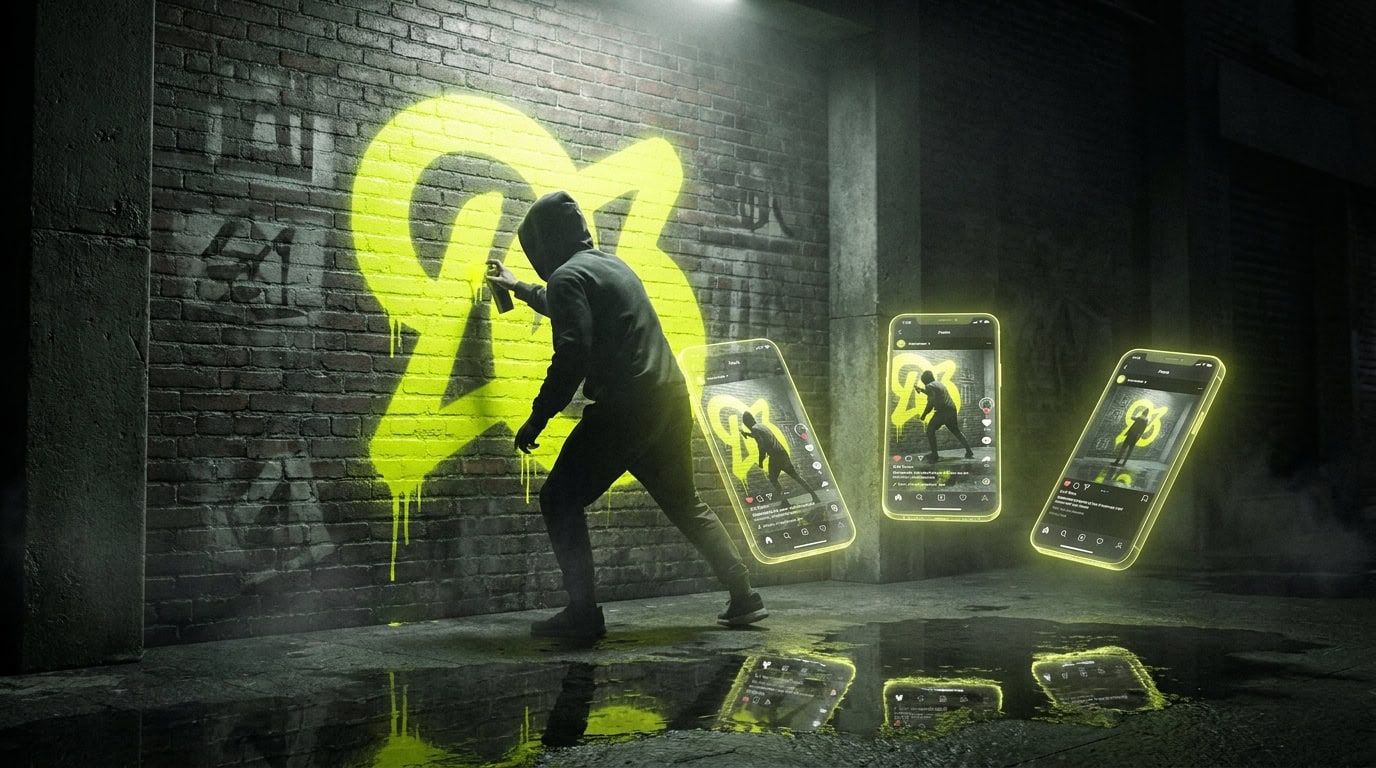
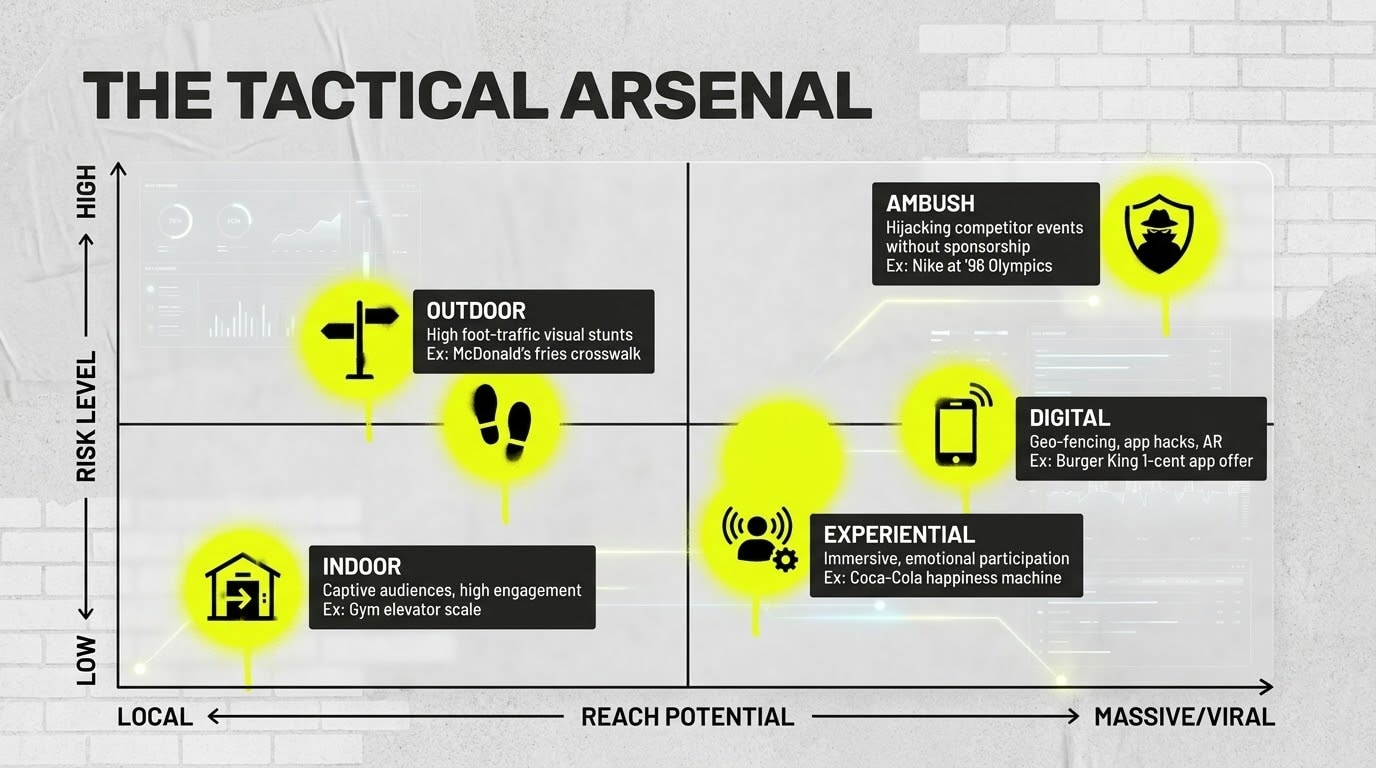
The four canonical families still hold too: ambient (physical environment turned into media), experiential (live event, stunt, installation), ambush (piggybacking on a competitor’s or event’s attention), and viral (content engineered to spread). “Digital guerrilla” isn’t a fifth category. It’s those same four families executed on platforms that let one good idea compound into billions of impressions overnight.
Related: Minneapolis Web Design Guide
Does Guerrilla Marketing Still Work?
Yes, and the scale is bigger than ever. Duolingo's "Dead Duo" stunt generated 1.7 billion social impressions across brand-owned channels in two weeks (Brand Genetics, 2025) and earned coverage in 450 news articles, 60% from top-tier publications (PR Daily, 2025). The launch post alone pulled 144 million views on X in 24 hours (PR Daily, 2025). Duolingo deferred campaign-tied download numbers to its earnings call, where it later reported a 41% revenue increase and 47.7 million daily users (Marketing Brew, 2025).
The Duolingo number isn’t an outlier. Spotify’s 2025 Wrapped drop engaged 200 million users in its first 24 hours, the biggest Wrapped in the product’s history (TechCrunch, 2025). Wrapped is a guerrilla play in disguise: an annual stunt that turns user data into shareable identity content.
The industry is noticing. WARC's 2025 Creative 100, the global benchmark of the most awarded campaigns for creativity, leans heavily toward earned-media-driven work over broadcast (WARC, 2025). Earned media, once treated as a free bonus on top of paid, is now a first-class metric on the brief.
Consumer receptivity has shifted too. Kantar's 2025 Media Reactions study found 58% of US consumers say they're receptive to advertising, up from 47% the prior year (Kantar, 2025). Edelman’s 2025 Trust Barometer found 80% of consumers trust brands they use more than media or government institutions (Edelman, 2025). Audiences are more open to brand voice than they’ve been in a decade, which is exactly the soil guerrilla needs.
What’s the Difference Between Traditional and Digital Guerrilla Marketing?
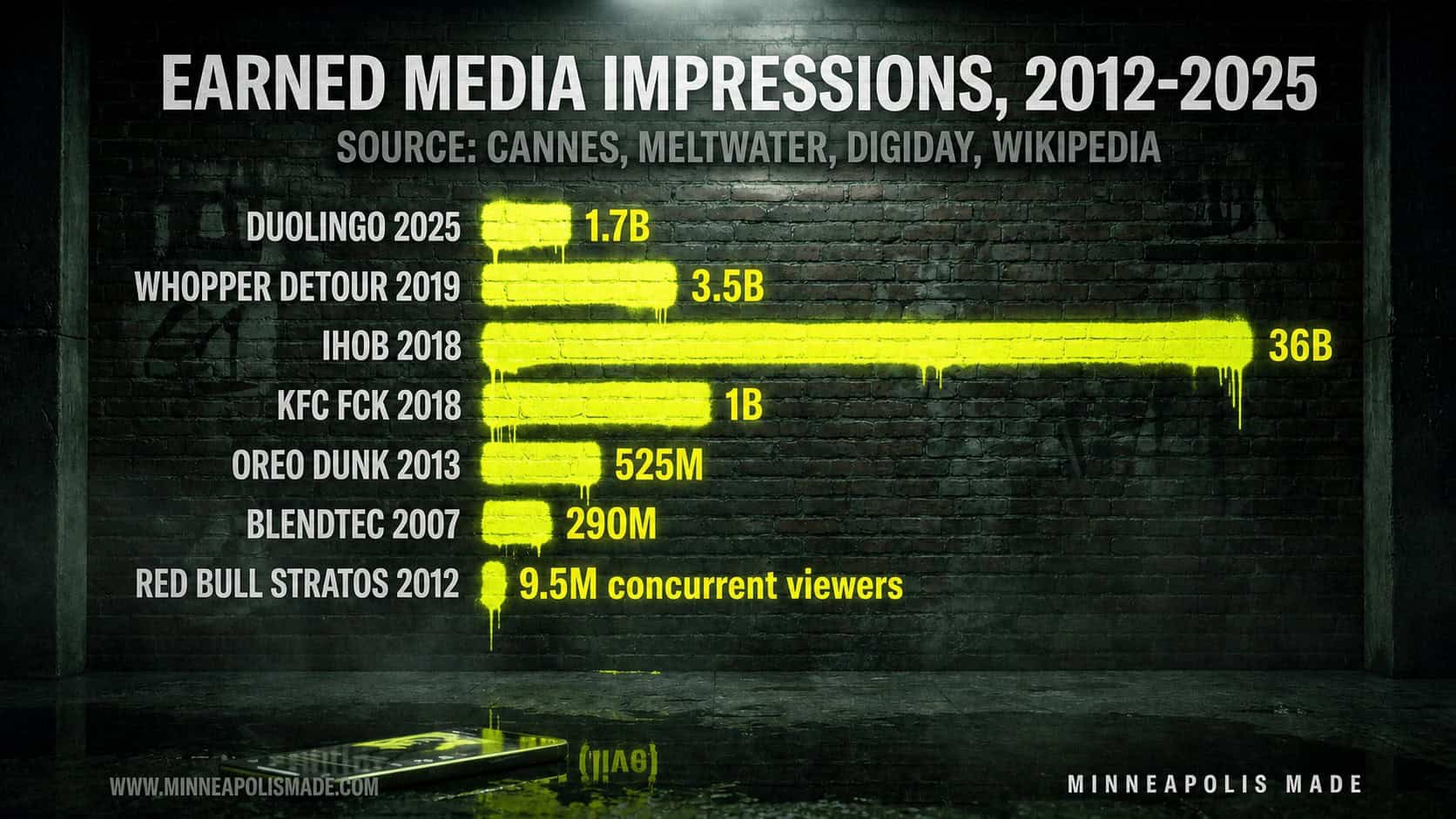
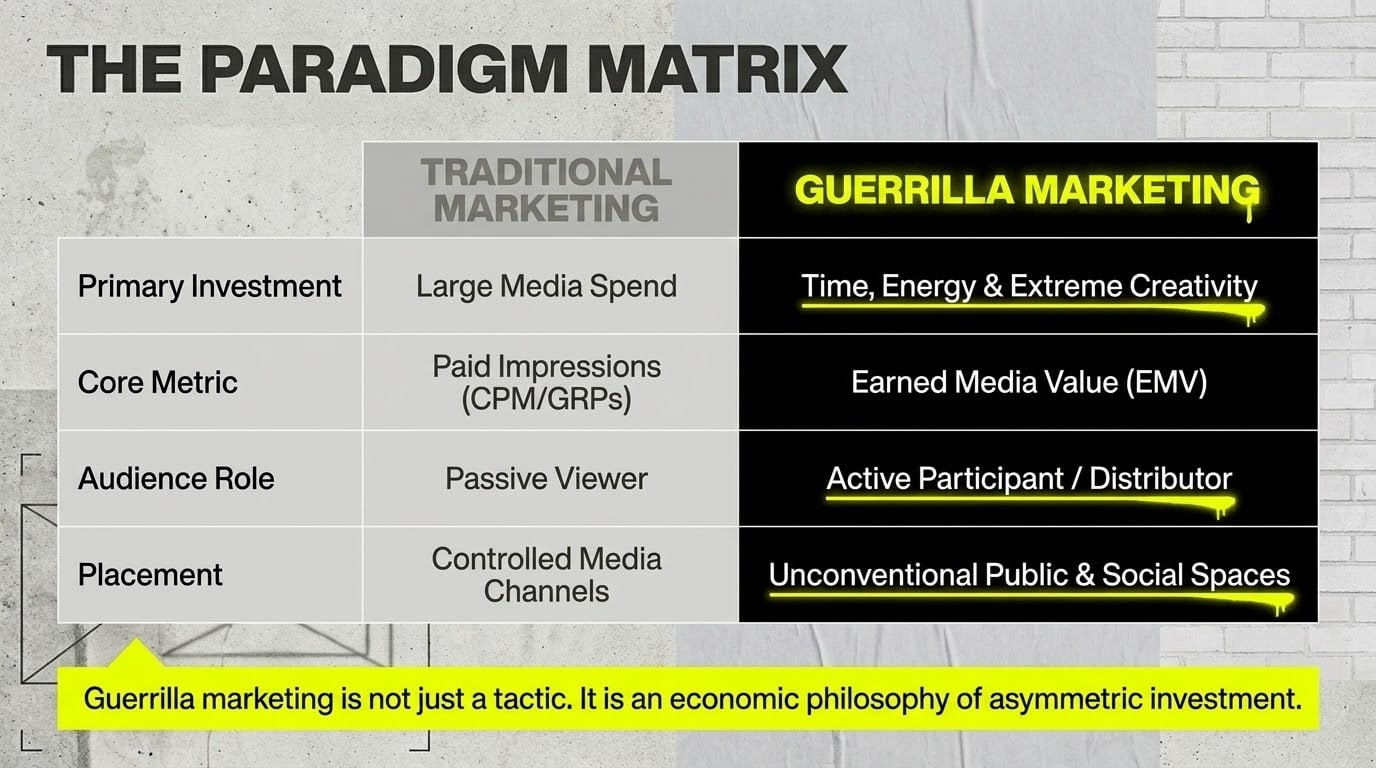
The quickest way to see the shift: in 2013, Oreo's Super Bowl "Dunk in the Dark" tweet earned 525 million impressions, the high-water mark of its era (Valens Research, 2013). In 2025, Duolingo's "Dead Duo" earned 1.7 billion (Brand Genetics). That's a 3.2× jump in 12 years on structurally similar earned-media plays.
Unique Insight
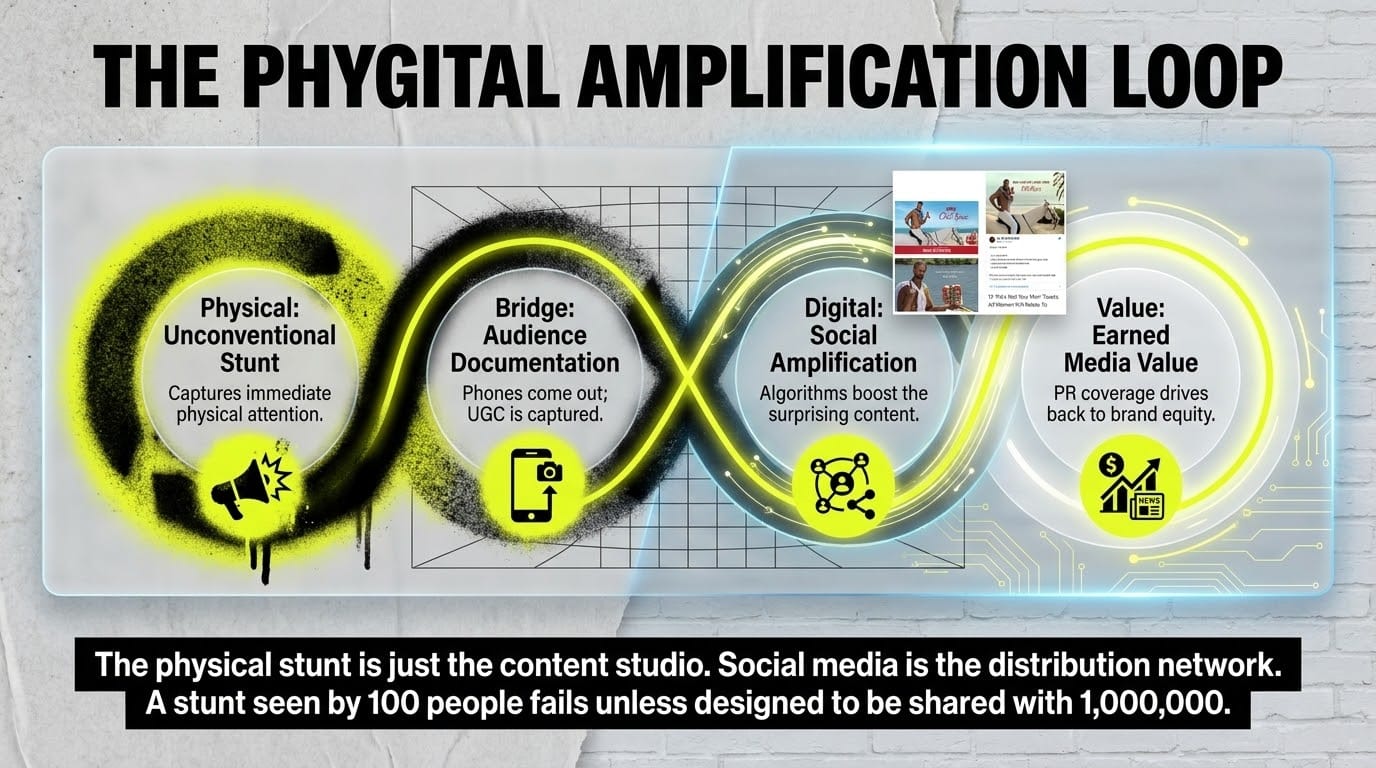
The 3.2× scale compression isn’t a fluke. It’s the combined output of three shifts: a single post can now hit a global audience before a press release is drafted, platform-native formats (TikTok, Reels, X threads) reward the exact traits guerrilla trades in (surprise, brevity, character), and measurement infrastructure finally catches the result. The Oreo tweet took a 15-person war room and a Super Bowl broadcast. Duolingo’s mascot died on a free app in Los Angeles.
Mechanics shifted too. Traditional guerrilla was physical-first (street posters, flash mobs, billboards). Digital guerrilla is social-first, with the physical element, if there is one, existing mostly to generate footage. Budgets tracked the shift. Red Bull's 2012 Stratos jump cost reportedly tens of millions of dollars in production; Blendtec's first "Will It Blend" video cost about $50 (UNSW BusinessThink).
Measurement shifted the most. The Oreo era ran on screenshots and guesswork. Today, brands pipe Meltwater, Brandwatch, and YouGov feeds straight into the campaign dashboard, and brand-lift studies quantify perception shift to a dollar figure. WARC's 2025 rankings show the same shift: broadcast-led ideas have lost ground to earned-media-driven work over the last decade (WARC, 2025). The effective work is moving off broadcast.
Related: a slow site wastes every earned impression
What Are the Four Types of Guerrilla Marketing?
Guerrilla marketing breaks into four tactical families, each with a traditional execution and a digital twin. The Fearless Girl bronze installation earned 4.6 billion Twitter impressions and $7.4 million in earned media value in its first 12 weeks (BusinessWire / State Street, 2020). That’s the ambient pattern: physical environment turned into shareable media.
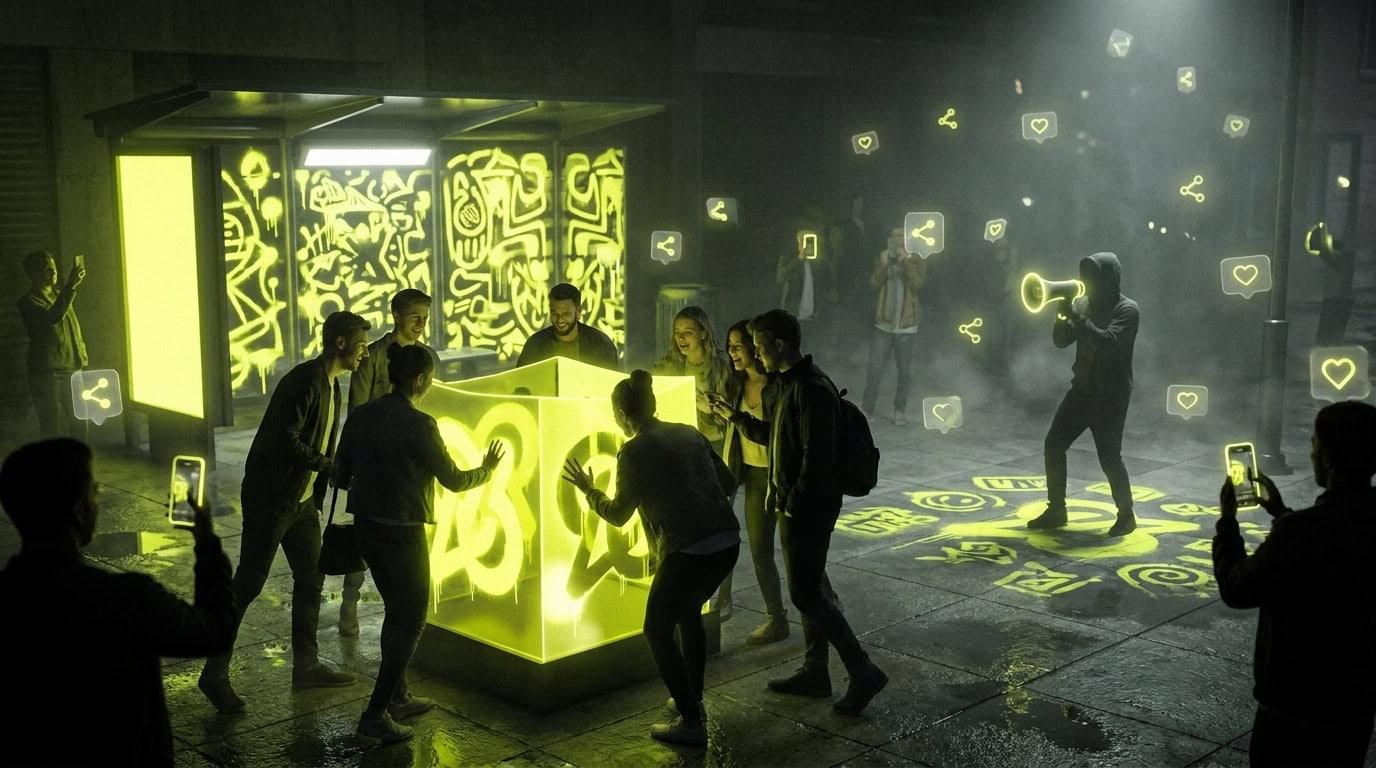
Ambient: physical environment as media
Classic example: Fearless Girl, installed overnight on Wall Street. Digital twin: Duolingo’s physical Duo “funeral” props staged in Los Angeles, designed less as an event and more as a set for social footage. Both share the same logic, make the environment do the talking, and let audiences do the amplifying.
Experiential: the live stunt
Red Bull Stratos in 2012 drew over 9.5 million concurrent YouTube viewers when Felix Baumgartner jumped from the edge of space, setting the record for the largest concurrent YouTube live audience to that point (Wikipedia). The digital twin is Spotify Wrapped, an experiential drop staged entirely inside an app, engineered for screen-recorded share-outs.
Ambush: borrowing another brand’s stage
IHOP's 2018 "IHOb" burger rebrand generated 36 billion earned media impressions across more than 20,000 media stories (Marketing Dive, 2018), and burger sales jumped four-fold during the campaign window. KFC’s 2018 “FCK” apology after the UK chicken shortage reached 1 billion-plus earned impressions against a 797 million audience (Campaign, 2018). Both hijacked a moment the category owned.
Viral: content engineered to spread
Blendtec's "Will It Blend" series scaled a $50 initial production budget into six million YouTube views in the first five days and lasting sales growth (UNSW BusinessThink). The Fearless Girl campaign also had a downstream policy effect: State Street disclosed that 681 companies added female board members in the three years after the installation (BusinessWire, 2020). Viral content used to mean a forwarded email. Now it’s the base case, with TikTok brand accounts like Wendy’s and Duolingo running what’s essentially a nightly late show.
Which KPIs Actually Measure Guerrilla Success?
Six KPIs cover every guerrilla campaign outcome worth paying for. Industry-standard brand-lift measurement carries real cost: platform-native surveys via Meta start around $30,000, while independent third-party studies via Nielsen, Kantar, or Ipsos historically required six-figure minimum spend (Criterion Global). That cost alone tells you the discipline is real. Most "guerrilla" post-mortems you've read skipped the line item.
Original Framework
Here’s the six-KPI framework we use with clients. Each KPI answers a different strategic question, which is why EMV alone, the number agencies love to quote, is insufficient.
- Reach / Impressions: raw exposure. Verified via Meltwater, Cision, or native platform data. Answers: did anyone see it?
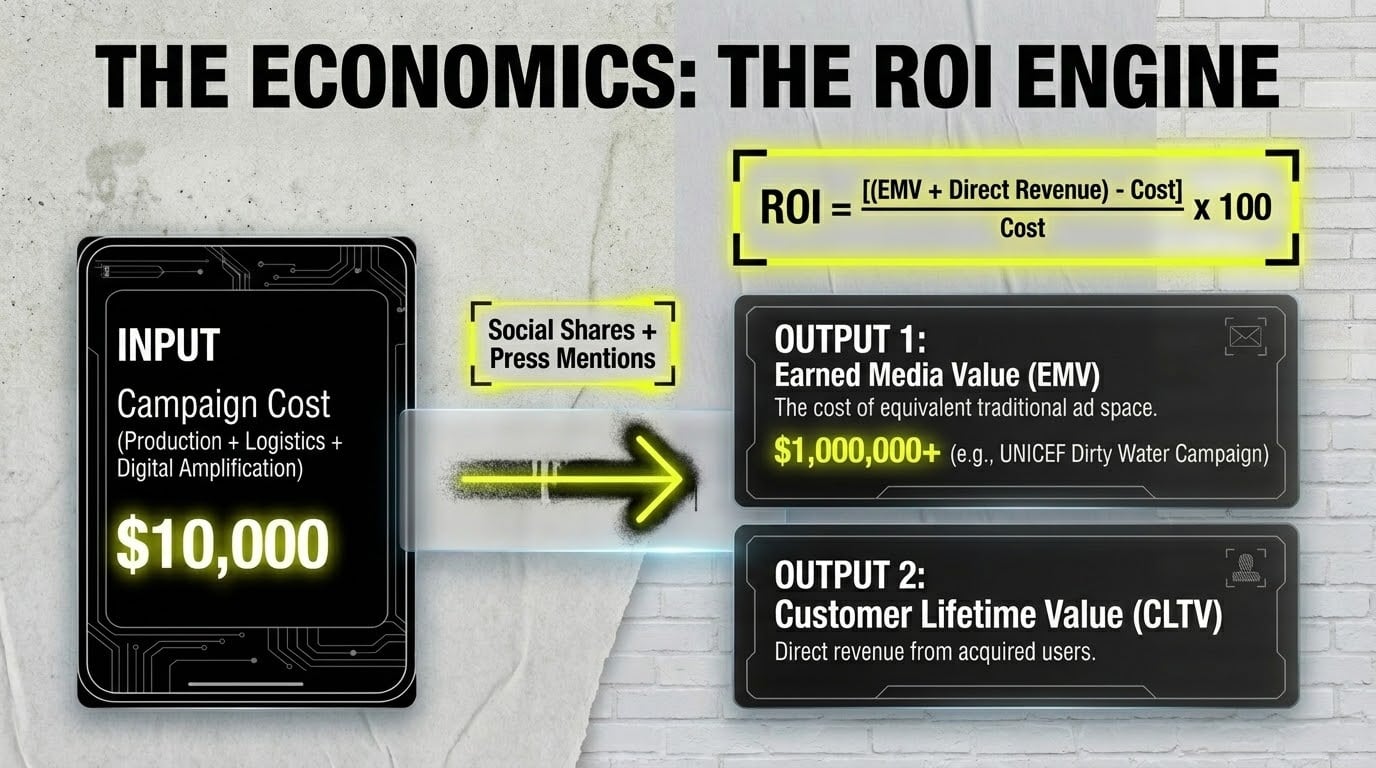
- Earned Media Value (EMV): dollar equivalent of the coverage. Verified via Apex Marketing or Onclusive. Answers: what would this have cost us in paid?
- Branded Search Lift: pre/post delta in branded queries. Pulled from Google Trends and Search Console. Answers: did attention convert into intent?
- Share-of-Voice: category mention share vs competitors. Tracked in Brandwatch, Sprinklr, Meltwater. Answers: did we take the category conversation?
- Brand-Lift Survey Delta: pre/post perception shift on awareness, consideration, purchase intent. Platform-native surveys via Meta start around $30k; independent Nielsen, Kantar, or Ipsos studies require six-figure minimum spend. Answers: did perception actually move?
- Downstream Conversion: app installs, trial starts, purchases. Attributed via offer codes, URL parameters, holdout comparisons, or time-series correlation. Answers: did the needle move on revenue?
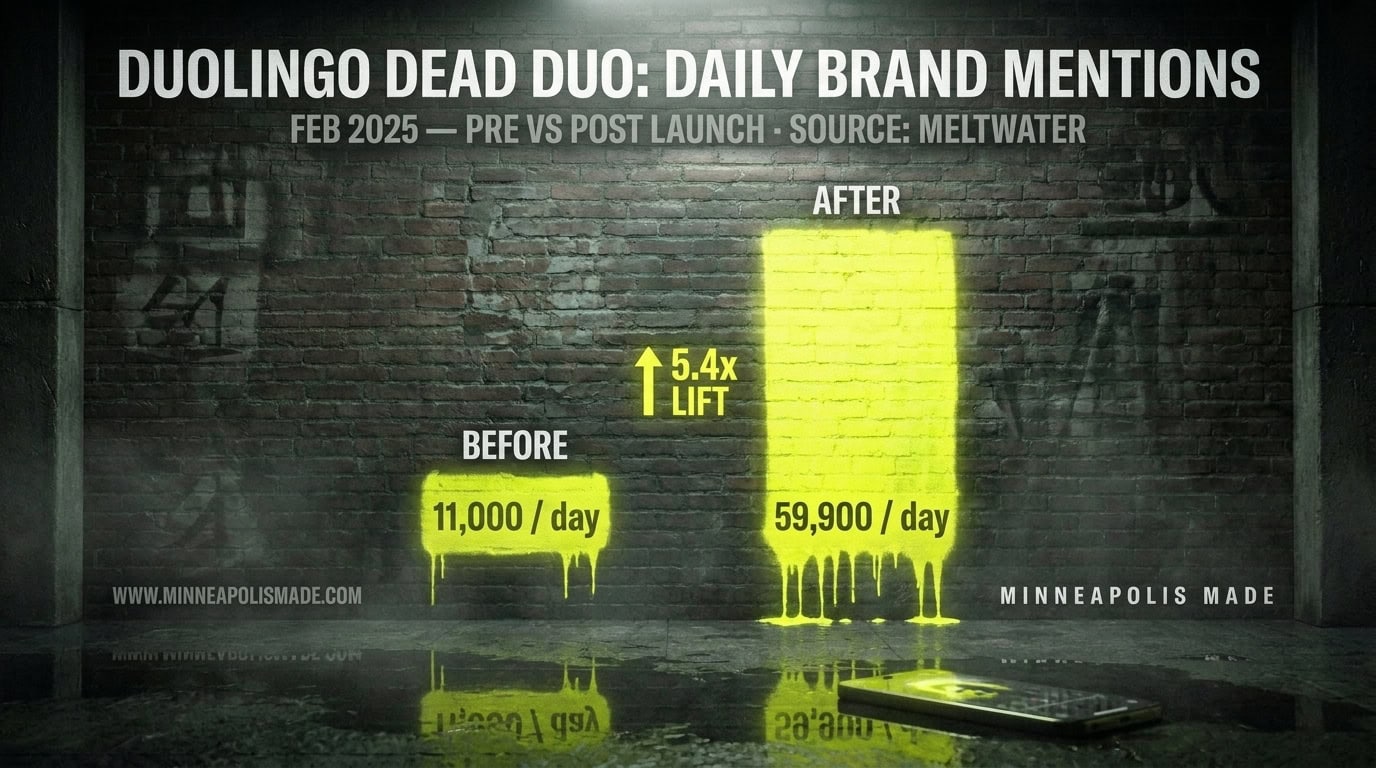
Duolingo's Dead Duo is a clean measurement example. Daily brand mentions jumped from ~11,000 baseline to 59,900 peak during the campaign window, and the campaign pulled 169,000 total mentions over two weeks (Meltwater, 2025). That's share-of-voice and reach captured in one feed.
Brand-lift measurement has its own nuance in short-form and emerging formats. Nielsen’s 2023 analysis found brand recall drove 38.7% of total brand lift in emerging media, more than any other component (Nielsen, 2023). Translation: if nobody remembers which brand ran the stunt a week later, you did a charity run for the internet’s amusement.
What’s the Real ROI of Guerrilla Marketing?
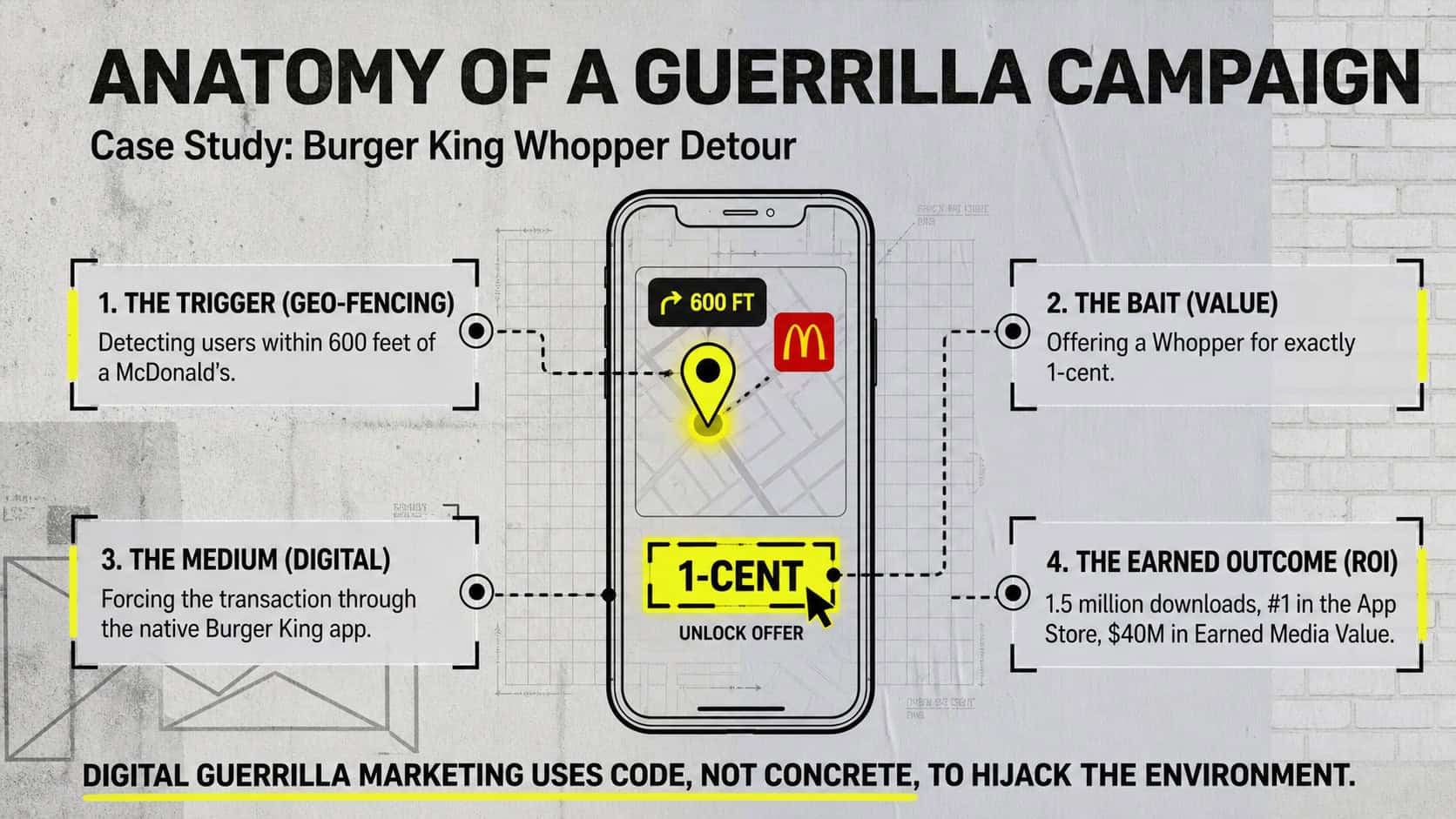
Case-by-case, but the ceiling is extraordinary. Burger King's Whopper Detour delivered a reported 37:1 ROI on a 9-day mobile geofence campaign that trolled McDonald's locations (Adweek, 2019). It also pulled 3.5 billion earned-media impressions and over $40 million in earned media value (The Brand Hopper case study, 2024). Blendtec's "Will It Blend" lifted sales 700% off a $50 first video (UNSW BusinessThink).
Sustained-growth examples matter more than one-off stunts. Liquid Death, the canned water brand built almost entirely on guerrilla creative, went from $3M in revenue in 2019 to $333M in 2024 (TapTwice Digital, 2025). That's 110× in five years, with the growth curve sitting directly on top of the brand's meme, merch, and stunt calendar.
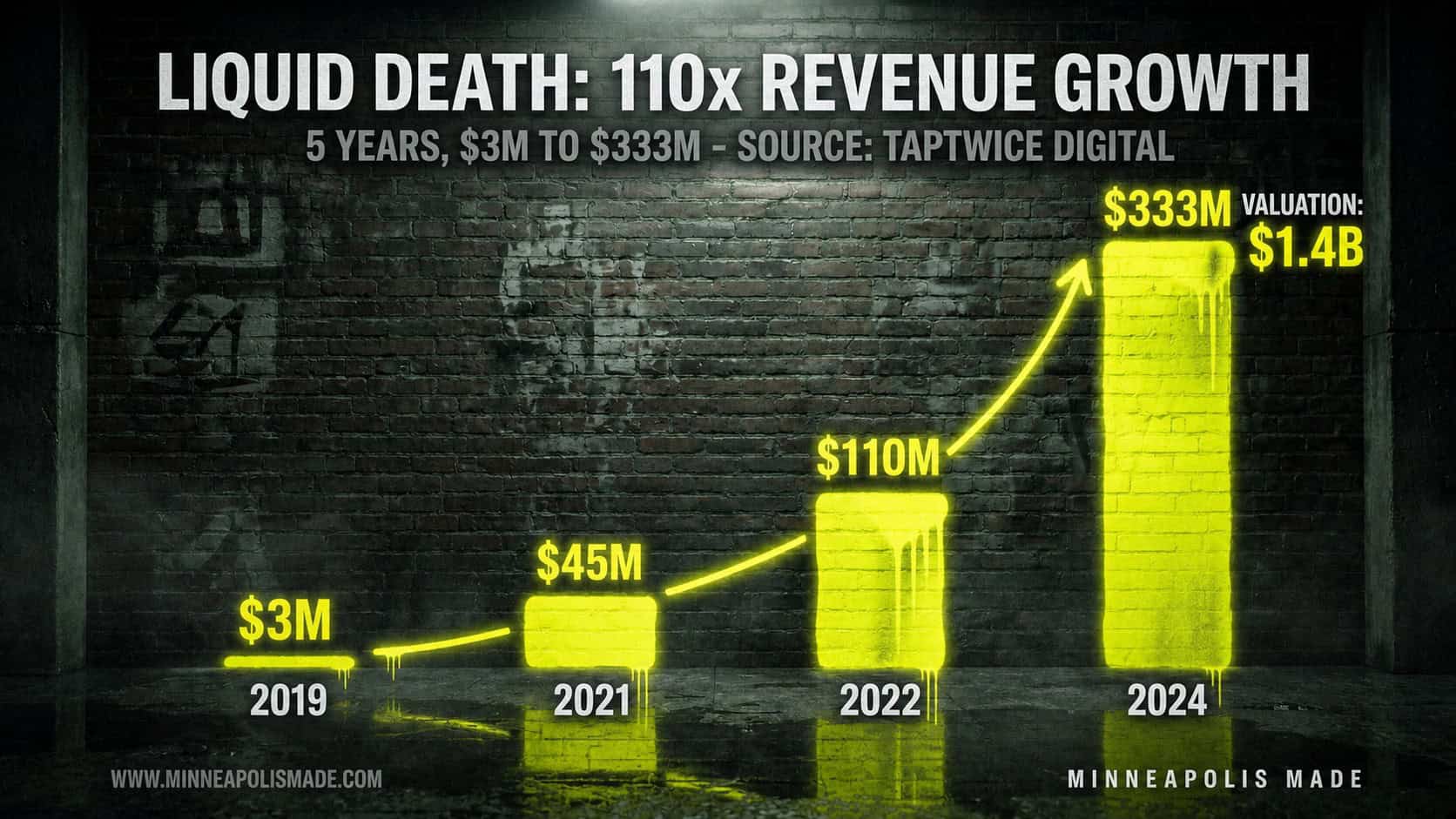
Why do the numbers span four orders of magnitude? Because creative quality is the dominant variable. Nielsen Catalina's long-running analysis of CPG sales-lift studies found creative quality is the dominant driver of in-market success, contributing as much as all other factors combined, and up to 80% of lift in traditional TV and 89% in digital advertising (Nielsen Catalina, 2017). The Whopper Detour and a bad billboard are running on the same physics; the creative is what separates them.
A word on single-number ROI claims. When an agency pitches “our guerrilla campaigns average a 4.5× ROI,” ask for the methodology. If they can’t name the attribution model, the control group, the baseline, and the measurement window, the number is decoration. The honest answer is always: here’s the reach, here’s the EMV, here’s the branded search delta, here’s the conversion tail, and here’s what we’re not sure about.
Related: landing page production budget
Why Do Some Guerrilla Campaigns Fail?
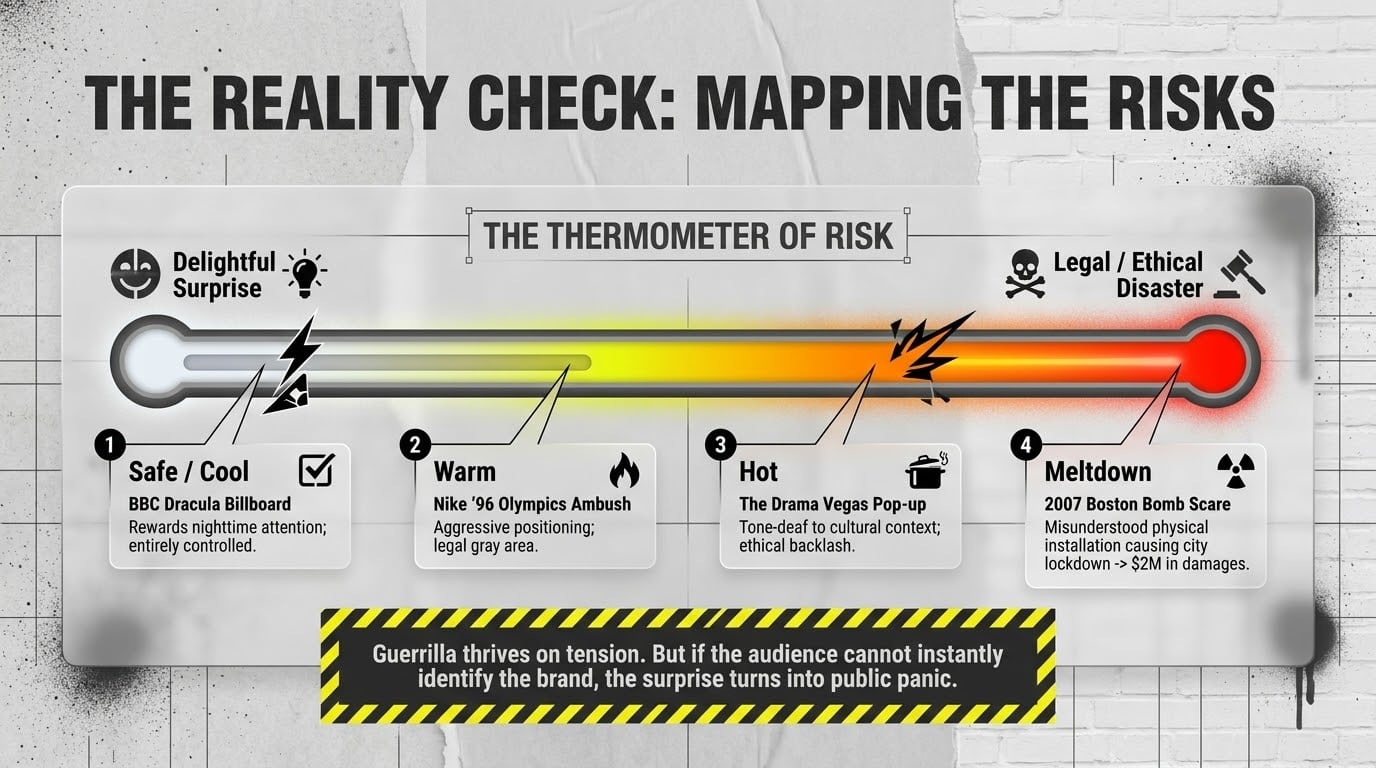
They fail when they misread their audience. Bud Light's 2023 Dylan Mulvaney partnership cost AB InBev roughly $1.4 billion in North American sales (Fortune, 2024) and approximately $26 billion in market capitalization (Wikipedia citing AB InBev market data, 2023-2024). One can, one influencer partnership, one of the largest brand-value destruction events in consumer history.
The pattern repeats across the decade. Pepsi's 2017 Kendall Jenner protest ad was pulled in under 24 hours after backlash over its handling of police-protest imagery. Peloton's 2019 "Gift That Gives Back" ad, which read to viewers as a dystopian marriage vignette, knocked roughly $1.5 billion off the company's market cap within days (Ad Age, 2019). McDonald's #McDStories hashtag, launched to celebrate franchise memories, was hijacked within an hour, with over 1,600 negative tweets piling onto the brand before McDonald's pulled the promoted push within two hours of launch (CBS News, 2012).
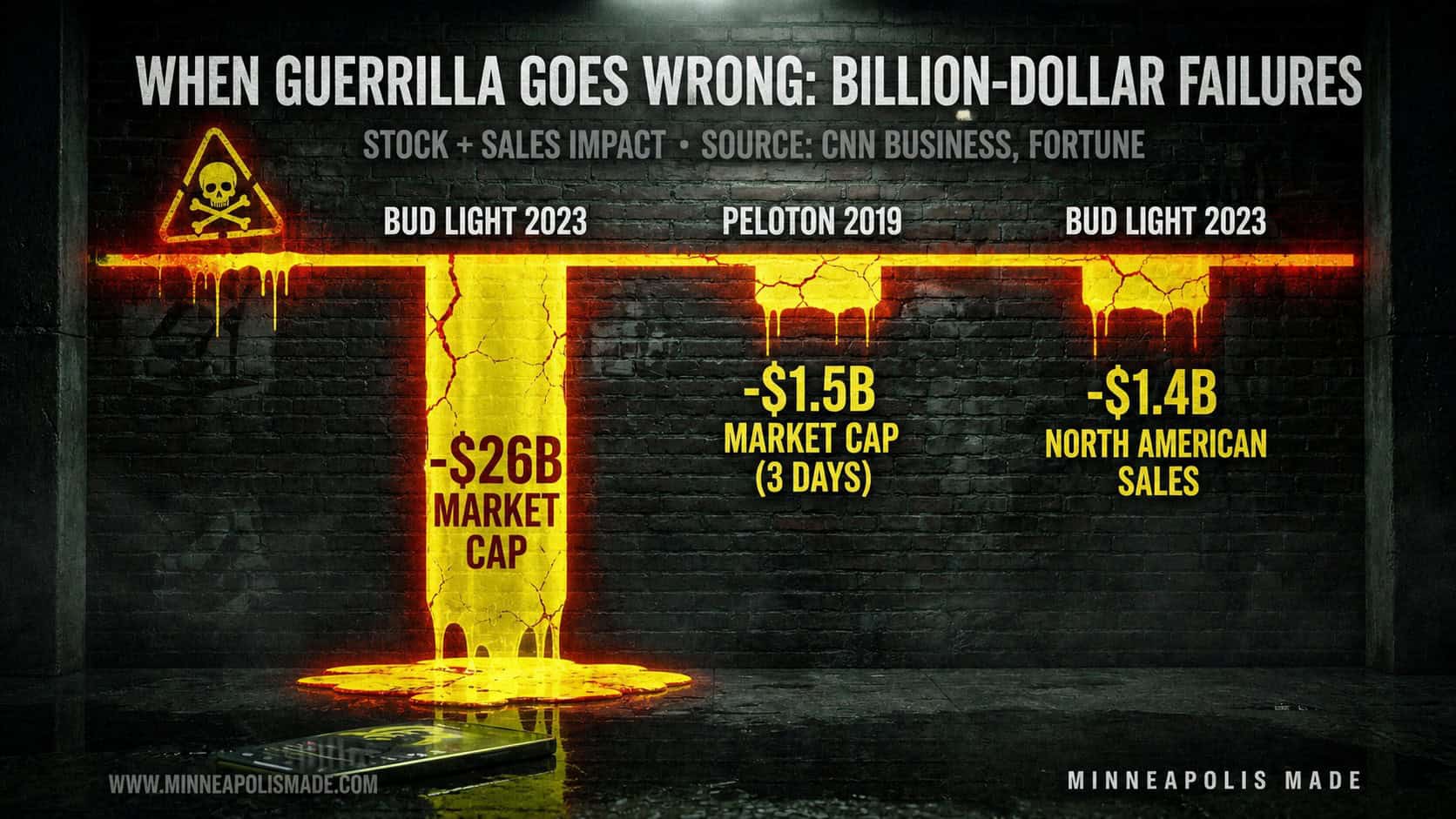
The failure modes pattern-match. Tone-deaf brand activism (Pepsi, Bud Light) treats a cultural moment as a product-demo backdrop. Hashtag control loss (#McDStories) hands the brand a megaphone, points it at the audience, and forgets to duck. Misreading platform culture (Peloton on broadcast, where nuance dies) puts the right creative in the wrong room. Vague benefit positioning, where the stunt is clever but the product promise is missing, leaves the audience entertained and unmoved.
What the failures share is the thing the wins share in reverse: the brands knew who they were. Bud Light knew its regular drinker and overrode that knowledge. The wins don’t override, they exaggerate. Duolingo already was the unhinged owl. Liquid Death already was the satirical death-metal water. The stunt matched the brand DNA. The failures fought it.
Who Shouldn’t Use Guerrilla Marketing?
Regulated industries, enterprise B2B, and audiences that reward predictability over novelty. Edelman’s 2025 Trust Barometer found 80% of consumers trust brands they use more than media or government (Edelman, 2025), which is the asset guerrilla either amplifies or burns. If your category is one where trust is the entire purchase, the risk math changes.
Financial services, legal, and medical live under compliance regimes that punish the exact improvisation guerrilla rewards. A law firm can’t run a Wendy’s-style roast account. A Medicare Advantage plan can’t fake a mascot funeral. The FTC, FDA, state bars, and FINRA all have opinions, and none of them are funny.
Enterprise B2B is a second category. A buying committee evaluating a seven-figure platform contract wants rigor, proof, and a reference list. They want stunts from the vendor about as much as they want a clown at the RFP meeting. The effective B2B “guerrilla” is usually a data-release play, a controversial research report, or a pointed teardown of a competitor’s claim.
Personal Experience
In our work with Minneapolis and St. Paul clients over the last 25 years, we've watched the same pattern repeat. Stunts that work nationally rarely translate to local SMB markets unless the tactic matches where the customer base actually spends its attention. A home-services brand with a 40-mile radius doesn't need 1.7 billion impressions. It needs 4,000 in the right zip codes. The right move for most local Twin Cities buyers isn't a stunt at all, it's showing up consistently in search and in the AI-assistant answer layer their customers now use to shortlist vendors.
The local SMB plays we've seen actually convert read more like Surly Brewing's 2010-2011 "Surly Bill" campaign than Duolingo's mascot funeral. Surly didn't buy billboards or hire a stunt agency; it printed political-style yard signs ("Free The Beer"), labeled bottles with calls to action, and turned every taproom regular into a lobbyist for a state law that didn't exist yet. The campaign helped pass the 2011 Minnesota law allowing breweries to sell pints on-site, and it built a brand that customers physically advocated for. That's what a small-market guerrilla play looks like when it works: a clear ask, a local audience already paying attention, and an outcome you can name and date.
The pattern we don't recommend is the opposite: a Minneapolis dental practice or remodeling firm spending five figures on a Mall of America activation because someone read a HubSpot article about Duolingo. The math doesn't work. Two thousand new branded searches in Hennepin County over 90 days will book more chairs than two million impressions split across the continental US. Local guerrilla is a discipline of fit, and fit is geographic before it's creative.
Related: invest in search and AI visibility instead
What Does Guerrilla Marketing Look Like for Twin Cities Businesses?
Local-scale, specific, and tied to a measurable outcome the buyer can see in 30 days. The Twin Cities metro has 3.7 million people across Minneapolis, St. Paul, and the suburbs, and that density is both the constraint and the unfair advantage: a campaign that hits 0.1% of the metro is 3,700 impressions in zip codes where you can actually deliver service, not 1.7 billion impressions across markets you don't serve.
The most cited Minnesota-rooted guerrilla play is Surly Brewing's 2010-2011 "Free The Beer / Surly Bill" campaign. Surly faced a Minnesota law that prevented breweries from selling pints on-site, and instead of buying advertising, the brand turned its taproom, its bottles, and its customer base into a distributed petition. Yard signs in Northeast Minneapolis, branded ask copy on every bottle, and an in-person presence at the State Capitol moved a coalition of legislators to pass the 2011 brewery-pint law. The downstream effect was a regulatory change, plus a brand that locals physically advocated for. That's the Fearless Girl pattern executed at Twin Cities scale.
Personal Experience
The Twin Cities offers four guerrilla surfaces most national playbooks ignore. The Minnesota State Fair draws roughly 1.9 million attendees in 12 days, the highest daily-average attendance of any state fair in the country, and a single well-placed activation reaches more in-state buyers than a billboard on I-94 runs in a year. Mall of America hosts ~32 million visitors annually with documented brand-activation programs (Target, Apple, Lego, and Polaris have all run experiential plays there). First Avenue and the Hennepin Avenue music corridor generate cultural-touchpoint earned media for any brand that ties to local-music identity (the venue's star wall, with 500-plus performers, is a 30-year-running ambient brand asset). Game-day surfaces at Target Field, US Bank Stadium, and Allianz Field offer concentrated regional attention without national-broadcast budgets.
For most Minneapolis-area SMB clients we've worked with, the right move isn't any of those high-traffic surfaces. It's a smaller, more honest play: a Northeast Minneapolis bakery printing political-style "Vote For Pie" lawn signs the week before a competitor's grand opening, a St. Paul law firm releasing a county-level data report the local press picks up because nobody else has the data, a remodeling contractor sponsoring a single Hennepin County neighborhood block-party calendar with QR-coded "Before/After" yard signs at each completed project. None of those plays will hit a million impressions. All of them produce branded-search lift and booked leads inside 60 days, which is the only KPI that matters when the customer base is a 40-mile radius.
The KPI framework above translates directly. Reach becomes local reach (Hennepin and Ramsey county zip-code coverage, not US population). EMV becomes regional EMV (a Twin Cities Business or Star Tribune mention is worth more than 50 generic syndicated pickups). Branded search lift is the cleanest local KPI: pull Google Trends for your brand restricted to the Minneapolis-St. Paul DMA, screenshot the pre-campaign baseline, and compare. The signal is usually visible inside 30 days if the play landed.
Related: how local SEO and guerrilla marketing reinforce each other in the Twin Cities
How Do You Build a Guerrilla Marketing Playbook?
Seven steps, in order, before a single asset is produced. Skip any of them and you're gambling, not marketing. WARC's 2025 Creative 100 underscores how heavily today's most awarded campaigns lean on earned media and PR-driven KPIs (WARC, 2025). That's the discipline, copied.
1. Define the brand-safe boundary
Run the concept past legal and a PR pressure-test. Identify the three worst-case headlines the stunt could generate, and decide whether you can live with any of them. If two of the three would cost you the quarter, redesign.
2. Pick the category fit
Ambient, experiential, ambush, or viral. Each has a different production cost, timeline, and amplification profile. Don’t mix. A campaign that’s three of the four is usually none of them.
3. Set KPI targets with named baselines
Pre-campaign branded-search volume. Pre-campaign share-of-voice. Pre-campaign baseline mentions. Write the numbers down before launch. Without baselines, every post-mortem is fiction.
4. Budget measurement before production
Platform-native brand-lift via Meta/Google/TikTok at $30k+; independent third-party (Nielsen, Kantar, Ipsos) at six-figure minimums (Criterion Global). Meltwater or Brandwatch for listening. Survey pre/post. These are not optional line items. If the measurement budget doesn't fit, the creative budget is wrong.
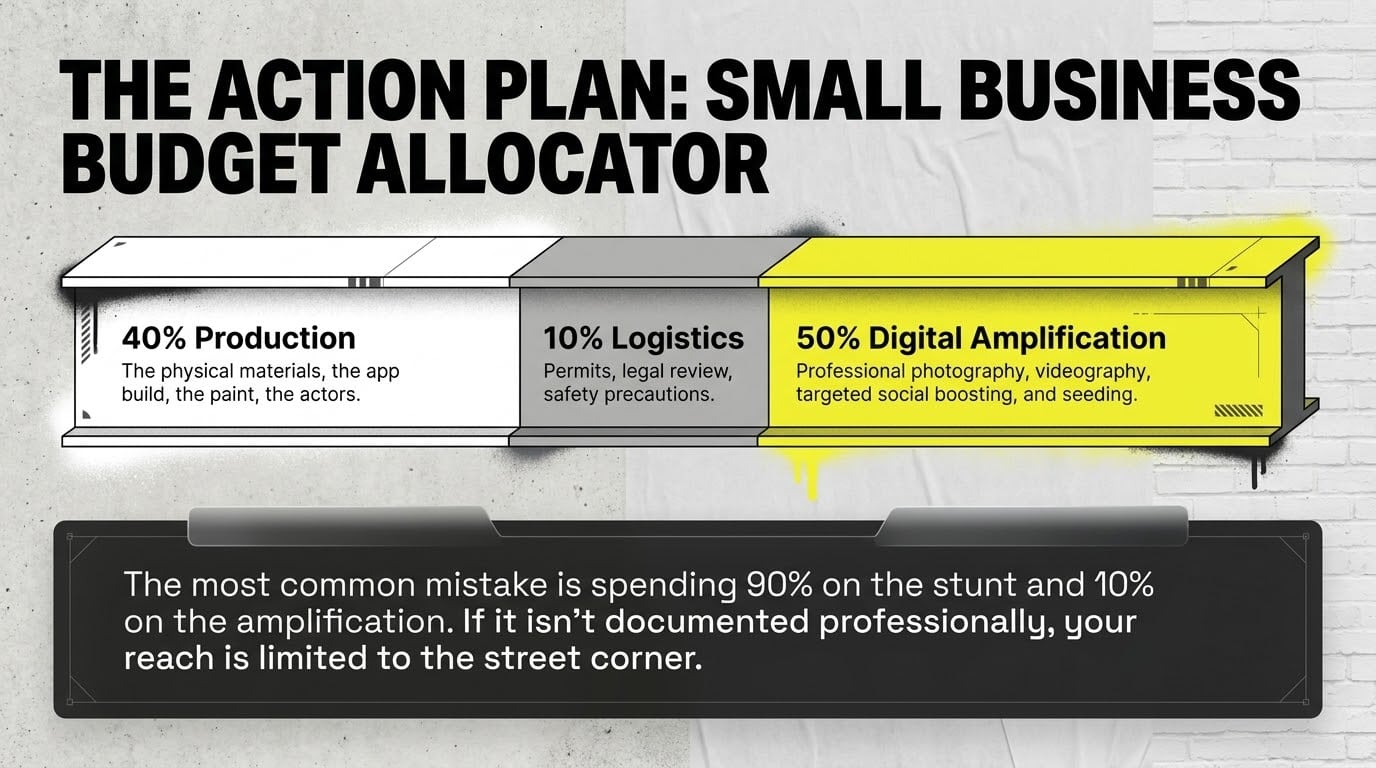
5. Build the amplification stack
Owned channels ready to carry day-one footage. A partner list (influencers, press, internal employees) briefed 48 hours ahead. A paid-ignition budget reserved to push the first signal past the platform’s organic ceiling. Guerrilla stunts that “go viral on their own” almost always had a paid push no one talked about.
6. Prepare for backlash
Escalation tree, approved response language, the person who has authority to pull the plug. The Bud Light tell was that nobody owned the response for 11 days. Eleven days of silence on the internet is 18 months.
7. Define the post-mortem window
Two weeks for reach, four weeks for branded-search lift, eight weeks for brand-lift delta, twelve weeks for conversion tail. Set the reporting cadence before launch so nobody changes the rubric mid-campaign.
Related: agencies vs. freelancers differ on multi-channel execution
Want a senior strategist to pressure-test your concept before launch?
We review creative tone, audience fit, KPI baselines, and measurement readiness in a 2-3 hour working session at $85/hr, billed weekly. You leave with a written risk inventory and a measurement spec, no retainer required.
The Bottom Line on Guerrilla Marketing in 2026
Guerrilla marketing still works, and it still bites. Duolingo’s 1.7 billion impressions and Bud Light’s $26 billion market-cap wipe came out of the same playbook, eighteen months apart. The difference wasn’t courage or budget. It was the work that happened before launch: the audience read, the KPI baseline, the pressure-test, the measurement stack.
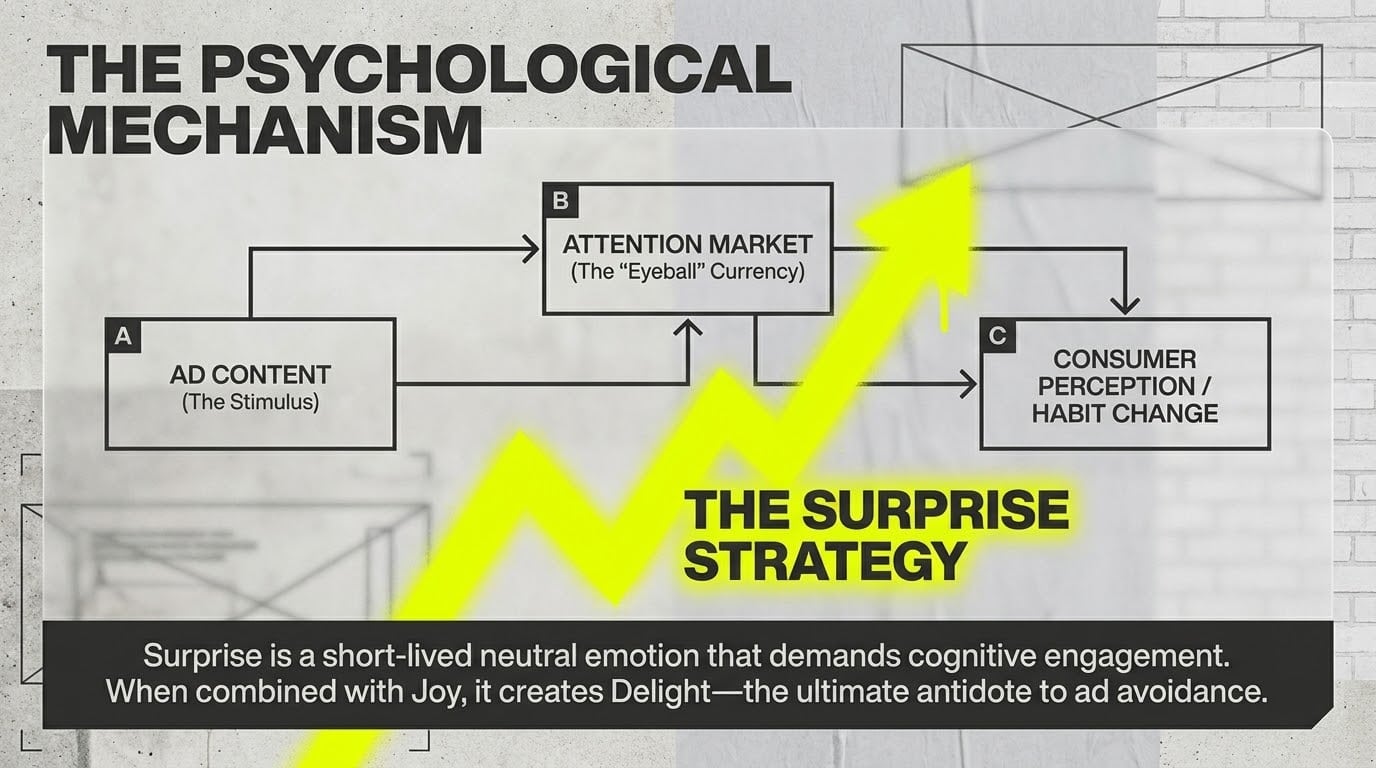
Here is the whole post at a glance: the mindset shift, the three tactical pillars, and why guerrilla’s ROI ceiling sits at roughly 15x paid-media in the right hands.
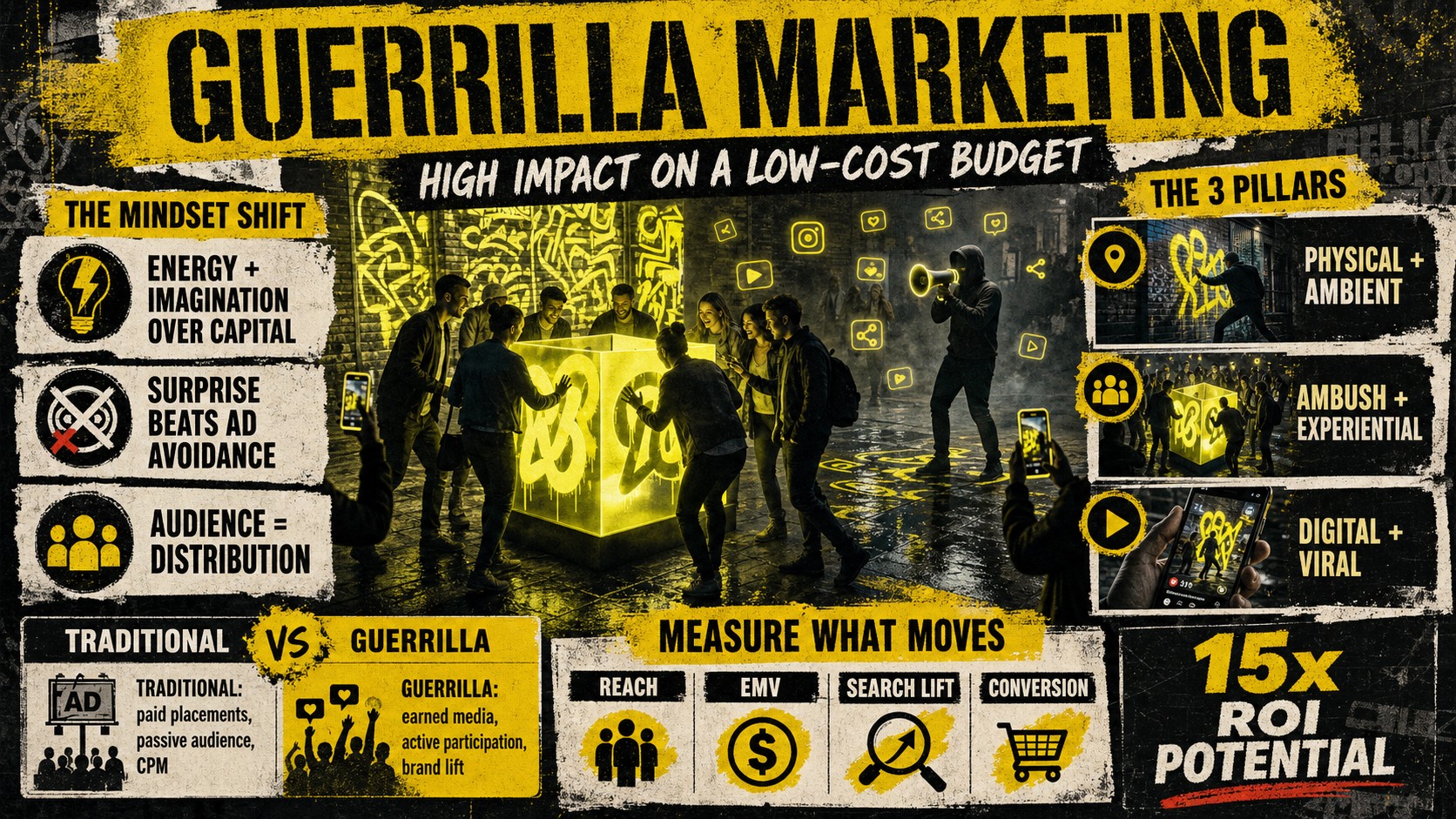
Five things to carry forward. First, the tactic works when KPIs are defined on the brief, not in the recap. Second, EMV is necessary but insufficient; pair it with brand-lift and downstream conversion or you're marking your own homework. Third, failure is priced into the discipline, so treat the backlash plan as a line item. Fourth, digital didn't replace traditional guerrilla, it scaled it 3.2× in 12 years, and the next scale jump is already underway in AI-mediated attention surfaces. Fifth, the framework scales down. A Minneapolis SMB running a 4,000-impression neighborhood play uses the same six KPIs Duolingo used; the budget and creative don't transfer, but the discipline does.
Related: small local-service buyers respond to different signals
Running a guerrilla play? Build the measurement stack first.
We architect the 6-KPI framework, set named pre-campaign baselines, track post-launch deltas, and write the post-mortem at $85/hr, billed weekly. Most Twin Cities measurement specs land in 8-15 hours of senior strategist time. No retainer, no minimum spend.
Frequently Asked Questions
Does guerrilla marketing still work in 2026?
Yes. Duolingo's 2025 "Dead Duo" stunt generated 1.7 billion social impressions and 144 million X views in two weeks (Brand Genetics; PR Daily, 2025). WARC's 2025 Creative 100 ranks the most awarded campaigns globally for creativity, with earned-media work dominating the rankings (WARC, 2025).
What’s the ROI of guerrilla marketing?
It varies widely. Burger King’s Whopper Detour reported 37:1 (Adweek, 2019); Blendtec's "Will It Blend" hit six million YouTube views in five days on a $50 first video (UNSW BusinessThink). Treat any vendor quoting a single “4.5× average” without naming the attribution model, control group, and window as unverified.
How is guerrilla marketing different from viral marketing?
Guerrilla is the parent category; viral is one of its four pillars alongside ambient, experiential, and ambush. Levinson coined “guerrilla marketing” in 1984 for small businesses priced out of network TV. “Viral” entered mainstream marketing vocabulary in the late 1990s as the web made forwarded content measurable at scale.
What KPIs should I track for a guerrilla campaign?
Six: reach/impressions, earned media value, branded search lift, share-of-voice, brand-lift survey delta, and downstream conversion. Budget around $30,000 minimum for platform-native brand-lift surveys (Meta), or six-figure minimums for independent third-party studies via Nielsen, Kantar, or Ipsos (Criterion Global). Write the baselines down before launch or the post-mortem is fiction.
How much does a guerrilla marketing campaign cost?
It spans four orders of magnitude. Blendtec's first viral video cost about $50 (UNSW BusinessThink). Red Bull Stratos reportedly cost tens of millions of dollars in production. Most SMB guerrilla plays land in the $1,000 to $25,000 creative-plus-execution range, with measurement budgeted separately at the brand-lift study cost above.
What’s the biggest risk of guerrilla marketing?
Reputation loss at enterprise scale. Bud Light's 2023 Dylan Mulvaney partnership cost AB InBev roughly $1.4 billion in North American sales (Fortune, 2024) and approximately $26 billion in market capitalization (Wikipedia, 2024). Peloton's 2019 ad knocked roughly $1.5 billion off market cap within days (Ad Age, 2019).
Is ambush marketing legal?
Generally yes, with limits. Ambush tactics can’t use protected trademarks, official logos, athlete likenesses, or broadcast footage without rights. Major events like the Olympics and FIFA World Cup enforce anti-ambush zones through host-city legislation that restricts advertising near venues, so check jurisdiction before you plan a stunt near a protected perimeter.
How do you prove a guerrilla campaign “worked”?
Three data points: a named pre-campaign baseline, a measurable post-campaign delta, and a control comparison. Duolingo's Dead Duo is the textbook case: mentions ran ~11,000/day baseline and hit 59,900/day peak during the window, for 169,000 total mentions over two weeks (Meltwater, 2025).