Local SEO for small business isn’t optional anymore. According to Google (2023), 46% of all Google searches have local intent. That’s nearly half of all search activity leading to queries like “plumber near me” or “best coffee shop Minneapolis.” If your business serves local customers and you’re not showing up in those results, you’re handing revenue to competitors who are.
We’ve managed local SEO for Twin Cities businesses across every industry, from restaurants and law firms to home service contractors and retail shops. The businesses that dominate local search aren’t doing one thing right. They’re doing five or six things consistently. This guide covers the complete local SEO strategy, not just Google Business Profile (we’ve got a deep-dive on GBP optimization if that’s what you need), but the full picture of what it takes to own local search in Minneapolis.
Key Takeaways
- 46% of all Google searches have local intent, and 76% of people who search for something nearby visit a business within a day (Google, 2023)
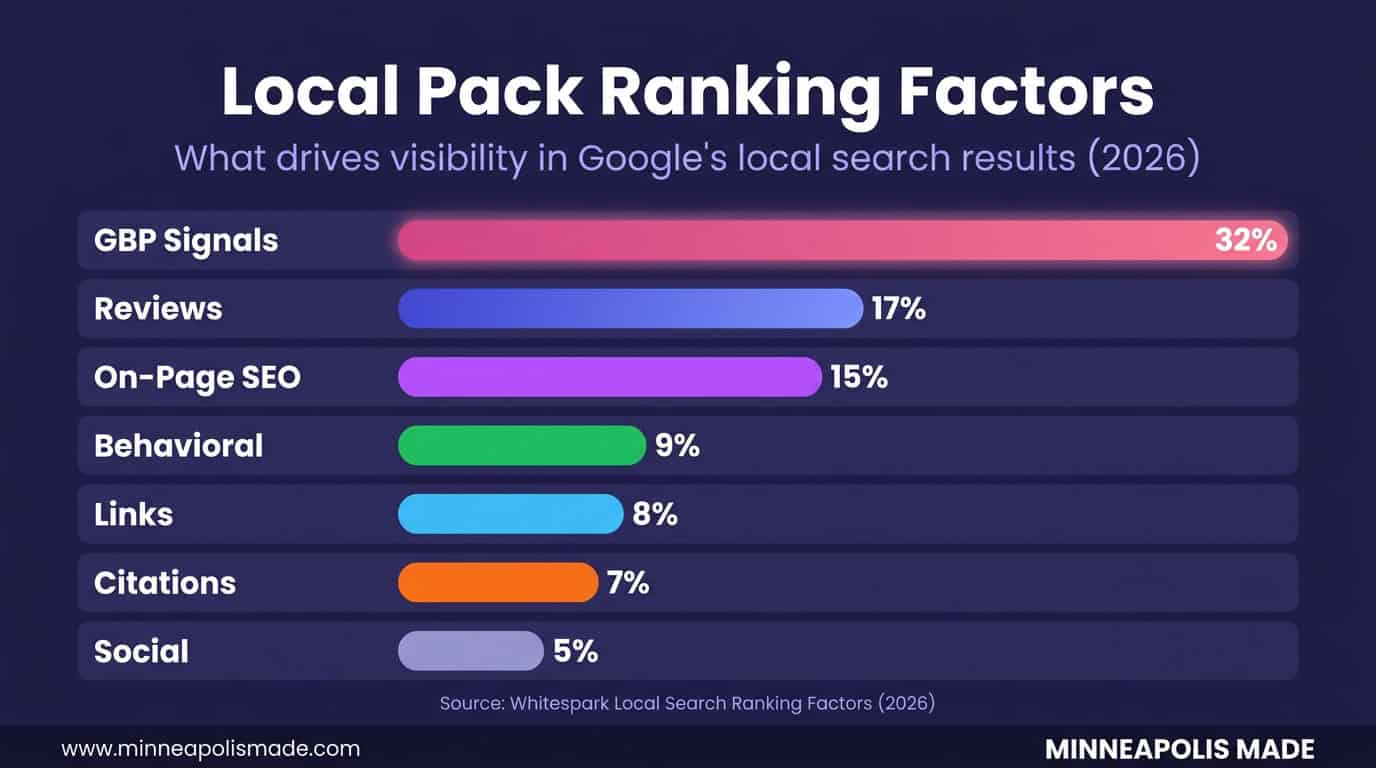
- Google Business Profile signals account for 32% of Local Pack ranking factors, but citations, reviews, on-page SEO, and links make up the other 68% (Whitespark, 2026)
- Businesses with complete and accurate citations across 40+ directories rank significantly higher in local results
- The complete local SEO stack has six layers: GBP, citations, reviews, on-page local signals, local content, and local links
What Is Local SEO, and How Is It Different from Regular SEO?
Regular SEO optimizes your site to rank in Google’s organic results for any searcher, regardless of location. Local SEO specifically targets the “Local Pack” (the map with three business listings) and location-based organic results. According to Whitespark’s 2026 Local Search Ranking Factors survey, the signals that drive local rankings are fundamentally different from traditional SEO signals.
Traditional SEO is primarily about content quality, backlinks, and technical health. Local SEO adds layers that don’t exist in traditional SEO: your Google Business Profile, citation consistency across directories, review signals, and geographic relevance. A Minneapolis bakery and a Minneapolis law firm use completely different local SEO tactics than a national SaaS company, even if all three have WordPress websites.
The Local Pack appears above organic results for almost every search with local intent. That means three businesses get prime visibility before the first traditional result even shows up. If you’re not in the Pack, you’re starting the race from behind.
Unique Insight
Most small businesses think local SEO means “do regular SEO but mention Minneapolis a lot.” That’s not how it works. Local SEO is a distinct discipline with its own ranking factors, tools, and strategies. Keyword-stuffing your city name into every page actually hurts more than it helps.
How Do Citations Affect Local Search Rankings?
Citations are mentions of your business name, address, and phone number (NAP) on other websites, directories, social platforms, and data aggregators. According to Whitespark (2026), citation signals account for 6% of Local Pack ranking factors. That might sound small, but in competitive markets like Minneapolis, 7% is often the difference between position 3 and position 6.
The key isn’t having more citations. It’s having consistent ones. If your Google Business Profile says “123 Main St” but Yelp says “123 Main Street” and the BBB says “123 Main St, Ste 200,” Google sees three different businesses. Moz’s research (2023) confirms that NAP consistency across directories is a top-five factor for local rankings.
The Must-Have Citation Sources
Start with these directories. They feed data to hundreds of smaller sites:
- Google Business Profile (foundation of everything)
- Apple Maps / Apple Business Connect
- Bing Places for Business
- Yelp
- Facebook Business Page
- Data aggregators: Foursquare, Data.com, Localeze, Infogroup
- Industry-specific: Avvo (lawyers), Healthgrades (medical), HomeAdvisor (contractors), TripAdvisor (hospitality)
Personal Experience
When we audit Minneapolis businesses, the most common citation problem isn’t missing listings. It’s inconsistent ones. A business moves offices, updates Google, but forgets about Yelp, the BBB, and 30 other directories. We’ve seen businesses jump 5-10 positions in the Local Pack just from fixing NAP inconsistencies. No other changes needed.
Related: Google Business Profile for Law Firms: The Complete Local Search Guide
How Important Are Reviews for Local Rankings?
Reviews are the second most influential Local Pack ranking factor at 20% of the total signal, according to Whitespark (2026). But it’s not just about star count. Google evaluates review quantity, velocity (how often you get new reviews), diversity (reviews across multiple platforms), and your response rate.
BrightLocal’s 2024 Consumer Review Survey found that 88% of consumers are more likely to use a business that responds to all reviews, and 41% of consumers always read reviews and 98% read them at least sometimes for local businesses. Reviews aren’t just a ranking signal. They’re the first impression most customers have of your business.
Building a Review Engine
Don’t leave reviews to chance. Build a system:
- Send a review request email 3-7 days after service completion
- Include a direct link to your Google review page (generate it from your GBP dashboard)
- Respond to every review within 24-48 hours, positive or negative
- Never offer incentives for reviews (violates Google’s guidelines)
- Diversify: ask satisfied customers to also leave reviews on Yelp, Facebook, or industry-specific platforms
Original Data
In our work with Minneapolis service businesses, we’ve found that a consistent review request process generates roughly 3-5 new Google reviews per month for a small business. After 6 months, that’s 18-30 reviews. Most local competitors have fewer than 20 total. The math works in your favor if you’re systematic about it.
What On-Page Signals Matter for Local SEO?
On-page signals contribute 14% to Local Pack rankings per Whitespark (2026). These are the elements on your actual website that tell Google where you operate and what you do. Most businesses get this partially right but miss key opportunities.
NAP on Every Page
Your business name, address, and phone number should appear on every page of your website, typically in the footer. Mark it up with LocalBusiness schema so Google can parse it programmatically, not just visually.
Location-Specific Title Tags and Meta Descriptions
Your homepage title should include your city. “Plumbing Services | Minneapolis, MN | Smith Plumbing” tells Google exactly where you operate. Each service page should target “[service] [city]” naturally. Don’t force it. “Emergency Plumber Minneapolis” works. “Minneapolis Emergency Plumber Minneapolis MN Plumbing” is spam.
Dedicated Location Pages
If you serve multiple areas (Minneapolis, St. Paul, Bloomington, Edina), create a dedicated page for each. Each page should have unique content about serving that specific area, not just the city name swapped out. Google penalizes thin, templated location pages. Write genuinely useful content about each area you serve.
Embedded Google Map
Embed a Google Map of your business location on your contact page and footer. This provides an additional geographic signal and helps customers find you. Use the Google Maps embed API, not a screenshot.
Related: Website Speed Optimization: The Real Cost of a Slow Website
Does Local Content Actually Help Rankings?
Yes. Creating content that’s specifically relevant to your local area sends strong geographic signals to Google. A Minneapolis landscaping company that writes about “Best Plants for Minnesota Zone 4b Gardens” is demonstrating local expertise that a national competitor can’t match.
Local content ideas that work:
- Local guides: “Best Neighborhoods for First-Time Homebuyers in Minneapolis”
- Local news/events: Coverage of industry-relevant local events
- Case studies: Projects you’ve completed for local clients (with permission)
- Local partnerships: Content featuring local organizations you work with
- Seasonal content: Minnesota-specific seasonal advice relevant to your industry
Personal Experience
One of our Minneapolis HVAC clients started publishing monthly blog posts about Minnesota-specific heating and cooling topics. “How Minneapolis Winters Affect Your Furnace” outranked national HVAC blogs for local searches within three months. Local expertise is a competitive moat that national content farms can’t replicate.
How Do Local Backlinks Differ from Regular Backlinks?
Link signals contribute 8% to Local Pack rankings (Whitespark, 2026). For local SEO, a link from the Minneapolis/St. Paul Business Journal is worth more than a link from a random national blog with the same domain authority. Geographic relevance matters.
Local link building strategies that work for Minneapolis businesses:
- Local sponsorships: Sponsor a Little League team, a charity run, or a neighborhood festival. Most include a website link.
- Chamber of Commerce: Join the Minneapolis Regional Chamber. The membership listing includes a backlink.
- Local media: Pitch stories to the Star Tribune, MinnPost, or Southwest Journal. One earned media link from a local publication is worth dozens of directory links.
- Local partnerships: Cross-link with complementary local businesses. A wedding photographer links to a florist who links to a caterer. Everyone benefits.
- University connections: Guest lecture at the U of M or participate in MCTC programs. .edu links carry significant authority.
Related: How to Choose a Web Development Agency
What’s the Complete Local SEO Checklist for Minneapolis Businesses?
Here’s the full stack, in priority order. Do these in sequence, not all at once:
| Action | Priority | Time to Complete |
|---|---|---|
| Claim and fully optimize Google Business Profile | Critical | 1-2 hours |
| Audit and fix NAP consistency across top 20 directories | Critical | 2-4 hours |
| Add LocalBusiness schema to website | High | 30 minutes |
| Optimize title tags with city + service keywords | High | 1 hour |
| Build systematic review request process | High | 1 hour setup |
| Create location pages for each service area | Medium | 2-4 hours per page |
| Publish local content monthly | Medium | Ongoing |
| Pursue 2-3 local backlinks per month | Ongoing | Ongoing |
Not sure where your local SEO stands?
We’ll audit your Google Business Profile, check your citation consistency across 40+ directories, analyze your review profile, and identify the fastest wins. Most Minneapolis businesses have at least 5 quick fixes hiding in plain sight.
Related: Local SEO services in Minneapolis
Related: AI search optimization to complement your local SEO
Related: SEO vs AEO vs GEO: understanding which strategy fits your local business
Related: AI content for Minneapolis businesses: the hybrid workflow that actually ranks
Want us to run your GBP + local SEO end-to-end?
GBP optimization, citation cleanup, review management, and on-site local SEO — all billed hourly at $85/hr. Free audit before any work.
Frequently Asked Questions
How long does local SEO take to show results?
Most businesses see initial improvements within 4-8 weeks of fixing foundational issues like NAP consistency and GBP optimization. Competitive keywords in Minneapolis typically take 3-6 months of consistent effort. Whitespark (2026) data confirms that review velocity and profile age are both ranking factors, meaning results compound over time.
Do I need a physical address for local SEO?
For Google Business Profile, you need either a physical location customers can visit or a clearly defined service area. Service-area businesses (plumbers, electricians, consultants) can hide their address and show a service radius instead. PO boxes and virtual offices are not allowed and risk suspension.
How many Google reviews do I need to rank in the Local Pack?
There’s no magic number. What matters more is having more reviews than your direct competitors, maintaining a 4.0+ star average, getting reviews consistently (not in bursts), and responding to every single one. In most Minneapolis industries, 30-50 quality reviews puts you in the competitive range.
Is local SEO different for service-area businesses vs storefronts?
Yes. Storefronts benefit from foot traffic signals, check-ins, and visible location data. Service-area businesses rely more heavily on reviews, content, and website authority since they don’t have a physical location driving proximity signals. Both need GBP optimization and citation management, but the strategy emphasis differs.
Should I do local SEO myself or hire an agency?
The foundational work (GBP setup, citation cleanup, review process) is doable yourself with this guide. Ongoing optimization, local content creation, link building, and competitive monitoring benefit from professional help. Most Minneapolis businesses start DIY, then hire once they realize the ongoing time investment required to maintain and grow rankings.