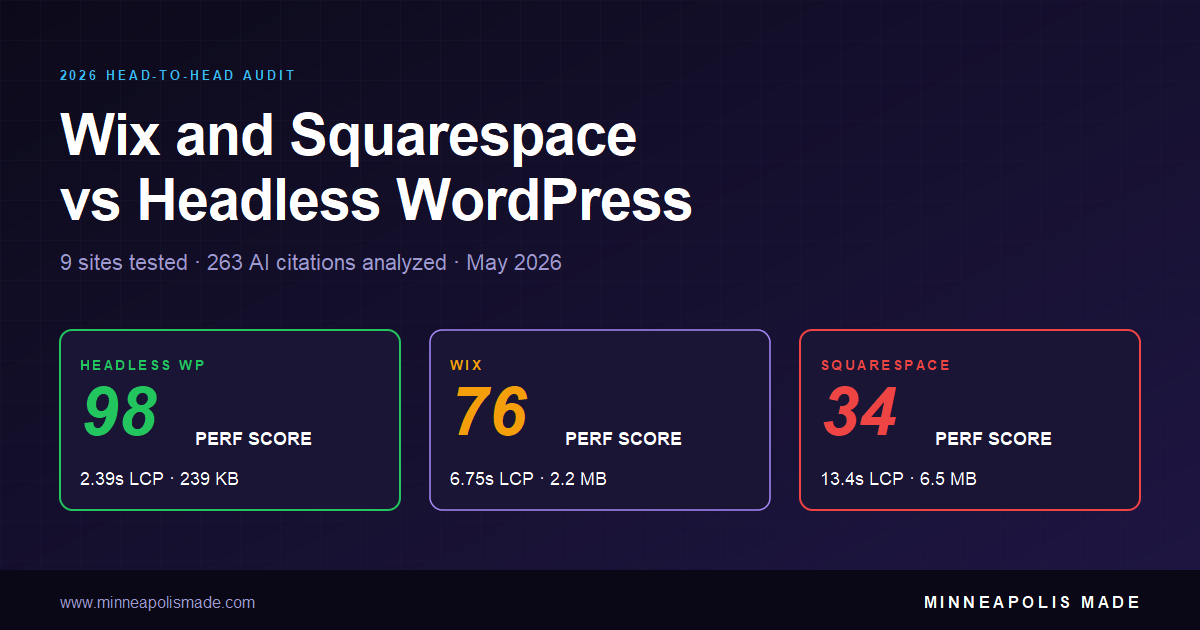
We pulled out Lighthouse and tested nine websites: five on Wix, three on Squarespace, and one custom headless WordPress install (this site). The headless site loaded a 239 KB page in 2.39 seconds with a Lighthouse Performance score of 98. The Squarespace average loaded 6.5 megabytes in 13.4 seconds and scored 34. The gap between them is not a defect or a bad day for one platform. It is what the architecture produces every time.
Then we pulled CMS data on 263 unique brands cited by ChatGPT, Gemini, and Perplexity in our Twin Cities AI citation audits. WordPress sites were cited 83 times. Squarespace sites were cited 15 times. Wix sites were cited twice. We will get into what that means for your business in a minute.
This post is not a hit piece on page builders. It is a head-to-head comparison with real numbers, run on May 5, 2026, in the same week the data was published. If you are paying for Wix or Squarespace today and wondering whether the platform is costing you anything, the answer is here, with the receipts.
Key Takeaways
- Our 9-site Lighthouse audit: headless WordPress scored 98 with a 2.39s LCP and 239 KB page weight. Squarespace averaged 34 with a 13.4s LCP and 6.5 MB pages. Wix landed in the middle (76 / 6.75s / 2.2 MB).
- Of 263 brands cited by ChatGPT, Gemini, and Perplexity for Twin Cities commercial-intent queries, only 2 (0.8%) were on Wix. Wix runs ~4.3% of all websites globally, so it is under-represented in AI citations by roughly 5 times.
- Squarespace was cited 15 times (5.7%) — actually over-performing its 2.5% global market share, mostly in dental and design-portfolio categories. Squarespace can rank when content is exceptional, but the page-weight tax is real.
- All five free wixsite.com subdomains we tested rank for zero organic keywords. Custom-domain Wix and Squarespace sites can rank, but the platform sets a hard performance ceiling at roughly 60-70 on Lighthouse.
- Page-builder sites carry 1 to 1+ MB of unused JavaScript per page even before your content loads. That is the editor-flexibility tax, and you cannot remove it.
How does headless WordPress compare to Wix and Squarespace head-to-head?
We tested nine real, public sites with the DataForSEO Lighthouse API on May 5, 2026. Results are mobile scores, which is what Google uses for ranking signals. Same test, same throttling, same day. Here is the table.
Original DataThe headless WordPress install (minneapolismade.com) loaded a 239 KB page in 2.39 seconds with a Lighthouse Performance score of 98 and zero milliseconds of total blocking time. That is what a properly built site is supposed to look like. The Wix sample (5 wixsite.com subdomains) averaged a 76 Performance score, 6.75-second LCP, and 2.2 MB page weight. The Squarespace sample (3 active designer-portfolio sites) averaged a 34 Performance score, 13.4-second LCP, and 6.5 MB page weight. The slowest Squarespace site we tested took 18.6 seconds to render its largest visible element on a mobile connection.
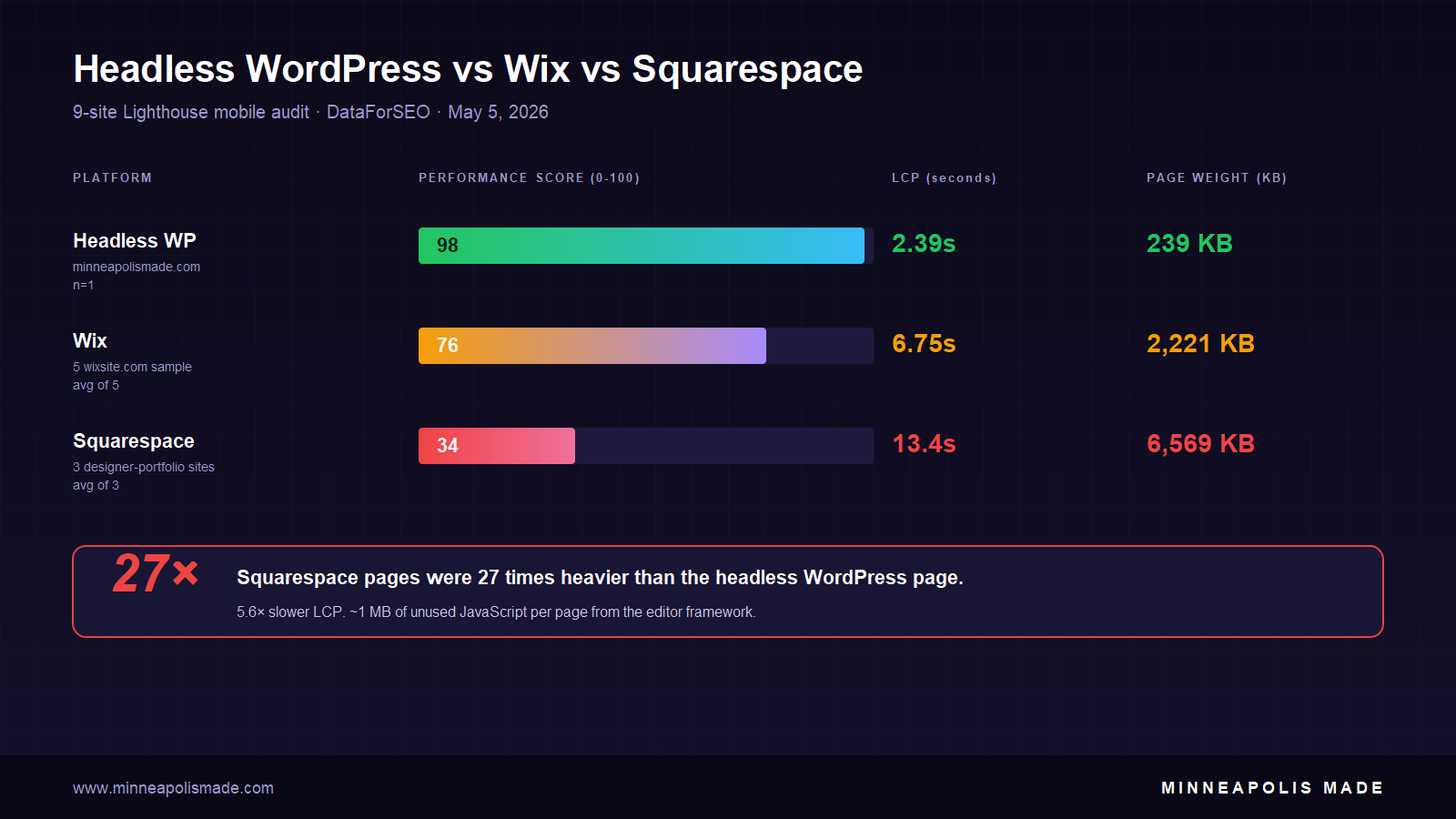
Why are Squarespace pages 27 times heavier than a custom site?
The answer is not bad code or shared hosting. Wix and Squarespace are SaaS platforms that ship a fixed bundle of JavaScript and CSS for every page on every site, because the editor that lets a non-developer drag boxes around the screen has to be ready to render any layout instantly. That payload is the editor-flexibility tax. You pay it on every page load whether your visitor needs the editor features or not.
Our Squarespace sample shipped roughly one megabyte of unused JavaScript per page. Wix sites shipped about 140 KB. The headless WordPress install shipped zero bytes of unused JavaScript because the build pipeline only sends the code each page actually uses. That single difference is most of the performance gap.
Related: Why headless WordPress is the new industry standard covers the architecture in depth.
But don't Wix and Squarespace beat WordPress on Core Web Vitals?
HTTP Archive's 2024 Web Almanac CMS chapter reports that 60% of Squarespace sites and 57% of Wix sites pass mobile Core Web Vitals on average, compared to 40% of WordPress sites. That looks like good news for the page builders, and at the aggregate level it is.
The catch: WordPress's 40% number is dragged down by millions of cheap-shared-hosting installs running heavy themes from 2014. The aggregate is not measuring what a properly built WordPress site looks like; it is measuring what the median wordpress.com or GoDaddy install looks like. When you compare Wix or Squarespace to a custom or headless WordPress build, the picture flips. We have seen plenty of custom WordPress sites pushing 95-100 on Lighthouse. We have not seen a single Squarespace site over 70.
Unique InsightThe right way to think about page builders is floor versus ceiling. Wix and Squarespace have a higher floor than typical WordPress because their hosting and infrastructure are uniform; you cannot accidentally make them as bad as a $4-a-month shared host. But they have a much lower ceiling because the editor's flexibility costs you bytes you cannot remove. For a hobby site or a portfolio under 10 pages, the floor is what matters and Wix or Squarespace is fine. For a business that wants to compete in a fast SERP or get cited by AI search, the ceiling is what matters, and the page builders cap at roughly 60 to 70 on Lighthouse no matter how much you optimize.
Do Wix and Squarespace sites actually rank organically?
Mixed answer, and the data is more interesting than the headlines suggest. We pulled organic-keyword visibility for all the sites we tested via DataForSEO's domain-rank-overview endpoint.
Every single one of the five wixsite.com subdomains we tested ranked for zero keywords. Not a few. Zero. The free Wix tier is functionally invisible to Google. If you are using a wixsite.com subdomain to grow a business, you are throwing the SEO motion away.
Custom-domain Squarespace sites tell a more nuanced story. paigebrunton.com (a Squarespace designer's content-marketing operation) has 3,695 ranking keywords and an estimated $485,000 in monthly traffic value. websitesbyelise.com, also Squarespace, has 674 keywords and $8,237 in traffic value. Same platform, two orders of magnitude apart in outcomes. The platform is not what determined the ranking; content depth and topical authority did.
Personal ExperienceThat said, every Squarespace migration we have run for clients has been a similar pattern. The site was ranking for branded queries and a handful of long-tail keywords. The category-level commercial terms that drive most service-business revenue ("Minneapolis [service]" type queries) were missing entirely. Once we moved them to a properly built WordPress install with real schema, real internal linking, and real page speed, the head terms started moving inside 90 days. The platform was not blocking branded ranking. It was blocking competitive ranking, where every signal matters.
Are Wix or Squarespace sites cited by ChatGPT, Gemini, and Perplexity?
This is where the page builders get hit hardest. We ran 96 commercial-intent prompts and 369 industry citation rows across ChatGPT, Gemini, and Perplexity in our Twin Cities AI citation audits in late April and early May 2026. We then detected the CMS for every unique cited brand. There were 263 distinct domains in the citation pool.
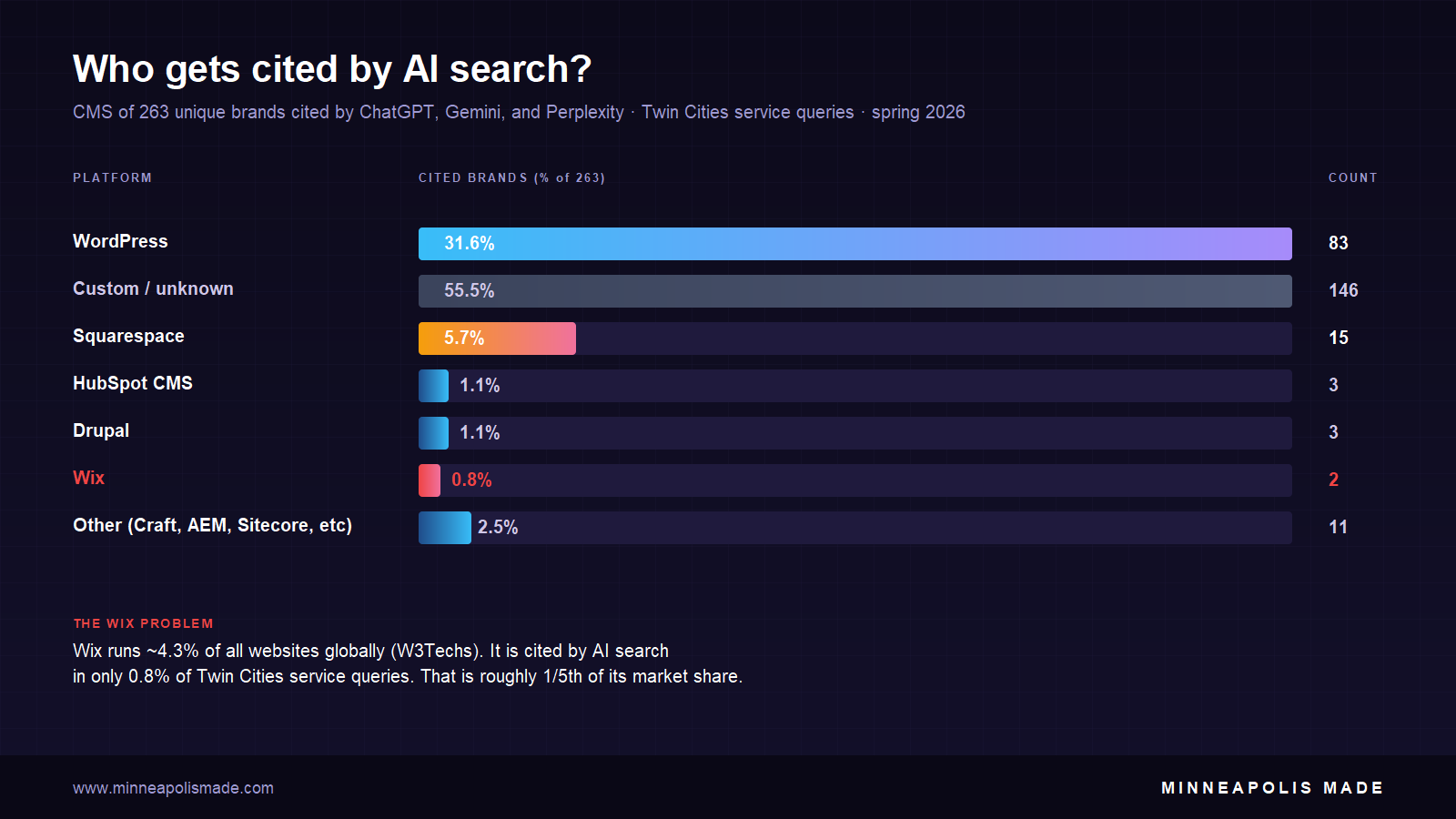
WordPress sites were cited 83 times (31.6%). Squarespace sites were cited 15 times (5.7%). HubSpot CMS Hub: 3. Drupal: 3. Wix: 2 (0.8%). The rest were either custom builds, directory or review sites where CMS detection returned nothing, or rare platforms (Adobe Experience Manager, Sitecore, Optimizely, Weebly, GoDaddy Builder, one each).
Squarespace is the surprise. Its 5.7% citation share is more than double its 2.5% global market share, mostly because Squarespace is the most popular platform for small dental practices and design-portfolio sites, both categories that AI tools cite frequently. So if you run a dental clinic on Squarespace, you might already be in the citation pool. If you run a Wix site, the chance you have ever been cited by ChatGPT, Gemini, or Perplexity in a service query is functionally zero.
When IS Wix or Squarespace the right call?
Honest answer: there are real cases where Wix or Squarespace is the right tool. We will not pretend otherwise.
- A single-page restaurant menu where the menu rarely changes
- An event landing page that exists for 6 weeks
- A photographer's portfolio under 10 pages with no SEO ambition beyond branded search
- A local hobby site or a community group page
- A small e-commerce shop with under 50 SKUs and a budget that excludes any developer time at all
If your site fits one of those descriptions, the editor flexibility and built-in hosting probably matter more than the performance ceiling. Use the platform that lets you do the work yourself.
The cases where Wix or Squarespace becomes a problem look like this: a Twin Cities law firm trying to rank for "Minneapolis personal injury lawyer." A dentist with three locations trying to dominate "family dentist in St Paul." An e-commerce site doing $500,000 a year that needs custom checkout flows. A B2B SaaS company that needs JSON-LD product schema, a programmatic blog, and integration with a CRM. In any of those scenarios, the page builder will be a ceiling on what you can achieve, and the gap will compound month over month.
What does headless WordPress cost compared to Wix Business or Squarespace Commerce?
Most of the cost comparisons online treat this question as if it is just about monthly subscriptions. It is not. Total cost of ownership over three years, including the parts nobody quotes, looks roughly like this for a small-business website.
Squarespace Business or Commerce: $36 to $72 per month subscription, plus 0% to 3% transaction fees on Commerce, plus typical add-ons (acuity scheduling, advanced analytics, third-party email tools): you are usually at $80 to $150 per month for a working small business setup. Three-year total: $2,880 to $5,400 in subscriptions alone, with no compounding asset value because you cannot move it anywhere.
Wix Business / Wix Studio: $29 to $159 per month for the various premium tiers, plus the Wix Apps Marketplace add-ons that you will end up needing. Three-year total: $1,000 to $5,700, again with no portable asset.
Custom WordPress (or headless WordPress) built by a real developer: $4,500 to $25,000 one-time build cost depending on scope, plus $30 to $300 per month for managed hosting (Cloudways, Pressable, WP Engine, Cloudflare for static frontends). Three-year total: $5,580 to $35,800. The asset is portable. The site is yours. You can hire any agency or developer to maintain or upgrade it.
The honest math: Wix and Squarespace look cheaper if you only count the first 12 months. By month 36, the cost gap shrinks to under 30% in most scenarios, and you have ended up paying real money for a site that you cannot take with you and that has a ranking ceiling baked into the platform.
Want to see what your current site is actually scoring?
We will run the same Lighthouse audit we ran for this article on your site, plus check whether your platform is appearing in ChatGPT, Gemini, or Perplexity for the queries that matter to your business. Same data, same week, free.
How hard is it to migrate off Wix or Squarespace?
Wix is the harder platform to leave. There is no functional export. Wix's documentation will tell you that you can export your blog posts as a CSV, and that is it. Pages, layout, widgets, custom code blocks, member areas: none of it exports cleanly. A Wix-to-WordPress migration is essentially a rebuild from scratch using the live site as the design reference. Allow 4 to 8 weeks for a 20-page site, depending on integration complexity.
Squarespace exports a WordPress XML file that contains your blog posts and basic page content. The styling, custom CSS, layout sections, and embedded blocks do not survive the export. Allow 2 to 4 weeks for a 20-page Squarespace migration, plus a careful URL-redirect map so you do not lose the rankings you do have.
The biggest mistake we see in DIY migrations: people rush the redirect map. Every existing URL on the old site needs a 301 to the matching new URL on the new site. Skip that step and the migration will take six months to recover, sometimes longer.
Related: We tested 21 Minneapolis web design agencies and only 4 passed Core Web Vitals covers the same speed math at the agency level.
What does this mean for your business?
Three things, depending on where you are.
If you are on Wix today: You are paying for a site that is functionally invisible to AI search and that has a built-in performance ceiling. If your business depends on organic search or AI citations, the platform is costing you money every month you stay on it. Migration is the harder lift; expect 4 to 8 weeks and a real budget.
If you are on Squarespace today: You may be doing fine. Squarespace can rank, especially in dental, design portfolios, and content-marketing-heavy categories. The question to ask is whether your CWV score is hurting you in your specific competitive set. If you are losing to faster sites in the SERP for the queries that drive revenue, Squarespace is the bottleneck. If you are not, the platform is doing its job.
If you are choosing a platform for the first time: Choose based on your three-year ambition, not your first-year budget. Wix and Squarespace are easy to get started on and hard to leave. Custom or headless WordPress is harder to start and easier to scale. Pick the platform that matches the second one.
Frequently Asked Questions
Is headless WordPress overkill for a small business?
Sometimes yes. If your site has fewer than 10 pages, no real e-commerce, and you do not plan to compete on organic search, a regular custom WordPress install (not headless) gets you 80% of the performance benefit at half the build cost. Headless makes the most sense when you need a fast, custom frontend (Next.js, Astro, custom PHP) talking to WordPress as a content API, which is the architecture of this site.
What about Webflow?
Webflow sits between page builders and custom code. It produces cleaner output than Wix or Squarespace, typically scores 60 to 80 on Lighthouse rather than 30 to 50, and has better SEO controls. It also has a steeper learning curve, costs more at scale, and locks you in nearly as hard. We have built sites on Webflow when the visual editor was a hard requirement. For most clients we still recommend WordPress because the ecosystem and exit options are wider.
Will Wix or Squarespace ever fix the performance ceiling?
Probably not in any meaningful way. The ceiling is a function of the editor architecture, not a bug to patch. Wix Studio (released 2024) and Squarespace 7.1 are both moves in the right direction, but the bundled JavaScript is structurally required for the visual editor to work. Until they release a build that strips the editor at deploy time the way headless builds do, the ceiling stays where it is.
Can I really not export my Wix site?
You can export your blog posts as a CSV. That is it. Pages, layout, custom design, member areas, and Wix Apps integrations do not export. If you need a Wix site moved to WordPress, plan for a rebuild using the live site as the visual reference. There is no shortcut.
How long does a typical Wix-to-headless-WordPress migration take?
For a 20-page small-business site with no e-commerce, expect 4 to 8 weeks. The breakdown: 1 week for content extraction and asset transfer, 2 to 4 weeks for the new site build (depending on design complexity), 1 week for redirect mapping and SEO preservation, 1 week for QA and launch. Total cost in our shop is typically $8,000 to $20,000 depending on scope and how much custom integration is involved.
The honest summary
Wix and Squarespace are not bad. They are the right tool for a narrow set of jobs. They beat the average WordPress install on Core Web Vitals because that average is dragged down by every cheap-shared-hosting site on Earth. They can rank when content is exceptional. They can even get cited by AI search, especially Squarespace in a few specific categories.
What they cannot do is hit the performance ceiling that custom or headless WordPress can. They cannot ship a 239 KB page that loads in 2.39 seconds and scores 98 on Lighthouse. They cannot give you a portable asset that you can take to any agency. They cannot stop charging you every month for a site you do not actually own. And in the AI search era specifically, Wix is functionally invisible (0.8% of cited Twin Cities brands vs 4.3% of all websites globally).
If you are running a business that depends on being found, the question is not "is Wix bad?" or "is Squarespace slow?" The question is whether the ceiling on those platforms is costing you more than a properly built site would cost to make and own. For most service businesses we work with in the Twin Cities, the answer is yes.
Thinking about migrating off Wix or Squarespace?
Book a 30-minute migration assessment. We will look at your current site, map out what would need to move, give you a realistic timeline and cost, and tell you honestly whether migration is worth it for your situation. No pressure, no pitch deck, just a conversation.
Related: Why headless WordPress is the new industry standard
Related: ChatGPT vs Perplexity: what they say about Twin Cities businesses